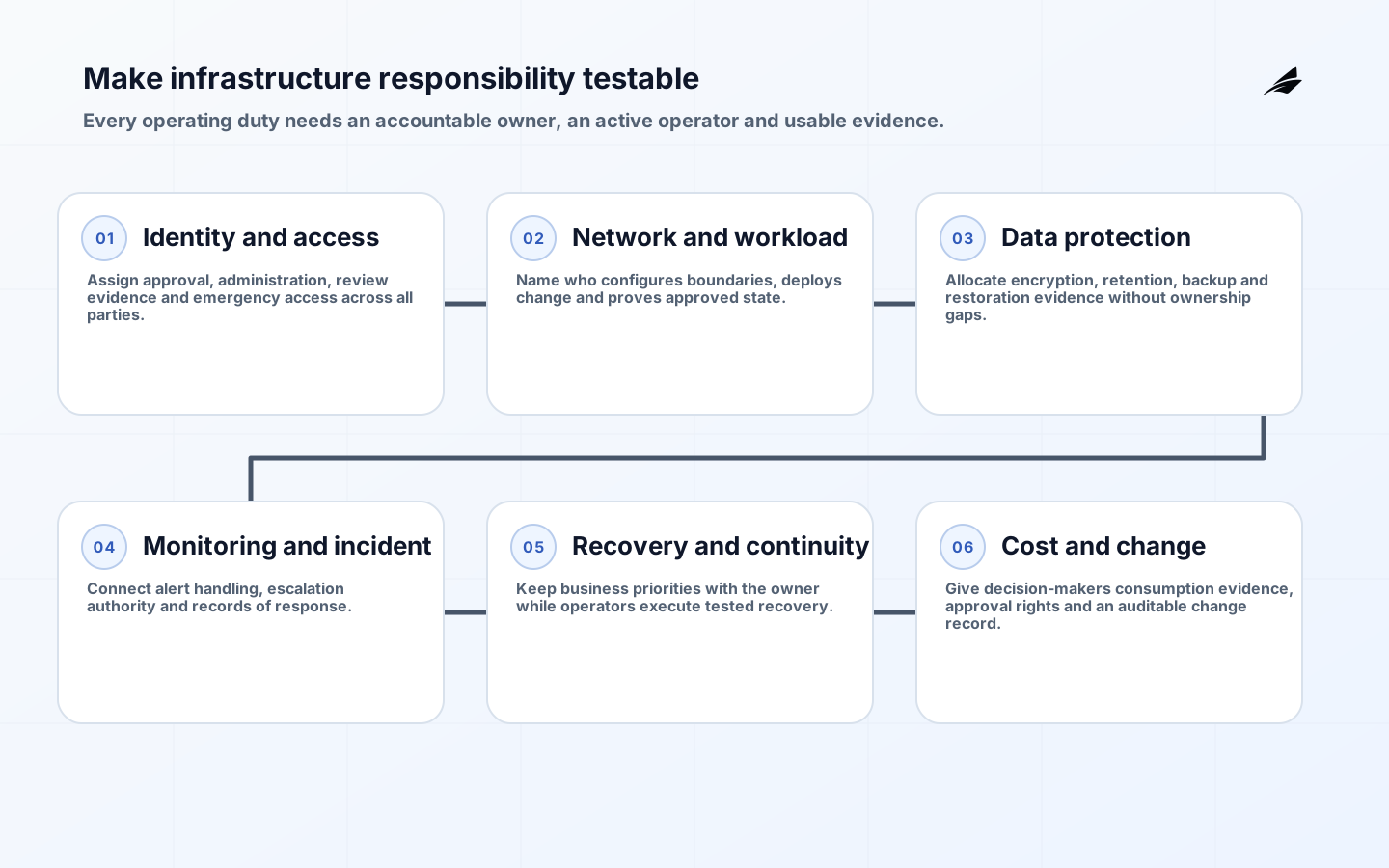
Infrastructure services and cloud work provides the computing, network, storage, identity, observability and operational foundations on which business systems depend. It may include an on-premises refresh, a cloud landing zone, workload migration, managed operations, resilience improvement or a hybrid platform. A useful engagement is defined by workload outcomes and clear responsibilities, not by a list of technologies. The service must remain secure, recoverable, supportable and economically visible after the change is complete.
Define the service boundary and business outcome
Start with the workloads and users whose outcomes must improve. Examples include reducing recovery uncertainty for an order platform, providing governed environments for product teams or moving from unsupported hardware before a renewal date. Inventory applications, data stores, dependencies, traffic paths, identities, batch schedules, certificates, licenses and support arrangements. Include business criticality, maintenance constraints and data location requirements so architecture decisions are tied to real service needs.
NIST defines cloud computing through characteristics such as on-demand self-service, resource pooling, rapid elasticity and measured service, with SaaS, PaaS and IaaS service models. Those models move responsibility; they do not remove it. A SaaS provider may run the application, but the customer still owns account governance, configuration, data use and continuity decisions. Record responsibilities at the level of each control and operational task rather than relying on the phrase 'shared responsibility.'
| Scope area | Questions to settle | Required output |
|---|---|---|
| Workloads | Which services, dependencies and critical journeys are included? | Validated inventory and dependency map |
| Platform | Which locations, accounts, networks and managed services are allowed? | Target platform architecture |
| Security | Who owns identity, configuration, keys, findings and incidents? | Control responsibility matrix |
| Resilience | What loss and outage can each workload tolerate? | Recovery objectives and tested design |
| Operations | Who monitors, patches, changes and supports each layer? | Service model and runbooks |
| Commercial | Which usage, licenses and support commitments apply? | Baseline and forecast model |
| Transition | How will coexistence and retirement be managed? | Wave plan and exit criteria |
Select an operating and sourcing model
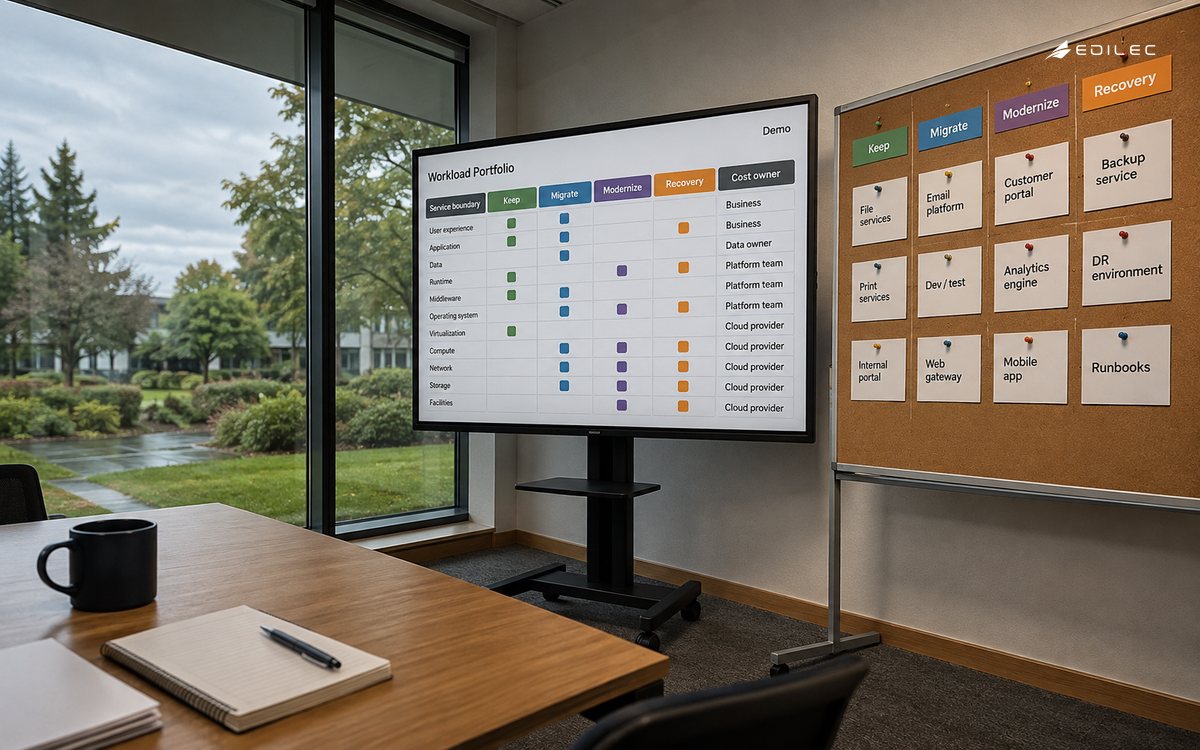
Decide which capabilities the organization must retain and where external support is useful. Internal ownership is important for architecture guardrails, risk acceptance, workload priorities and provider decisions. A managed service can supply monitoring, routine change, platform expertise or support coverage, but the agreement needs measurable responsibilities and access to operational evidence. Avoid a model where the provider can act but the organization cannot inspect configurations, costs, incidents or recovery results.
| Model | Useful when | Watch for |
|---|---|---|
| Internal platform team | Cloud is strategic and demand supports dedicated capability | Queues and bespoke exceptions can overwhelm the team |
| Co-managed service | Internal owners need added coverage or specialist skills | Handoffs and decision rights must be explicit |
| Managed infrastructure | Services are stable and outputs can be clearly measured | Opaque tooling, access or subcontractor responsibilities |
| Project migration partner | Temporary discovery and migration capacity is needed | Operational ownership may be deferred too late |
| Cloud provider support | Product-level guidance and escalation are important | It does not replace workload operations or governance |
Build a platform with enforceable guardrails
A landing zone or platform foundation should establish account and subscription structure, identity federation, network connectivity, name resolution, logging, key and secret handling, policy enforcement, backup and deployment paths. Express repeatable configuration as code where practical, review changes and keep emergency access controlled and observable. Standard patterns should cover common workloads while allowing documented exceptions. Too little standardization creates drift; too much can force teams into unsafe workarounds.
Use the relevant provider's well-architected guidance as a review aid, not a guarantee. AWS, Azure and Google Cloud each organize guidance around closely related concerns including security, reliability, operations, performance and cost. Review the actual workload because a platform control may not satisfy an application requirement. Record decisions, accepted risks and remediation owners; otherwise a review becomes a snapshot with no operating consequence.
Engineer security and resilience as operating capabilities
NIST's Cybersecurity Framework 2.0 adds Govern to the familiar Identify, Protect, Detect, Respond and Recover functions. Apply that lifecycle to infrastructure: maintain asset and data visibility, use least privilege, protect management planes, centralize appropriate logs, detect configuration drift, rehearse incident coordination and verify recovery. Security tooling only helps when findings are triaged, ownership is clear and exceptions expire.
Define recovery point and recovery time objectives from business impact, then design backups, replication and failover accordingly. A replicated mistake or compromised account is not a backup. Protect recovery copies from the same failure domain, monitor successful completion and perform restoration exercises that include applications, identity, keys, dependencies and data reconciliation. High availability reduces some interruptions; disaster recovery addresses a broader loss of service and requires a usable operating plan.
Model cost before, during and after transition
Cloud cost is consumption multiplied by rates, commitments and commercial terms, but a delivery estimate must also include people, network, security, observability, migration and coexistence. Build a current baseline from invoices and resource evidence rather than estimates alone. Forecast by workload driver such as users, transactions, retained data or training runs. State assumptions about growth, availability, regions, support and discount commitments. Sensitivity ranges are more useful than one precise total.
| Cost group | Typical components | Control |
|---|---|---|
| Compute and platform | Instances, containers, functions and managed databases | Rightsizing and demand-based scaling |
| Data | Storage tiers, backups, snapshots and requests | Lifecycle, retention and ownership policies |
| Network | Internet, inter-region and cross-zone transfer | Architecture-aware flow estimates |
| Security and operations | Logging, monitoring, scanning, keys and support | Telemetry plan and value review |
| Migration | Discovery, tooling, testing, transfer and remediation | Wave estimate with contingency |
| Coexistence | Parallel hosting, licenses and dual support | Time-bound exit criteria |
| People | Platform, security, FinOps and on-call effort | Capacity and responsibility model |
The FinOps Framework treats cloud value as a collaboration among engineering, finance, product, leadership and procurement. Give resources reliable ownership and allocation metadata, provide timely cost views and connect spending to business value. Budgets and anomaly detection help, but they do not replace design decisions. Commitments should follow stable usage evidence; premature discounts can lock in waste or an architecture that still needs to change.
Example: migrating a small business-system portfolio
Consider a portfolio containing a customer portal, a reporting database and a nightly file exchange. Discovery shows the portal can run on a managed application platform, but reporting depends on a shared database and the file exchange uses fixed partner addresses. The first wave establishes identity, network, logs, policy and deployment automation, then moves a non-critical portal environment. It tests connectivity, support and cost allocation before production data is introduced.
The production portal moves with progressive traffic and a return route. Reporting waits until data ownership and extract schedules are separated from the old database. The file exchange receives a managed transfer endpoint and partner testing window. Each wave includes restoration, monitoring and cost review. The old environment is retired only after jobs, records, certificates, network routes, backups and licenses have named evidence of closure.
Manage infrastructure and cloud risks
| Risk | Control | Early signal |
|---|---|---|
| Unknown dependency | Traffic, configuration and owner discovery before waves | Unexpected calls to old addresses |
| Privilege sprawl | Federated identity, role design and access review | Standing administrator access grows |
| Configuration drift | Versioned templates, policy checks and exception expiry | Manual changes outside the pipeline |
| Recovery failure | Protected copies and full restoration exercises | Backups succeed but restores are untested |
| Cost surprise | Allocation, forecast, anomaly alerts and unit measures | Unowned or rapidly growing spend |
| Provider concentration | Document critical dependencies and feasible exit actions | Proprietary service use without contingency |
| Permanent coexistence | Fund retirement and enforce exit evidence | Old cost persists after migration |
A phased infrastructure and cloud delivery plan
- Frame business outcomes, workload criticality, constraints, owners and investment guardrails.
- Discover assets, dependencies, identities, data, current cost, incidents and recovery evidence.
- Design the target platform, control responsibilities, operating model, cost model and migration waves.
- Prove the foundation with a representative low-risk workload and forced recovery and security scenarios.
- Migrate in bounded waves with production-readiness gates, progressive exposure and reconciliation.
- Stabilize service, tune demand, exercise incident and recovery runbooks and transfer knowledge.
- Retire old access, routes, jobs, hardware, licenses and data copies after documented validation.
A production-readiness gate should cover ownership, monitoring, alert response, capacity, security findings, backup restoration, deployment, rollback and cost visibility. During a wave, define stop conditions for error rate, user impact, reconciliation differences and spend. Do not schedule decommissioning as an administrative afterthought; it is the stage that removes duplicated cost and attack surface.
Key takeaways
- Define infrastructure services around workload outcomes and control responsibilities.
- Choose sourcing based on retained accountability, skills, coverage and evidence access.
- Include security, recovery, operations and policy guardrails in the platform foundation.
- Model migration, coexistence, people and operational tooling alongside resource consumption.
- Use small waves with readiness gates and fund retirement so old risk and cost actually end.
Frequently asked questions
Is cloud infrastructure always cheaper?
No. Cloud can improve flexibility and access to managed capabilities, but cost depends on architecture, demand, data movement, commercial terms and operating discipline. Compare total service cost and value against realistic alternatives.
Which workload should migrate first?
Choose a representative workload with manageable business impact, known ownership and enough dependencies to test the foundation. The easiest workload may prove little, while the most critical creates unnecessary first-wave risk.
What should a managed infrastructure agreement include?
Define service boundaries, response and restoration expectations, access, change approval, security duties, subcontractors, evidence, cost reporting, escalation, data return and transition assistance. Align measures with user-visible service, not ticket closure alone.
Deliver a service, not a destination
Infrastructure and cloud delivery succeeds when the organization can see what it owns, recover what matters, control change and connect spending to value. A clear service boundary, tested platform and staged migration turn technology choices into an operable business capability. Completion means stable ownership and verified retirement, not simply that workloads now run somewhere new.