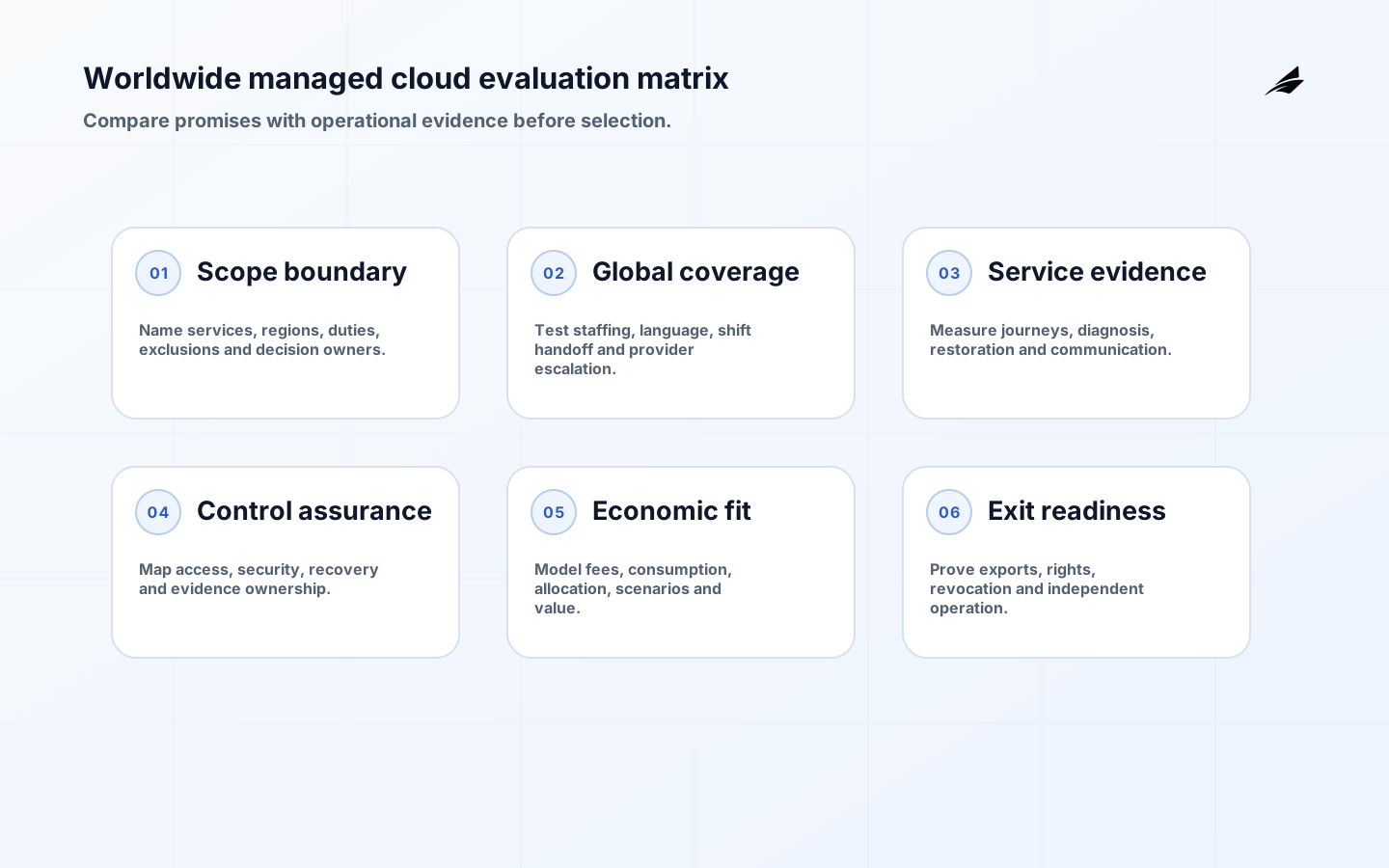
Worldwide managed cloud services should create a clear operating capability across regions, providers and time zones. They should not merely add a global ticket queue. A buyer needs to know which resources the supplier operates, which events it detects, which decisions it may make, where qualified people are located, and how both parties prove that a business service is healthy. The contract must connect infrastructure work to customer journeys, data obligations and recovery priorities. That distinction matters because the cloud provider, managed service provider and client workload team retain different responsibilities even when they all touch the same incident.
This guide answers the questions enterprise buyers should settle before selection. Use the worldwide managed cloud scope guide to structure the commercial package, the implementation checklist to plan transition, and the global delivery plan for a broader provider comparison. NIST defines cloud service and deployment models in SP 800-145; a managed contract sits above those models and must make the operational allocation explicit.
What should worldwide managed cloud services include?
Start with a service inventory, not a provider capability catalog. List the business services, accounts or subscriptions, regions, cloud products, data classifications, environments and support windows in scope. For each service, identify its owner, critical journeys, dependencies, objectives and change authority. Then map recurring work: monitoring, incident triage, patching, vulnerability handling, backup, restoration, capacity, cost optimization, access review, certificate renewal, platform upgrades and provider escalation. A service is included only when the triggering event, response, approval boundary, evidence and escalation route are all stated.
Separate steady-state operation from projects. Landing-zone changes, workload migration, architecture remediation and major version upgrades need their own outcomes, estimates and acceptance. Also distinguish cloud control-plane operation from application and data operation. A supplier may keep clusters available while a failed release, corrupt queue or incompatible schema stops the customer journey. The proposal should identify exclusions and assumptions beside every included tower. Require named patterns for infrastructure, managed platform services, containers, data platforms and software-as-a-service integrations rather than accepting one generic responsibility chart.
How should responsibility be documented?
Use a responsibility matrix at the level where work changes hands. Labels such as responsible and accountable are useful only when paired with a trigger and deliverable. For a critical alert, state who maintains the rule, receives the page, validates impact, communicates with users, changes production, contacts the cloud provider and closes follow-up work. The CISA Cloud Security Technical Reference Architecture emphasizes understanding shared services and the division of responsibilities. Apply that principle to operations as well as security.
Keep client authority for risk acceptance, business priority, data use and material architecture decisions. The provider can execute approved procedures and make bounded emergency changes, but those powers need least privilege, recording and review. Require a current roster for every region and shift, including subcontractors. Follow-the-sun coverage is credible only when each handoff transfers incident state, recent changes, hypotheses, owners and next actions. Test a handoff during evaluation; a diagram of offices does not prove continuity.
| Operating area | Provider commitment | Client commitment | Acceptance evidence |
|---|---|---|---|
| Monitoring | Maintain agreed signals and staffed response | Define journeys and impact thresholds | Representative alert reaches the right responder |
| Change | Execute authorized standard changes | Own product priority and risky approvals | Change traces to request, artifact and result |
| Security | Operate assigned controls and escalate | Set risk tolerance and data policy | Control sample and incident exercise |
| Recovery | Run documented restoration tasks | Approve business sequence and data loss | Timed restore with reconciliation |
| Cost | Provide allocation and anomaly response | Own forecasts and value decisions | Invoice reconciles to tagged consumption |
| Exit | Transfer assets, knowledge and access | Provide successor and acceptance owners | Revocation and independent operation test |
Which service levels reveal operational quality?
Infrastructure uptime is necessary but incomplete. Measure detection, acknowledgement, meaningful diagnosis, containment, restoration and communication for incidents that matter to users. Define the clock, severity authority, pause conditions and evidence source. Add completion objectives for backups, restore tests, patches, access reviews, certificate renewals and cost anomalies. Averages conceal severe misses, so report distributions and missed critical cases. Service credits may recognize failure, but they do not restore trust; improvement actions and repeated-failure remedies are more important.
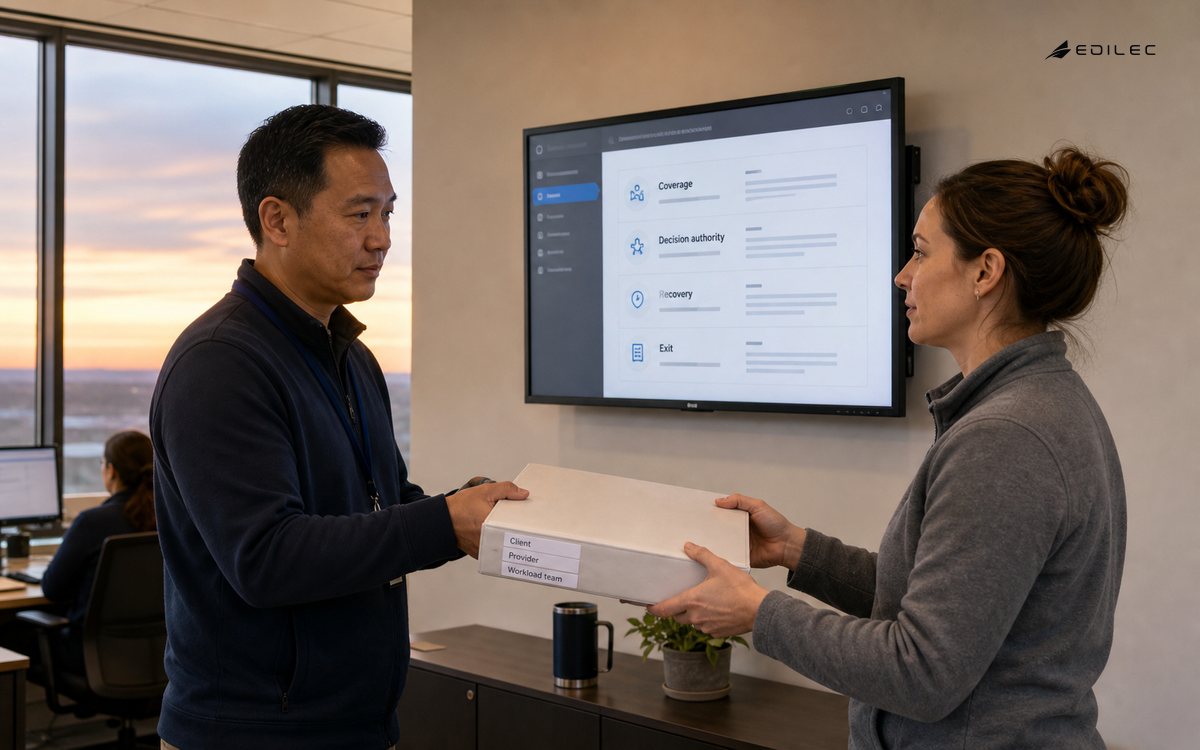
Service objectives should align with end-to-end journeys and dependencies. Use traces, metrics and logs together where appropriate; OpenTelemetry signals provide a vendor-neutral model for that telemetry. Preserve client access to raw evidence and configuration. Define retention, privacy controls and export formats before centralizing data in the provider's platform. During evaluation, inject a realistic failure and observe whether the supplier connects a technical symptom to business impact, coordinates the correct parties and keeps a coherent timeline.
Who owns security, compliance and incident evidence?
Security ownership follows the actual control, not the logo on a compliance report. Build a control matrix that identifies the requirement, implementation owner, inherited portion, evidence location, test frequency, exception authority and remediation target. Cover identities, privileged access, network paths, encryption, keys, secrets, configuration, workloads, software supply chain, data, logs and response. The NIST Cybersecurity Framework 2.0 can organize governance and outcomes, but buyers still need control-specific evidence for their architecture and obligations.
Provider personnel should use federated, time-bounded identities rather than shared standing accounts. Log administrative actions to a client-accessible destination and protect the path that can disable logging. State notification thresholds, evidence preservation, forensic access, regulator support and public-communication authority. Verify how subcontractors and offshore teams access data, where support artifacts are stored, and how access is revoked. Certifications and independent reports help due diligence; they do not prove that the purchased service configured a control correctly for a particular workload.
How should cost and capacity be governed?
Model provider fees and cloud consumption separately. Clarify whether pricing follows resources, accounts, tickets, labor, service tier or a hybrid, then test how it changes during migrations, acquisitions, seasonal peaks and retirement. Include transition overlap, observability licenses, network egress, premium cloud support and retained internal roles. A cheap baseline with expensive change requests can cost more than a transparent service. Require rate cards, indexation rules, minimum commitments and approval thresholds for work outside the run scope.
The FinOps Framework treats cloud value as a collaboration among engineering, finance and business roles. Require ownership and allocation metadata, anomaly handling, forecasts, commitment governance and unit measures such as cost per order or active tenant. The managed provider can recommend rightsizing or purchase options, but the client should approve business tradeoffs. Track realized savings net of fees, engineering effort and performance effects. Never reward cost reduction alone when it can be achieved by weakening resilience or moving work back to internal teams.
| Evaluation dimension | Weak signal | Stronger evidence | Governance measure |
|---|---|---|---|
| Global coverage | Office-location map | Named shift roster and tested handoff | Unowned handoffs and escalation delay |
| Reliability | Cloud uptime dashboard | Journey objectives and recovery exercise | Objective attainment and restore time |
| Security | Certification list | Mapped controls and sampled evidence | Exceptions, access age and response time |
| Economics | Discount percentage | Allocated bill and scenario model | Forecast variance and unit cost |
| Automation | Tool screenshots | Versioned runbooks with approval boundaries | Safe automation coverage and rollback |
| Exit | Generic assistance clause | Export formats, rights and revocation test | Independent-operation readiness |
What makes transition and exit credible?
Transition should move service by service through discovery, shadowing, supervised operation and acceptance. Reconcile assets, alerts, open risks, backups, access, contracts and runbooks before responsibility changes. Select representative services and include a high-severity incident, failed change, restore, cost anomaly and provider escalation in acceptance. Preserve a joint issue log with owners and dates. Do not treat elapsed time or the number of migrated accounts as acceptance evidence; the incoming team must demonstrate the work while the outgoing team is still available.
Design exit at contract signature. Client-controlled repositories should hold infrastructure definitions, policy, runbooks, service metadata and decision records. Define data and telemetry export formats, intellectual-property rights, credential transfer, subcontractor obligations, deletion evidence, assistance rates and overlap. Exercise supplier independence by removing provider access from a noncritical service and having the client or successor operate it. The worldwide managed cloud implementation checklist provides a companion set of transition gates.
How should the service be governed after go-live?
Run operational, service and executive reviews at different cadences. Operations should examine active incidents, risky changes and immediate capacity. Monthly service reviews should analyze objectives, repeat failures, control exceptions, cost, automation quality and backlog age. Executive reviews should decide material risk, investment, geographic or supplier changes and persistent contractual failure. Every measure needs a decision it informs. A dashboard that cannot change priority, funding or behavior is reporting overhead.
Keep a joint improvement backlog ranked by customer and risk impact. Sample evidence instead of accepting presentation summaries. Compare regions and shifts to expose handoff weakness, but do not rank teams using raw ticket volume. Revalidate scope when new cloud services, acquisitions, regulations or business journeys enter the estate. Worldwide service quality is a maintained operating system: ownership, telemetry, authority and learning must evolve together.
Key takeaways
- Buy explicit operational outcomes for named services, not a broad promise to manage cloud.
- Test regional staffing and shift handoffs with scenarios before relying on global coverage claims.
- Connect service levels to journeys, recovery, controls and cost decisions as well as infrastructure availability.
- Retain client authority over risk, data use, architecture and supplier change.
- Require client-accessible evidence and a tested exit path from the start.
Worldwide managed cloud services FAQ
Does a managed provider replace an internal cloud team? No. Internal roles still own product outcomes, risk acceptance, enterprise architecture, financial decisions and supplier governance. The retained team can be smaller or differently skilled, but it must remain capable of challenging evidence and changing direction.
Is follow-the-sun support always better than one regional team? It helps when incidents and changes genuinely span time zones. It also introduces handoff risk. Compare time-to-qualified-response, language, service knowledge and continuity, then test an incident across a shift boundary.
Should the provider have production administrator access? Only where required for assigned work. Prefer federated, just-in-time, least-privilege access with approval, recording and rapid revocation. Separate the ability to change a service from the ability to weaken the evidence path.
How many providers should reach the final evaluation? Enough to compare genuinely viable operating models, but not so many that scenario testing becomes superficial. A focused shortlist with deep evidence is more useful than a large scoring exercise based on written claims.
Conclusion
The best worldwide managed cloud services make a distributed responsibility model easier to operate and verify. Buyers should define the service inventory, authority, evidence, handoffs, objectives, economics and exit before comparing branded capabilities. Then use live scenarios to test whether the provider can protect and restore a real customer journey. A contract built this way supports accountable global operation; one built around generic service towers merely relocates ambiguity.