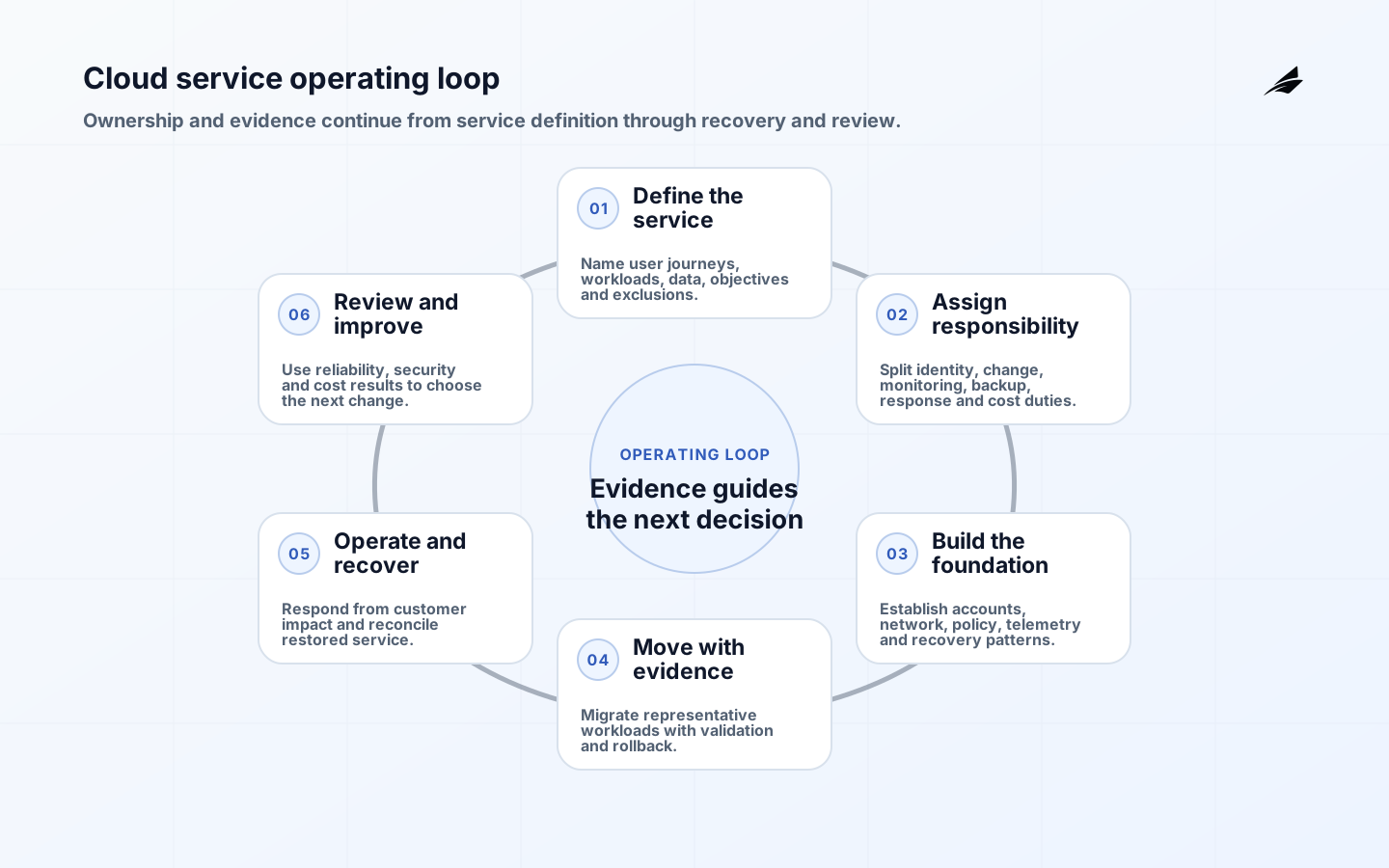
Infrastructure services and cloud work is the design and operation of compute, storage, networking, identity, observability, recovery and support as one accountable service. The difficult questions are rarely about whether a virtual machine can run. They concern who may change it, what happens when a dependency fails, how data is protected, how spend is attributed and whether the receiving team can recover the service without the provider present. This infrastructure services and cloud FAQ answers those buyer and delivery questions.
Use this guide with the infrastructure services implementation checklist, the deeper cognitive infrastructure checklist and Edilec's cloud DevOps delivery checklist. Together they connect a sourcing decision to architecture, acceptance and day-two ownership.
What do infrastructure services and cloud include?
NIST defines cloud computing through on-demand self-service, broad network access, resource pooling, rapid elasticity and measured service, and distinguishes software, platform and infrastructure service models. The NIST cloud definition is useful because the service model changes the customer's operating duties. Buying managed databases removes some engine maintenance, for example, but it does not decide data classification, access policy, retention, query behavior or business recovery.
A complete scope names the workloads, environments, accounts, regions, network boundaries, identities, data stores, deployment paths, monitoring, backups, service desk and suppliers included. It also names exclusions. A provider may monitor infrastructure health while the customer owns application health; another engagement may include application on-call. Ambiguous verbs such as manage or optimize should be replaced by observable activities, decision authority, response times and evidence.
| Service area | Provider may operate | Customer must still decide | Acceptance evidence |
|---|---|---|---|
| Foundation | Accounts, network patterns, policy and provisioning | Business units, approved regions and exception authority | Provisioning and policy-denial test |
| Runtime | Compute, containers, databases and patching | Workload architecture, data use and release risk | Version, patch and failover record |
| Operations | Telemetry, event intake and incident response | Business impact, escalation and recovery priority | Scenario exercise and incident timeline |
| Resilience | Backups, replication and recovery tooling | Recovery point, recovery time and acceptable loss | Restore result with reconciled data |
| Economics | Usage reporting and optimization recommendations | Budget, allocation and value tradeoffs | Attributed bill and approved forecast |
How should responsibility be divided?
Draw the boundary by resource and activity, not by organization name. For identity, separate directory administration, privileged-role design, access requests, authentication policy, emergency access, periodic review and log investigation. For backups, separate policy, execution, failure monitoring, retention, immutability, restoration and business reconciliation. Assign one accountable role for each decision and identify the people allowed to execute it.
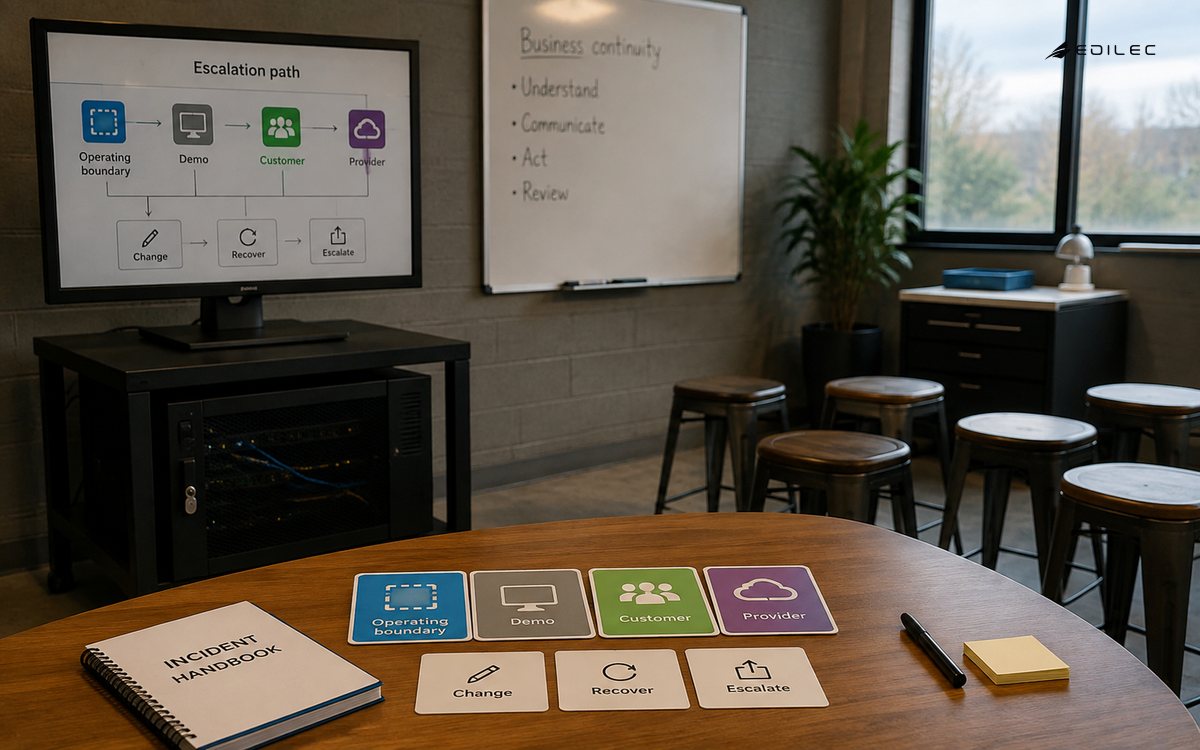
CISA's Cloud Security Technical Reference Architecture emphasizes shared services, migration and cloud security posture management. It also makes responsibility delineation central to cloud adoption. Put that delineation in the architecture, contract, role assignments and runbooks. A responsibility matrix that exists only in procurement material will not guide an operator during an outage.
Should a workload be migrated, modernized or left in place?
Begin with the business event that creates pressure to change: expiring hardware, an unsupported platform, slow release flow, unreliable recovery, geographic expansion or a new data requirement. Inventory dependencies, data movement, identity, latency, licensing, support windows and batch schedules. A low-utilization server may be cheap to host but expensive to move because it anchors several undocumented integrations. Conversely, a high-cost workload may be a poor first migration if its behavior is not understood.
Use a disposition for each workload: retain, retire, rehost, replatform, refactor or replace. Record the expected benefit, migration mechanism, rollback point and condition that would invalidate the choice. Rehosting can be a legitimate risk-reduction step, but do not present it as modernization if operational coupling remains unchanged. Pilot a representative workload that exposes identity, network, deployment, data and support constraints rather than selecting the easiest static site.
What does reliable cloud operation require?
Define service objectives from user journeys. Availability, latency and correctness should be measured at a boundary the user experiences. Internal CPU health cannot prove that checkout, case submission or data export works. Google's monitoring guidance recommends attention to latency, traffic, errors and saturation. Add dependency, release and business-completion context so an alert gives the responder a useful next action.
Recovery needs more than replicated resources. State the recovery point objective, recovery time objective, restoration order, required credentials, clean-room needs and data reconciliation method. Run a restore into an isolated environment and have the intended operators perform it. Test a regional dependency failure, credential loss, accidental deletion and a harmful application release. A successful backup job is evidence of a copy, not evidence that the service can be recovered.
| Operating signal | Question answered | Owner action | Failure threshold |
|---|---|---|---|
| Journey success | Can users complete the service? | Triage application and dependencies | Objective burn or sustained failure |
| Freshness and correctness | Is the result current and valid? | Pause publication or reconcile | Age or variance beyond contract |
| Recovery readiness | Can a clean service be restored? | Repair backup or runbook | Missed restore test or objective |
| Security posture | Are risky changes or exposures present? | Contain, remediate or approve exception | Critical finding or expired exception |
| Unit cost | Is consumption aligned with value? | Investigate allocation and demand | Forecast variance beyond tolerance |
How should security and cloud cost be governed?
Start with federated workforce identity, least-privilege roles, separate production administration, protected emergency access and auditable changes. Express repeatable network, encryption, logging, retention and resource policies as code where practical. Scan continuously, but distinguish findings by reachable exposure and business impact. Every exception needs an owner, reason, compensating control and expiry. Provider certifications can support due diligence; they do not prove that the customer's configuration and use are compliant.
Cloud economics need the same operating cadence. The FinOps Framework joins engineering, finance and business perspectives around value. Require ownership and environment metadata at provisioning, report unallocated spend, set anomaly routes and forecast material commitments. Evaluate total cost including support, observability, egress, resilience, migration and specialist skills. Optimize against a business unit such as transaction, active tenant or processed job, not simply the lowest monthly bill.
Architecture reviews should expose tradeoffs rather than award a generic score. The AWS Well-Architected Framework organizes questions around operational excellence, security, reliability, performance efficiency, cost optimization and sustainability. Similar provider frameworks can be useful regardless of platform, provided the team translates recommendations into owned work and tests instead of treating a completed questionnaire as assurance.
How should a provider be selected and accepted?
Ask candidates to work through one real service scenario. Give them a release failure, exposed credential, failed backup or sudden demand increase and request the event path, authority model, evidence, communications and recovery steps. Review staff continuity, subcontractors, privileged access, data locations, tooling ownership, commercial dependencies and exit support. References are most useful when they involve comparable operating constraints, not merely a familiar logo.
Acceptance should prove that an approved change can be deployed, observed and reversed; a privileged user can be revoked; a representative workload survives or recovers from failure; data can be restored and reconciled; an incident reaches the correct business owner; and spend can be attributed. Transfer source, infrastructure definitions, inventories, credentials, dashboards, runbooks, supplier contacts and open risks. The customer team should execute the final exercise while the provider observes.
Infrastructure services and cloud FAQ
Is multi-cloud necessary?
Use multiple clouds when a defined requirement justifies the integration and operating cost, such as an acquisition boundary, a unique capability or a tested concentration-risk response. Duplicating every workload rarely creates automatic resilience because identity, data and operations may still share failure points.
Does a provider SLA guarantee business availability?
No. Provider SLAs define a commercial service boundary and remedy. Business availability also depends on application design, dependencies, quotas, data correctness, customer configuration and response. Set end-to-end objectives and understand how each provider commitment supports them.
How should vendor lock-in be managed?
Document data export, identity dependencies, proprietary interfaces, replacement options, contract termination, skills and realistic transition time. Accept useful managed services deliberately where their value exceeds exit cost; test the highest-risk export or restoration path before it is urgently needed.
A practical cloud operating rhythm
Run a weekly service review around exceptions and user impact, not a tour of every dashboard. Review objective burn, unresolved incidents, failed changes, backup and restore status, security exceptions, expiring certificates or commitments, unallocated spend and capacity risk. Assign one owner and date to every action. Separate urgent restoration work from structural improvement so recurring failures are not repeatedly closed as isolated tickets.
Each month, reconcile the declared service inventory with cloud resources, identities, monitoring, backup coverage and billing. Investigate resources with no owner, production identities with no current purpose, services outside approved regions and costs with no useful allocation. Review supplier notices and planned provider changes against affected workloads. Update the architecture and responsibility records when the operating boundary moves; otherwise the contract, runbook and technical reality will diverge.
Each quarter, exercise one consequential path with business participants: restore a service, rotate a high-impact credential, fail a dependency, invoke emergency access or move support between teams. Record actual recovery time, missing authority and unclear communication. Use the result to change platform patterns and training. The purpose is not a theatrical pass; it is to find inexpensive weaknesses before a customer-impacting event makes them expensive.
Key takeaways
- Define cloud infrastructure as an operated service with a user boundary and named owners.
- Split shared responsibility into concrete activities, authority and evidence.
- Choose workload dispositions from dependencies, risk and measurable value.
- Test user-visible monitoring, restoration, revocation and incident routing.
- Govern cost as a value decision shared by engineering, finance and service owners.
- Accept the service only when the receiving team can operate and recover it.
Conclusion: make the cloud boundary operable
Infrastructure services and cloud engagements succeed when flexible technology is enclosed by clear responsibility, evidence and recovery. Start with one important service, make its architecture and duties explicit, prove the difficult operating paths and use real reliability, security and cost results to guide expansion.