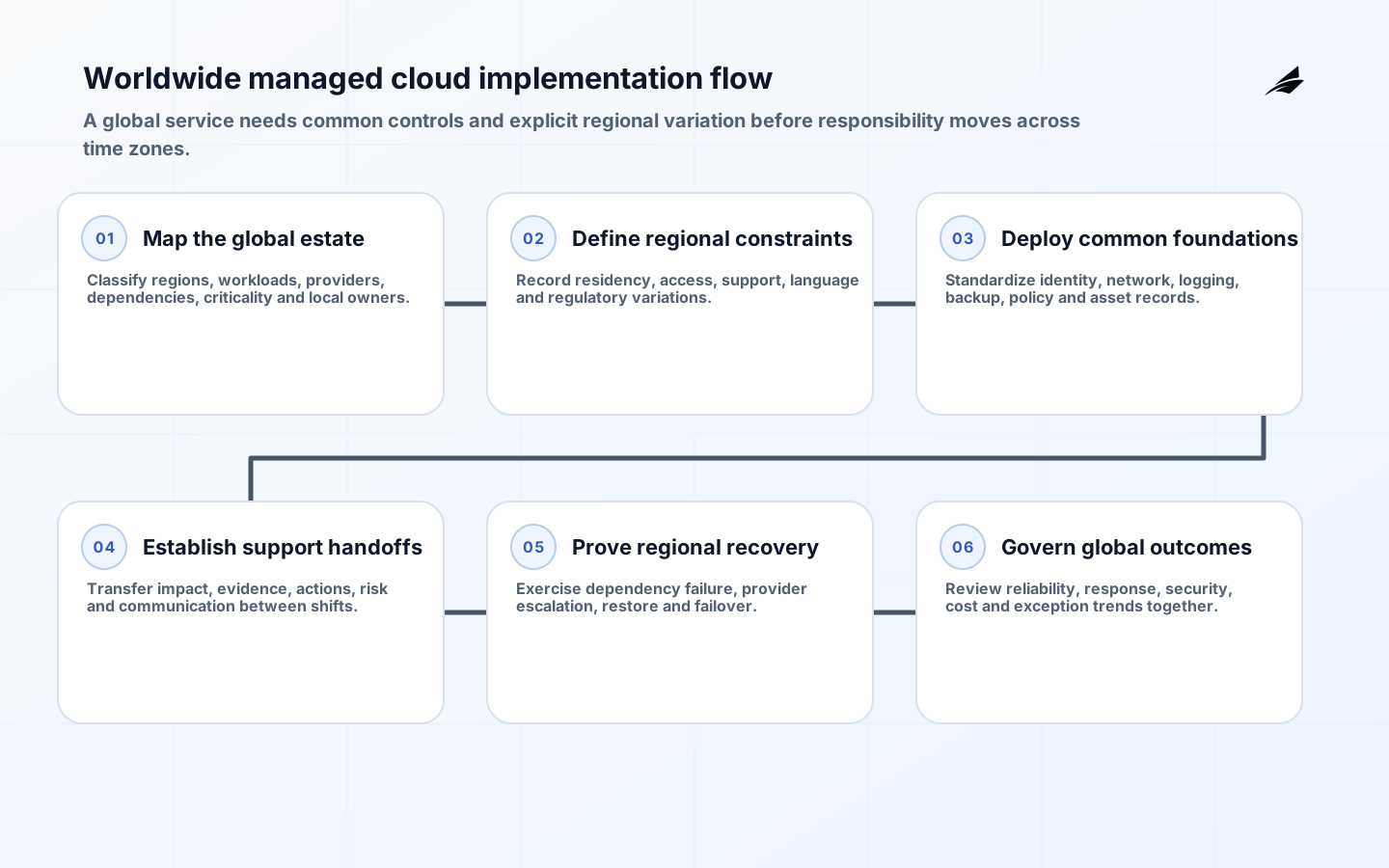
A worldwide managed cloud implementation checklist has to reconcile two forces that pull in opposite directions. Global operations need repeatable identity, policy, telemetry, recovery and service-management practices, while each country or cloud region can impose different data, access, language, provider and support constraints. Copying one landing zone everywhere does not create a worldwide service. The implementation succeeds only when common controls have named regional variants, and when every workload retains an accountable owner as work moves between providers, legal entities and time zones.
Use this checklist after the service boundary and target operating model in the worldwide managed cloud delivery plan are approved. It converts that design into acceptance evidence for regional onboarding, shared foundations, support transfers and recovery. The companion worldwide managed cloud FAQ covers sourcing and accountability questions. The purpose here is narrower: prove that the global service can operate each included workload without erasing local obligations or creating gaps between shifts.
1. Build a region-by-region service register
Inventory the estate at workload level, not merely by cloud account. Record business owner, technical owner, deployment regions, user locations, data classes, identity tenant, upstream and downstream dependencies, provider support plan, recovery target, maintenance window and local escalation contact. Mark which services are regional by design and which rely on a control plane, data store or specialist team elsewhere. The NIST cloud definition is useful here because resource pooling and broad network access do not remove the consumer's responsibility to understand where service management and data processing occur.
Add a regional constraint record beside every workload. It should state residency and transfer rules, approved administrative locations, encryption or key-custody requirements, log-retention periods, language coverage, labor restrictions for on-call work, and public-holiday support expectations. Cite the policy or contract that creates each constraint and name the person authorized to interpret it. A generic label such as “regulated” is not actionable. The implementation team needs a testable rule, an affected component and a route for deciding exceptions.
| Decision area | Evidence to collect | Acceptance question |
|---|---|---|
| Workload and dependency map | Service owner, regions, data flows and shared dependencies | Can responders identify the complete impact of a regional failure? |
| Data location | Storage, backups, logs, replication paths and transfer basis | Does every copy remain in an approved location? |
| Administrative access | Operator locations, privilege route and session evidence | Can support act without violating access restrictions? |
| Service coverage | Local hours, language, holidays and escalation roster | Is the promised response staffed in real conditions? |
| Provider dependency | Support tier, quotas, regional service list and contacts | Can the team escalate the actual services used? |
2. Separate global controls from regional overlays
Define a minimum control set that every region inherits: federated workforce identity, workload identity, privileged-access workflow, network segmentation, encryption defaults, asset tags, immutable logging, vulnerability handling, backup policy and infrastructure-as-code promotion. Publish these as versioned platform capabilities with owners and supported upgrade paths. The CISA cloud security reference architecture emphasizes shared services and continuous posture management; implementation should therefore produce both reusable controls and evidence that each regional deployment is still conforming.
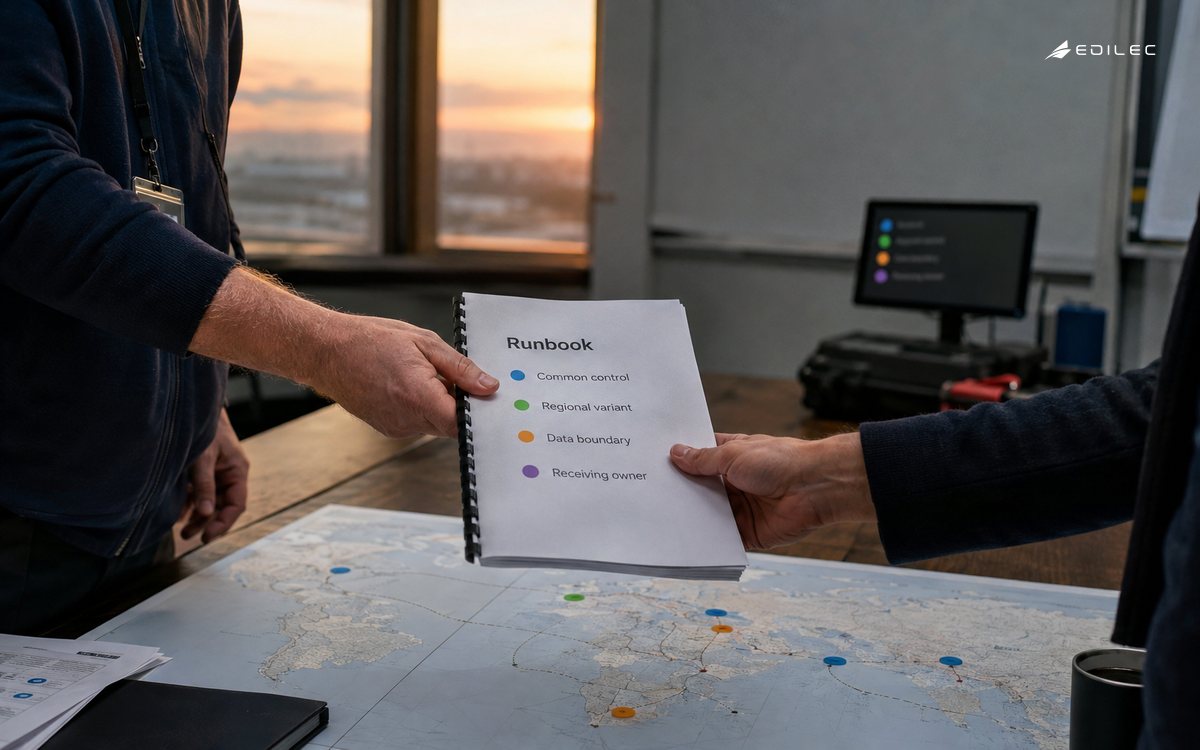
Keep overlays narrow and visible. A region may use a local key service, prohibit remote administration from certain countries, require an extra log sink or retain backups for a different period. Encode the difference in policy and modules where possible, then register its rationale, owner, review date and effect on support. Do not fork an entire platform stack to express one local rule. Conversely, never force a global default through when local evidence shows it is unlawful or operationally unsafe. Platform governance should decide whether to generalize, isolate or retire each exception.
3. Design follow-the-sun ownership as a transaction
A follow-the-sun model is not three independent queues. For every service window, identify the team holding incident command, the team authorized to change production, the specialists available on escalation and the manager accountable for customer communication. Define overlap periods and a fallback when the receiving site is unavailable. Google's guidance on communication and collaboration in SRE describes cross-site work as an interface between teams; treat that interface as an operating contract with required inputs, acknowledgement and a clear transfer of authority.
The handoff record should summarize customer impact, current health, hypotheses, actions completed, risky changes, pending decisions, evidence links, communications due and the exact next owner. The receiving person must acknowledge the transfer after reviewing live dashboards and unresolved work. High-severity incidents should keep one commander until an explicit command handover occurs; geographic daylight is not sufficient reason to split authority. Sample ordinary handoffs as well as incidents, because stale maintenance work and security findings often expose weak transfers before an outage does.
| Transfer item | Sender responsibility | Receiver acceptance |
|---|---|---|
| Active incident | State impact, command role, timeline and current mitigation | Repeat priorities and accept command or support role |
| Planned change | Provide approval, window, validation and backout trigger | Confirm staffing, dependencies and decision authority |
| Security finding | Record exposure, containment, evidence and disclosure status | Accept remediation clock and escalation obligation |
| Provider case | Attach case number, entitlement, diagnostics and promised update | Own the next provider contact and internal communication |
| Routine queue | Flag age, blocked items and service-level risk | Reconcile counts and challenge incomplete records |
4. Prove location failure and regional recovery
Choose deployment locations from business impact, latency, data rules and recoverability rather than from a blanket “multi-region” policy. The AWS Well-Architected guidance on fault isolation distinguishes location boundaries and warns against adding regional dependencies that weaken isolation. For each critical journey, document whether availability relies on zones, regions, another provider or an on-premises component. Then identify the control plane, identity, DNS, secrets, observability and human decisions needed during impairment; these hidden dependencies often determine whether a secondary region is usable.
Run recovery exercises with representative data and constrained assumptions. Verify detection, declaration, traffic movement, capacity, write authority, replication state, data integrity, user access, external communications and safe return to normal. A successful infrastructure failover is insufficient if operators cannot authenticate, a local payment service remains unavailable or replicated data violates residency. Store measured recovery time, recovery point, manual steps and unresolved risks. Regional leadership should accept the remaining exposure before the service enters steady operation.
5. Test sovereign access and security response
Global support widens the administrative path, so location-aware access needs deliberate engineering. Use named federated identities, short-lived elevation, approved devices, session attribution and server-side authorization. Where a region restricts foreign access, route work to permitted staff and make emergency access conditions explicit. Separate platform administration from customer-data access; many incidents can be diagnosed from metrics and sanitized logs without opening records. Confirm that central security tooling receives only approved telemetry and that local teams can still investigate when cross-region links fail.
Exercise a compromised operator identity, leaked deployment credential and malicious configuration change. The test should show who can revoke access across all regions, preserve evidence, identify affected workloads and notify regional decision makers. Align vulnerability deadlines with the strictest applicable commitment but keep local disclosure and maintenance constraints visible. Global consistency should improve response speed, not create a central account whose compromise silently reaches every workload.
6. Reconcile cost and supplier performance globally
Normalize provider consumption, currencies, taxes, discounts, support plans, managed-service labor and project charges into one allocation model. Retain the native billing record so regional finance teams can reconcile it. Tags or account structure should connect spend to a workload, environment, region and accountable product owner. The FinOps Framework treats value as a collaboration among engineering, finance and business roles; a worldwide service should use that collaboration to decide where resilience, residency or low-latency capacity justifies a regional premium.
Measure the supplier against outcomes the operating model controls: actionable alert response, handoff completeness, restore success, change failure, unresolved vulnerability age, toil reduction and cost-forecast accuracy. Compare regions carefully because workload mix, local service availability and regulatory effort differ. A single global average can conceal an unsupported location. Commercial schedules should state which engineering changes are included, how out-of-hours work is charged, who owns provider credits and what records transfer during exit.
7. Transfer regions through evidence gates
Onboard one representative region first, but do not choose the easiest environment. A useful pilot includes a production workload, sensitive data, at least one local dependency and a real support transfer. Shadow the incumbent team, reconcile the register, deploy common controls, close unsafe access gaps and operate the queue before transferring authority. Test a deployment, a restore, an incident handover and a provider escalation. Record rejected evidence and repeat the exercise until the receiving team can act without private knowledge or borrowed credentials.
- Regional owner signs the workload and constraint register.
- Platform owner demonstrates baseline inheritance and approved overlays.
- Security owner accepts access locations, evidence paths and open exceptions.
- Service owner witnesses a cross-site handoff and recovery exercise.
- Finance owner reconciles allocation from provider bill to workload view.
- Exit package contains code, inventories, credentials, cases, runbooks and decision history.
Expand by regional cohort only after the pilot produces stable operations over representative demand. Keep the former owner available during a bounded warranty period, with criteria for returning command if the managed team cannot operate safely. At the end of each wave, compare promised coverage with actual staffing, queue age, exception volume and recovery evidence. The worldwide model is ready when local teams can explain their obligations and the global team can see the service as one accountable system.
Key takeaways
- Register workloads, data paths and operational constraints separately for every region.
- Implement a common control baseline with narrow, governed regional overlays.
- Transfer follow-the-sun authority through acknowledged records, not queue assignment alone.
- Test regional impairment with identity, data, dependencies and communications in scope.
- Allocate cost and assess supplier outcomes without hiding weak regions in global averages.
- Move each region into service only after owners accept concrete operating evidence.
Frequently asked questions
Should every region use exactly the same cloud platform?
No. Every region should meet the same approved outcomes, but service availability, residency, connectivity and local regulation can require different implementations. Keep the control intent common, encode the smallest practical overlay and test that the regional variant produces equivalent evidence.
Does follow-the-sun support remove local on-call work?
Usually not entirely. Local knowledge, access restrictions, language and third-party relationships may require regional participation. The model should reduce unnecessary night work while preserving an explicit path to the people authorized to make location-specific decisions.
Must every workload run in multiple regions?
No. Use business impact and recovery requirements to select the fault boundary. Multi-region operation adds replication, consistency, cost and command complexity; a tested single-region design with recoverable data may be the sounder choice for some services.
Conclusion
Worldwide managed cloud operations become dependable through disciplined variation. The organization establishes one service language for ownership, controls and evidence, then preserves the regional facts that change how each workload may be accessed, recovered and supported. That balance is more durable than either a fragmented collection of local contracts or an inflexible global template.
Complete implementation when teams can demonstrate the operating model under pressure: a shift can accept command, a region can recover within its commitment, security can trace privileged action, finance can reconcile value and the customer can retrieve the records needed to change providers. Those proofs turn geographic coverage into an accountable global service.