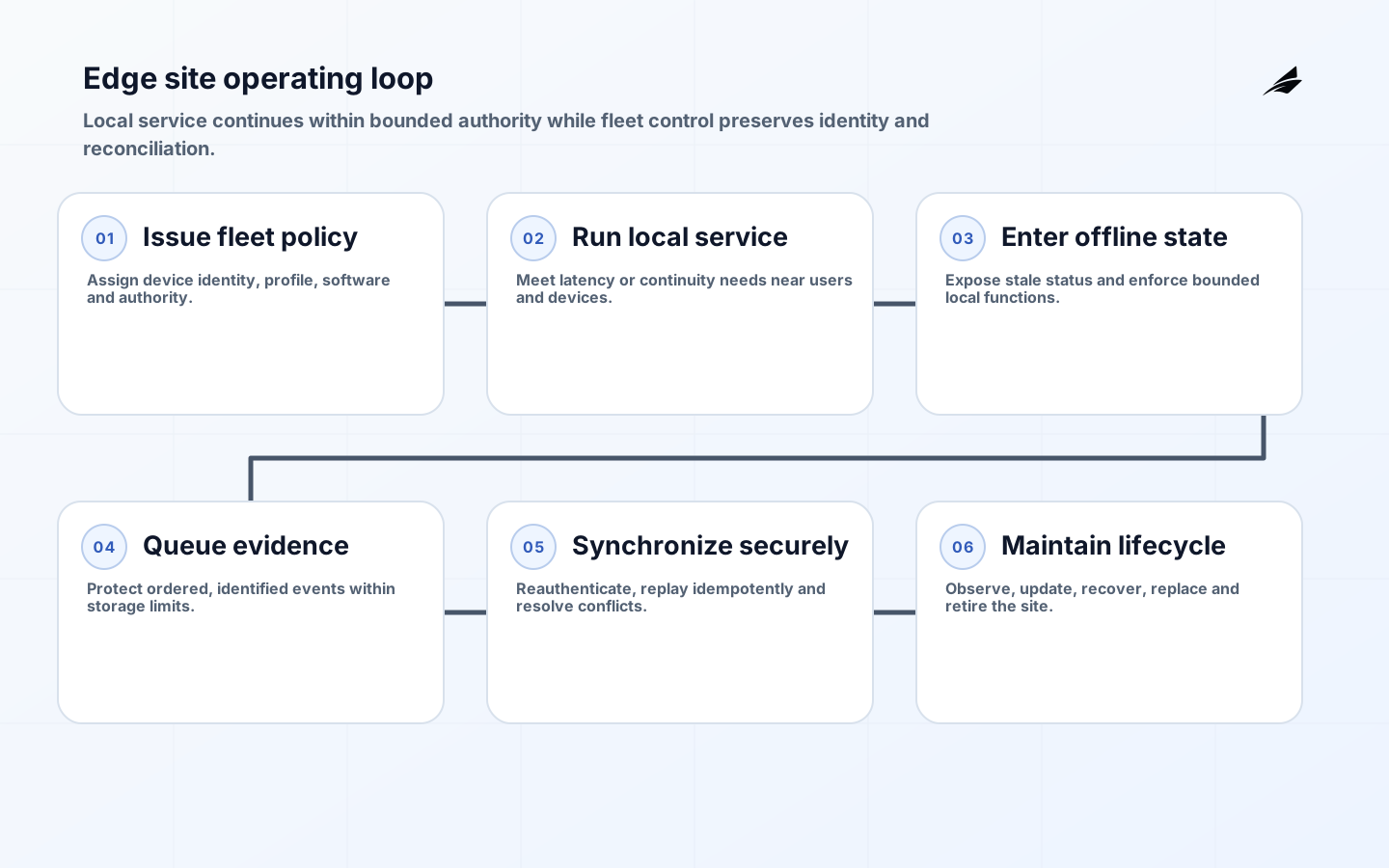
Network and edge computing places application capability closer to devices, sites or users when local latency, bandwidth, resilience, privacy or physical control matters. It also creates a distributed fleet with unreliable links, diverse hardware and limited hands-on support. A good design proves why a workload belongs at the edge and defines what the site does when central services, time, identity or connectivity are unavailable.
This network and edge computing FAQ complements Edilec's business guide, implementation checklist and cognitive infrastructure checklist. ETSI describes MEC as cloud capability at the network edge and its current work includes heterogeneous, federated and intermittently connected environments.
Which workloads should run at the edge?
Place only the functions whose measured requirements benefit: safety control, local inference, protocol translation, filtering, short-lived caching or continuity during disconnection. Keep global coordination, durable aggregation and cross-site policy central where practical. Document latency target, data volume, offline duration, hardware needs, site environment and central dependency. A workload is not an edge workload merely because a vendor appliance can host it.
| Driver | Edge candidate | Proof required |
|---|---|---|
| Latency | Immediate local decision | End-to-end timing under load |
| Bandwidth | Filter or aggregate high-volume data | Loss and fidelity comparison |
| Continuity | Bounded local operation | Offline scenario and reconciliation |
| Privacy | Local processing of sensitive source | Data-flow and retention review |
| Safety | Deterministic protective action | Hazard analysis and fail-safe behavior |
How should connectivity and offline behavior be designed?
Assume delay, loss, reordering, changed addresses and partial reachability. Define primary and alternate links, DNS and certificate behavior, queue limits, compression and priority. Separate control traffic from bulk synchronization. Every command and event needs stable identity, business time, sequence or version and duplicate handling. Decide which data may be discarded, summarized or stored locally when the queue fills.
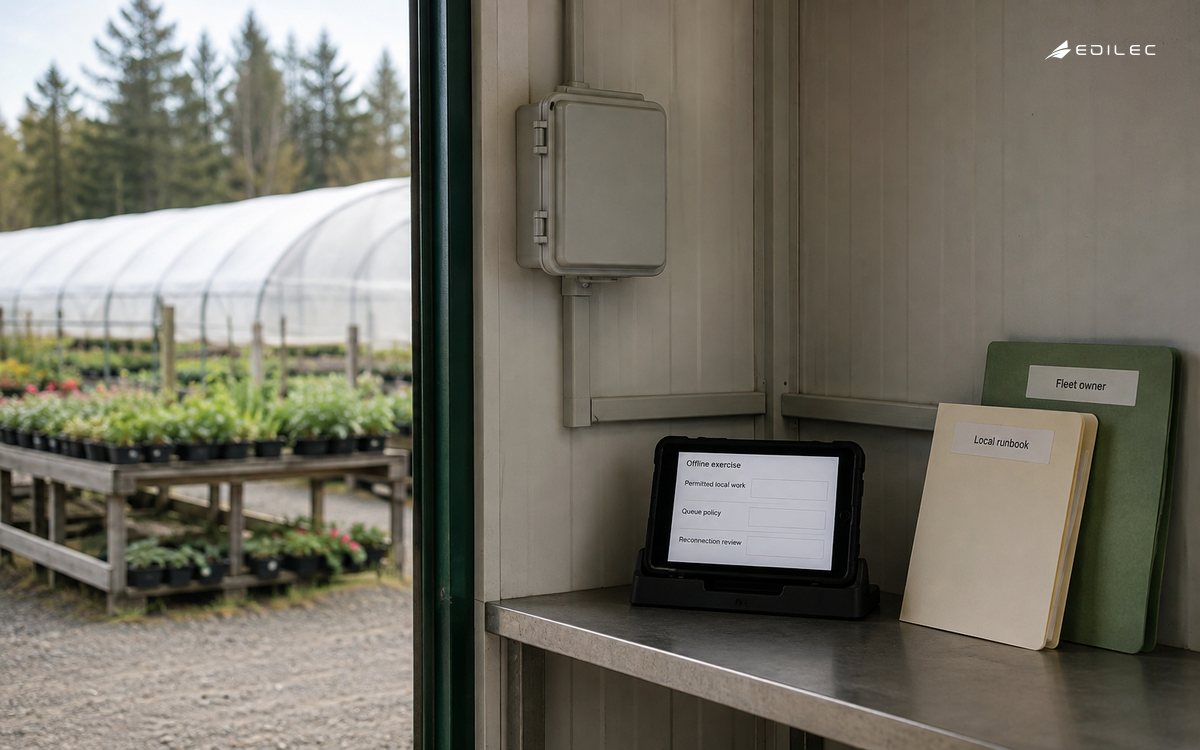
Offline mode is a product state. Specify permitted functions, local authority, stale-data indicators, user communication and maximum duration. On reconnect, authenticate again, replay idempotently and reconcile conflicts through explicit policy. Do not assume last-write-wins is safe for inventory, access or physical process state. Test clock drift and expired credentials because disconnected sites often lose more than network reachability.
How is edge access secured?
Treat site network location as insufficient trust. Give each device and workload a unique identity, authenticate connections, authorize by resource and operation, encrypt suitable data and segment management, application and device traffic. NIST's IoT baseline highlights device identification, configuration, data protection, logical access, secure update and cybersecurity-state awareness. Inventory hardware roots, firmware, operating system, containers, certificates and dependencies through retirement.
Use outbound connections where possible, narrowly scoped remote support and time-bound privilege. Protect local secrets against physical access and plan replacement of a lost or stolen node. Validate signed updates and prevent unsafe downgrade. CISA's modern network access guidance favors zero trust and secure service-edge approaches over broad remote network access; select controls from actual site and workforce risk.
Should edge sites run Kubernetes?
Only when orchestration benefits exceed resource and operating cost. Kubernetes can standardize packaging, rollout and desired state, but clusters need lifecycle, identity, storage, networking and troubleshooting. A single-purpose device may be safer with an image-based service manager. Compare fleet size, workload count, team skill, hardware, disconnection and update model. Prototype upgrade and recovery, not only deployment.
How should distributed data be governed?
Classify data at creation and define local retention, encryption, aggregation, transfer, central authority and deletion. Keep an append-only event or synchronization ledger for important state. Avoid building an accidental permanent database in site queues. Schema and policy versions must travel with records so delayed events remain interpretable. Test migration while sites run different software versions.
What must edge observability show?
Monitor user or physical outcome, application health, hardware, storage, temperature, power, link quality, queue age, certificate expiry, update state and configuration drift. Buffer essential telemetry during outage with limits. Use consistent service and site identifiers to correlate traces, metrics and logs, but avoid sending sensitive payloads. A central green dashboard must distinguish no data from healthy state.
| Condition | Local response | Central evidence |
|---|---|---|
| WAN unavailable | Enter approved offline state | Last contact and queue growth |
| Storage pressure | Prioritize and shed allowed data | Discard count and capacity trend |
| Node unhealthy | Fail safe or use local redundancy | Health history and action |
| Certificate near expiry | Rotate before disconnection | Fleet expiry coverage |
| Update failure | Hold or roll back bounded cohort | Version and failure reason |
| Telemetry silence | Local alert if possible | Unknown-state alarm |
How should a fleet be rolled out and costed?
Group sites by connectivity, hardware, environment and criticality. Start with a representative difficult site. Use zero-touch provisioning with unique identity, desired configuration and attestation where supported. Release in rings, monitor service outcomes and preserve rollback. Cost hardware spares, connectivity, platform licenses, data transfer, field visits, remote operations, security updates and retirement. Cheap compute can be overwhelmed by support travel.
- Approve placement outcome and central-edge responsibility.
- Model offline state, queues, reconciliation and safety.
- Build identity, segmentation, secure update and inventory.
- Instrument service, site and fleet health with unknown-state alerts.
- Pilot a representative site and rehearse update, outage and replacement.
- Expand by site profile with ring releases and cost ownership.
Manage hardware and software through retirement
Create a fleet bill of materials linking site, device identity, hardware, firmware, operating system, workload, configuration, owner, warranty and support date. Define approved versions and maximum age. Keep spares compatible and protected. Update rings should include a laboratory, friendly sites and progressively higher-consequence groups; pause automatically when health or reconciliation thresholds fail.
Remote recovery needs an independent path where risk justifies it: out-of-band management, known-good image, local contact or replaceable unit. Test reset and reprovisioning without reusing identity or leaving customer data. On retirement, revoke certificates, erase storage, remove authorization, close connectivity and record disposition. A device that stops reporting is not evidence that it was retired.
Accept each site profile under failure
Run load, power loss, link loss, packet delay, central outage, full disk, clock drift, certificate expiry, bad update and physical replacement. Verify local communication and safe state, then reconcile after recovery. Have ordinary support staff follow the runbook; a recovery dependent on the original engineer is not fleet-ready.
Measure successful local transactions, latency, offline duration, queue age, reconciliation breaks, update coverage, security posture, field visits and cost per site. Segment by profile. Review recurring manual work as a product problem. Edge value should remain demonstrable against a central-only or simpler local alternative as the fleet evolves.
Key takeaways
- Place workloads at the edge only for measured local requirements.
- Design disconnection, queue limits and reconciliation as normal states.
- Use identity-led access, segmentation and secure lifecycle management.
- Choose the simplest fleet platform the operating team can recover.
- Observe unknown state and include field support in total cost.
Frequently asked questions
Is edge computing the same as an on-premises server?
Not necessarily. Edge describes placement near a source or user for a specific distributed requirement. An on-premises data center can be centrally operated and well connected; an edge fleet usually emphasizes many constrained sites and local autonomy.
How much offline time should be supported?
Use observed outage patterns and business consequence. Longer support increases local state, security and reconciliation complexity. Define permitted functions and a maximum safe duration for each site profile rather than one arbitrary number.
Does edge computing require 5G?
No. Edge can use fixed, Wi-Fi, private cellular, public cellular or intermittent links. 5G and MEC enable valuable low-latency and network-context use cases, but architecture should follow workload and site evidence.
Govern configuration and site exceptions
Define desired configuration by site profile and keep deviations explicit, owned and expiring. Avoid hand-edited nodes that central control later overwrites unpredictably. Record why an exception exists, what risk it creates and how it will be removed. Compare reported state with desired state and route drift through a controlled correction path rather than silently forcing safety-relevant settings.
Site enrollment should verify identity, location or ownership where relevant, hardware profile and approved software before receiving production authority. Protect bootstrap credentials and prevent a retired device from rejoining. Separate tenant and environment identifiers throughout queues, caches and telemetry. Test moving a site between owners or regions without losing data responsibility.
Plan local capacity and physical conditions
Model peak compute, memory, storage write endurance, queue growth, network recovery and thermal limits. Reserve headroom for updates and diagnostics. Monitor power quality, cooling and enclosure conditions where they affect reliability. Decide whether local redundancy improves service enough to justify twice the hardware and operational complexity; sometimes a safe degraded mode is more dependable.
Forecast fleet demand from site openings, hardware lead times, replacement rates and software growth. Validate newer hardware against the complete image and peripheral set. Keep golden images reproducible and spares updated without consuming their credentials. Capacity planning must include central control planes and synchronization bursts after widespread outages.
Design support for distant sites
Give support a timeline of connectivity, configuration, update, application and hardware state with bounded actions. Document when to retry, roll back, switch mode, dispatch a replacement or escalate to a safety owner. Package logs for low-bandwidth transfer and protect their contents. Train local contacts only for safe physical checks and avoid requiring them to bypass security.
Finally, maintain a site closure procedure as carefully as site opening. Confirm service migration, drain local queues, reconcile durable state, notify users, revoke trust, recover reusable equipment and dispose of storage responsibly. Closure evidence prevents abandoned edge nodes, active subscriptions and retained data from becoming invisible operational and security liabilities.
Conclusion
Edge systems exchange centralized simplicity for local capability. Make that trade explicit, keep offline authority bounded and manage every node as a securable, observable, replaceable product. A fleet is ready when sites continue safely through failure and the central team can update, explain and retire them without heroic field work.