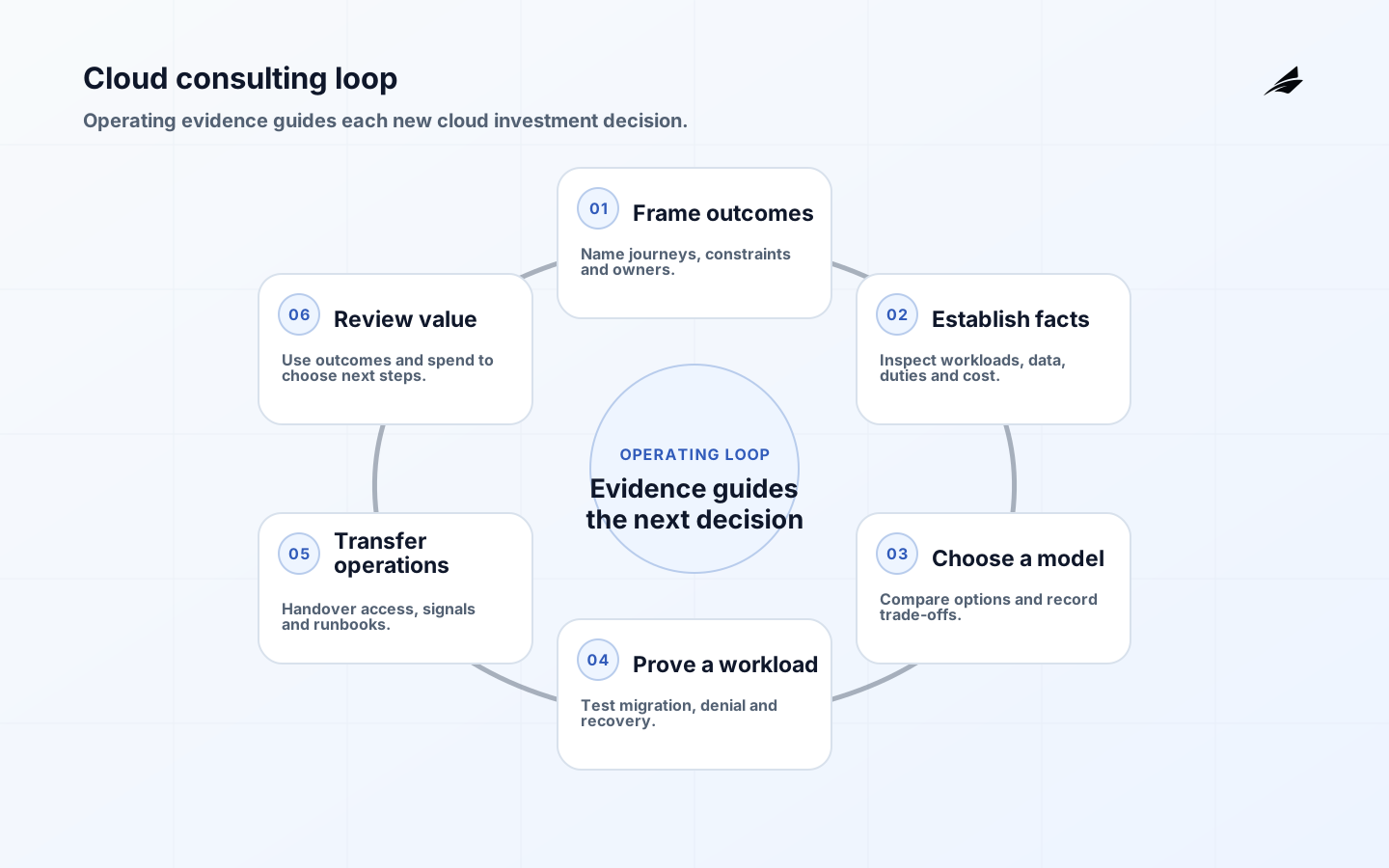
Cloud computing consulting helps an organization make and execute decisions about workloads, platforms, security, migration, operations and economics. It is most valuable when the problem crosses teams or when a consequential decision needs independent evidence. A consultant should leave an operable capability, not only a strategy deck: customer-owned accounts, explicit responsibility, tested workloads, measurable service objectives, recovery evidence and people who can make the next change.
This cloud computing consulting FAQ complements Edilec's cloud consulting delivery plan, cloud consulting implementation checklist and cloud consulting services FAQ. Use those resources when moving from provider selection into a specific backlog and acceptance plan.
When should an organization use cloud computing consulting?
Use external help when the organization lacks a temporary specialist capability, needs a neutral options assessment, faces a fixed transition event or must align business, security, finance and engineering decisions quickly. Typical triggers include expiring infrastructure, data-center exit, an unsupported platform, unreliable recovery, acquisition integration, rapid growth or uncontrolled consumption. Consulting is a poor substitute for an absent service owner. Name the executive sponsor, product owners and operators who will make decisions and receive the work.
Cloud is a service and operating model, not a location. The NIST cloud definition identifies five essential characteristics plus service and deployment models. Those models change the division of duties. A managed database can remove engine maintenance, for example, but the customer still decides data classification, access, schema, workload behavior, retention and business recovery. A consultant should make that residual accountability visible before recommending products.
| Engagement type | Core question | Useful deliverable | Acceptance evidence |
|---|---|---|---|
| Strategy | Which outcomes justify change? | Options, target principles and sequenced roadmap | Approved decisions with assumptions |
| Foundation | How will accounts, identity and policy work? | Landing-zone patterns and operating model | Provisioning and denial tests |
| Migration | How will workloads move safely? | Dependency map and wave plan | Reconciled cutover and rollback |
| Optimization | Where is reliability or cost leaking? | Measured findings and prioritized changes | Outcome change after implementation |
| Recovery | Can critical services be restored? | Scenario, runbooks and remediation | Timed restore with business validation |
What should the consulting scope contain?
Define business journeys, workloads, environments, data, regions, identity systems, networks, deployment paths, observability, backup, support and suppliers in scope. List exclusions and customer dependencies. Replace verbs such as manage, secure or optimize with observable activities, authority, response expectation and evidence. For identity, distinguish directory administration, privileged-role design, access approval, emergency access, review and investigation. For recovery, distinguish backup policy, execution, failure response, restoration and business reconciliation.
Ask for decision records as well as diagrams. Each material choice should state context, options, consequence, owner and review trigger. Require infrastructure code, configuration, inventories, tests and runbooks in customer-controlled repositories. Clarify administrative access, intellectual property, subcontractors and knowledge transfer in the contract. The customer should be able to inspect its estate and continue operating after the engagement without renewing merely to retain access.
How should architecture and security be assessed?
Assess a small number of representative end-to-end paths: user authentication, application request, data access, release, monitoring, incident response and restoration. Review trust boundaries, regional dependencies, quotas, encryption, key authority, logging, time synchronization and supplier services. The CISA, USDS and FedRAMP Cloud Security Technical Reference Architecture emphasizes shared services, migration, responsibility delineation and cloud security posture management. Adapt its principles to the organization's sector and jurisdiction rather than copying a federal pattern literally.
Use a framework as a question set, not an architecture score. The AWS Well-Architected Framework, for example, organizes considerations across operational excellence, security, reliability, performance efficiency, cost optimization and sustainability. A consultant using any provider framework should identify provider assumptions and supply equivalent reasoning for hybrid or alternative platforms. The output should prioritize risks and trade-offs, not maximize the count of recommended services.
How should migration be planned and accepted?
Inventory dependency, data movement, identity, latency, licensing, support windows, batch schedules and recovery. Give each workload a disposition such as retain, retire, rehost, replatform, refactor or replace, with expected benefit and invalidating condition. A rehost can be a sensible risk-reduction step, but it is not modernization when application coupling and operating effort remain unchanged. Choose a first workload that exposes representative constraints while limiting business consequence.
For each wave define data synchronization, write authority, freeze, validation, observation and rollback. Test normal operation, denied access, a failed dependency, deployment reversal and restoration. Acceptance belongs to the service owner and includes business records, performance, monitoring, security, cost attribution and support routing. Remove transitional network paths, identities and duplicate systems after evidence is accepted; otherwise temporary migration machinery becomes permanent attack surface and expense.
| Decision | Question to settle | Proof before scale | Warning sign |
|---|---|---|---|
| Workload disposition | Why change this service now? | Baseline and expected outcome | Cloud destination chosen first |
| Shared responsibility | Who decides and executes each duty? | Scenario walk-through by named owners | Provider owns ambiguous verbs |
| Resilience | What loss and interruption are acceptable? | Restore and failover with reconciliation | Backup success treated as recovery |
| Security | Which identities cross each boundary? | Denied paths and incident evidence | Broad permanent administrator roles |
| Economics | Who sees and acts on consumption? | Attributed bill, forecast and decision cadence | Savings assumed without workload change |
How are cloud consulting cost and value managed?
Consulting cost depends on estate diversity, discovery quality, regulatory evidence, migration volume, custom integrations, change windows and internal availability. Separate fees for assessment, foundation, workload waves, enablement and stabilization. Include the cloud cost of parallel environments, data transfer, logging, security tooling, support plans and recovery tests. Fixed-price milestones work when assumptions and acceptance are bounded; open-ended staff augmentation needs clear outcomes and review points.
Cloud consumption must be linked to decisions. The FinOps Framework 2026 expands the practice beyond public cloud and adds executive strategy alignment, while retaining collaboration across engineering, finance and business. Establish ownership tags or accounts, allocation rules, anomaly response, forecasts and a value review. Do not equate optimization with indiscriminate discount commitments; architecture, demand and risk determine whether a commitment is useful.
What does a successful operational handover include?
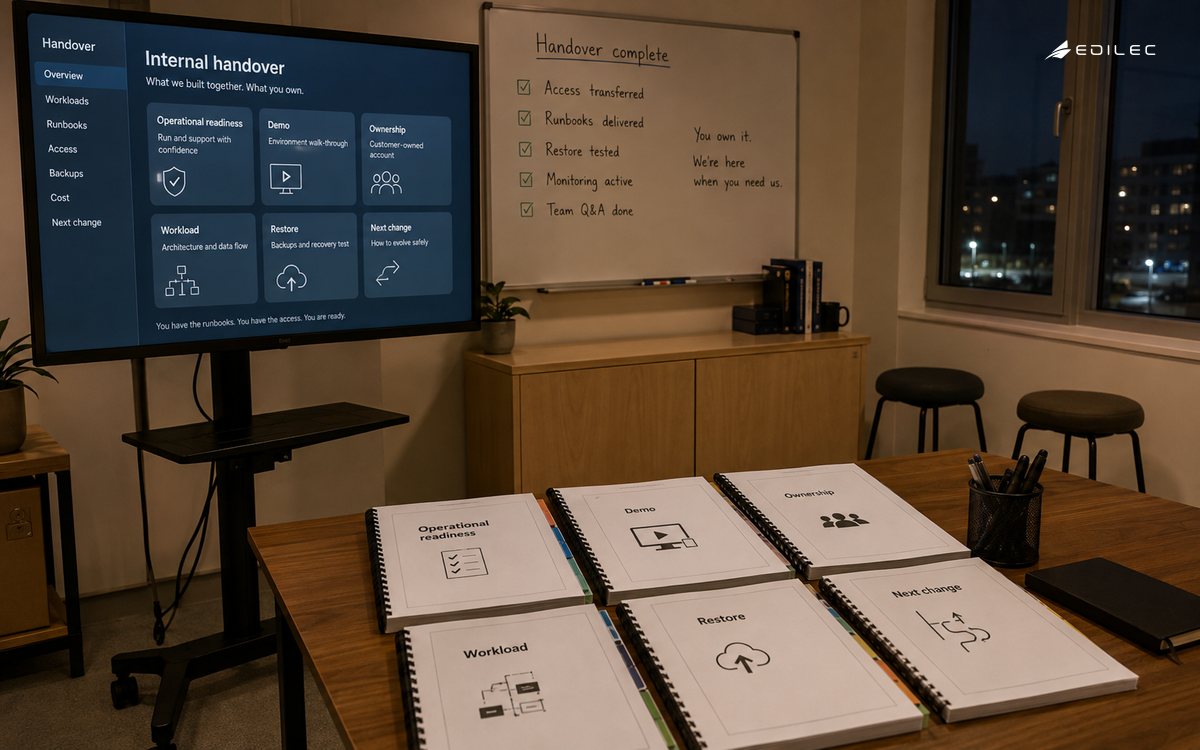
Handover includes customer-owned inventories, architecture, infrastructure code, policies, dashboards, runbooks, escalation, recovery records, decision history and open risks. Operators should provision a service, investigate an alert, revoke access, deploy a change and restore a representative workload themselves. Knowledge-transfer meetings without task completion are weak evidence. Assign owners and review dates for every temporary exception and unresolved dependency.
Measure user-facing service indicators alongside component health. Google's distributed-systems monitoring guidance highlights latency, traffic, errors and saturation as core signals. Add business transactions, deployment outcomes, restore performance, security correction, support load and cost variance. Review 30 and 90 days after transition, when real demand and operating effort are visible, and decide whether to expand, stabilize or change the model.
How should a cloud consulting partner be selected?
Evaluate the proposed team, not only the firm's capability list. Ask who will perform discovery, architecture, implementation, security review, cost analysis and handover, and how substitutions are governed. Request a worked example that includes an option the consultant advised against, a migration that changed after evidence, and an operating problem found after launch. This reveals whether the provider can challenge assumptions and stay accountable beyond a polished target diagram.
Use a scenario-based proposal. Give bidders a representative workload, constraints and ambiguous dependency, then ask for questions, approach, risks, customer effort and acceptance. Strong responses expose missing information and distinguish facts from assumptions. Compare the ownership and evidence model, not merely day rates. References should come from customers with comparable regulation, scale and internal skill, and should address handover quality as well as delivery speed.
Before signature, settle escalation, decision rights, access, data handling, tools, subcontractors, expenses, deliverable formats and termination assistance. Define who owns cloud accounts, repositories, domains, keys and billing from the first day. A consultant may administer these assets through delegated roles, but customer ownership improves visibility, incident control and transfer. Require privileged access to expire by default and review it at each delivery milestone.
Ask for a short discovery phase with a decision checkpoint before committing to portfolio migration. Discovery should test inventory quality, interview operators, inspect representative configuration and quantify the first constraints. Its output is an updated scope, risk register, workload cohort and forecast, not a generic maturity score. The customer should be free to pause or compete the delivery work if evidence materially changes the case. This commercial structure pays for uncertainty reduction while protecting both parties from an unrealistic fixed plan.
Key takeaways
- Engage consultants for a bounded capability or decision, with internal owners named.
- Define cloud scope through workloads, duties, authority and acceptance evidence.
- Assess representative end-to-end paths and provider assumptions.
- Migrate in waves with reconciliation, rollback and retirement.
- Connect consumption to engineering, finance and business decisions.
- Accept the work only when customer operators can run and recover it.
Frequently asked questions
Should a consultant be independent of cloud providers?
Independence can help during options analysis, but provider expertise is also valuable. Require disclosure of incentives and assess recommendations against documented outcomes, constraints, total operating cost and exit implications.
Does good consulting always recommend multicloud?
No. Multiple providers can reduce some concentration risks but add skills, integration and operating cost. First improve portability of data, backups, identity records and recovery; add another provider only for a specific justified outcome.
What is the most important consulting deliverable?
A tested operating capability with traceable decisions. Documents matter, but they should connect to customer-owned configuration, observability, recovery evidence and people able to make the next decision.
Conclusion
Cloud computing consulting succeeds when strategy survives contact with production. Scope duties precisely, compare options honestly, migrate representative workloads, prove recovery and make cost visible to decision-makers. The enduring result is an understandable service the customer can govern, operate and change.