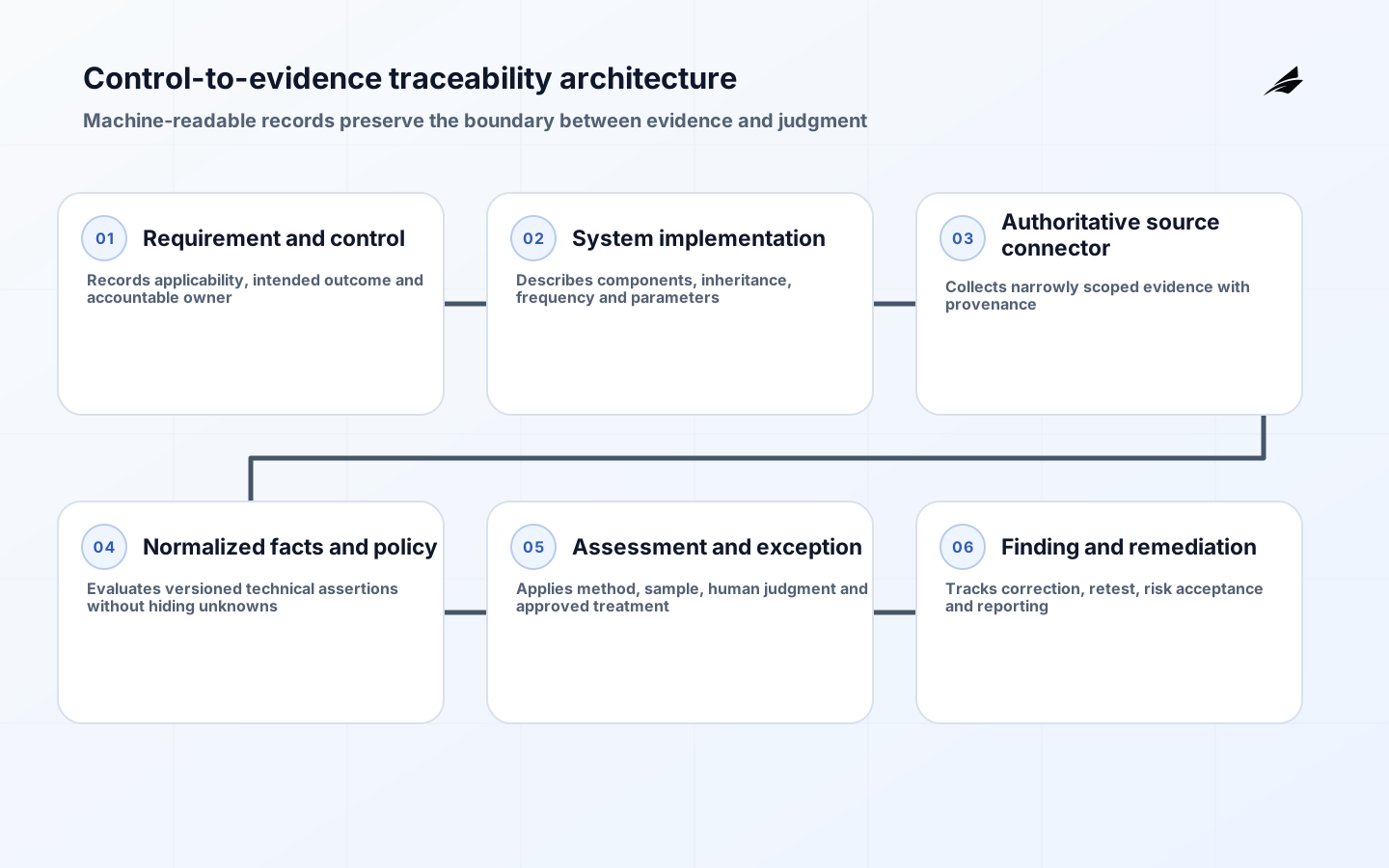
Compliance infrastructure is the data, integrations, policy logic, workflows and reporting that help an organization understand control obligations and produce assessment evidence. It can collect cloud configuration, identity changes, software provenance, vulnerability status, approvals and test results. It cannot declare an organization compliant by itself. Compliance is evaluated against applicable requirements, scope, implementation and evidence, with professional and legal judgment. The infrastructure should make that judgment better informed and less dependent on periodic document assembly.
The design goal is trustworthy traceability: from an obligation to a tailored control, implementation owner, technical or procedural evidence, assessment result, finding and remediation. Start with one system boundary and one evidence-heavy control family rather than ingesting every available signal. A successful first release might show whether privileged cloud access is approved, time-bounded, reviewed and removed. It should explain evidence gaps and exceptions, not paint an unqualified green dashboard.
Key takeaways
- Map requirements to tailored controls and responsible owners before automating evidence.
- Separate policy, implementation, evidence, assessment and risk acceptance as distinct records.
- Collect evidence close to source with provenance, scope, time and integrity metadata.
- Use policy as code for testable technical assertions, not as a substitute for legal interpretation.
- Design exceptions, compensating controls and manual evidence as first-class workflows.
- Measure coverage and freshness while checking whether controls actually reduce the intended risk.
Define scope and a control data model
Identify the system, services, environments, data, users, suppliers and shared controls in scope. Record why each requirement applies and who can interpret it. Select or tailor a control baseline according to risk and obligations. A control statement should describe the intended outcome without becoming inseparable from one tool. The implementation record then explains how a specific system satisfies it, including inherited portions, parameters, frequency, owner and evidence. This separation allows technology to change without losing the governing rationale.
OSCAL provides machine-readable models for catalogs, profiles, component definitions, system security plans, assessment plans, results and remediation information. It can improve interoperability and traceability, but it is a format family, not an assessment engine. Adopt only the models and fields the workflow can govern. Maintain stable identifiers, versions and links to source authority. If simpler internal records meet the immediate need, design an export path rather than forcing every stakeholder to author raw OSCAL.
| Record | Purpose | Accountable role | Essential metadata |
|---|---|---|---|
| Requirement | Preserve external or internal obligation | Legal, compliance or policy owner | Source, jurisdiction, version and applicability |
| Control | State intended risk outcome | Control owner | Parameters, frequency and scope |
| Implementation | Describe how a system performs control | System owner | Component, inheritance and responsible party |
| Evidence | Support a test or assertion | Evidence producer | Provenance, period, scope and integrity |
| Assessment | Evaluate design and operation | Independent assessor or assurance role | Method, sample and conclusion |
| Finding | Track gap and response | Risk owner | Severity, treatment, due date and acceptance |
Build a provenance-preserving evidence pipeline
Use read-only connectors where possible and give each a narrowly scoped workload identity. Collect from authoritative APIs, event streams, build systems and repositories instead of screenshots when structured evidence exists. Preserve source, query or rule version, collection time, resource identity, environment, period and cryptographic digest where useful. Store raw evidence immutably for its required period and derive normalized facts separately. A normalized fact should always link back to the source record that supports it.
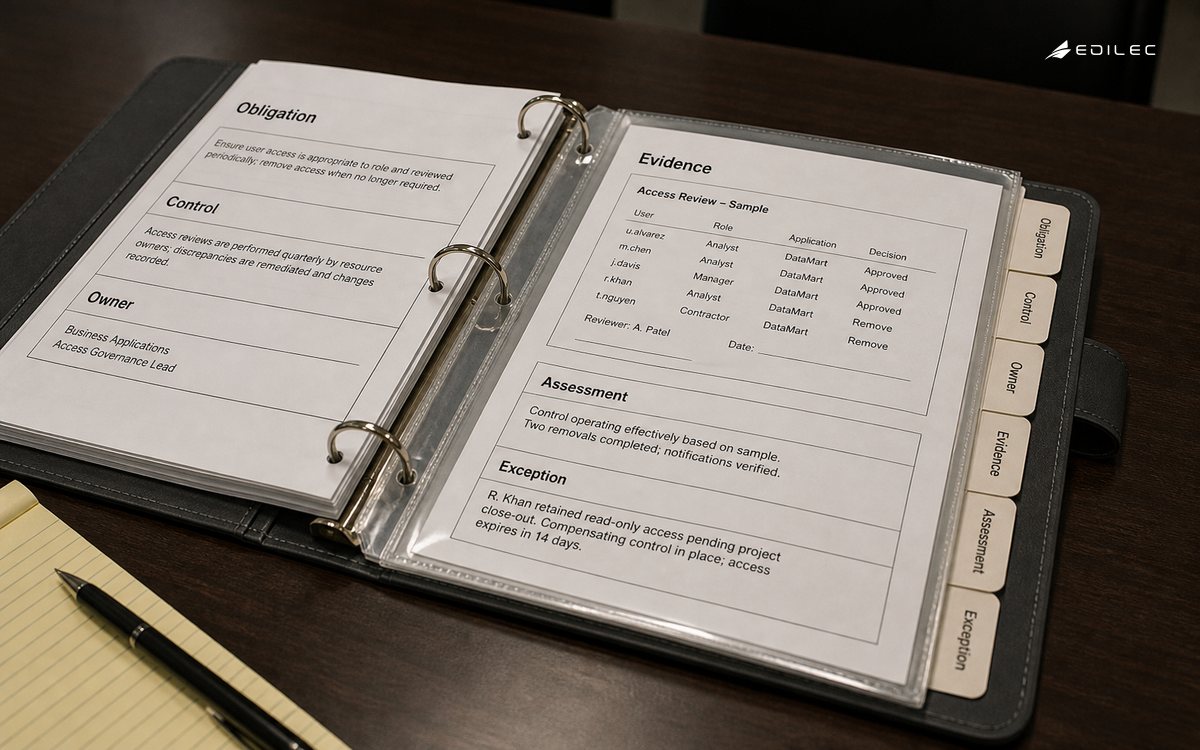
Schedule by how quickly risk can change. A yearly user list is weak evidence for access that changes daily. Event-driven collection may shorten detection, but periodic reconciliation is still needed for missed events and connector failures. Monitor completeness, lateness, authorization errors and schema drift. Quarantine malformed evidence rather than silently dropping fields. Sensitive evidence can reveal architecture, identities and vulnerabilities, so classify it, restrict access, encrypt it and apply retention and deletion rules.
Use policy as code within clear limits
Policy as code expresses testable rules in version-controlled logic. It works well for assertions such as approved regions, encryption settings, public exposure, required labels or protected build conditions. Link each rule to the control implementation and document assumptions. Test rule logic with allowed, denied, missing and unknown inputs. Review changes, sign or protect releases, and record which version evaluated each resource. A passed rule is evidence for that assertion, not proof of the entire control.
Many controls involve people, governance, physical processes, effectiveness or contextual judgment. Represent them through attestations, sampled records, interviews, exercises or assessor work rather than inventing a technical proxy. A backup-enabled flag does not prove recoverability; a successful timed restore provides stronger evidence. Avoid converting ambiguous regulatory language directly into code without an authorized interpretation. Keep the interpretation, technical rule and assessment conclusion independently reviewable.
| Control question | Possible automated evidence | Required contextual check |
|---|---|---|
| Is access limited? | Roles, grants and policy evaluation | Role appropriateness and emergency process |
| Are builds protected? | Provenance, branch policy and signer identity | Threat model and exception handling |
| Is data encrypted? | Resource configuration and key reference | Data scope, key governance and exposure paths |
| Are vulnerabilities managed? | Scan, inventory and remediation records | Coverage, exploitability and accepted risk |
| Can service recover? | Backup jobs and restore telemetry | Business reconciliation and achieved objectives |
| Are suppliers governed? | Inventory and review dates | Contract obligations, concentration and exit |
Secure the compliance platform and its supply chain
The platform is a high-value map of controls and weaknesses. Separate ingestion, normalized control data, evidence storage, policy evaluation, workflow and reporting. Use strong identity, least privilege, tenant or business-unit boundaries, immutable audit events and protected administrative actions. Keep production collectors isolated from lower environments. Do not let a policy failure automatically change production unless a separately designed remediation workflow authorizes and validates the action. Evidence collection should not become an unreviewed control plane.
Apply secure development practices to collectors, rules and reporting. Inventory dependencies, protect source and build systems, verify artifacts and maintain vulnerability response. SLSA offers a framework for reasoning about software supply-chain integrity and provenance; use the level or controls appropriate to risk rather than claiming a label without evidence. Threat-model falsified evidence, compromised collectors, replay, deletion, privilege escalation, data leakage and a malicious insider changing rule logic before an assessment.
Support exceptions and independent assessment
Real systems will produce unknown, not-applicable and temporarily nonconforming results. An exception should contain scope, rationale, approver, risk, compensating control, start, expiry and review evidence. Expired exceptions return to attention automatically. Prevent broad exceptions from swallowing new resources. Findings need ownership, severity criteria, remediation, retest and formal acceptance where allowed. Preserve the difference between a control operator's statement and an assessor's conclusion.
Assessment planning defines method, sample, period and independence. The platform can assemble populations, select transparent samples, deliver evidence and track results, but assessors must be able to inspect provenance and challenge completeness. Avoid dashboards that collapse design, implementation and operating effectiveness into one score. Report control coverage, evidence freshness, test outcome, open findings and accepted exceptions separately. Leadership needs uncertainty and scope, not a percentage whose denominator is unclear.
Deliver incrementally and model full cost
Begin with a control-to-evidence workshop, system boundary and source inventory. Implement one connector and normalized record, validate it with control operators and assessors, then add policy evaluation and exception workflow. Run the old and new evidence process through one assessment cycle and compare completeness, effort and findings. Expand by reusable evidence source, not by creating separate pipelines for every framework. Many requirements can map to the same owned implementation without pretending their wording is identical.
Cost includes control analysis, data modeling, connectors, API or tool licensing, storage, policy authoring, security, assessor participation, operations, exception handling and source changes. Automation has maintenance cost when providers alter schemas or controls. Estimate with source count, evidence frequency, system diversity and assurance depth. Measure hours displaced, but also time to detect drift, stale evidence, unresolved exceptions, repeated findings and assessor rework. Faster evidence that is incomplete or misleading is not a benefit.
Frequently asked questions
Can compliance be fully automated?
No. Many technical checks and evidence flows can be automated, but applicability, interpretation, control design, sampling, effectiveness and risk acceptance need accountable judgment. Good infrastructure shows where automation ends and who owns the next decision.
Is OSCAL required for compliance as code?
No. OSCAL offers valuable standardized models, especially for interoperability and control-based programs. Teams can begin with governed internal schemas and adopt OSCAL where it improves exchange. The important properties are stable semantics, provenance, versioning and ownership.
How should a compliance infrastructure provider be evaluated?
Test a representative control and evidence source. Verify data access, provenance, rule transparency, framework versioning, exports, exceptions, security, availability, subcontractors and exit. Confirm who maintains mappings and who is qualified to make compliance conclusions. Product certifications do not transfer automatically to customer configuration.
Plan for source and framework change. When a provider renames a field, a control catalog is revised or organizational scope changes, the platform should identify affected mappings, rules, evidence and reports. Test migrations on historical records, retain prior interpretations and require owners to approve semantic changes. This version discipline prevents a routine connector update from silently rewriting compliance history or changing a control conclusion without assessment. Reconcile a sample before and after migration and publish unexplained differences to the responsible control and assessment owners.
Conclusion
Compliance infrastructure should make controls easier to understand, operate and assess without disguising uncertainty. Start with scope and accountable control records, preserve evidence provenance, and automate only assertions that can be tested honestly. Protect the platform as sensitive infrastructure, represent exceptions and manual evidence explicitly, and retain independent assessment. When obligations, implementations and results remain traceable, continuous evidence can reduce audit friction while giving leaders a more current view of risk instead of a more colorful version of compliance theater.