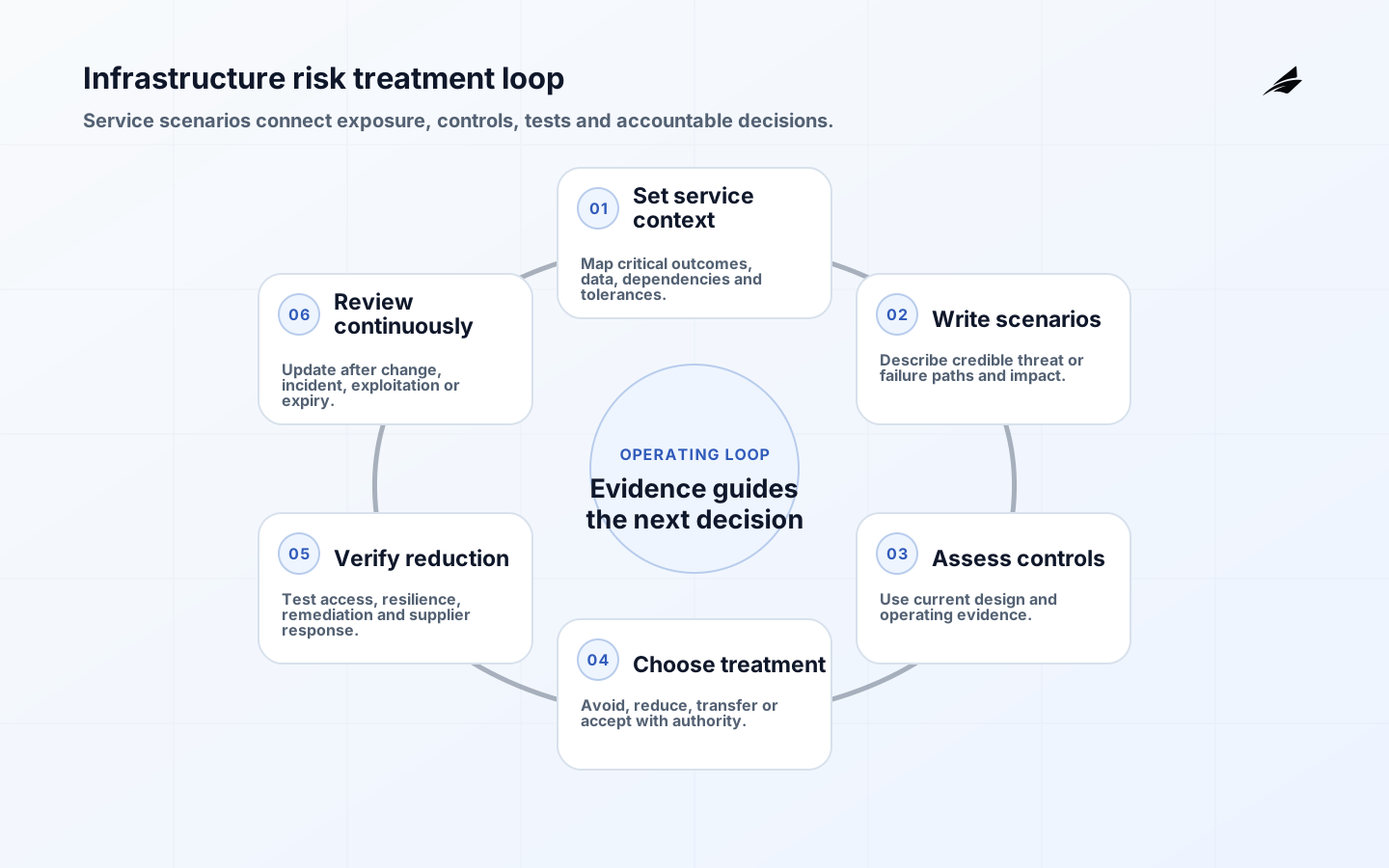
Infrastructure risk management is not a product purchase with a predictable outcome. It is an operating change spanning cloud accounts, networks, compute, identity, data services, suppliers and recovery. The useful question is whether the proposed service improves a named workflow while preserving security, recoverability and accountable ownership. This guide turns that question into a sequence of decisions, evidence and release gates that buyers, architects and delivery leaders can use together.
Begin with the companion Edilec resources on the infrastructure risk management guide, the infrastructure risk checklist, cloud incident response planning. They provide neighboring architecture and implementation detail. This article concentrates on the exact boundaries, delivery evidence and recurring management decisions that determine whether infrastructure risk program remains useful after the first release.
What is infrastructure risk management?
Infrastructure risk management identifies how technology failures or misuse could impair a business service, estimates likelihood and impact with available evidence, selects treatment and verifies that controls work. The unit of analysis should be a service or critical outcome, not an isolated server. Cloud resources, SaaS control planes, on-premises systems, network dependencies, identity providers, build systems, backups and suppliers can participate in the same scenario and must be modeled together.
A risk register is an index of decisions, not the program itself. Each material record needs a scenario, affected service, assets and dependencies, threat or failure event, existing controls, credible impact, uncertainty, treatment owner, due date, verification and residual-risk authority. Separate inherent and residual risk carefully. Avoid false numerical precision: ranges and explicit assumptions are more useful than multiplying unsupported one-to-five scores into a colorful ranking.
| Decision | What must be explicit | Acceptance evidence |
|---|---|---|
| Service context | Critical outcome, users, data, dependencies and tolerance | Current service map and approved impact criteria |
| Scenario | Threat or failure path and plausible consequence | Scenario narrative tied to assets and controls |
| Treatment | Avoid, reduce, transfer or accept with accountable owner | Funded action, due date and acceptance authority |
| Verification | How design and operation will be tested | Control test and retained evidence |
| Review | Change, incident or time trigger for reassessment | Scheduled review and event-driven workflow |
How should infrastructure risk be modeled?
Build a service-centered model connecting business outcomes to identities, data, applications, infrastructure, providers and recovery paths. Maintain inventories through authoritative sources where possible, but reconcile them with runtime discovery and ownership. Model concentration: one identity provider, region, DNS service, network hub or deployment system may affect many nominally separate applications. Risk architecture should expose those shared dependencies and control planes rather than treating every resource as independently protected.
Use classification and flow maps to determine confidentiality, integrity, availability and retention needs. Identify control-plane data and secrets as well as business records. A backup copy is not a recovery capability until the organization can locate it, authenticate during an outage, restore dependencies in order and verify application consistency. Define recovery time and recovery point by business process, then test the entire route, including identity, network, keys, configuration and external integrations.
Which control evidence should leaders request?
Select controls from scenarios and obligations, then request operating evidence. Identity controls need role, credential and access-review records; vulnerability controls need coverage, exploitability context, remediation and exception evidence; configuration controls need approved baselines and drift response; resilience controls need restore and failover results. Prioritize known exploitation and exposed paths rather than raw finding counts. A scanner dashboard cannot prove that a critical service is recoverable or that privileged access is bounded.

Use the NIST Cybersecurity Framework 2.0 to organize governance and outcomes, and SP 800-30 for risk-assessment concepts. The SP 800-53 control catalog helps teams select control families. CISA’s Known Exploited Vulnerabilities Catalog supplies exploitation evidence for vulnerability priorities, while NIST SP 800-34 supports contingency planning.
| Control area | Implementation detail | Proof before scale |
|---|---|---|
| Identity | Federation, least privilege, workload identity and emergency access | Privilege-path test and break-glass audit |
| Configuration | Versioned baseline, policy checks and drift response | Sample drift detection through remediation |
| Vulnerability | Asset coverage, exposure, exploitation and exception expiry | Critical path remediation evidence |
| Resilience | Dependency-aware backup, restore and failover | Timed recovery with integrity checks |
| Supplier | Service dependency, notification, assurance and exit | Contract mapping and provider-outage exercise |
How do you establish the program without stalling delivery?
Start with three to five critical services and a cross-functional workshop. Define impact criteria, map dependencies, develop a small scenario library and identify existing evidence. Select a few treatments that materially reduce exposure: privileged-access redesign, internet exposure removal, immutable recovery, unsupported component retirement or concentration mitigation. Integrate actions into normal engineering work and architecture review. Expand after owners can keep records current and verification changes decisions, not after every asset has a risk score.
Treat every stage as a gate, not a calendar milestone. The owner records the decision, evidence, unresolved exceptions and rollback trigger. A stage closes only when representative users complete the workflow, telemetry explains failure, support can diagnose it, and recovery has been exercised. This keeps infrastructure risk program from expanding on enthusiasm while operational debt remains invisible.
What does infrastructure risk management cost?
Costs include discovery, asset and dependency tooling, engineering remediation, testing, security monitoring, recovery environments, assurance, supplier review, training and risk administration. The expensive items are often structural: removing a shared privileged account, redesigning network trust or proving regional recovery. Compare treatment cost with an impact range, risk appetite, time horizon and reduction evidence. Do not present risk transfer as elimination; insurance and contracts may reduce financial exposure while operational and customer harm remains.
For infrastructure risk programs, estimate lifecycle cost by workload and by responsibility. Include discovery, integration, migration, verification, security review, environments, observability, support, change management, vendor management, data movement, incident response and exit work. Keep contingency attached to known uncertainty rather than hiding it in a blended rate. Reforecast after the pilot with observed effort and consumption; that is more defensible than extrapolating a demonstration.
Common failure modes and practical responses
Programs fail when they inventory assets without mapping services, score risks without writing scenarios, count vulnerabilities without exposure context, accept risk without authority, or close actions on policy documents rather than tests. Cloud shared-responsibility assumptions are another source of gaps. So are backups managed through the same credentials and control plane as production. Repeated incidents should update scenarios and treatment priorities; otherwise the register becomes a historical report detached from operations.
For infrastructure risk programs, the practical response is a small control loop: detect the condition, identify the accountable owner, limit exposure, preserve evidence, recover the workflow, and decide whether the underlying design must change. Record exceptions with an expiry date and compensating control. Repeated exceptions are architecture evidence, not administrative noise, and should change the roadmap or narrow the service boundary.
Example: reducing identity and recovery risk in a cloud estate
A company finds that production administration, backup control and deployment all depend on one identity tenant. The scenario is not simply “identity outage.” It covers malicious privilege escalation, accidental tenant lockout and provider disruption, each of which could block service operation and recovery. The team maps privileged roles, workload identities, recovery credentials, dependent regions and current emergency procedures, then estimates customer and regulatory impact over several outage durations.
Treatment removes standing administration, separates recovery authority, stores tested emergency material outside the normal control plane, hardens federation changes and exercises loss of the primary tenant. Evidence includes role assignments, approval logs, alert behavior, successful emergency access, restore timing and post-test revocation. Residual concentration is accepted only for a defined period by the named service and risk owners, with a funded alternative assessed at the next architecture milestone.
For infrastructure risk programs, the team releases only the proven slice, monitors user and system outcomes through a full operating cycle, and keeps the previous route available until reconciliation closes. At the review, leaders compare baseline and observed results, examine near misses and support effort, and either expand, redesign or stop. That decision discipline matters more than completing every item in an original feature list.
How to measure value and operating health
Track critical-service coverage, unknown ownership, overdue high-exposure treatment, control-test pass rate, exception age, internet-exposed assets, known-exploited-vulnerability exposure time, privileged-path reduction, restore success and recovery time against objective. Pair counts with outcome review. A rising inventory can improve visibility while making a dashboard look worse; explain whether movement reflects discovery, exposure, treatment or validation so leaders fund the right response.
| Measure type | Example measure | Decision it informs |
|---|---|---|
| Coverage | Critical services with current dependency and scenario review | Whether important exposure is visible |
| Treatment | Material actions completed and verified by due date | Whether resources reduce risk |
| Exposure | Time on exploitable paths and expired exceptions | Whether preventable exposure is shrinking |
| Resilience | Successful restore and recovery-objective attainment | Whether disruption can be survived |
Key takeaways
- Analyze risk around business services and credible scenarios.
- Map control planes and shared dependencies, not only resources.
- Require tested operating evidence before declaring a treatment complete.
- Prioritize exploitable paths, concentration and recovery weakness.
- Give every acceptance a named authority, expiry and reassessment trigger.
Frequently asked questions
Is a vulnerability scan an infrastructure risk assessment?
No. Scanning provides useful technical findings, but assessment adds service context, exposure, threat evidence, controls, impact and treatment decisions. Some of the largest risks, such as concentration or untested recovery, may have no vulnerability identifier.
How often should infrastructure risks be reviewed?
Use both scheduled and event-driven review. Material architecture changes, incidents, new exploitation, supplier changes, unsupported components and failed tests should trigger reassessment rather than waiting for an annual register cycle.
Can infrastructure risk be quantified in money?
Financial ranges can improve comparison when assumptions are transparent and supported by incident, outage, revenue and recovery data. Do not disguise weak inputs with precise numbers. Combine financial estimates with legal, safety, customer and operational impact.
Conclusion
Risk management infrastructure becomes useful when leaders can trace a service scenario to controls, evidence, treatment and accountable residual-risk decisions. Focus on shared dependencies, exploitable paths and recoverability. A smaller current set of tested, decision-ready risks will protect the organization better than a large register whose scores cannot explain what should change.