Cloud storage services can provide durable object, file, block, archive and backup capabilities, but selecting a service class is only one part of the design. Teams must map data purpose, access pattern, authority, retention, recovery, geography, security and lifecycle cost. Provider durability does not by itself protect against authorized deletion, ransomware, application corruption, lost keys or a migration that omits metadata.
This guide helps buyers and engineers define scope, cost, risk and delivery. Pair it with the cloud storage implementation checklist, cloud storage FAQ and small-business cloud DevOps plan. Retention and residency duties vary by data and jurisdiction; confirm them with legal, records and security owners.
Classify data and choose the correct storage model
Inventory datasets by owner, purpose, format, volume, growth, object count, typical size, read and write pattern, concurrency, latency, throughput, retention, deletion, residency and recovery. Identify the application semantics: object stores usually update by key and do not provide filesystem locking or atomic transactions across objects. File workloads may need shared namespace and locking; databases need block or database-aware persistence. Avoid forcing every workload into the cheapest advertised capacity tier.
Classify confidentiality, integrity, availability and legal significance. Separate public assets, operational records, personal data, regulated evidence, backups and replaceable derived outputs. Define the authoritative copy and downstream replicas. If multiple applications write the same namespace, specify ownership and conflict behavior. Include metadata, tags, access policy, checksums and retention controls in migration scope; preserving bytes while losing context can make data unusable or noncompliant.
| Workload | Storage need | Design focus | Common mistake |
|---|---|---|---|
| Application objects | API access and scalable namespace | Key design, consistency and lifecycle | Assuming filesystem behavior |
| Shared files | Directory and concurrent access | Identity, locking and throughput | Migrating incompatible applications unchanged |
| Database volumes | Low latency and ordered writes | Snapshot and database-consistent recovery | Treating crash copy as verified backup |
| Archive | Long retention and infrequent retrieval | Immutability, catalog and restore time | Ignoring retrieval lead time and fees |
| Backup | Independent recoverable copies | Isolation, retention and restore tests | Keeping only an accessible replica |
Separate durability, availability, replication and backup
Durability describes long-term preservation against storage failures; availability describes immediate access. Location and storage class affect outage behavior and service commitments. Replication places copies in other zones or regions but can also propagate deletion or corrupt application state. Versioning preserves prior object versions under defined conditions. Immutable retention can resist deletion, but governance-mode bypass privileges and key loss still need control. No single feature proves recoverability.
Set recovery time and recovery point objectives from business impact, then design independent copies and restoration. CISA recommends offline or otherwise protected backups and regular integrity testing because ransomware often targets reachable backups. Keep recovery identities, keys, infrastructure definitions and application dependencies available during a primary-account incident. Test a representative restore into an isolated environment and reconcile business records, not merely the number of files copied.
Design identity, encryption and exposure controls
Disable public access by default and use policy-based access rather than scattered object ACLs where the platform and workload permit it. Grant human and workload identities the minimum actions, resources and conditions needed. Separate read, write, delete, retention-bypass and key-administration authority. Use short-lived credentials and private service paths where justified. Monitor changes to policies, public settings, replication, lifecycle, retention and logging, as well as material object reads and writes.
Cloud services commonly encrypt stored data by default, but teams still decide key ownership, rotation, separation, recovery and access. Customer-managed keys can satisfy control needs while increasing outage and deletion risk. Encrypt transport and validate certificates. Prevent sensitive object names or metadata from leaking information. Scan untrusted uploads, set safe content types and force download where content should not execute in a browser. Protect audit logs from the identities that administer primary data.
Model lifecycle cost instead of capacity price
Estimate stored bytes over time, object operations, retrieval, early deletion, data transfer, replication, inventory, logging, keys, backup, support and taxes. Small-object workloads may be operation-heavy; archives may be cheap to retain but expensive or slow to retrieve. Include application changes, migration tools, network capacity, testing, dual running, compliance evidence and internal operations. Price at downside, expected and growth scenarios rather than multiplying current capacity by one list rate.
Lifecycle policies can transition or expire data automatically, but encode records policy and application needs before enabling them. A broad rule can delete current versions, noncurrent versions or multipart remnants differently. Test prefixes, tags and dates with representative objects. Use inventory and access evidence to tune class transitions. Review whether retained versions and delete markers create hidden cost. Assign exceptions an owner and expiry rather than permanently excluding growing namespaces.
| Cost driver | Question | Control | Evidence |
|---|---|---|---|
| Capacity growth | Which data and versions accumulate? | Forecast by class and owner | Monthly inventory trend |
| Requests | How many reads, writes and listings occur? | Batch and cache appropriately | Operation metrics |
| Retrieval | When must archive be available? | Match tier to recovery objective | Restore exercise cost and time |
| Transfer | Which regions and consumers move bytes? | Place processing and control replication | Flow and egress report |
| Protection | What do versions, copies and logs add? | Retain from explicit policy | Protected-copy inventory |
| Operations | Who handles access, restore and exceptions? | Service ownership and automation | Labor and ticket trend |
Plan migration around integrity and application behavior
Profile source data, unsupported names, permissions, links, sparse files, timestamps, versions and change rate. Choose offline bulk transfer, network copy, appliance or continuous synchronization from volume and deadline. Establish a manifest with source identifier, size, checksum, metadata and target. Encrypt transfer and isolate credentials. Throttle to protect production. Rehearse duration and failure recovery using representative object sizes; a test of a few large files does not predict millions of small objects.
Define change capture and cutover. Freeze writes only when acceptable; otherwise synchronize deltas and establish a final authority point. Validate counts, bytes, checksums, metadata, permissions and application journeys. Sample content independently. Keep source read-only through a rollback window, subject to security and records policy. A rollback must account for writes made to the target after cutover. Communicate user-visible path, latency or retrieval changes before they become support incidents.
Use a controlled data lifecycle
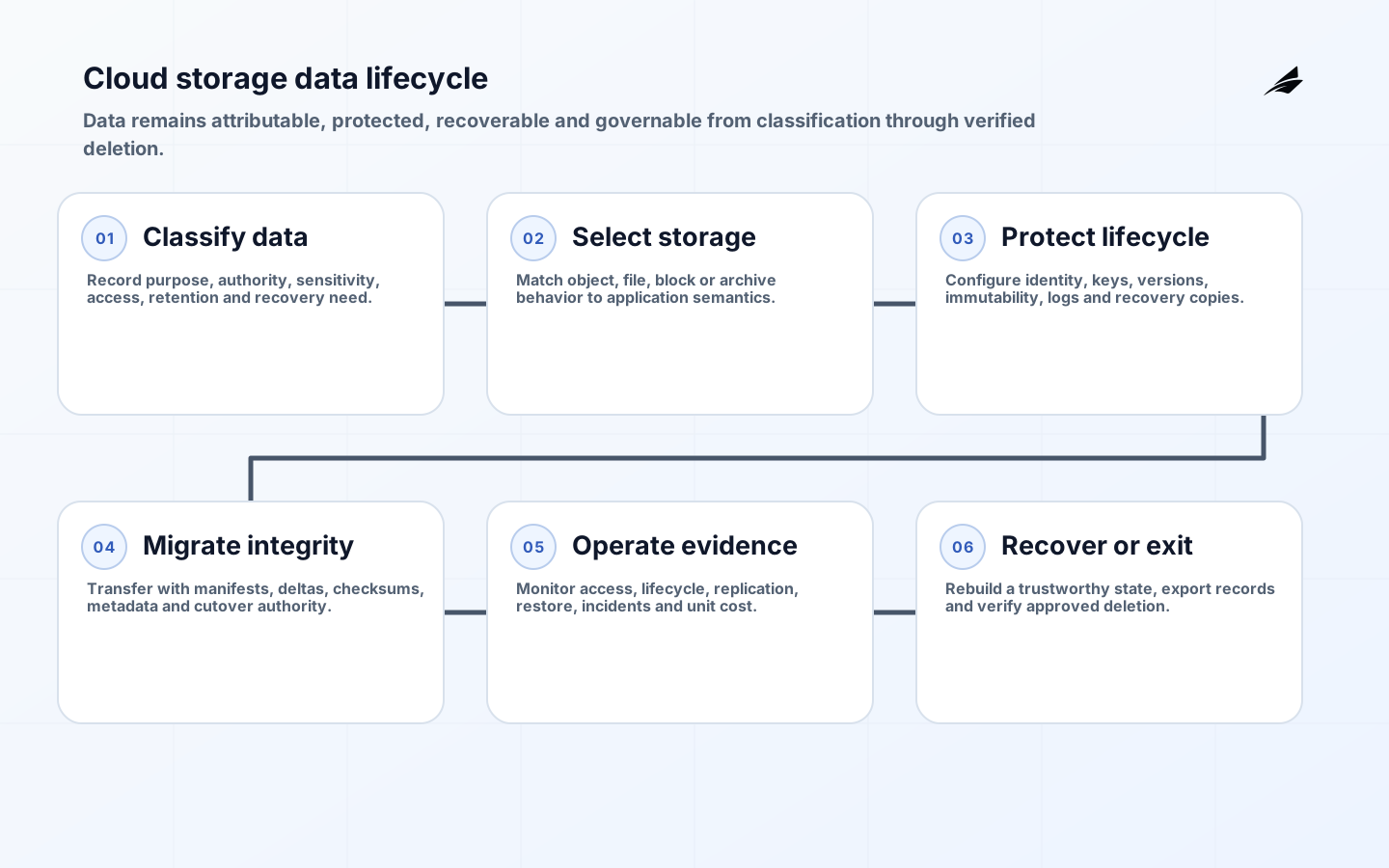
- Classify data purpose, authority, access, retention, residency and recovery need.
- Select storage type, location and protection features from workload semantics.
- Implement identity, encryption, logging, lifecycle and protected recovery copies.
- Migrate with manifests, synchronization and integrity reconciliation.
- Validate application behavior, restoration, cost allocation and operational ownership.
- Review access, classes, exceptions and deletion; rehearse recovery and exit.

Operate evidence, incidents and exit continuously
Monitor access denials, unusual downloads, destructive actions, replication lag, lifecycle failures, capacity, request errors, restore tests and spend anomalies. Alert only where a responder can act. Review privileged access and public exposure automatically. Patch transfer agents and rotate credentials. During an incident, preserve logs and object versions, contain compromised identities, determine affected scope and restore under business approval. Document customer or regulator communication authority.
Maintain export procedures, schemas, metadata mappings, keys, retention obligations and deletion evidence. Understand provider limits and fees for bulk extraction. Test export of a representative protected dataset and rebuilding its access policy elsewhere. When retiring storage, stop producers, verify consumers, satisfy holds, preserve required records, delete remaining data through approved methods and revoke keys and identities. Keep closure evidence without retaining the protected content unnecessarily.
Key takeaways
- Choose object, file, block or archive services from application semantics and data class.
- Treat durability, availability, replication, versioning and backup as distinct controls.
- Separate delete and retention authority and protect audit and recovery identities.
- Model requests, retrieval, transfer, protection and labor alongside stored capacity.
- Migrate with manifests and reconcile a restored business state before declaring success.
Frequently asked questions
Is provider durability enough for backup?
No. Durability protects against infrastructure loss, not every logical, credential or application failure. Use independent recovery points, isolation, retention and tested restore according to business objectives.
Should all data use immutable storage?
No. Use immutability where records or recovery risk justify its operational and cost consequences. Choose retention carefully because premature or excessive locks can conflict with correction, deletion and legal requirements.
Does multi-region storage remove disaster-recovery work?
No. It can improve location resilience, but applications, identity, keys, networks and dependencies still need a recovery design. Validate the provider's replication behavior and your complete service under the failure boundary you promise.
Design deletion as carefully as retention. A deletion request may need to reach primary objects, versions, replicas, indexes, caches, exports and backups under different schedules, while legal holds may suspend part of that process. Record authority, scope, execution and verification. Cryptographic erasure can be useful only when key scope and destruction behavior are understood and independently controlled.
Run recovery exercises at several levels: restore one object version, reconstruct a dataset, rebuild an application environment and operate during loss of the primary account or region where promised. Measure elapsed time, data point reached, missing dependencies and manual work. Update the design and recovery objective from observed evidence. A successful provider console restore that the application cannot read is not a successful recovery.
For regulated archives, preserve a catalog that can locate records without exposing their contents, and test retrieval within the required deadline. Validate format readability, integrity and chain of custody over long retention periods. Plan format migration and key continuity before software or encryption mechanisms reach end of support. Ownership must outlast the project that originally stored the data.
Conclusion
Cloud storage succeeds when data remains usable, protected, recoverable and economically governed throughout its lifecycle. Start with workload semantics and authority, choose explicit protection controls, migrate with integrity evidence and rehearse restoration. The service is ready when owners can explain where data is, who can change it, how it returns after failure and how it will eventually leave.