Education cloud professional services turn institutional goals into a cloud service that teachers, learners, families and administrators can actually depend on. The work is broader than moving servers: it includes student-record privacy, identity, accessibility, integrations, learning continuity, security operations, cost control and a support model that still functions during enrollment, examinations and reporting peaks. This education cloud professional services implementation checklist gives sponsors concrete gates for that work.
Use it with the education cloud scope and delivery plan, education cloud FAQ and security engineering checklist. The checklist is intentionally evidence-based. A phase is complete only when accountable education and technology owners have reviewed representative records, workflows, controls and recovery results, not when a vendor reports that configuration is finished.
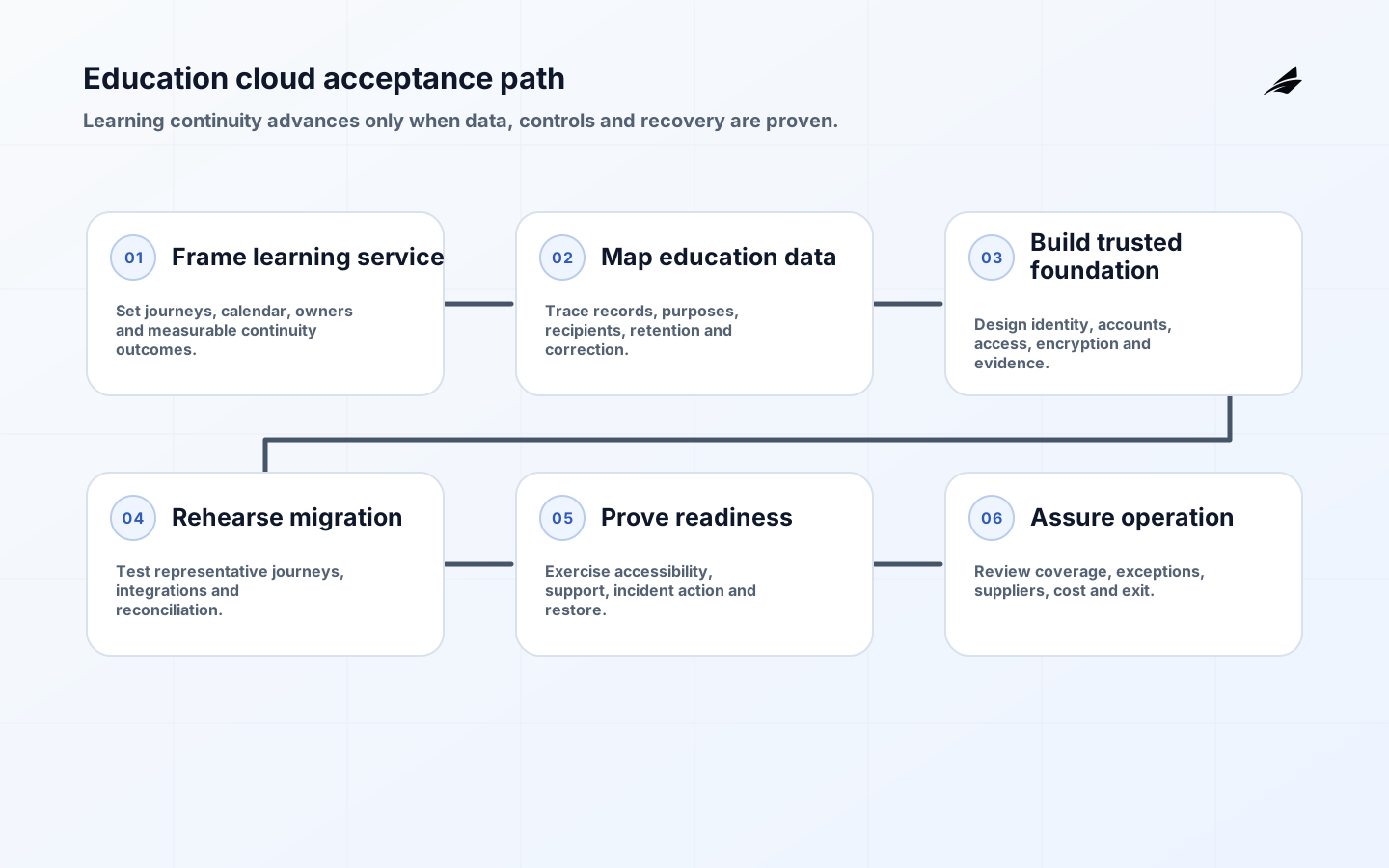
1. Define learning outcomes and service boundaries
Begin with educational outcomes and calendar constraints. Name the services being changed, populations affected, campuses and jurisdictions, peak periods, unavailable maintenance windows, and the decisions that remain with the institution. A learning management system, student information system, research platform and productivity suite have different records and tolerance for interruption. Set measurable outcomes such as faster course provisioning, fewer failed logins, a defined restore time, or lower infrastructure toil; do not use migration itself as the outcome.
Create a service boundary showing cloud provider, professional-services provider, institution, schools or departments, and downstream vendors. For each workflow, record who approves access, corrects data, handles safeguarding concerns, communicates outages and accepts residual risk. The Department of Education cloud-computing FAQ explains that FERPA does not prohibit cloud hosting, but use of the school-official exception depends on conditions including institutional control over the provider’s use and maintenance of education records.
| Decision area | Required implementation evidence | Acceptance owner |
|---|---|---|
| Learning service | Critical journeys, peak calendar, service objectives and excluded use cases | Academic or service sponsor |
| Student records | Data inventory, purpose, lawful disclosure basis, retention and deletion route | Records and privacy owner |
| Technology boundary | Architecture, integrations, identity flow, regions and supplier responsibilities | Enterprise architect |
| Continuity | Impact tiers, recovery objectives, restore test and manual fallback | Business continuity owner |
| Operations | Support tiers, telemetry, change windows, escalation and cost controls | Named service owner |
2. Map student data, records and retention
Inventory data before selecting migration mechanics. Trace student, guardian, employee, research and operational data from collection through exports, analytics, support systems, backups and deletion. Label authoritative systems, identifiers, sensitive fields, permitted purposes, recipients, residency constraints and retention schedules. Include derived data such as engagement scores and support transcripts. A contract clause is not enough if engineers cannot show where copies, logs and temporary files exist.
Test provider commitments against actual features. Confirm whether the provider may use data to improve services, whether subcontractors receive it, how schools inspect or correct records, and what happens to backups after deletion. Establish a process for legal holds and public-record obligations where applicable. Use synthetic data in lower environments by default; when representative personal data is essential, approve the minimum fields, protect access, log use and remove the dataset after the test.
3. Build identity, architecture and acquisition controls
Design identity around the risk of each journey rather than one password policy. Staff administrators, teachers, students, guardians, guests and service accounts need distinct lifecycle and recovery rules. The current NIST Digital Identity Guidelines separate identity proofing, authentication and federation assurance. Apply that distinction when deciding whether a guardian can reset access, an instructor can change grades, or an integration can read an entire class roster.
Choose account, subscription and network boundaries that limit failure and administrative reach. Centralize audit evidence while allowing approved local autonomy. Require infrastructure as code for repeatable foundations, encrypted transport and storage, managed secrets, time-bounded privileged access, tested break-glass accounts and explicit internet exposure. CISA’s K-12 acquisition guidance is useful during procurement because it asks buyers to favor products that are secure by design and to examine vendor defaults, vulnerability handling and transparency.
4. Pilot migration and integrations with real journeys
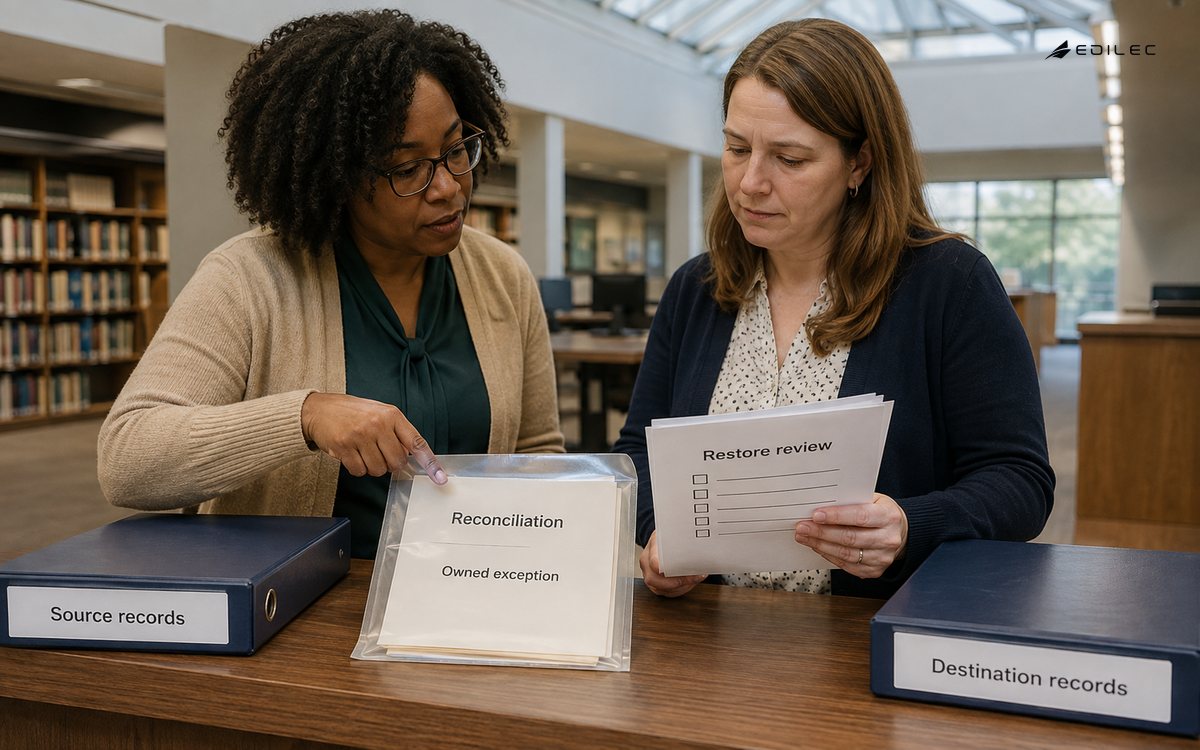
Select a pilot that is representative but recoverable. Include a full workflow: roster or account creation, sign-in, learning activity, assessment, grade or result transfer, support request, record correction and offboarding. Reconcile counts and key fields between source and target, then sample individual histories. Test late enrollment, duplicate identities, course changes, inaccessible content, expired links and interrupted integrations. The rollback trigger must be numeric and owned, not a meeting scheduled after trouble appears.
- Freeze the approved source inventory and document transformation, deduplication and exception rules.
- Run migration rehearsal with production-scale volumes and record duration, failed objects and reconciliation totals.
- Verify federation, role assignment, delegated administration, account recovery and rapid revocation for every user class.
- Test accessibility with keyboard, screen reader, zoom and error recovery across critical journeys, using WCAG 2.2 as the testable baseline.
- Exercise integration timeout, duplicate delivery, out-of-order events and replay without corrupting grades, attendance or payments.
- Obtain academic, privacy, security, support and records sign-off on unresolved exceptions before expanding the cohort.
5. Prove security, continuity and support readiness
Cloud reduces some infrastructure burden but does not transfer institutional accountability. CISA’s K-12 cybersecurity report prioritizes multifactor authentication, mitigation of known exploited vulnerabilities, tested backups, exercised incident response and training. Translate these priorities into owned controls: define coverage, evidence, response time and exceptions. Confirm that security logs survive compromise of a workload account and that the institution can obtain evidence without waiting for a commercial escalation.
Run an operational rehearsal before go-live. Simulate an identity-provider outage, corrupted import, unavailable region, compromised administrator and provider support delay. Restore a representative dataset into an isolated environment and have the education owner validate usability, not just file existence. Publish a support route appropriate for children and vulnerable users, with clear identity verification and escalation. Train service-desk staff on privacy-preserving diagnostics so screenshots and exports do not become uncontrolled copies of student records.
| Readiness test | Pass condition | Evidence retained |
|---|---|---|
| Access revocation | Departed or compromised identity loses all applicable sessions and roles within target time | Identity and application audit events |
| Data reconciliation | Approved totals and samples match; every exception has disposition and owner | Signed reconciliation report |
| Restore | Critical journey works from restored data within recovery objectives | Timed runbook and user validation |
| Incident exercise | Authority, containment, evidence, communications and safeguarding handoffs work | Exercise log and action register |
| Accessibility | Critical journeys meet agreed WCAG level with documented residual issues | Manual and automated test records |
| Support load | Peak demand is handled within service targets without privacy shortcuts | Load result and staffing plan |
6. Control go-live and continuous assurance
Treat go-live as a controlled business transition. Publish the cohort, freeze window, communications, status channel, decision authority and rollback deadline. Monitor sign-in success, integration lag, failed records, service latency, support demand and cost against the pilot baseline. Separate adoption problems from technical defects: a working feature that teachers cannot fit into classroom practice still needs intervention. Keep legacy data read-only until reconciliation, retention and audit needs are accepted.
After stabilization, review service objectives, privileged access, supplier changes, vulnerabilities, backup tests, accessibility defects, privacy requests and cost allocation on a fixed cadence. Reconcile the cloud inventory with billing and identity records to find unknown resources. Require evidence that subcontractor and platform changes remain within the approved boundary. Plan exit while the service is healthy: preserve export formats, configuration, keys, logs, documentation and deletion evidence so the institution is not trapped by its own records.
Key takeaways
Practical example: a district moving its learning platform first selects two schools that include primary and secondary learners, guardians, delegated administrators and accessibility needs. The team rehearses roster import, federated sign-in, assignment submission, grade transfer, support recovery and withdrawal. It reconciles record totals and samples, then disables the identity provider and restores a course from backup. Expansion waits until the academic owner confirms the restored class is usable, privacy approves remaining data exceptions, and support meets the target without requesting screenshots of student records. This bounded exercise reveals real integration and operating gaps while the institution can still fall back safely.
- Start from learning journeys and the academic calendar, then set measurable service and continuity outcomes.
- Map every education-record copy, purpose, recipient, retention rule and correction path before migration.
- Make identity assurance, accessibility and integration failure part of acceptance, not post-launch remediation.
- Use representative pilot journeys and signed reconciliation to prove migration rather than relying on job completion.
- Exercise restore, incident authority, support and provider escalation before placing critical learning services at risk.
- Keep an accountable institutional service owner and maintain evidence throughout operation and eventual exit.
Frequently asked questions
Does FERPA prohibit storing education records in the cloud?
No. The Department of Education states that FERPA does not prohibit cloud computing. The institution must still establish an applicable disclosure basis and meet its obligations, including direct control requirements when relying on the school-official exception. Applicable state, local, contractual and other privacy duties also need separate review.
Should a school migrate one application at a time?
Usually, but define the unit around an end-to-end educational journey. Migrating a portal without its identity, roster and grade integrations can produce a technically isolated success that proves little. Keep the pilot bounded while including the dependencies and exception paths that determine whether the service is usable.
Are provider backups enough for learning continuity?
Only after the institution verifies scope, retention, isolation, recovery time and usable restoration. Ask which failures the provider covers and which remain the customer’s responsibility. A successful backup job is not proof that staff can restore the right point, reconcile records and resume a critical learning workflow.
Conclusion
An education cloud implementation succeeds when it preserves trusted records and learning continuity while reducing operational burden. Scope the educational service, map data and responsibility, build defensible identity and architecture, rehearse migration, and require operational evidence before expansion. The resulting cloud service is easier to govern because acceptance rests on outcomes that educators and institutional owners can verify.