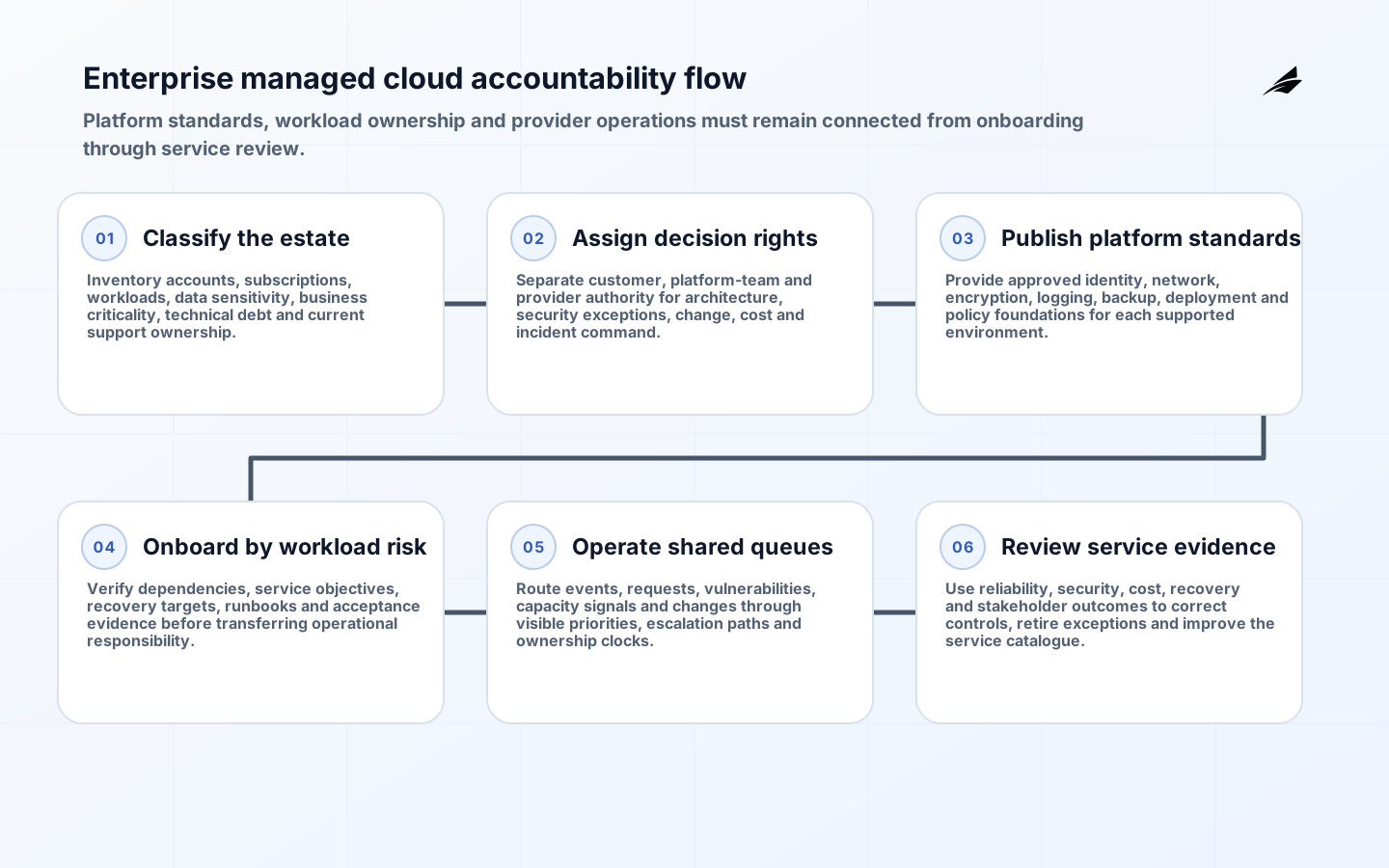
Managed cloud services for enterprise teams transfer defined operational work to a provider, but they do not transfer accountability for the business service. The useful question is not whether a provider “manages the cloud.” It is which resources, events, decisions and service outcomes the provider owns; which remain with workload teams; and how both sides prove that their work is complete. A precise operating model covers identity, network, platform, application, data, deployment, monitoring, recovery, security response and cost. A vague bundle of monitoring and tickets usually leaves the most consequential seams unowned.
This FAQ helps enterprise buyers and platform leaders turn a managed-cloud proposal into an operable service. It complements the managed cloud scope and delivery plan and the managed cloud implementation checklist. NIST’s definition distinguishes infrastructure, platform and software service models because customer control changes across them. A managed-services contract sits on top of that technical allocation; it must state the operational allocation rather than assuming the cloud service model answers every responsibility question.
What should a managed cloud service actually include?
Begin with a service catalog whose entries describe an outcome, eligible resources, request path, hours, target, dependencies and exclusions. “Backup management” is incomplete unless it identifies protected data, schedule, retention, encryption, failed-job handling, restore testing and who authorizes recovery. “Security monitoring” must identify telemetry sources, detection ownership, triage authority, escalation clocks and containment permissions. The catalog should distinguish standard work, chargeable changes, projects and customer-retained tasks. This prevents normal lifecycle work from becoming a contract dispute after production begins.
Map every catalog item to the business services it supports. A provider may manage a Kubernetes platform while a product team owns application health, data correctness and customer communication. Central security may own policy while the provider operates controls. Finance may approve commitments while engineering controls consumption. Record these intersections in a responsibility matrix with one accountable owner and named deputies. Include decisions, not just activities: who can isolate an account, approve a major change, declare disaster, accept residual risk or exceed an agreed cost threshold.
How should shared responsibility be documented?

Use a layered model that starts with the underlying cloud provider and continues through tenant configuration, shared platform, workload, data and business process. For each layer, name the party that designs, implements, verifies, monitors and responds. These verbs often belong to different parties. A managed provider might implement an identity policy, an enterprise security team might approve it, and an internal audit function might test evidence. Make responsibility conditional where necessary: a workload team can own patching for virtual machines while the managed provider owns it for a managed database.
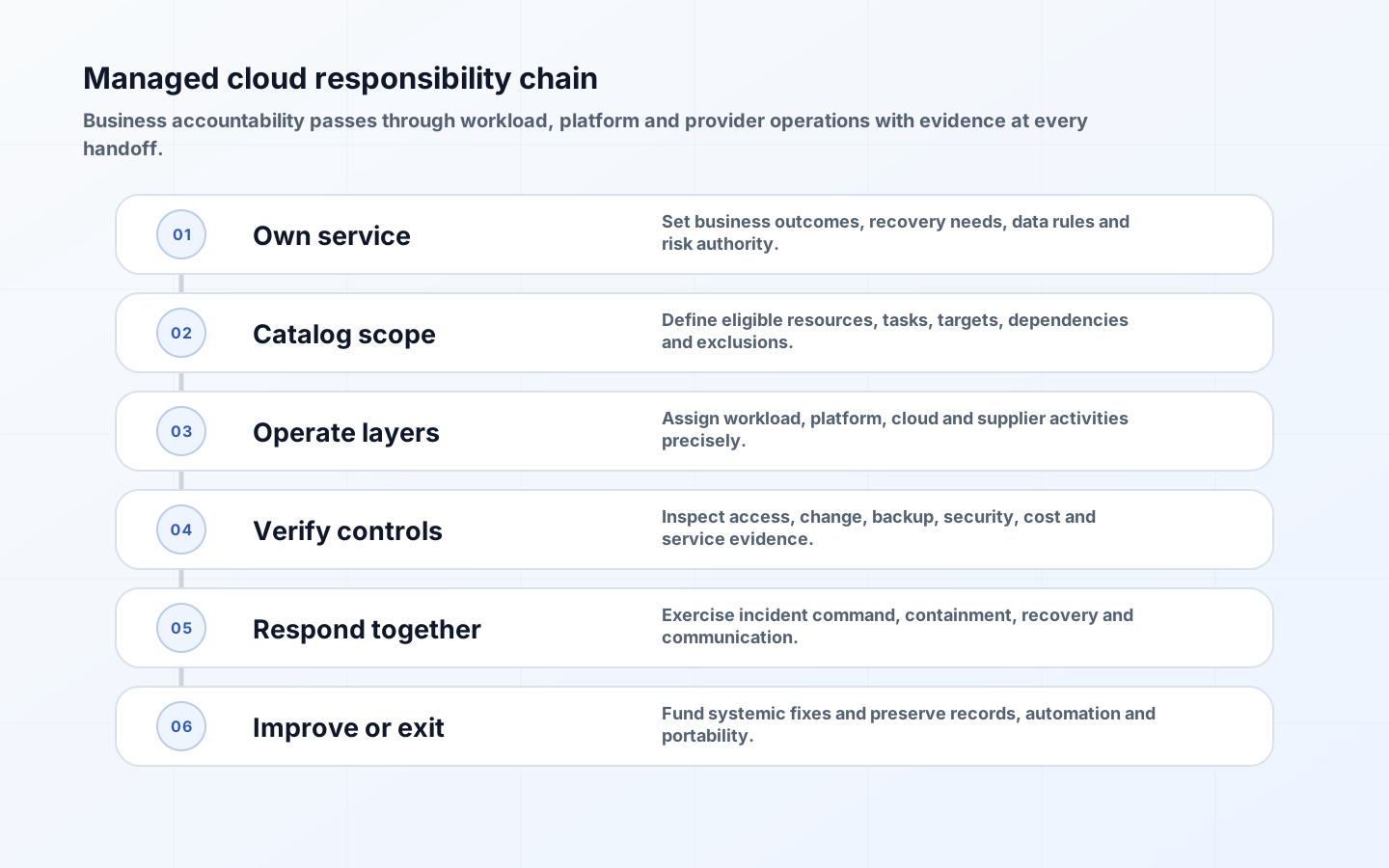
Treat interfaces between parties as first-class controls. Define how asset inventory is synchronized, how urgent vulnerabilities enter work queues, how application releases announce dependency changes and how incidents cross organizational boundaries. Require stable identifiers for accounts, subscriptions, resources, services and owners so reports reconcile. A RACI chart alone is insufficient because it does not describe data, tools, timing or acceptance. Pair it with runbooks and executable examples for recurring events such as a failed backup, expiring certificate, privileged-access request and sudden traffic surge.
| Service area | Provider evidence | Enterprise decision |
|---|---|---|
| Identity | Privileged-access logs and review results | Approve role policy and emergency authority |
| Recovery | Successful restore and recovery-time evidence | Set business recovery objectives |
| Security response | Detection, triage and containment record | Accept risk and direct external notification |
| Cost | Allocated spend, forecast and anomaly record | Approve budgets and commitments |
Which service levels matter beyond uptime?
Contractual availability can be useful, but it rarely describes whether users received a dependable business service. Define service-level objectives for signals the operating parties can control: incident acknowledgement, restoration, backup success, tested recovery, patch completion, change success, alert delivery and request fulfilment. Specify measurement source, exclusions, maintenance treatment and reporting window. A monthly average can hide a severe regional outage or repeated short disruptions. Pair aggregate targets with maximum event duration and critical-business-period protections where consequences justify them.
Connect every target to an error budget or decision rule. If change failures consume reliability tolerance, reduce risky releases and address systemic causes. If a target is repeatedly missed, require a corrective plan rather than accepting service credits as the remedy. Review leading indicators such as queue age, certificate expiry, capacity headroom and unresolved high-risk findings alongside lagging outage totals. Service credits may allocate commercial consequence, but they do not restore lost customer trust, regulatory deadlines or corrupted data; operational governance must focus on prevention and recovery evidence.
Who owns security and compliance in a managed model?
The enterprise retains responsibility for classifying data, determining lawful use, approving risk and setting access policy. The managed provider can operate controls such as configuration baselines, vulnerability workflows, logging, key rotation and privileged access, but authority and evidence must be explicit. Require least-privilege roles, time-bound administrative access, strong authentication, separation of duties and customer visibility into material actions. Provider staff access should be attributable to an individual and linked to an approved purpose, not hidden behind an undifferentiated support identity.
Define the assurance package before onboarding: architecture and data-flow records, configuration evidence, access reviews, vulnerability status, penetration-test boundaries, incident records, subcontractor dependencies and relevant attestations. Certifications are useful inputs, not proof that the enterprise’s own workloads are configured safely. Establish notification thresholds for suspected compromise, data exposure and control failure, with preservation requirements and coordinated communication. Confirm who may contain an event when customer approval is unavailable, because a contract that requires permission for every urgent action can make rapid containment impossible.
How are cost and capacity governed?
Managed services should make cloud economics observable without promising simplistic savings. Require allocation tags or account structure, billing-data access, shared-cost rules, anomaly detection, forecast cadence and named budget owners. Separate provider fees, cloud consumption, marketplace licenses, network transfer, support tiers and one-time transition work. Baseline unit measures such as cost per active tenant, transaction or environment where the business model supports them. Absolute spend can rise while unit economics improve, so decisions need both consumption and outcome context.
Give the provider bounded optimization authority. Safe actions might include scheduling nonproduction resources or recommending reservations; risky actions include downsizing production, changing storage retention or purchasing long commitments. State approval thresholds, rollback expectations and benefit attribution. Track realized savings after performance, resilience and labor effects rather than reporting theoretical recommendations. Capacity management should combine provider quotas, workload forecasts, scaling tests and seasonal business events. A cost-efficient service that cannot absorb a known renewal or claims peak is not well managed.
| Transition gate | Proof | Stop condition |
|---|---|---|
| Inventory | Reconciled resources, dependencies and owners | Unknown critical assets |
| Access | Tested least-privilege and emergency paths | Shared or missing identities |
| Operations | Representative alerts and requests completed | Runbooks or tools unavailable |
| Exit | Export and access-return procedure exercised | Customer cannot recover authoritative records |
What makes transition and exit safe?
Transition begins with a verified inventory of resources, owners, dependencies, data classifications, operational tools, open risks and existing commitments. Shadow operations should exercise real alerts and requests before authority moves. Test access provisioning, escalation, deployment coordination, backup restoration and incident command. Use entry criteria for each service rather than one ceremonial handover date. Knowledge transfer is demonstrated when the receiving team resolves representative scenarios with current runbooks and access, not when documents have merely been delivered.
Design exit at contract start. Specify export formats for configuration, infrastructure definitions, logs, asset history, tickets, cost records and runbooks; identify customer-owned accounts and repositories; and set access-return and deletion evidence. Require reasonable transition support and rules for subcontractor changes. Periodically rehearse a partial exit or provider substitution for a bounded service. Portability has limits, especially for provider-native platforms, but operational dependency can still be reduced by retaining authoritative records, automation source, decision history and internal capability.
How should performance be governed after go-live?
Run governance at three cadences. Operational reviews examine incidents, changes, vulnerabilities, requests, cost anomalies and near-term risks. Service reviews examine objectives, recurring failure, capacity, roadmap and improvement work. Executive reviews address business outcomes, material risk, commercial changes and strategic dependency. Use one evidence set across these levels so summaries reconcile with underlying events. Meetings should produce owned decisions and dates, not parallel status presentations. Persistent exceptions belong in a risk register with consequence, compensating control and expiry.
Measure improvement in the work system: lower detection delay, faster safe restoration, fewer repeated incidents, higher automated-policy coverage, better restore evidence and shorter platform onboarding. Avoid rewarding ticket volume or raw alert closure, which can encourage noise. Sample closed work for quality and confirm customer outcomes. The provider and enterprise should share a backlog for reliability, security, developer experience and cost. Reserve capacity for it; otherwise urgent operations crowd out the changes that reduce future operational load.
Key takeaways
- Define managed work as measurable service outcomes, not broad activity labels.
- Document design, implementation, verification, monitoring and response ownership separately.
- Use reliability, recovery, security and cost evidence together.
- Prove transition through exercises and make exit artifacts contractual.
- Govern recurring improvement with an owned, funded backlog.
Frequently asked questions
Does a managed provider replace an internal cloud team?
Usually not. The enterprise still needs service ownership, architecture, security authority, financial accountability and supplier governance. Internal teams may become smaller or shift toward product and platform decisions, but outsourcing every informed decision creates dependency and weakens assurance.
Should the provider receive production administrator access?
Only where a cataloged service requires it. Use individual, time-bound, approved and logged access with narrow roles. Emergency access needs a documented trigger, strong authentication, retrospective review and prompt revocation. Routine work should use automation identities with constrained permissions.
How often should disaster recovery be tested?
Set frequency by business consequence and material change, not a universal calendar rule. Exercise component restores frequently and full service recovery periodically. Re-test after architecture, data, identity or provider changes, and preserve measured recovery time, data loss and reconciliation results.
Conclusion
Managed cloud services for enterprise teams succeed when responsibility becomes observable. A buyer should be able to trace a business service through technical layers, identify who can decide and act, inspect evidence of control operation and understand the cost of the arrangement. If the answer depends on a sales label or an informal relationship with a few individuals, the service is not yet enterprise-ready.
The practical acceptance test is simple: select a failure, a security event, a cost anomaly and an exit request. Ask both parties to execute their part using current access, tools, data and authority. Close the remaining gaps before scaling the estate. This turns a managed-cloud contract from a promise of reduced burden into a tested operating system.