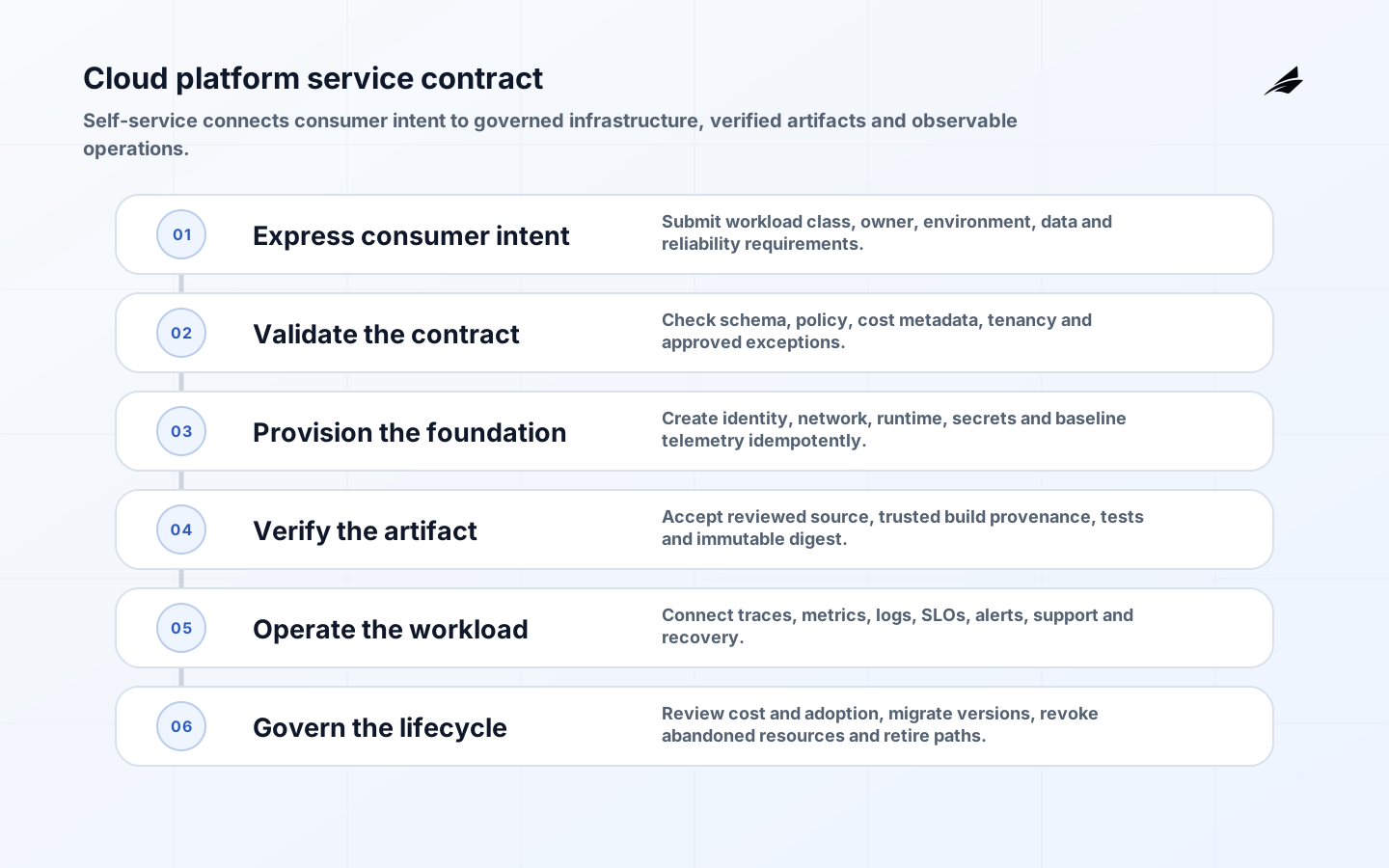
A cloud platform service design implementation checklist should treat the platform as a product used by delivery teams to provision, deploy and operate software through supported contracts. It is not simply a cloud account, Kubernetes cluster or portal. Good platform design reduces repeated decisions while keeping security, cost and ownership visible. Poor design hides provider complexity behind another layer of tickets and gives application teams templates they cannot safely change or recover.
This implementation checklist turns platform intent into an operable service. Use the platform service scope and cost guide and platform service FAQ for planning. Teams building an AWS-specific variant can compare the AWS platform implementation checklist while retaining vendor-neutral product and control principles.
Define platform users, outcomes and non-goals
Interview application engineers, operators, security teams and finance. Identify repeated work and delay: environment requests, identity, network connectivity, secrets, deployment, telemetry or compliance evidence. Choose measurable outcomes such as lead time to a compliant environment, percentage of services with tested rollback, developer success rate and reduction in high-risk configuration variance. Do not define success by number of templates published.
Name platform product and engineering owners. State which workload classes, regions and assurance levels are supported and what remains with application teams. A paved road should be optional when a workload has a justified need, with an exception process and operating owner. Document non-goals such as owning application code, providing every data service or absorbing all on-call responsibility.
Design the service contract and responsibility boundary
Describe platform capabilities as contracts: create an environment, deploy an artifact, request a database, expose a service, retrieve telemetry or rotate a secret. Define inputs, defaults, policy checks, outputs, service levels, cost signals and lifecycle. The NIST Cloud Computing Reference Architecture remains useful for clarifying consumer, provider, broker, auditor and carrier responsibilities even though implementation technology has evolved.
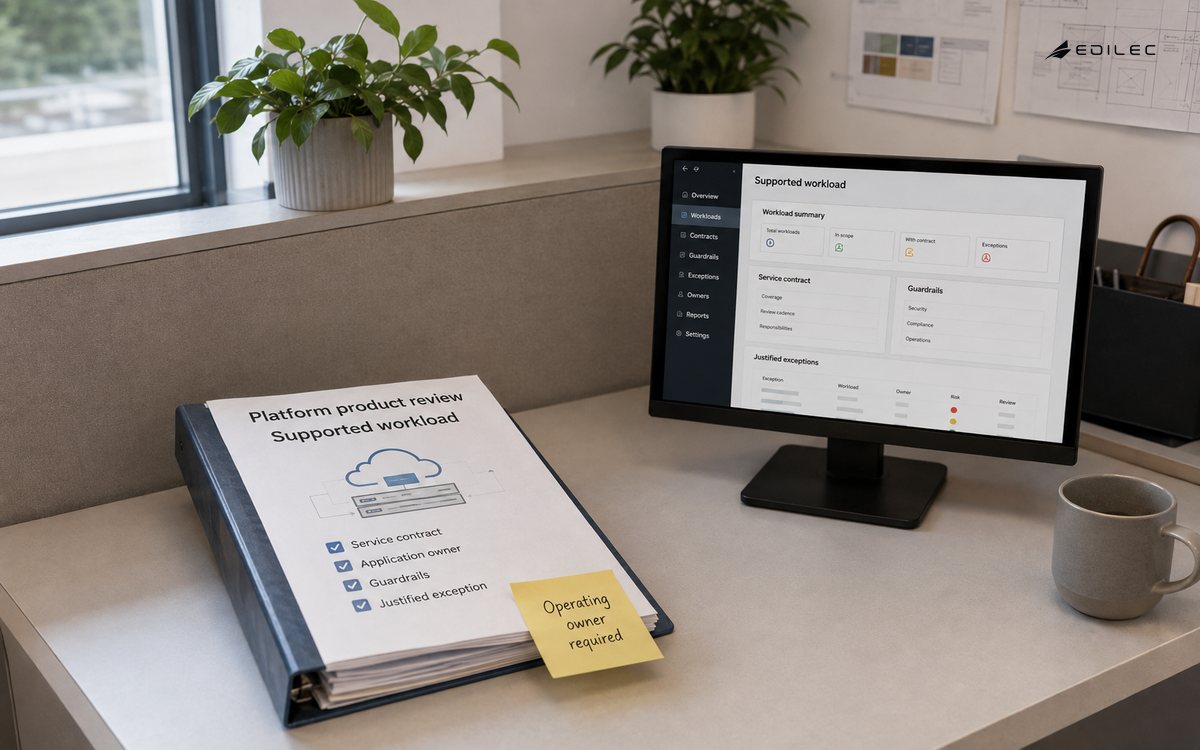
Publish a responsibility matrix. The platform may own account vending, baseline policy, identity integration, build primitives and telemetry transport; the application team may own code, data use, service objectives and incident response. Shared items such as vulnerability remediation and recovery need explicit coordination. Every capability should have support, change and deprecation terms.
| Capability | Platform owns | Application team owns | Contract evidence |
|---|---|---|---|
| Environment | Account, network and baseline policy | Workload classification and approved use | Provisioning record and policy result. |
| Deployment | Pipeline primitive and artifact verification | Code, tests and release decision | Provenance, approvals and deployed digest. |
| Runtime | Cluster or compute service and guardrails | Resource needs and failure behavior | Configuration, limits and ownership labels. |
| Observability | Signal collection and routing | Instrumentation, SLOs and actionable alerts | Trace coverage, dashboards and runbooks. |
| Recovery | Backup service and platform restoration | Data consistency and application recovery | Restore test and recovery objective result. |
Build self-service on APIs and lifecycle state
Create an API or declarative contract before a polished portal. Requests need stable schemas, validation, idempotency, status and error explanations. Long-running provisioning should expose progress and recovery. Keep desired state in version control or another auditable source, and reconcile drift. A portal can improve discovery and usability, but it should call the same governed interfaces used by automation.
Model create, update, suspend, transfer and delete. Require ownership and cost metadata at creation. Define what happens when an owner leaves, a service is abandoned or a policy changes. Destructive actions need dependency checks and retention handling. Test concurrency and partial failure so a timed-out request does not leave chargeable or exposed resources outside inventory.
Choose tenancy and isolation according to threat
Identify tenants as teams, environments or customers and assess how much they trust one another. Shared clusters and services can reduce cost but increase noisy-neighbor and policy risk. The official Kubernetes multi-tenancy guidance explains namespace, control-plane and data-plane considerations. Namespace separation alone is not a universal security boundary.
Use organization and account boundaries, network policy, workload identity, resource quotas, admission controls, node isolation and dedicated infrastructure where justified. Prevent one tenant from reading another's secrets, telemetry or cost data. Test denial-of-service and policy misconfiguration. Document the isolation claim in plain language so consumers understand both protection and residual risk.
Protect the platform software supply chain
Treat platform modules, images, operators and pipeline components as production software. Apply the NIST SSDF: protect source and build systems, review changes, manage dependencies, produce supported releases and respond to vulnerabilities. Pin and verify inputs. Generate artifact provenance and promote immutable artifacts rather than rebuilding in each environment.
Use the SLSA specification as a framework for supply-chain integrity where appropriate. Separate platform administration from application deployment. Require review for policy and identity changes. Maintain a component inventory, update cadence and emergency process. Test rollback of controllers, infrastructure modules and policies, not only application workloads.
| Release gate | Question | Evidence |
|---|---|---|
| Source | Was the change reviewed in the expected repository? | Commit identity, review and protected branch result. |
| Build | Did an approved builder produce the artifact? | Build identity, inputs and provenance. |
| Policy | Does configuration meet platform guardrails? | Versioned policy result and justified exception. |
| Deployment | Is the expected immutable artifact running? | Artifact digest and environment record. |
| Recovery | Can the change be reversed without hidden state? | Rollback or forward-recovery exercise. |
Make platform and workload behavior observable
Instrument control-plane requests, provisioning workflows, deployments and runtime paths. OpenTelemetry provides vendor-neutral concepts for traces, metrics and logs. Propagate correlation from a self-service request to cloud API and resulting resource. Protect telemetry as potentially sensitive data, and define retention and tenant access.
Set platform SLOs for high-value journeys such as environment creation, deployment and secret rotation. Measure success rate and latency distributions, not only component uptime. Alerts should identify affected consumers and route to a named owner. Application teams still need service-level objectives for their workloads; the platform should make good instrumentation and alerting easier without owning every symptom.
Pilot with real workloads and measure adoption quality
Choose pilot teams with representative but recoverable workloads. Pair with them through first deployment, incident and change. Observe where documentation, contracts or defaults fail. Keep a manual escalation path but record every intervention as product evidence. Do not onboard many teams until the platform group can support the current cohort and recover failed provisioning.
Measure successful self-service completion, time to first deploy, support demand, policy exceptions, abandoned resources, cost allocation and reliability outcomes. Adoption is meaningful when teams choose the platform because it helps them deliver, not because access to alternatives was removed. Publish a roadmap and deprecation notices, and gather structured feedback from both users and operators.
Operate capabilities through change and retirement
Maintain on-call ownership, incident severity, dependency maps and runbooks. Test account recovery, credential rotation, backup restoration, region failure and loss of a critical controller. Use the NIST CSF 2.0 to connect platform governance with protection, detection, response and recovery. Review platform incidents with application teams when responsibility crosses boundaries.
Version service contracts and give consumers migration windows. Track adoption of new module and runtime versions. Remove old paths only after dependencies are known and recovery is planned. A platform accumulates operational risk when every historical option remains supported. Product ownership includes saying no, consolidating choices and retiring capabilities safely.
Prove one golden path with a real service
Use a representative API service to test the complete platform contract. The team declares owner, data class, environment, expected traffic and recovery objective. The platform creates an isolated account or namespace, workload identity, network policy, secret references, deployment pipeline, telemetry route, budget tags and baseline alerts. The application team supplies reviewed code, tests, resource requirements and service objectives. Deploy the same verified artifact through test and production, inject a dependency failure, confirm that traces reach the correct tenant view, and exercise rollback. Then delete a temporary environment and verify that retained data and shared dependencies follow policy.
Record every manual step and ambiguous error encountered during the exercise. A platform engineer opening a privileged console to repair each request is evidence that the contract is incomplete, even if the final demo succeeds. Convert repeated intervention into validation, reconciliation or documented support. Have a second application team use the path from published documentation without coaching, and compare completion time and failure points. The golden path is ready for wider adoption only when it works under normal and degraded conditions, produces cost and ownership evidence, and can be upgraded without requiring consumers to understand hidden implementation details.
Key takeaways
- Design the cloud platform as an internal product with measurable consumer outcomes.
- Express capabilities through governed APIs and explicit responsibility contracts.
- Choose tenancy boundaries from threat and operating needs, not cost alone.
- Protect platform artifacts, policies and delivery infrastructure as a software supply chain.
- Measure self-service success, reliability and lifecycle health rather than template count.
Frequently asked questions
Does an internal developer portal equal a platform?
No. A portal is one interface for discovering and invoking capabilities. The platform includes APIs, automation, policy, runtime services, telemetry, support and lifecycle ownership. Build reliable contracts first; otherwise the portal becomes a friendly front end for ticket queues and inconsistent scripts.
How much should a platform standardize?
Standardize repeated, high-value decisions where a supported default reduces risk and effort. Preserve an exception route for workloads with justified constraints. Too little standardization leaves teams rebuilding foundations; too much pushes them into unsafe workarounds. Use adoption, exceptions and incidents to tune the boundary.
Conclusion
A cloud platform service succeeds when teams can obtain a secure, observable and recoverable path to production without learning every provider detail. Define consumers and contracts, build self-service on reliable APIs, protect isolation and the supply chain, and own each capability through retirement. That is platform engineering as an operating product, not a collection of infrastructure templates.