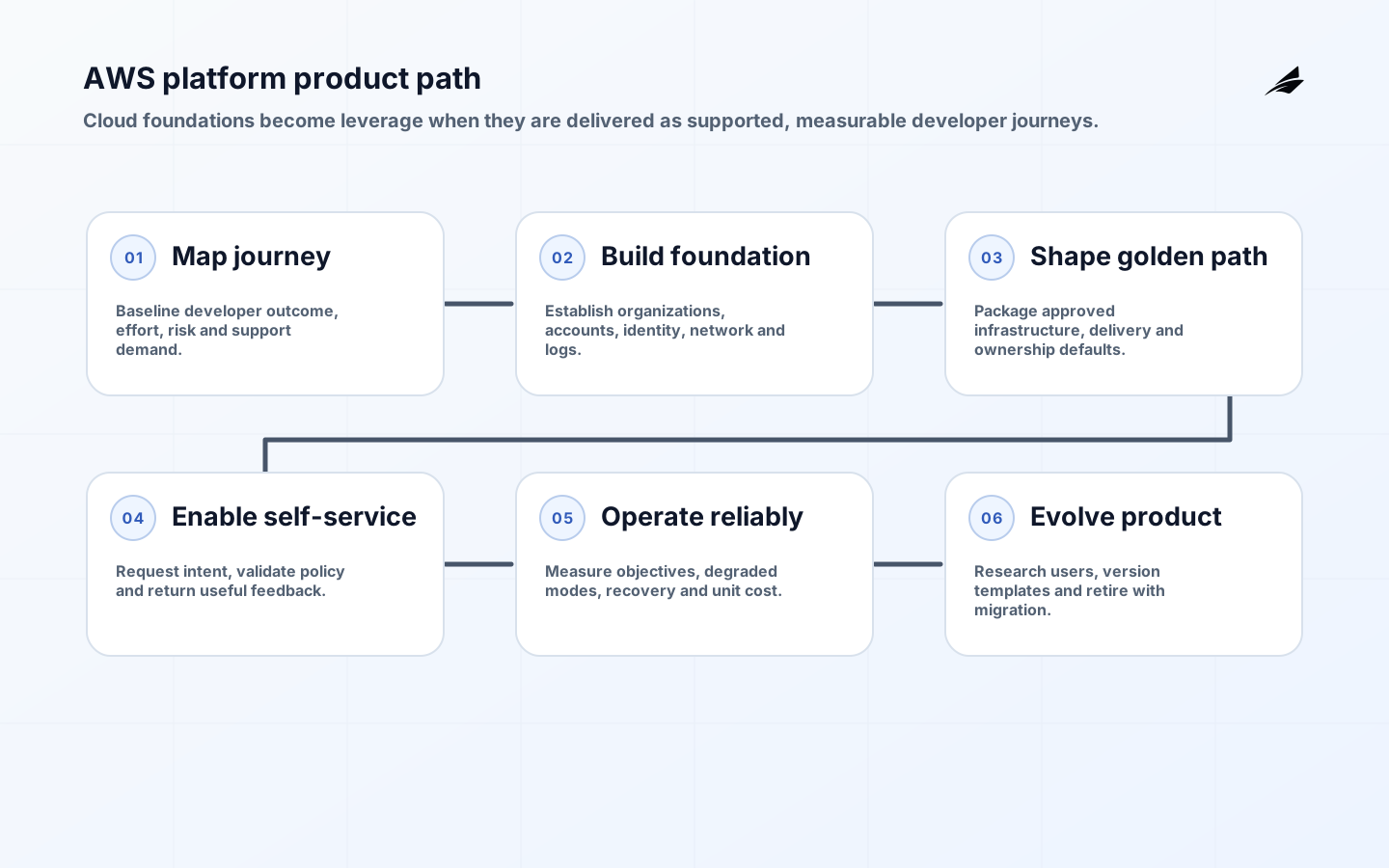
An AWS platform service is an internally operated product that gives application teams secure, supported ways to obtain accounts, environments, deployment paths, runtime capabilities, data services and operational evidence on Amazon Web Services. It is broader than a landing zone and narrower than an attempt to abstract every AWS feature. This AWS platform service FAQ explains architecture, product, security, reliability, cost and adoption decisions.
Use the AWS platform scope and cost plan before funding and the AWS platform implementation checklist during build. The admin console design checklist is useful when self-service includes consequential approvals. The answers below treat developers and operators as platform customers whose outcomes must be measured.
What should an AWS platform service provide?
Start with developer journeys: create a workload boundary, deploy a service, obtain data access, expose an endpoint, observe behavior, respond to an incident and retire resources. Baseline lead time, handoffs, errors, cognitive load, policy exceptions and operating cost. Select a small set of golden paths that cover frequent needs and encode approved defaults. Preserve an exception route for legitimate requirements. A platform that blocks every variation will be bypassed; one that permits every variation does not reduce risk or effort.
AWS platform engineering guidance describes a compliant multi-account environment, reusable cloud products, federation, centralized logging, guardrails and financial management. Use it as provider guidance and verify choices against enterprise obligations. Publish a service catalog with intended use, support, service objective, cost unit, data classification, lifecycle and owner. Do not expose raw cloud complexity merely through a portal and call it self-service.
Is a landing zone the same as the platform?
No. A landing zone establishes foundational account, identity, network, logging and governance patterns. The platform adds consumable products, delivery workflows, observability, support, documentation and lifecycle management. AWS Control Tower provides an AWS-managed way to set up and govern a multi-account environment; the official Control Tower overview should be checked for current region and feature behavior. Teams can also assemble foundations directly, but then own more integration and lifecycle work.
Design organization units and accounts around isolation, ownership, policy and quotas, not the reporting chart alone. Separate production from nonproduction and protect security, log archive and shared-network functions. AWS Organizations best practices recommend a single organization in many cases, validating email addresses, using supported root controls and testing policy effects. Service control policies set maximum permissions; they do not grant access and should be tested progressively.
| Platform layer | Product provided | Acceptance evidence |
|---|---|---|
| Organization | Account vending and lifecycle | Created, moved, suspended and closed account |
| Identity | Federated roles and temporary access | Join, privilege and revoke tests |
| Network | Approved ingress, egress, DNS and connectivity | Reachability and failure scenarios |
| Delivery | Reviewed templates, pipelines and artifacts | Progressive deploy and rollback |
| Operations | Logs, metrics, traces, backup and incident hooks | Detection and restore exercise |
| Finance | Ownership, tags, budgets and usage records | Cost allocated to service and team |
How should developer self-service work?
Offer an API, command line or portal that requests intent with the fewest necessary parameters. Behind it, provision versioned infrastructure, identity, policy, observability, backup and ownership records. The AWS guide to building an internal developer platform describes self-service, reduced cognitive load and reusable golden paths as central goals. Treat that document as an architecture input; interview local teams and measure actual friction before selecting capabilities.
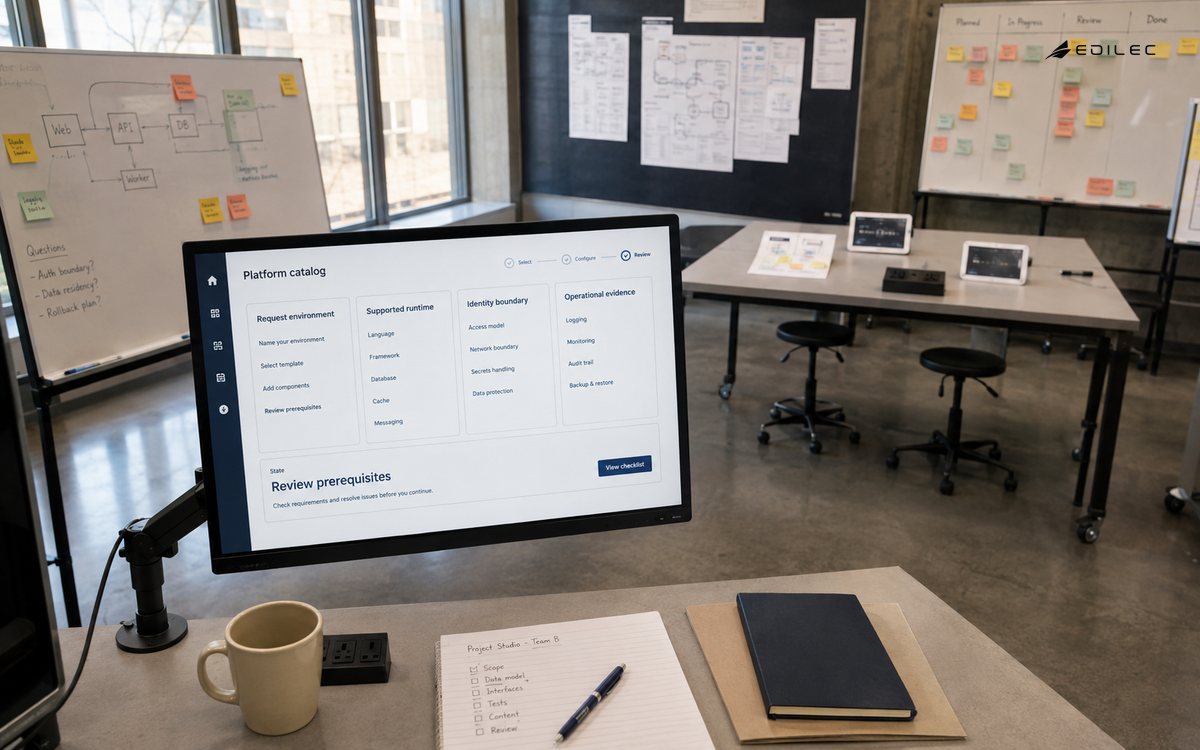
Make feedback immediate and actionable. A failed request should identify the violated rule, affected field, approved alternative and escalation route without exposing sensitive policy internals. Use asynchronous workflows for long-running provisioning with stable status and idempotent retry. Prevent duplicate or orphaned accounts after timeouts. Test names, quotas, partial failures, canceled requests and provider throttling. Every resource should inherit an owner, environment, data class and lifecycle marker from the request or be rejected.
Who is responsible for AWS platform security?
AWS operates security of the cloud, while customer responsibilities vary by service; the current AWS Shared Responsibility Model explains that boundary. Inside the customer, the platform and workload teams need another explicit matrix. The platform may own account baseline, federation and central logs while a workload team owns application authorization, data use and dependency patching. Managed partners introduce additional divisions. Exercise the matrix through a vulnerability and incident rather than relying on a document.
Use federation and temporary credentials; minimize root use; protect break-glass access; segment high-consequence services; centralize protected audit evidence; manage secrets and keys; and make infrastructure changes through reviewed paths. Guardrails should be preventative where a condition is always unacceptable and detective where context matters. Route findings to the resource owner with severity and remediation. Test how controls behave during an AWS service issue. A central dependency can become a platform-wide failure if every deployment, resolution or authorization requires it.
How is platform reliability designed?
Define service objectives for journeys the platform controls: account fulfillment, deployment, artifact retrieval, identity access, observability and support. Map dependencies and quotas. Use regional and multi-account patterns only when the business objective justifies their complexity. The AWS Well-Architected Framework organizes reviews around operational excellence, security, reliability, performance efficiency, cost optimization and sustainability. Apply its questions per workload and platform service, documenting tradeoffs rather than treating review completion as certification.
Design degraded modes. Existing workloads may need to deploy a known rollback when account vending is unavailable; local telemetry may need buffering when central aggregation fails; emergency access may need an independent path. Back up platform state, source, artifacts, configuration and documentation and test reconstruction in a clean account. Rehearse compromised pipeline, unavailable region, exhausted quota, accidental organization policy and lost federation. Measure user-visible recovery and reconcile configuration afterward.
How should platform cost be governed?
Track shared foundation, team, software, support and cloud consumption separately. Allocate shared cost using a transparent rule and expose direct workload use through accounts, tags, cost categories or billing records. Provide budgets and anomaly routes, but avoid automated shutdown of production without an approved policy. Golden paths should include efficient defaults for logging tiers, storage lifecycle, compute scaling and nonproduction schedules. Review unit cost alongside reliability and developer outcome; the cheapest path may create expensive support or risk.
Model control-plane API, network transfer, NAT, observability, security, backup and support-plan charges, not compute alone. Price showback and chargeback behaviors with finance and product owners. Detect abandoned accounts, snapshots, addresses, load balancers and test environments. A platform team should improve architecture and demand behavior, not merely distribute invoices. Record commitments and discounts at the correct ownership level and avoid locking volatile workloads into consumption assumptions they cannot meet.
| Platform measure | What it reveals | Metric trap |
|---|---|---|
| Time to first safe deployment | End-to-end onboarding outcome | Account creation time alone |
| Golden-path adoption | Voluntary fit for common demand | Mandated use without satisfaction |
| Exception age | Where standards or products lag need | Number of denied requests |
| Change success and recovery | Platform delivery stability | Deployment count alone |
| Developer effort | Cognitive and queue burden | Portal page views |
| Unit cost | Complete cost per supported outcome | AWS bill without people or tools |
How should the AWS platform be launched and evolved?
Pilot with two or three teams representing different but supportable workloads. Pair with them through account, deployment, operation and incident. Baseline and compare lead time, developer effort, control evidence, reliability and cost. Keep the path optional during discovery so adoption exposes true fit. Accept only after a team can operate without privileged platform intervention. Publish limitations and known exceptions. Use office hours and embedded support to learn, not as a permanent substitute for usable products.
Run the platform as a product with a manager, roadmap, support model, deprecation policy and user research. Prioritize improvements from repeated friction and enterprise risk. Version templates and offer migration assistance; do not silently mutate every workload. Track AWS service changes and test new versions in isolated environments. Retire products with notice, replacement, dependency discovery and evidence that consumers moved. Avoid measuring success by accounts, clusters or templates created; measure how safely teams deliver and operate valuable software.
Example: a serverless API golden path
A platform team can offer a golden path for an externally exposed serverless API. The request captures owner, environment, data class, domain and service objective. The product provisions an account boundary, repository template, pipeline, API endpoint, runtime role, encrypted storage option, logs, traces, alarms, backup policy, cost tags and incident integration. Tests reject public data storage, broad IAM actions, missing ownership and unapproved regions. A sample service deploys progressively and rolls back after a synthetic failure.
Pilot teams should be able to diagnose latency, rotate a secret, restore data and retire the service without platform administrators. Measure time and effort against their former path and record requests the template could not support. Publish when to use the pattern, quotas, cost behavior, reliability assumptions and an exception route. Version subsequent improvements and migrate consumers deliberately. This makes the golden path a supported product with evidence, not a repository that drifts after its initial launch.
Key takeaways
- Treat the AWS platform as an internal product serving complete developer journeys.
- Use the landing zone as a foundation, not the whole service.
- Encode secure defaults in golden paths and preserve governed exceptions.
- Design for dependency failure, clean recovery and transparent unit economics.
- Scale through voluntary fit, measured team outcomes and versioned products.
Frequently asked questions
Is AWS Control Tower required?
No. It is one AWS-managed approach to a landing zone. Choose it by evaluating current capabilities, supported regions, customization, migration and operating ownership against alternatives.
Does an AWS platform need Kubernetes?
No. Offer runtime products that fit workload needs and team capacity. Serverless, managed containers, virtual machines and managed data services may all belong. Kubernetes is justified only when its capabilities and operating cost fit the demand.
Conclusion
A useful AWS platform service converts cloud capabilities and enterprise policy into supported paths that developers can trust. Establish a sound multi-account foundation, productize common journeys, assign security boundaries, engineer degraded operation, expose full cost and evolve from user evidence. That creates leverage without hiding accountability or manufacturing a new central queue.