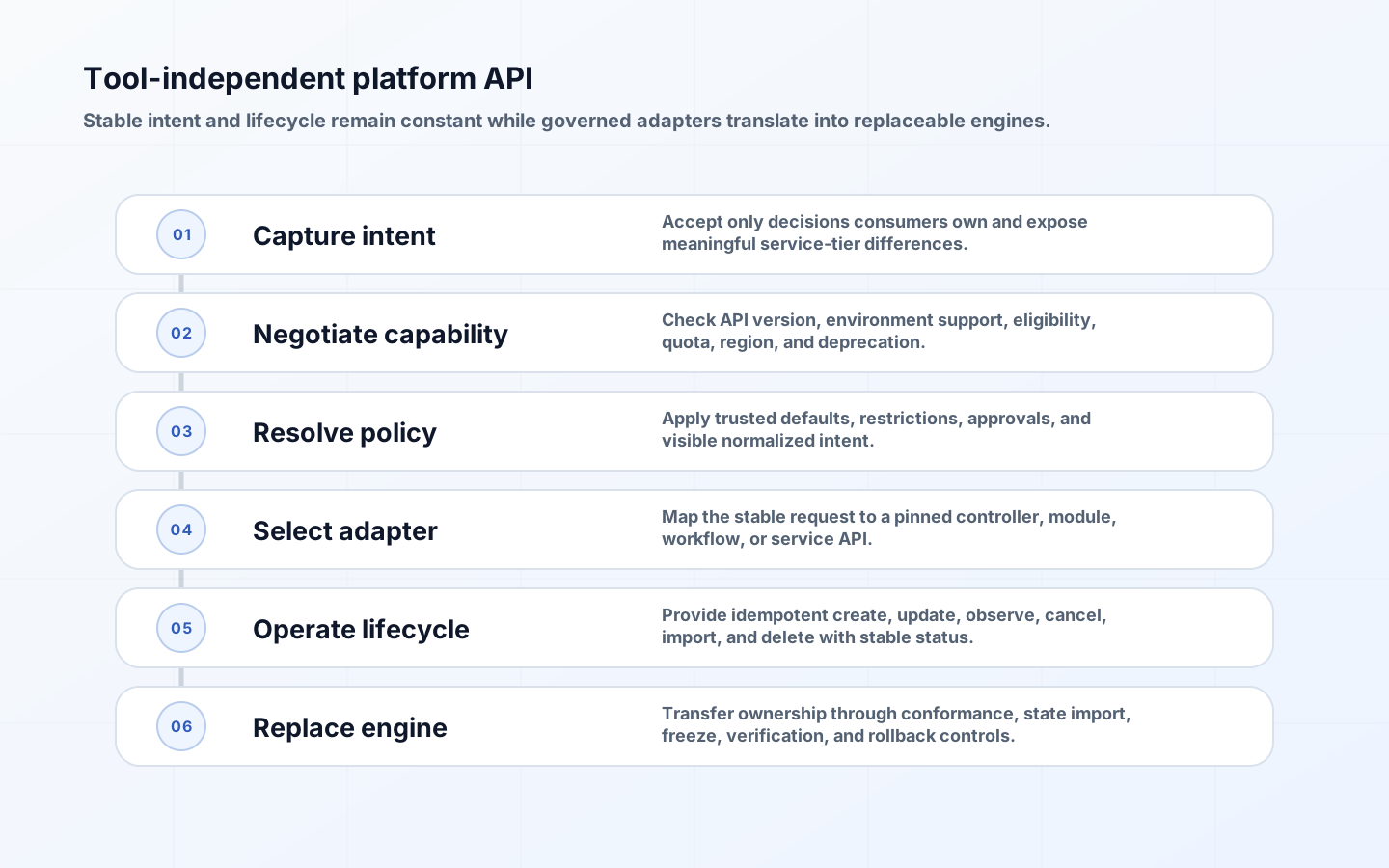
A portal field named terraformModuleVersion is not an abstraction; it is a remote control for Terraform. A request containing Kubernetes annotations, cloud provider classes, and pipeline workspace names will move implementation details into every application repository. Effective platform API design protects a smaller, intent-oriented contract so the platform can replace portals, workflow engines, modules, controllers, and providers without requiring every consumer to relearn infrastructure.
Tool independence does not mean lowest-common-denominator infrastructure or effortless multi-cloud portability. It means consumers depend on semantics the platform owns: a workload, database class, environment, service endpoint, or deployment operation with defined behavior. Adapters map that contract to implementations and report explicit capability gaps. The platform remains accountable for migration when a tool changes; it simply avoids making that migration every product team's source-code project.
Start from consumer jobs and lifecycle
Choose a bounded resource or workflow and interview users about decisions they actually make. For a relational data service, consumers may choose data class, availability tier, region policy, capacity range, backup objective, connectivity, and owner. They should not choose provider subnet IDs, parameter-group names, module internals, or reconciliation policies unless those are genuinely part of the product. Define create, observe, update, scale, rotate, restore, import, and retire behavior before choosing transport or schema.
State responsibilities beside each field. Consumer-owned intent can be changed through the API. Platform-selected defaults are visible and explainable. Derived implementation values are read-only. Policy facts come from authoritative systems. Backend diagnostics are linked but not promoted to stable contract. This prevents an apparently simple API from becoming a bag of overrides where no one knows whether the user, adapter, or provider owns the final value.
| Contract element | Stable example | Leaky example | Owner |
|---|---|---|---|
| Capability | relational-db with documented tiers | Cloud product and SKU field | Platform product |
| Identity | Stable request and resource ID | Pipeline run or workspace ID | Platform API |
| Configuration | Recovery objective and capacity range | Raw module variables | Consumer within policy |
| Status | Accepted, progressing, ready, degraded | Provider status copied verbatim | Platform API |
| Diagnostics | Reason, remediation, correlation link | Controller stack trace | Adapter and operator |
| Lifecycle | Retain, snapshot, or delete semantics | Tool destroy flag | Platform capability owner |
Model intent without hiding meaningful differences
Score demonstrates a deliberately tight workload boundary: developers declare containers, services, and resource dependencies, while implementations resolve target-platform details. Use the same restraint. Standardize only behavior the platform can promise. If database offerings differ in consistency, failover, residency, or recovery, expose a tier or separate capability. Pretending they are interchangeable creates surprising runtime behavior and makes the adapter an undocumented policy engine.
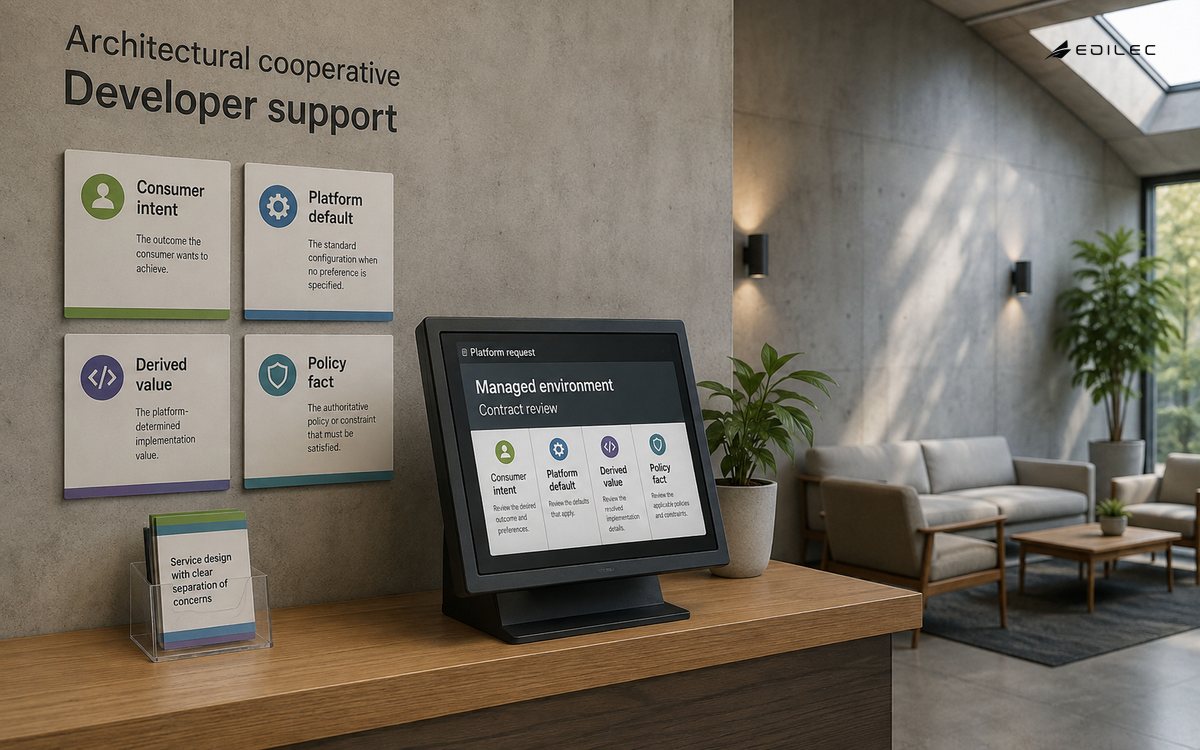
Support extensions through namespaced, governed mechanisms, not arbitrary free-form fields. An extension should have an owner, schema, stability level, compatible implementations, and migration plan. Track demand; repeated use may justify promotion into the core contract. Reject unknown fields to prevent misspellings from being silently ignored. Preserve original intent and the resolved defaults in status so users can see what the platform decided.
Publish capability discovery and negotiation
Environments rarely offer identical features. Publish machine-readable capability names, API versions, tiers, regions, constraints, lifecycle support, and deprecation dates. Let clients validate before submission, then recheck at the trusted server. A request can specify required and preferred capabilities: deny when a requirement cannot be met, but select and report a supported alternative for a preference only when that behavior is explicitly documented.
Capability discovery must not expose sensitive topology or become a promise that capacity is currently available. Distinguish schema support, policy eligibility, quota, and real-time capacity. Return stable reason codes for unsupported API version, unavailable region, policy restriction, quota exhaustion, and temporary provider failure. Those differences determine whether the consumer should change intent, seek approval, wait, or contact operations.
Define asynchronous lifecycle and status semantics
Infrastructure operations are asynchronous and partially fail. Accept a request with an immutable operation ID, make idempotency keys mandatory for creation, and expose observed generation so clients know whether status reflects their latest intent. Use a small condition vocabulary with reason, message, transition time, and diagnostics. Do not report ready merely because a workflow completed; verify the resource's consumer-visible readiness contract.
Define cancellation, retry, update collision, deletion, orphan, and import. Some creates cannot be safely canceled after provider acceptance. Some deletes must retain snapshots or wait for dependent workloads. Use optimistic concurrency or generation checks so two clients do not overwrite intent. Keep an operation journal linking requester, policy decision, adapter version, backend actions, external identities, and final result.
| Operation | Required semantics | Dangerous ambiguity | Test |
|---|---|---|---|
| Create | Idempotent request and stable resource identity | Retry creates duplicate infrastructure | Drop response, retry, inspect one resource |
| Update | Allowed mutable fields and concurrency rule | Replacement hidden as routine edit | Concurrent and destructive update |
| Observe | Freshness, generation, conditions, resolved values | Ready reflects old intent | Change intent during reconciliation |
| Cancel | Which phases can stop and resulting state | UI says canceled while provider continues | Cancel before and after external create |
| Delete | Retention, dependency, protection, completion | Tool destroy implies data disposal | Blocked, retained, and successful deletion |
| Import | Identity proof and ownership adoption | Two controllers manage one object | Conflict and rollback of adoption |
Keep adapters narrow and replaceable
An adapter validates a resolved platform request, translates it to a pinned implementation contract, initiates or reconciles work, and maps backend observations into stable status. It should not contain unreviewed business policy or invent defaults independently. Place organization policy before adapter selection; place provider-specific safety checks inside the adapter where concrete data exists. Version both mappings and preserve which revision handled each operation.
Crossplane can implement an adapter with an XRD and Composition; composition revisions support controlled implementation changes and manual or automatic update policy. A pipeline adapter can select a pinned Terraform or OpenTofu module and workspace. A managed-service adapter can call a vendor API directly. Conformance tests should run the same API scenarios against each implementation and compare contract outcomes, not generated resources byte for byte.
Version compatibility and deprecation explicitly
Identify breaking changes in field syntax, validation, defaults, lifecycle, output meaning, status, and policy. Additive fields can still break clients if they become required in practice or change selection. Support overlapping API versions through conversion or separate adapters, record consumer usage, and publish a migration path and support date. Never make a backend upgrade silently reinterpret stored intent.
Test old requests against new adapters and new requests against every supported environment. Store a canonical representation so conversions are reproducible, but retain the original submitted document for evidence. When a capability retires, discover affected resources, offer compatible targets, run migration prechecks, and require explicit confirmation for semantic or destructive changes. API retirement is a consumer program, not a router change.
Rehearse tool replacement before it is urgent
Select a small cohort and implement a second adapter. Export or discover external identities, translate stable intent, import without duplicate ownership, compare status, stop the old engine, and verify updates and deletion through the new path. Reconcile state and audit history. Measure fields that leaked, undocumented defaults, provider differences, and manual work. Those findings reveal whether the API is genuinely owned by the platform.
Keep rollback realistic. Once a new engine changes an external resource, switching control back may require state import and compatibility checks. Avoid concurrent reconcilers. Freeze high-risk updates during cutover, maintain an ownership marker, and verify no pending operations remain. Tool-independent contracts reduce consumer change; they do not remove infrastructure migration risk.
Govern the API as an internal product
- Assign an API product owner and capability owners for every resource type.
- Publish schemas, examples, lifecycle, SLOs, quotas, and deprecation dates.
- Generate client validation where useful, but keep server validation authoritative.
- Measure task success, invalid requests, unsupported capabilities, exceptions, and adapter failures.
- Review extension growth and remove implementation fields that crossed the boundary.
- Run conformance, recovery, version-conversion, and adapter-replacement tests continuously.
Key takeaways
- Model durable consumer intent and meaningful capability differences.
- Define lifecycle and status before choosing portal, protocol, or engine.
- Keep policy, adapter mapping, and backend diagnostics in distinct layers.
- Version defaults and semantics, not only schema syntax.
- Prove replaceability with a second adapter and controlled ownership transfer.
Frequently asked questions
Should a platform API expose every provider option?
No. Expose decisions consumers legitimately own and behavior the platform supports. Provider-specific needs can use governed extensions or a specialized capability. An unrestricted option map destroys validation, portability, and product accountability.
Does an abstraction reduce infrastructure control?
It reallocates control. Consumers retain explicit intent; capability owners control implementation and defaults. Strong status, diagnostics, policy transparency, and escape processes are essential so abstraction does not become opacity.
Can one API support both pipelines and controllers?
Yes, if lifecycle and status are defined independently. Adapters may implement discrete runs or reconciliation, but must satisfy idempotency, operation, readiness, error, and deletion conformance. Differences that affect consumers belong in capabilities, not hidden mappings.
Conclusion
A tool-independent platform API is a long-lived product promise backed by replaceable adapters. Its value comes from clear intent, honest capability differences, deterministic lifecycle, stable status, tested compatibility, and controlled ownership transfer. Build that contract first, and implementation tools can evolve without exporting every migration to the teams the platform exists to serve.