Customer experience infrastructure consulting should connect a real customer journey to the systems, controls and teams that keep it usable. This implementation checklist begins with observable moments such as sign-in, search, quote, checkout, support or account change and then traces the infrastructure needed to complete them. It avoids treating a cloud migration, content-delivery network or observability purchase as the outcome. The outcome is a faster, dependable and recoverable journey whose cost and ownership are understood.
Use the checklist after agreeing the CX infrastructure scope and delivery plan and keep the infrastructure consulting FAQ available for stakeholder decisions. Every item should produce evidence: a measured baseline, architecture record, automated test, dashboard, restore result, ownership entry or accepted risk. A checked box without deployed proof should not move a customer-facing service through its gate.
Confirm the customer journey and service outcome
Select one or two journeys for the first release. Name the user segments, channels, regions, accessibility needs, peak periods and failure consequences. Record current completion rate, latency distribution, abandonment, error categories, support contacts and incident minutes. Include customer perception where it can be measured responsibly, but pair it with behavioral and technical signals. An average page-load number cannot show whether payment confirmation fails for one browser or whether authenticated users encounter a slow downstream dependency.
- Assign a business owner for each journey and a technical owner for the service.
- Define the transaction start, successful end and customer-visible failure states.
- Set service-level indicators from user behavior, including percentile latency and correctness.
- Document critical periods, tolerated degradation and communication expectations.
- Identify a baseline and a dated target that infrastructure work can influence.
Separate demand from solution assumptions. Estimate normal, peak, campaign and failure-mode traffic, including bots, retries, partner calls and background work. Decide which experiences must remain available when personalization, analytics or a third party is impaired. A graceful-degradation rule may preserve catalog and checkout while disabling recommendations. Write that policy with product and operations teams so infrastructure does not invent customer priorities during an incident.
Map dependencies and customer-visible failure paths
Trace representative requests across DNS, edge controls, identity, application services, queues, databases, search, payment, communications and external APIs. Include asynchronous outcomes such as an order accepted online but never fulfilled. For each dependency, record owner, interface, timeout, retry behavior, capacity, data classification, support path and contractual objective. Mark where one failure can amplify through retry storms, queue growth or exhausted connection pools.
The NIST cloud definition distinguishes service and deployment models and emphasizes measured, on-demand resources. Use those distinctions to clarify the responsibility boundary around SaaS, PaaS and IaaS dependencies. A managed database removes hardware administration, for example, but the customer still owns schema behavior, access, backup choices and application recovery. Confirm each boundary with current provider documentation and the contract.
| Journey layer | Implementation evidence | Acceptance test |
|---|---|---|
| Edge and DNS | Ownership, certificates, routing and protection rules | Failover and certificate-renewal rehearsal |
| Identity | Authentication flow, session policy and recovery path | Peak sign-in and account-recovery test |
| Application | Versioned services, dependencies and degradation rules | Representative transaction under dependency loss |
| Data | Authority, consistency, retention, backup and reconciliation | Restore plus business-record comparison |
| Third parties | Timeouts, limits, status route and exit option | Controlled latency and unavailable-provider test |
| Customer support | Status, escalation and transaction trace tools | Agent resolves a seeded failed journey |
Build the minimum governed infrastructure foundation
Establish account or subscription hierarchy, environment separation, network paths, workforce and workload identities, secrets, keys, policy, logging destinations, approved regions, labels and cost ownership before production traffic. Provide infrastructure as code and a reviewed delivery path. Limit manual console changes and make emergency changes discoverable and reversible. Test that a product team can provision a compliant environment without broad standing privilege or a prolonged ticket chain.
Security should follow the transaction and data. The CISA Cloud Security Technical Reference Architecture page highlights shared services, migration and cloud security posture considerations. Threat-model account takeover, credential stuffing, exposed administration, API abuse, supply-chain compromise, data export and denial of service. Apply phishing-resistant authentication where feasible for administrators, narrowly scope machine identities, protect build artifacts and centralize logs needed for detection and investigation.
Engineer reliability from the user's perspective
Define service-level indicators at the point that represents customer success. Infrastructure health is supporting evidence, not the service objective. The Google Cloud reliability guidance recommends defining reliability from user-experience goals, setting realistic targets, designing graceful degradation and testing recovery. Apply those principles provider-neutrally: identify failure domains, eliminate unjustified single points, bound retries, protect capacity and make partial failure visible.
Set an error-budget policy that tells product and platform teams what happens when reliability falls outside tolerance. Test realistic load using arrival patterns, payloads, cache behavior and dependency constraints rather than a single request benchmark. Exercise zone or node loss, slow dependencies, expired credentials, queue backlog and data-store recovery. Measure detection, decision and restoration separately; a fast automated restart is not success if transactions become duplicated or lost.
Automate delivery, observability and rollback
Store application, infrastructure, policy and database changes in version control. Build canonical artifacts, scan dependencies, separate duties where required and promote the same tested artifact through environments. Add contract, accessibility, performance and resilience tests around the selected journeys. Progressive delivery can limit exposure by region, cohort or traffic percentage, but only if telemetry can distinguish the new version and the team has an automatic or rapidly executable rollback.
Observability must answer which customers are affected, where the journey failed, what changed and whether the business record is correct. Correlate front-end signals, traces, logs, metrics, deployment events and support cases without collecting unnecessary personal data. Provide journey dashboards and actionable alerts with owners. Avoid alerting on every noisy infrastructure symptom; page on conditions that require timely human action and route lower-urgency work to a backlog.
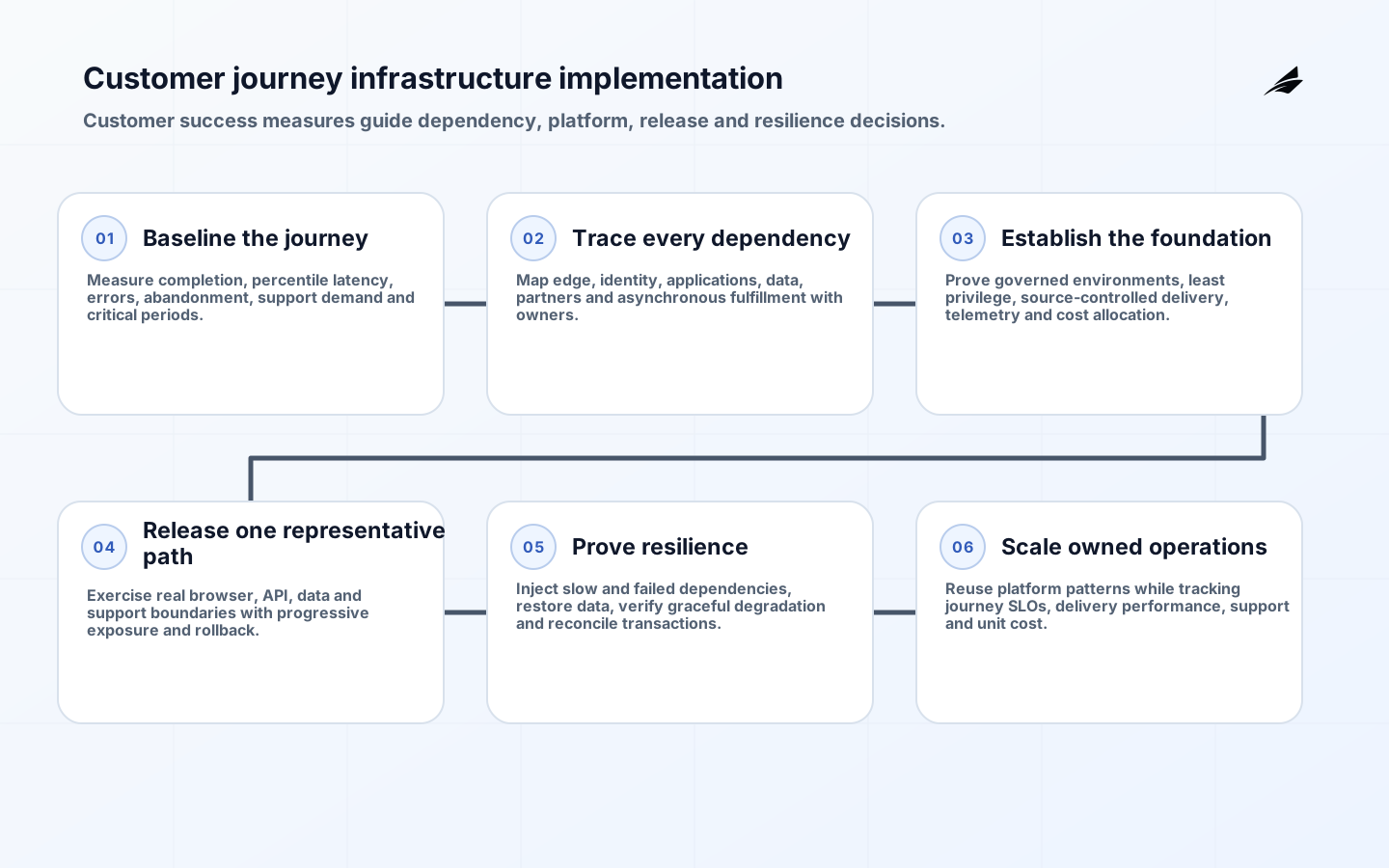
Execute a six-stage CX infrastructure roadmap
Sequence work from journey baseline to transaction map, governed foundation, representative release, resilience proof and scaled operations. The representative release should cross enough identity, application, data and support boundaries to test the operating model without placing the entire customer base at risk. Feed its findings back into templates, policies and runbooks before onboarding additional journeys. The roadmap is evidence-led, so stages may iterate when a test exposes a weak assumption.
Platform work should be measured as a product used by delivery teams. DORA's platform-engineering guidance includes software-delivery performance, developer satisfaction, adoption and task success in a balanced scorecard. For this program, add customer-journey reliability and support load. A platform can standardize a safe path, but service teams remain accountable for the behavior and data of their applications.
Control cost without damaging the customer journey
Allocate costs to products, journeys or environments using consistent labels and billing rules. Model compute duty cycle, autoscaling headroom, content delivery, data transfer, storage, observability, security services, support, licenses and temporary overlap. Measure cost at representative demand and failure conditions. Aggressive scale-down, short log retention or reduced redundancy can appear efficient while increasing latency, investigation time or recovery loss.
The FinOps Framework frames technology value as a shared responsibility across business, finance and engineering. Establish budget and anomaly routes before scale, then review cost per successful transaction alongside reliability and conversion. Buy commitments only after stable demand is understood. Make optimization hypotheses explicit: changing image delivery may reduce bytes and improve latency, while removing a resilient replica may save money but increase a quantified outage exposure.
| Control area | Operational metric | Customer guardrail |
|---|---|---|
| Capacity | Utilization, saturation and scaling delay | Peak journey latency and rejection rate |
| Edge delivery | Cache hit, bytes and origin load | Freshness and accessibility remain correct |
| Observability | Ingest volume and actionable-signal ratio | Required investigation evidence is retained |
| Resilience | Redundancy and recovery cost | Approved RTO, RPO and degradation behavior |
| Third parties | Requests, overages and support fees | Timeout and alternative journey are tested |
| Engineering | Toil and support hours | Teams can restore service without unsafe shortcuts |
Complete production and operational acceptance
Require architecture and data-flow records, threat findings, source-controlled builds, access review, performance results, SLOs, alert ownership, restore and failover evidence, cost allocation, runbooks, supplier contacts, accessibility results and a rollback plan. Confirm privacy and retention decisions for telemetry. Obtain business sign-off on transaction correctness and degradation behavior rather than asking only technical teams to approve production.
Have the support and engineering teams diagnose seeded symptoms, correlate a customer report, deploy a routine change, rotate a secret, restore data and explain the current bill. Record gaps with owners and dates. After launch, review SLOs, abandonment, failed transactions, support contacts, deployment outcomes and cost together. Close old environments and temporary access after reconciliation; otherwise the program leaves duplicate cost and attack surface behind.
CX infrastructure checklist takeaways
- Derive infrastructure requirements from representative customer journeys.
- Map synchronous and asynchronous failure paths across every dependency.
- Measure reliability at customer-success boundaries, not only resource health.
- Automate infrastructure, application and database change evidence.
- Review journey quality, delivery performance and unit cost together.
- Accept production only after internal teams prove diagnosis, recovery and support.
Frequently asked questions
Is CX infrastructure only front-end performance? No. Identity, APIs, data correctness, fulfillment and support all shape the journey. Does moving to cloud automatically improve experience? No; architecture, dependencies, delivery and operations determine the result. Should every journey have the same SLO? No. Set objectives from user and business impact. Is multi-region required? Only when impact analysis justifies its cost and complexity and the application can actually fail over correctly.
What is the best first journey? Choose one that is valuable and representative but has bounded rollout risk. How much observability is enough? Enough to detect, scope, diagnose and learn from material failures while respecting privacy and cost. Who owns third-party outages? The provider owns its platform response; your service owner owns timeout, degradation, customer communication and continuity decisions. When is implementation complete? When agreed outcomes and controls operate in production and legacy obligations are closed.
Conclusion
A useful CX infrastructure program turns customer moments into engineering and operating evidence. Baseline the journey, trace dependencies, establish a governed foundation, release progressively and test failure as deliberately as success. Cost controls and platform standards should preserve the service outcome rather than optimize isolated resources. With explicit ownership and operational acceptance, infrastructure becomes a dependable part of the customer experience instead of an invisible source of surprises.