Customer experience infrastructure consulting connects the reliability of a digital journey to the platforms, networks, data paths and operating practices beneath it. A slow checkout, missing status update or repeated sign-in may look like a front-end defect while its cause sits in an overloaded dependency, stale cache, regional design, deployment process or missing service ownership. The engagement should improve a named customer outcome, not produce a generic cloud assessment.
This plan is for leaders responsible for web, mobile, commerce, support or account experiences whose infrastructure has become a constraint. Use it with the customer experience infrastructure implementation checklist, the infrastructure services delivery plan and the infrastructure services checklist to connect strategic findings with executable work.
Scope the engagement around critical journeys
Select a small number of journeys such as sign-in, search, checkout, file upload or case status. Map each from the user's device through edge, application, data and external dependencies. Include identity, consent, asynchronous work and notification. Define the outcome and current baseline: completion, error, p95 or p99 latency, abandonment, support contacts and affected revenue. Segment by region, client, channel and customer tier where averages hide poor experiences.
Set explicit boundaries for production systems, cloud accounts, vendors, environments and data. Gather architecture and network diagrams, service inventory, objectives, incidents, deployment history, costs, contracts, logs, metrics, traces and customer evidence. State unavailable evidence as a finding rather than inventing precision. Consulting should leave a prioritized decision backlog and verified changes, not only a maturity score.
| Scope area | Evidence | Decision | Deliverable |
|---|---|---|---|
| Journey health | Completion, latency and errors | Which step constrains value? | Journey service map |
| Reliability | Objectives and incident history | Which failures exceed tolerance? | Reliability backlog |
| Delivery | Deployment and recovery records | Where does change add risk? | Release improvement plan |
| Security | Assets, access and threats | Which exposure changes priority? | Risk treatment record |
| Economics | Cost allocation and demand | Which spend supports value? | Scenario cost model |
Diagnose experience across technical boundaries
Instrument the journey with correlation identifiers and measure from the customer edge, not only inside servers. Compare real-user performance with synthetic checks. Trace critical requests across services and providers while avoiding sensitive payloads. Distinguish latency, availability and correctness: a fast request returning stale inventory still fails the journey. Review queue age and notification delay for asynchronous steps. Validate monitoring gaps by reproducing one known failure.
Analyze demand and dependency behavior by time and tenant. Look for connection exhaustion, retry storms, unbounded queues, cache stampedes, hot partitions, regional distance and provider limits. AWS reliability guidance recommends monitoring components, calculating useful metrics, controlled retries, timeouts, idempotency and automated change. Recommendations should name the failure they address and include a test; adopting a service category without evidence is not remediation.
Design a target that the operating team can own
Define service boundaries and objectives for the journey. Allocate latency and failure budgets across dependencies, then decide where caching, asynchronous processing, graceful degradation or redundancy provides value. Preserve correctness for payments, identity and authoritative records. A degraded experience may defer recommendations or notifications, but it should not confirm an order that was never committed. Document recovery point and time objectives from business impact rather than selecting an expensive pattern by default.
Use infrastructure as code, policy, environment standards and observability conventions to reduce drift. Clarify central platform and workload responsibilities. Microsoft Cloud Adoption Framework separates Strategy, Plan, Ready and Adopt from ongoing Govern, Secure and Manage work; an engagement should cover both change delivery and the operating model that sustains it. Avoid a target architecture that requires skills or staffing the client cannot provide.
| Risk | Design response | Acceptance test | Tradeoff |
|---|---|---|---|
| Provider slowdown | Timeout, circuit and fallback | Injected latency preserves core task | Reduced secondary features |
| Demand spike | Load shedding and scaling | Peak test meets objective | Capacity cost |
| Bad release | Progressive exposure and rollback | Canary failure stops rollout | Longer rollout |
| Data loss | Backup and tested restoration | Representative restore meets RPO/RTO | Storage and rehearsal |
| Account compromise | Least privilege and strong admin controls | Access review and response drill | Operational friction |
Estimate cost and business value honestly
Consulting cost depends on journey count, estate size, cloud and vendor mix, evidence quality, regulated data, access lead time, testing and whether implementation is included. Separate discovery, remediation and ongoing operation. Quote ranges with assumptions and stage gates. A short assessment can identify major constraints; migration, observability redesign or resilience testing requires delivery capacity and production windows.
Model infrastructure and service cost against a useful unit such as completed checkout, active account or resolved case. FinOps planning guidance supports scenario estimates that include pricing, policy and support costs. Compare low, expected and peak demand and include data transfer, logs, backups, security and commitments. Optimization must preserve customer objectives. A cheaper architecture that increases abandonment or incident exposure is not lower cost in business terms.
Deliver improvements in reversible stages
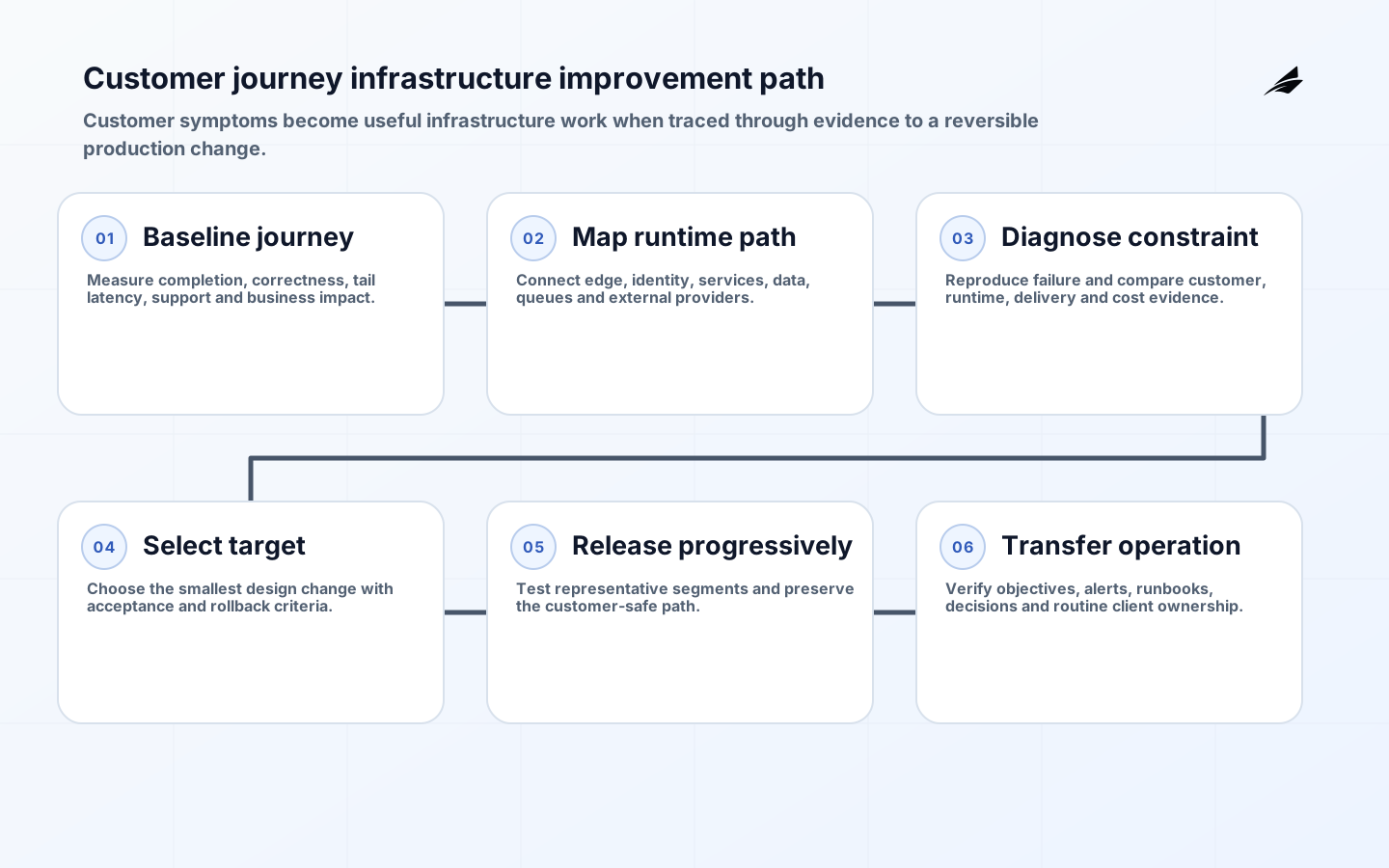
- Agree the critical journey, baseline, objective, risk tolerance and decision owner.
- Build a current-state service map from runtime and customer evidence.
- Reproduce or trace the most material failure and rank contributing constraints.
- Choose one thin remediation with a hypothesis, acceptance test and rollback.
- Implement through versioned infrastructure and the normal delivery pipeline.
- Release progressively and compare customer, reliability, security and cost signals.
- Document the decision, runbook and remaining risk; transfer operation to named owners.
- Repeat for the next constraint only after the first change is stable.
Control migration and consulting risks
The main risks are partial evidence, broad transformation scope, unsafe production access, migration data loss, vendor lock-in claims without analysis and recommendations detached from team capability. Use read-only discovery access where possible, time-bound privileged access for changes, tested backups, migration reconciliation and explicit change approval. Maintain a risk register with probability, impact, owner, treatment and residual decision.
Protect customer data in telemetry. Redact tokens and personal content, restrict observability access and set retention deliberately. Apply NIST CSF 2.0 outcomes across Govern, Identify, Protect, Detect, Respond and Recover. Framework mapping should improve ownership and evidence; it does not prove compliance. Industry and jurisdiction-specific duties require qualified review.
Measure customer and delivery outcomes together
Track journey success, error classes, tail latency, abandonment, support contacts, objective attainment and incident impact. Add cost per successful journey and capacity headroom. For the change system, DORA's five measures help identify throughput and instability over time. Do not compare unrelated services or optimize one measure alone. A faster deployment process matters when it safely shortens time to restore or deliver customer improvements.
Review metrics at a fixed cadence with product, engineering, operations and finance. Tie every alert to an owner and response. Use qualitative support and customer evidence to explain numbers. Retire dashboards that do not change a decision. The engagement is complete when the client can observe, operate and improve the journey without relying on the consultant's private interpretation.
Example: stabilize account sign-in
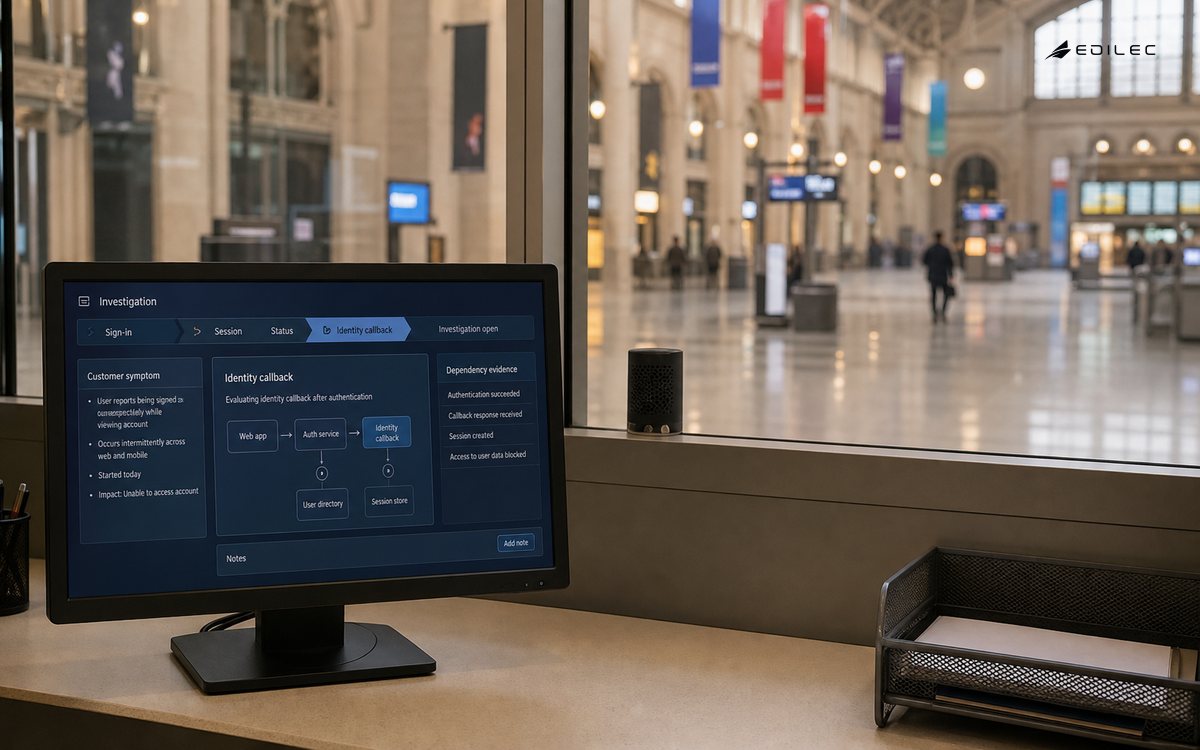
A subscription service sees rising sign-in complaints, but its API average remains healthy. Journey mapping reveals that users in one region wait on a third-party identity callback, retries create duplicate session work, and a sticky header masks a client error. The engagement establishes real-user latency by region, traces callback timing, classifies failures and checks support cases against correlation IDs. This turns a broad “the site is slow” complaint into testable constraints.
The first change adds bounded callback timeouts, idempotent session creation, a clear retry state and tenant-aware telemetry. It rolls out to a small regional cohort. Acceptance compares sign-in completion, p95 and p99 latency, duplicate sessions, support contacts and identity-provider errors with the baseline. A contingency path preserves existing sessions if the provider degrades. The team records why regional replication was deferred because evidence did not justify its cost.
Thirty days later, product, operations and finance review whether the improvement persisted through normal releases and peak demand. They inspect alert usefulness and realized cost, then choose the next constraint. That follow-through matters: a successful test under consultant observation does not prove the client's routine operating path is durable.
Key takeaways
- Frame infrastructure work around a critical customer journey.
- Measure correctness and tail behavior, not only average uptime.
- Choose resilience and cost tradeoffs from explicit business impact.
- Ship thin, tested and reversible improvements through normal delivery.
- Transfer telemetry, decisions and operating ownership to the client.
Frequently asked questions
Is this the same as a cloud audit?
No. A cloud audit may review account configuration broadly. Customer experience infrastructure consulting starts with customer outcomes and follows the technical path that produces them, while still addressing security, governance, reliability and cost in that scope.
Does poor performance require a platform rebuild?
Usually not as a first conclusion. Measure the journey, reproduce bottlenecks and test focused changes. A rebuild is justified only when incremental options cannot meet requirements or carry greater migration and operating cost than a staged replacement.
How long does an engagement take?
A bounded assessment may take weeks; implementation and observation depend on the estate, access, migration and release windows. Use evidence gates rather than a single transformation date, and state which remediation work is inside the engagement.
Acceptance should include a joint incident walk-through using the new service map. Give the client team a customer report, then ask them to locate the affected dependency, identify current impact, choose the correct runbook and explain communication authority. This exercise exposes missing telemetry and ownership more effectively than checking whether files were delivered. Record the elapsed diagnosis and any private consultant access that the client still lacks explicitly.
Conclusion
Customer experience infrastructure consulting is useful when it makes the customer journey technically explainable and operationally improvable. Connect user evidence to runtime behavior, prioritize one constraint, deliver a reversible change and transfer ownership. That creates a durable path from infrastructure investment to customer value.