A cloud exit architecture is the maintained ability to move a workload and its data to an acceptable replacement when a defined trigger occurs. It is not the same as keeping a second cloud hot. Permanent active multicloud duplicates production capacity, platform engineering, security controls and operational expertise; for many workloads that cost is larger than the risk it addresses. Exit readiness can instead rely on recoverable data exports, portable business logic, an honest dependency inventory, prepared target mappings and rehearsed restoration. The organization buys an option to move without pretending the move will be instant or free.
The UK public-sector cloud guide advises balancing technical lock-in with commercial, security, operations, people and value considerations. That balance matters: refusing every differentiated managed service can sacrifice delivery and reliability today, while adopting one without an exit record can create an unpriced future obligation. The architectural goal is conscious, bounded dependency. Teams should know what value they receive, what would have to change, how long it would take and which evidence proves the answer is still credible.
Define the exit scenario before designing portability
Name the trigger, scope, decision authority, target class and business objective. Triggers might include a contract termination, sustained price change, service withdrawal, regulatory direction, strategic consolidation, unacceptable concentration risk or provider failure. A planned commercial transition with twelve months of cooperation is not the same problem as an urgent loss of a regional service. Define separate scenarios rather than publishing one implausible maximum. Each scenario needs a recovery time range, tolerable data loss, minimum business capability and assumptions about provider assistance.
AWS exit-strategy guidance calls out scope, objectives, triggers, target environment, technical and operational considerations, contracts, assumptions, tests and ownership. Turn those topics into a signed workload record. Identify the executive who can invoke the plan, the product owner who prioritizes reduced service, the technical lead who controls migration and the commercial lead who exercises termination and data-return rights. Without authority and funding, an exit document is only a description of work someone might attempt later.
| Exit scenario | Planning assumption | Minimum success | Evidence to maintain |
|---|---|---|---|
| Planned provider switch | Months of notice and normal source access | Validated workload on approved target | Timed rehearsal and commercial schedule |
| Managed service withdrawal | Migration window but component replacement required | Equivalent business capability, not identical API | Coupling map and replacement prototype |
| Cost-driven repatriation | Source remains healthy while economics change | Target unit cost meets approved threshold | Cost model including transition overlap |
| Urgent risk reduction | Limited change window and partial provider cooperation | Critical workflows and recoverable records | Offline exports, credentials and restricted-mode runbook |
Inventory coupling at the level migration work occurs
Map data, semantics and transformation
List every authoritative dataset, replica, object store, queue, search index, feature store, secret and audit trail. For each, record owner, volume, growth, format, export interface, consistency point, encryption key, retention, deletion method and restore order. Portability is not achieved because a service has an export button. The receiving system must preserve business meaning: timestamps, identifiers, null behavior, ordering, transactions, access labels and referential integrity. Store transformation code with tests and produce checksums, counts and reconciliation queries that work independently of the source console.
NIST SP 800-146 discusses workload portability in terms of standardized interfaces and data formats while noting that higher-level services can expose provider-specific resource definitions. The NIST publication is a useful warning against equating virtual-machine portability with application portability. A database may use familiar SQL while depending on proprietary change streams, identity integration, backup semantics or global replication. Record those behavioral dependencies, not only product names.
Map control-plane and operating dependencies
Trace deployment, identity, policy, keys, DNS, certificates, telemetry, alerting, incident access, backups, support tooling and cost allocation. Infrastructure code written for one provider is still valuable because it makes intent reviewable, but it is not automatically portable. Separate business configuration from provider resource declarations, retain source code and artifacts outside the runtime account, and document how foundational services are recreated. Capture quotas and lead times; a target may support the required service yet be unable to allocate it during an urgent move.
Build a coupling register with four fields: present business value, replacement pattern, estimated change effort and evidence date. Rate semantic coupling higher than syntactic coupling. Replacing an API call may be easy; reproducing exactly-once claims, consistency behavior, security inheritance or operational automation may be difficult. Assign an owner and review trigger to high-coupling choices. This turns vendor dependency from an emotional label into managed architecture debt.
Make data and configuration exports recoverable
Choose an export cadence from recovery-point needs and the time required to extract at current scale. Keep at least one logically independent copy under customer-controlled identity and keys where risk warrants it. Export schema, access policy, lifecycle configuration, application settings and infrastructure intent alongside records. Encrypt in transit and at rest, restrict restore operators and test key recovery. An inaccessible encrypted archive is not readiness, nor is a dataset that cannot be tied to a consistent application checkpoint.
Run automated restore verification into a disposable environment. Validate checksums and business invariants, sample attachments, rebuild derived indexes and execute representative read and write workflows. Measure extraction and ingestion throughput so the exit time is based on observed rates. Include change capture or an agreed outage when the full export cannot fit the recovery objective. Document the final synchronization, write freeze, DNS transition and rollback boundary rather than assuming a bulk copy is the whole migration.
Prepare a replacement without operating duplicate production
Select a target class, not necessarily a permanently contracted provider: another public cloud, private environment, colocated infrastructure or replacement SaaS. Maintain service mappings, network and identity prerequisites, capacity estimates, deployment definitions, license needs and a minimal landing-zone specification. Prototype the hardest proprietary dependency and the largest restore path. Commodity components can remain documented mappings until a rehearsal; high-coupling services deserve executable adapters or a tested redesign.
Use a workload-specific migration strategy. Microsoft's cloud migration strategy guidance distinguishes paths such as rehost, replatform, refactor, repurchase, retire and retain. An exit can mix them: rehost a stable worker, replatform the database, repurchase observability and retire an obsolete reporting job. Preserve business interfaces between components so these choices can proceed in waves. Requiring every component to move by the same mechanism creates unnecessary coupling to the migration itself.
| Readiness layer | Artifact | Test | Failure signal |
|---|---|---|---|
| Data | Versioned export plus schema and keys | Restore and reconcile business invariants | Unexplained count, key or semantic mismatch |
| Application | Source, artifacts and provider coupling register | Build and run critical workflow on target class | Undocumented proprietary dependency |
| Platform | Landing-zone and service mapping | Provision representative environment | Quota, identity or network prerequisite missing |
| Operations | Monitoring, access and incident runbooks | Operate target during rehearsal window | No owner can diagnose or recover safely |
| Commercial | Termination, assistance and egress terms | Tabletop notice and cost schedule | Rights, fees or delivery format are ambiguous |
Rehearse a representative exit and price the result
A rehearsal should restore a production-shaped slice into the intended target class, reconnect dependencies, run business acceptance tests and operate long enough to expose monitoring and support gaps. Time human approvals as well as data transfer. Inject a missing credential, incompatible record, throttled export and failed cutover. Record recovery time, data age, manual steps, defect count, temporary security exceptions and staff hours. A tabletop is useful for authority and communication, but it cannot validate throughput or semantic compatibility.
Price engineering, target capacity, data transfer, licenses, specialist help, parallel-run period, contract commitments, user migration and reduced delivery during the transition. Compare this switching cost with the continuing value of the managed services and the probability-weighted risk. The answer may rationally accept high switching cost for a noncritical, short-lived product. For durable critical data, the same score may require more frequent exports and rehearsals. Exit architecture is proportional risk management, not a universal mandate for provider neutrality.
Keep contractual rights aligned with technical evidence
Contracts should specify data ownership, export formats and frequency, access during transition, deletion evidence, assistance, notice for material service changes, termination timing, egress charges and treatment of prepaid commitments. Architects must test whether those rights are technically usable. A promise to return data has little value if the format omits relationships or extraction at full volume exceeds the notice period. Conversely, a perfect export pipeline cannot overcome a contract that removes access before reconciliation.
Review the exit record after major schema changes, adoption of a new managed service, acquisition, contract renewal, material growth or staff turnover. Keep evidence dates and confidence levels. Track export restore success, estimated exit duration, percentage of critical dependencies with a replacement pattern and unresolved contractual gaps. Fund remediation when these measures cross approved thresholds rather than waiting for a trigger to turn architecture debt into emergency work.
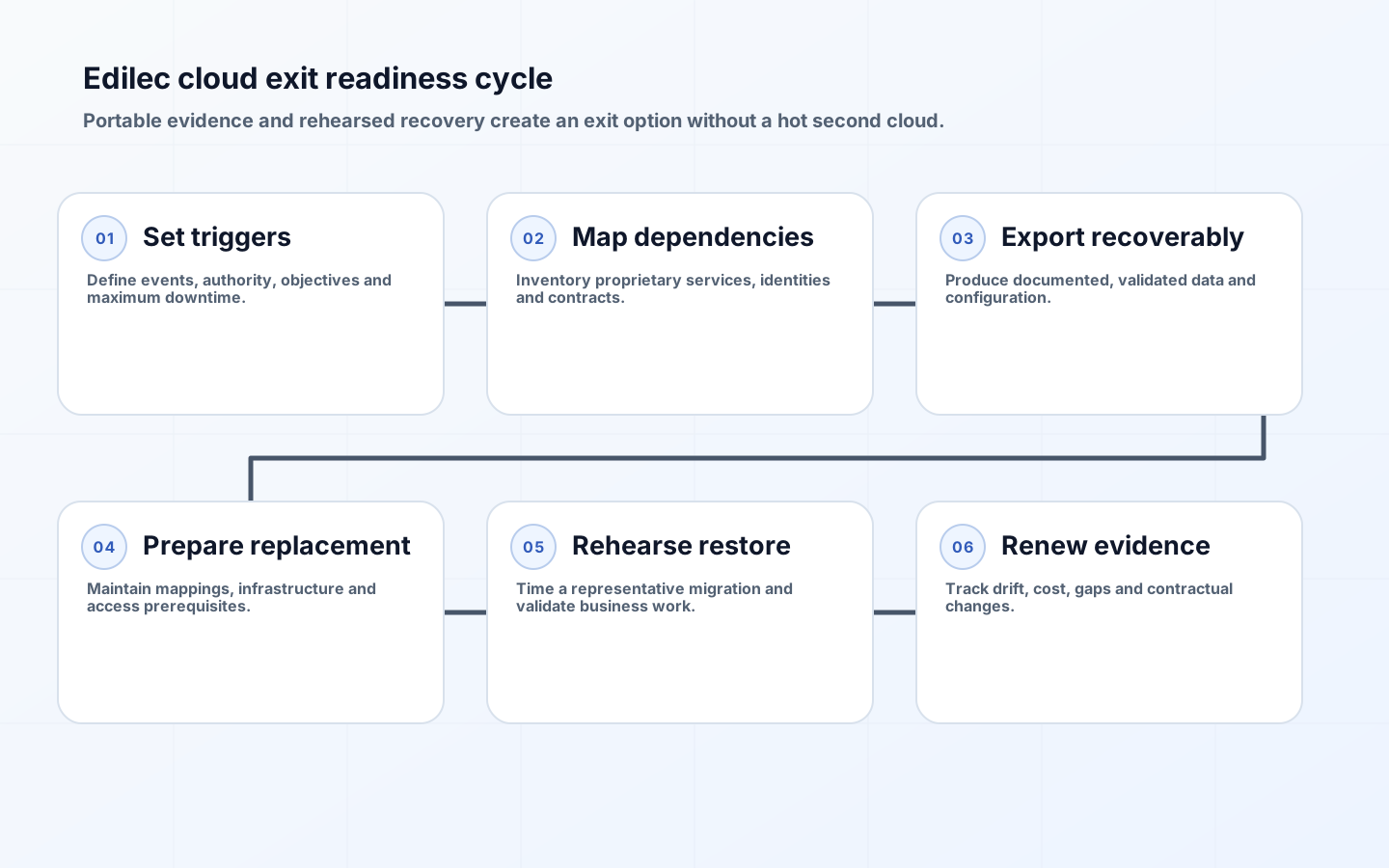
Use the six-stage Edilec cloud exit readiness cycle
Set triggers, map dependencies, export recoverably, prepare the replacement, rehearse restoration and renew the evidence. The cycle is deliberately recurring because data volume, provider features, contracts and team knowledge drift. A readiness claim expires when its underlying test no longer represents production.

Key takeaways for cloud exit architecture
- Define separate planned and urgent exit scenarios with authority, minimum capability and realistic assumptions.
- Inventory semantic, operational and contractual coupling instead of counting proprietary APIs.
- Prove that exported data, configuration and keys can restore a usable business service.
- Prototype the hardest replacements and maintain a target-class runbook without funding a permanent hot cloud.
- Rehearse, measure and renew exit evidence when workload scale, architecture or contracts change.
Frequently asked questions about cloud exit architecture
Does a credible exit plan require active multicloud?
No. It requires evidence that data and critical capability can move within approved objectives. Active multicloud may be justified for a specific continuity need, but offline exports, target preparation and rehearsals can create a credible exit option at much lower steady-state cost.
Do containers solve cloud portability?
They can standardize application packaging, but they do not move databases, identities, keys, networks, managed-service semantics, telemetry or contracts. Treat containers as one artifact in the exit plan, not proof that the workload is portable.
How often should an exit be tested?
Base frequency on criticality, growth and rate of architectural change. Test exports more often than full rehearsals, and trigger an additional review after material schema, provider-service or contract changes. Every readiness claim should have an evidence date and owner.
Conclusion
A credible cloud exit is a recovery capability built from explicit scenarios, restorable information, replacement knowledge, usable commercial rights and practiced people. It does not demand permanent duplicate production. By measuring coupling and rehearsing the hardest steps, organizations can use valuable managed services today while retaining a truthful, governed option to change tomorrow.