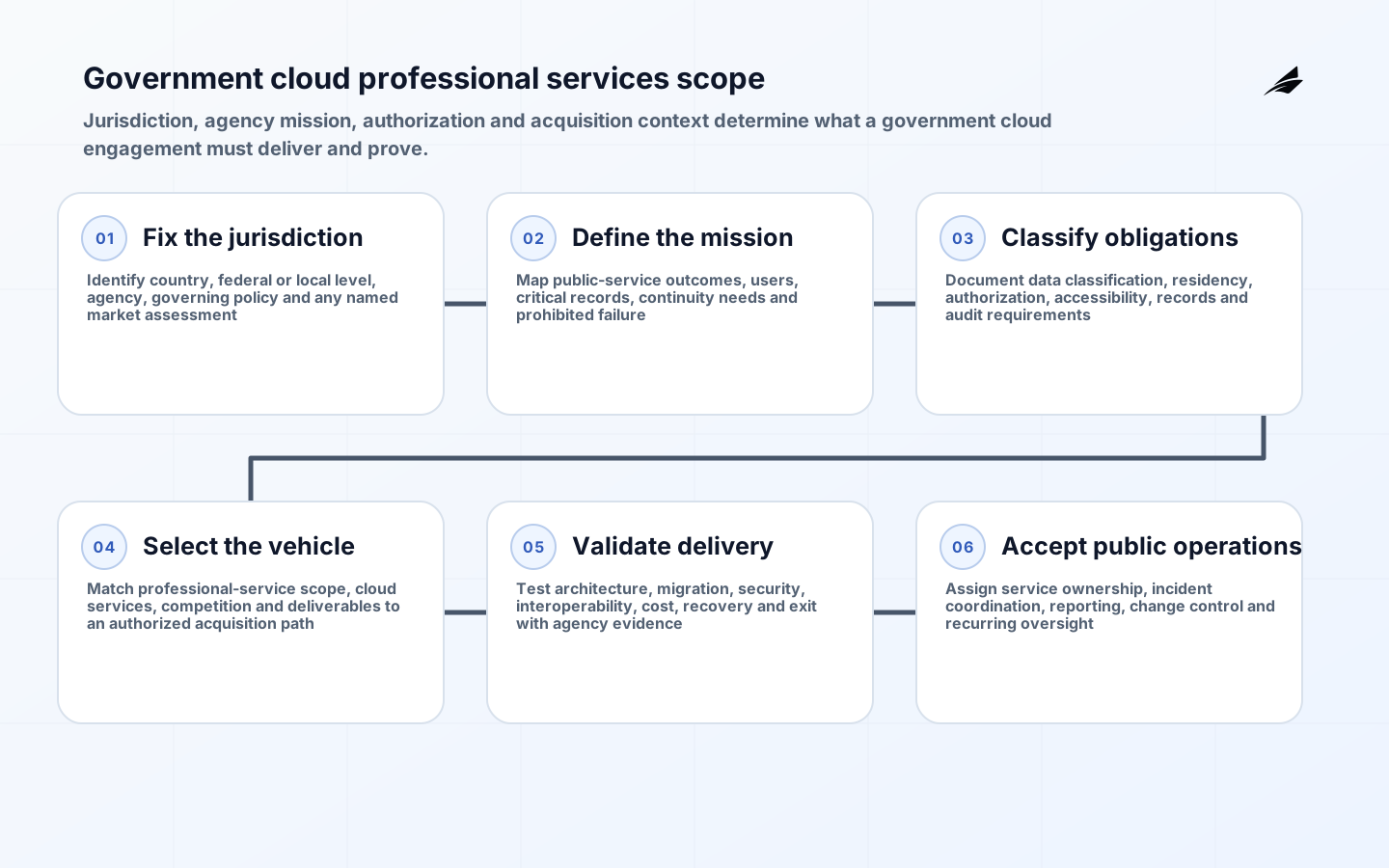
This government cloud professional services FAQ helps public bodies buy and govern expertise without outsourcing accountability. Government cloud work combines mission delivery, acquisition, records, privacy, cybersecurity, accessibility and continuity. A consultant can assess an estate, design a landing zone, migrate workloads or improve operations, but the agency must still own its mission priorities, risk decisions and authorization. The engagement should therefore produce usable evidence, transferred capability and an operable service, not a presentation that expires when the supplier leaves.
The phrase cloud should be used precisely. NIST SP 800-145 defines essential characteristics, service models and deployment models; a hosted environment is not automatically cloud merely because a vendor operates it. Pair this FAQ with Edilec's government cloud scope and delivery plan and implementation checklist to turn procurement language into acceptance tests.
What should government cloud professional services cover?
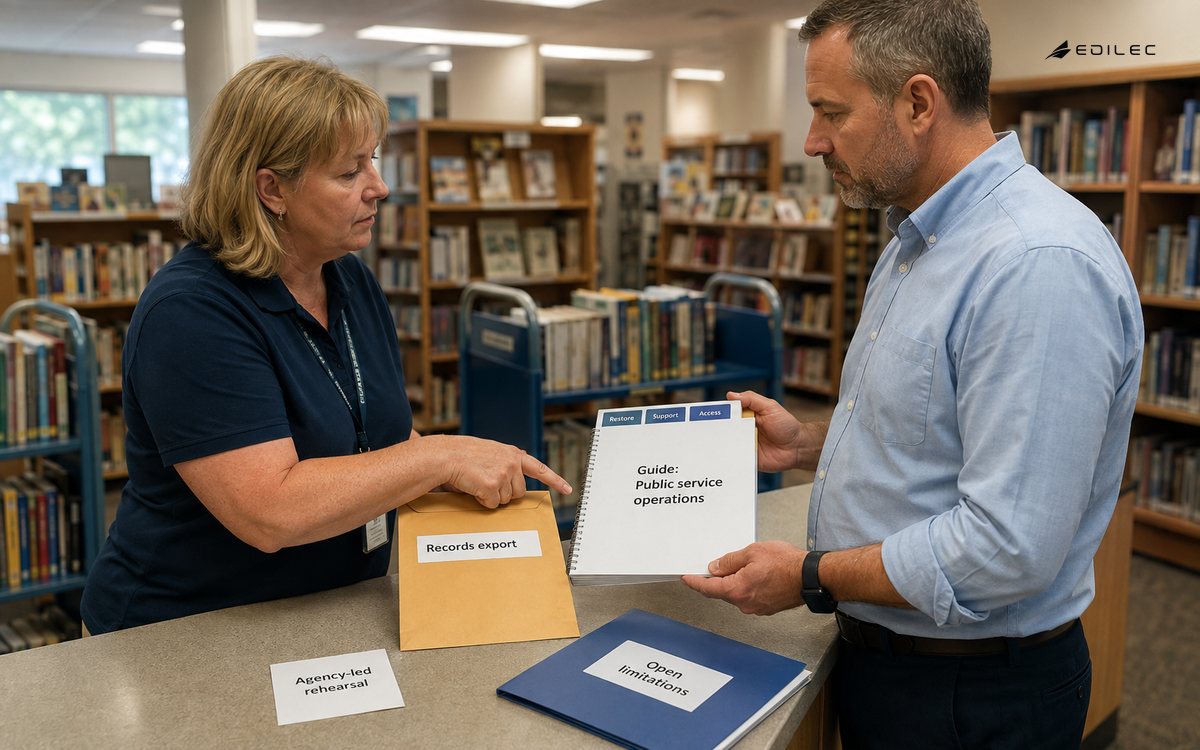
Define the engagement around a mission outcome and bounded systems. Common workstreams include portfolio discovery, business case, cloud foundation, identity, network, data protection, application modernization, migration, DevSecOps, authorization evidence, continuity, cost management and workforce enablement. State which deliverables are advisory and which the supplier must implement. For every deliverable, name the government owner, required inputs, review authority, acceptance evidence and future maintainer. A reference architecture has limited value unless it becomes enforceable configuration, deployment patterns and operating procedures.
Separate cloud service provider responsibility from professional-services responsibility. The platform provider operates capabilities within its service boundary; the consulting team configures or integrates assigned components; the agency determines lawful use, data categorization, risk acceptance and mission continuity. Document subcontractors and toolchains because consultants may introduce their own SaaS systems for code, tickets, scanning or documentation. Those systems can hold government information and require the same deliberate approval, access control, retention and exit treatment as the target environment.
| Work package | Required output | Agency decision | Acceptance test |
|---|---|---|---|
| Discovery | Verified inventory, dependencies, data and operational baseline. | Confirm mission priority and system ownership. | Samples reconcile to technical sources and named owners. |
| Foundation | Identity, hierarchy, network, logging and policy as code. | Approve guardrails and exception authority. | Automated tests prevent prohibited configurations. |
| Migration | Wave plan, runbooks, reconciliation and recovery route. | Approve outage, data and rollback tolerance. | Rehearsal meets transaction and recovery criteria. |
| Authorization | Boundary, controls, implementation evidence and open risks. | Authorize operation or require remediation. | Evidence is current, attributable and repeatable. |
| Transition | Runbooks, training, access transfer and exit package. | Accept operational readiness. | Government staff operate and recover a representative service. |
How should an agency procure and evaluate a partner?
Procure outcomes and evidence rather than a large pool of generic roles. Give bidders a representative scenario and ask how they would discover unknown dependencies, handle authorization constraints, recover a failed migration and transfer skills. Evaluate relevant platform and sector experience, but verify the people proposed and the supplier's quality controls. Require disclosure of assumptions, dependencies and exclusions in pricing. A low bid based on clean data, immediate access and no remediation is not comparable with a proposal that includes realistic discovery and risk treatment.
Commercial terms should cover intellectual property, reusable accelerators, data handling, background checks where required, subcontractor approval, incident notification, accessibility, open standards, documentation formats, termination assistance and secure deletion. Milestones should be paid against accepted evidence such as a tested foundation or completed migration wave, not elapsed time alone. Preserve government access to repositories and decision records throughout delivery. Avoid technical lock-in created by proprietary automation that the agency cannot inspect, run or procure competitively after the engagement.
How do FedRAMP and authorization boundaries affect delivery?
A provider authorization is valuable reusable evidence, but it does not authorize every agency deployment or transfer all risk to FedRAMP. Define the actual system boundary, inherited controls, agency-configured controls, interconnections and customer responsibilities. Confirm that the exact service offering and impact level fit the planned information and use. Professional services should maintain traceability from requirements to architecture, configuration, tests, findings and risk decisions so the authorizing official can evaluate the implemented system rather than a generic product description.
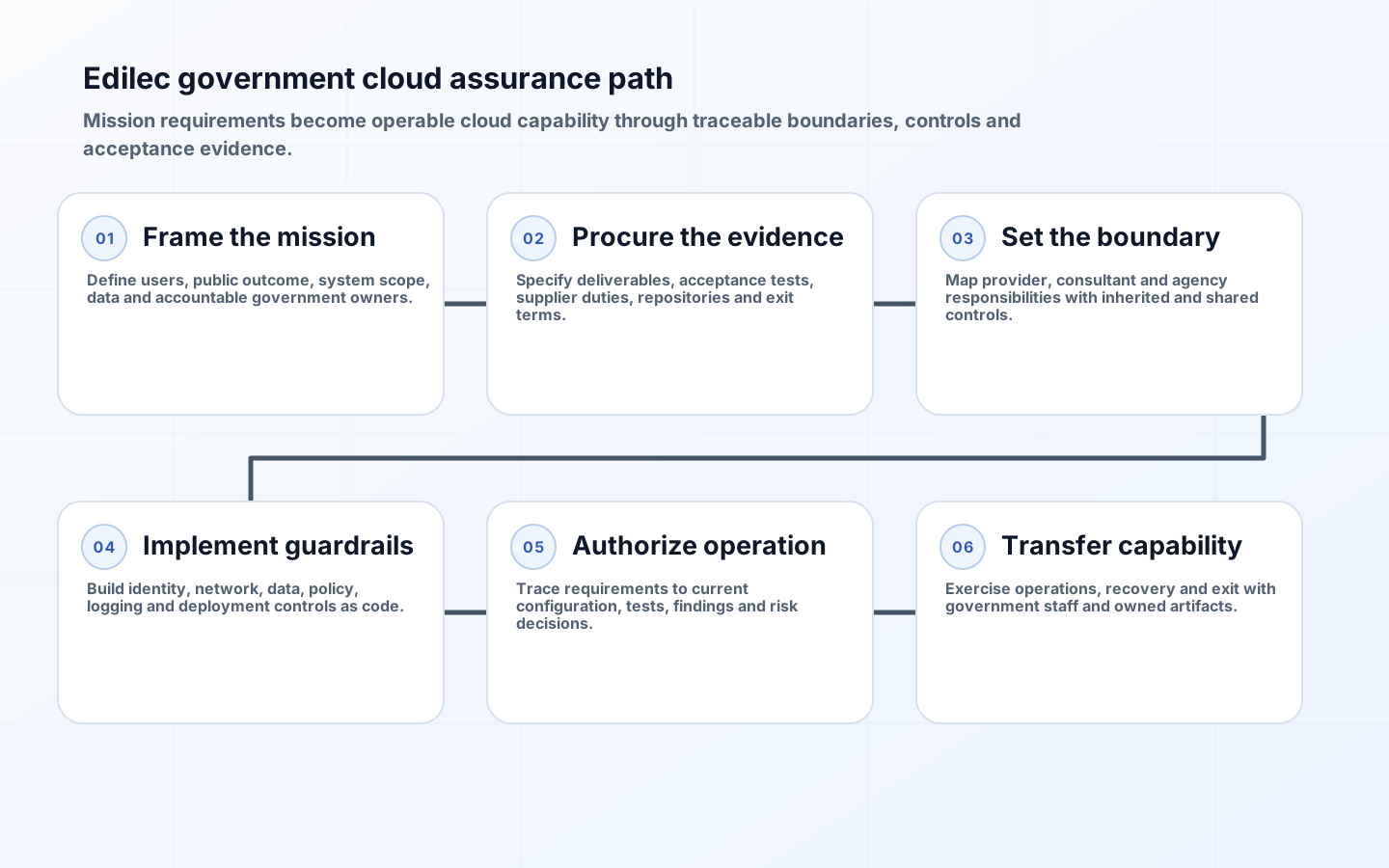
Authorization is an operating process. FedRAMP's Continuous Reporting Standard requires providers to supply objective security reporting that supports agency awareness and risk decisions. The consulting plan should establish vulnerability, configuration, incident, change and evidence flows before go-live. Significant changes need defined evaluation and communication. Open findings require owners and milestones, and accepted risks need expiration or review conditions instead of becoming permanent undocumented exceptions.
What security and data decisions come first?
Start with enterprise identity, device posture and resource authorization. NIST SP 800-207 describes zero trust as protecting resources rather than relying on network location. Use phishing-resistant authentication where policy and risk require it, separate workforce and workload identities, minimize standing privilege and log policy decisions. Emergency access must be testable without becoming an unmonitored bypass. Contractors should use attributable identities within the agency's lifecycle controls rather than shared accounts owned solely by their employer.
Categorize information and map its complete flow: collection, transmission, processing, backup, analytics, support access, export and disposal. Apply encryption and key ownership appropriate to the threat model, but do not mistake encryption for authorization or minimization. Record location and replication constraints, including diagnostic and security data. The CISA Cloud Security Technical Reference Architecture emphasizes shared services, secure migration, posture management and zero trust. Use those concerns to review the deployed architecture and operating model together.
| Risk question | Evidence expected | Owner | Decision trigger |
|---|---|---|---|
| Who can act? | Identity source, authorization policy, elevation and access review. | Agency identity and system owners | Unattributed or standing privileged access appears. |
| Where does data go? | Flow map, inventory, keys, retention and support-access record. | Data owner and privacy officer | New region, processor, interface or purpose is proposed. |
| Can service recover? | Dependency map, backups, restore and failover exercises. | Mission and operations owners | Recovery objectives or dependencies change. |
| Are controls effective? | Automated tests, findings, incidents and assessment results. | Security and authorizing officials | Control evidence degrades or threat conditions change. |
| Can government exit? | Portable artifacts, data export, credential removal and deletion proof. | Contract and service owners | Supplier, platform or mission strategy changes. |
How should migration and continuity be planned?
Prioritize migration waves by mission value, dependency complexity, security remediation and learning potential. Establish performance, reliability, cost and user baselines before moving. Rehearse data transfer, validation, cutover, rollback and communications. Do not call a wave complete when virtual machines start; verify transactions, integrations, records, monitoring, backup and support ownership. Preserve legacy evidence and disposition records according to records obligations. Some modernization changes cannot roll back cleanly, so define forward recovery and dual-operation limits as well as technical rollback.
Continuity should cover cloud-region failure, identity-provider disruption, network isolation, corrupted deployment, supplier control-plane outage, compromised credentials and loss of consulting support. Set recovery time and recovery point objectives from mission impact. Test decision authority and communications, not just infrastructure scripts. Ensure government staff can access runbooks and critical evidence during supplier or collaboration-platform outages. Dependencies such as DNS, certificates, source repositories and third-party APIs belong in the exercise because they often determine whether an otherwise sound recovery design can operate.
How are cost, skills and exit controlled?
Build a total-cost model that includes consumption, licenses, network transfer, security tooling, observability, support, professional services, remediation, dual running and government labor. Assign account and resource ownership so invoices can be reconciled to mission capabilities. Budgets should trigger decisions, not only email alerts. Review commitments against credible demand and portability. A migration business case should state which costs are avoided, which are displaced and which new operating capabilities are funded; cloud adoption does not automatically reduce expenditure.
Make knowledge transfer continuous through paired design, code review, recorded decisions, government-owned repositories and exercises. Track whether staff can deploy, diagnose, authorize changes and recover services without supplier intervention. The exit package should include current architecture, configuration and code, build instructions, inventories, open risks, licenses, contracts, data exports, keys and access-removal evidence. Exercise an incremental handoff before contract end. For local public bodies, the local government cloud delivery plan adds useful context on constrained teams and shared regional services.
Government cloud services takeaways
- Procure mission outcomes, testable artifacts and knowledge transfer rather than generic labor categories.
- Distinguish platform-provider, professional-services and agency responsibilities at task level.
- Treat authorization as continuous evidence and risk management, not a launch gate.
- Design identity around resources, attributable access and bounded privilege.
- Verify migrations through transactions, data, monitoring, recovery and support ownership.
- Maintain government-controlled repositories and exercise exit before the engagement ends.
Frequently asked questions
Does a FedRAMP-authorized service eliminate an agency ATO? No. FedRAMP supplies standardized, reusable assessment and authorization information for the cloud offering. The agency still evaluates its use, configuration, inherited and customer controls, interconnections and mission risk under its applicable authorization process.
Should a government cloud consultant also operate the service? It can be efficient, but design and operating assurance should remain sufficiently independent for the risk. The contract must distinguish build defects from ongoing operations, preserve government oversight and provide a credible transition route to another operator.
What is the most important consulting deliverable? There is no universal single artifact. The highest-value result is a coherent evidence chain from mission requirement through implemented control and tested operation, owned by people who can maintain it after the supplier leaves.
Conclusion
Government cloud professional services succeed when expert assistance strengthens public accountability. A precise scope, realistic procurement, implemented guardrails, continuous authorization evidence, tested continuity, explainable cost and deliberate capability transfer create a service the agency can govern. The durable measure is not how much architecture the supplier produced, but whether mission owners can operate, assess and change the resulting system with confidence.