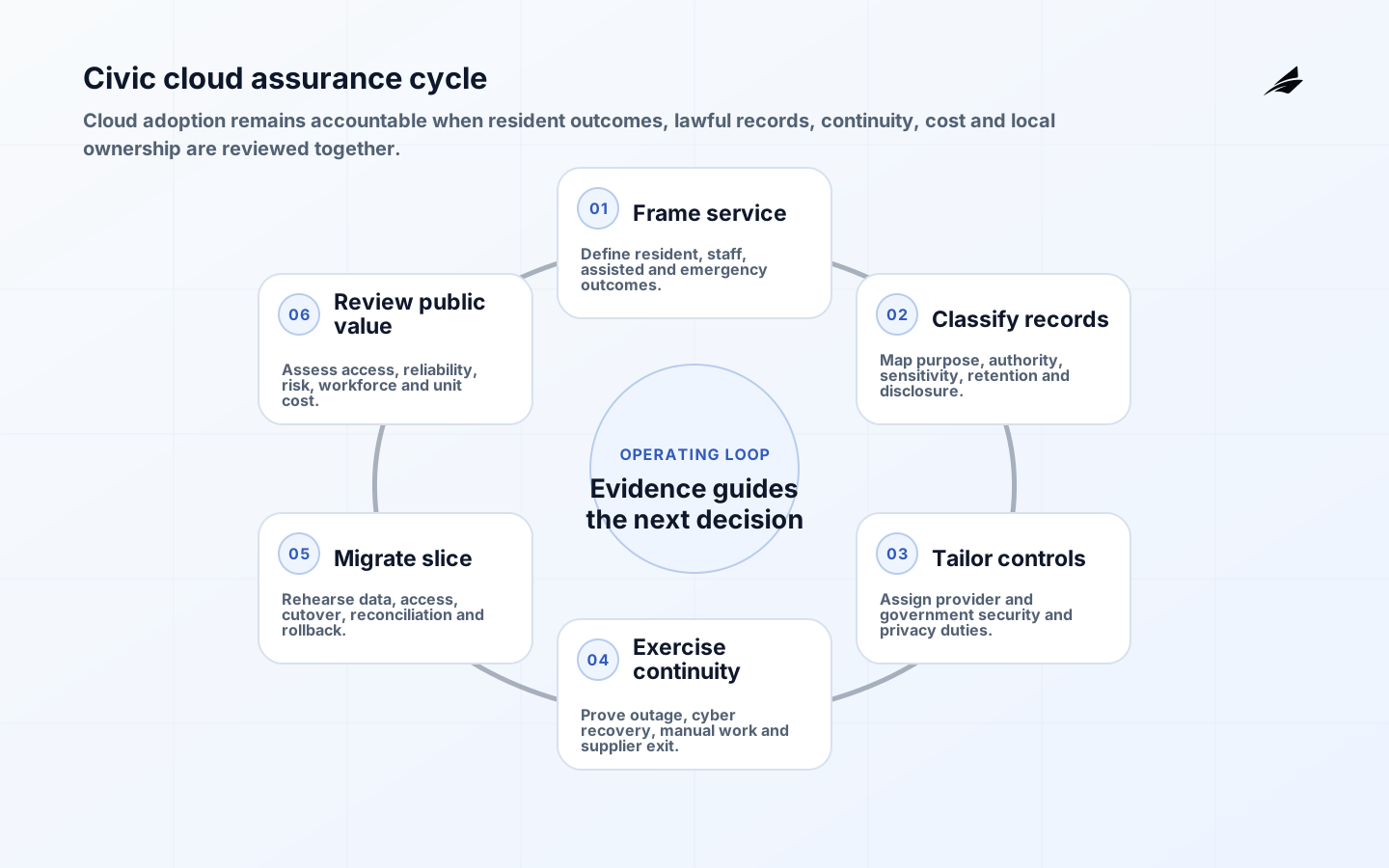
Local government cloud services should improve a public service while preserving access, lawful data use, democratic accountability and continuity. A council or municipality may use cloud for benefits, permits, licensing, revenue, records, public safety support, collaboration and infrastructure operations. These services have different harms and recovery needs. A cloud strategy that starts with provider preference instead of resident and staff journeys will move technology without necessarily improving government.
This guide covers scope, cost, risk and a delivery plan for local government cloud services. It complements the local government cloud checklist, the public-value and continuity FAQ and the government cloud professional services guide. Local law, records schedules, procurement rules, accessibility and sector security obligations must be established by authorized officials.
Start with residents, staff and critical public outcomes
Map important journeys and their failure consequences: apply, pay, report, inspect, decide, notify, appeal, retrieve a record and continue during emergency. Identify who cannot rely on broadband, a smartphone, English fluency or a digital identity. Define assisted and offline paths. Baseline completion, elapsed time, repeat contact, error, case backlog, accessibility barriers, staff touch time and service availability. Name the service owner with authority across policy, operations and technology.
Classify workloads by criticality, information sensitivity, legal basis, retention, integration, latency, recovery and market availability. Include shadow systems and spreadsheets used to complete the public service. Decide whether to retire, replace with software as a service, replatform or refactor. NIST SP 800-145 provides a stable vocabulary for cloud characteristics and models, but deployment labels do not determine fitness. Document why each placement meets the specific public-service need.
| Workload cohort | Cloud approach | Primary concern | Proof before migration |
|---|---|---|---|
| Public information | Managed web or content platform | Accessibility, integrity and surge | Inclusive journey, publishing control and load test |
| Case management | SaaS or managed application platform | Identity, records, integration and appeals | Role matrix, data flow and complete case rehearsal |
| Payments and revenue | Compliant payment plus governed application services | Financial integrity and reconciliation | Tender-to-ledger test and recovery |
| Emergency or infrastructure support | Resilient hybrid or multi-region design as justified | Continuity under dependency and communications failure | Scenario exercise with manual operation |
Map data, records and public accountability
Create a data-flow map for resident, employee, location, financial, health, justice and infrastructure information. Record purpose, authority, classification, owner, users, sharing, region, retention, legal hold, disclosure and deletion. Identify the authoritative case and record. Cloud copies, indexes, logs, backups and support access all count in the flow. Minimize fields and separate analytics where it would otherwise expand operational access.
Translate records schedules and public-information obligations into export, search, preservation and disposal tests. Confirm that format, metadata and audit evidence remain usable without the provider interface. Define how corrected data propagates and how contested decisions retain their original evidence. Review automated decision support for explanation, appeal and equal-service impact. Residents must not lose procedural rights because a supplier classifies information as model context or telemetry.
Design cloud security through shared responsibility
Map provider and government duties for identity, configuration, network, endpoints, data, keys, logging, vulnerability, incident response, backup and recovery. NIST SP 800-53 provides a broad, tailorable control catalog; select controls through risk and applicable policy rather than copying a baseline without implementation. CISA's Cloud Security Technical Reference Architecture connects shared services, migration, posture management, DevSecOps and zero-trust considerations for public-sector cloud adoption.
Use centralized identity, phishing-resistant authentication where risk warrants, conditional access, workload identities and least privilege. Separate administrative paths and protect emergency accounts. Configure logging before migration and route actionable security events to an owned response. Test vendor and contractor offboarding, cross-department access, compromised device, excessive export and support access. Contract notification, evidence preservation and coordinated public communication for incidents.
Plan resilience from community impact
Set availability, recovery time and recovery point from the consequence of service interruption. Map identity, network, DNS, telecom, payment, integration, provider, staff and facility dependencies. Decide which functions must work during internet or regional failure and how staff record work for later reconciliation. The UK public-sector cloud guide emphasizes cross-functional decisions across commercial, technical, security and people concerns rather than one universal architecture.
Use multiple regions or providers only when they improve a defined scenario enough to justify complexity. Recent UK government guidance on multi-region cloud highlights controlled region use for resilience, capacity and innovation while considering legal, data-protection and security practices. Maintain backups isolated from routine administration, but prove application-consistent restoration. Exercise cyberattack, identity outage, supplier outage, office loss and surge demand with service owners and communications staff.
| Failure scenario | Continuity decision | Exercise evidence | Recovery completion |
|---|---|---|---|
| Identity unavailable | Which public and staff functions continue? | Emergency access and offline procedure | Temporary actions reconciled and access removed |
| Cloud region impaired | Fail over, degrade or wait by service tier | Traffic, data consistency and communication trace | Primary state restored without lost cases |
| Ransomware or destructive admin | Contain identities and preserve trusted recovery | Isolated backup restore and clean control plane | Security validation and record reconciliation |
| Supplier exit | Transfer service, data and operating knowledge | Timed export and replacement import | Deletion evidence and contract closure |
Procure outcomes, transparency and exit readiness
Specify user and service outcomes, workload profiles, security and privacy evidence, accessibility, data rights, interoperability, support, recovery, audit, pricing and exit. Evaluate the actual service configuration and subcontractor chain, not only the provider brand. Avoid terms that prevent public records access, security testing or incident evidence. Define change-notice and price-protection mechanisms for essential services. Keep enough internal architecture and contract capability to challenge suppliers.
Build total cost from licenses, usage, data transfer, connectivity, security, observability, migration, remediation, training, support, retained staff, dual running, records and exit. Model normal, peak, incident, growth and contract-renewal scenarios. The FinOps Framework emphasizes timely cost data and collaboration among engineering, finance and business roles. Allocate cost to services and environments, forecast with service owners and use unit measures such as cost per completed case, not arbitrary budget cuts.
Migrate in public-service slices
Choose a representative but bounded journey. Remediate data and access before copying. Build target foundations through reviewed infrastructure and configuration. Rehearse extract, transform, load, validation, cutover and rollback with immutable inputs. Reconcile records, cases, documents, permissions, balances and retention. Test accessibility and assisted service on real devices and locations. Train frontline, contact-center, records, finance and support roles on exceptions and continuity.
Cut over with a named command structure, resident communication and criteria to pause or reverse. Keep legacy access only under a controlled purpose and end date. During early life, review completion, backlog, repeated contact, access errors, security, cost, integration, staff workload and cohort disparities. Resolve root causes before the next wave. Decommission only after dependency, record, financial, contract and disposal checks pass.
Create a durable local cloud operating model
Maintain a service and cloud inventory with owner, data, provider, criticality, region, recovery, cost and lifecycle. Operate platform guardrails, access review, configuration posture, vulnerability treatment, backup, observability and incident coordination. Give departments a supported path and clear exceptions instead of forcing uncontrolled workarounds. Review supplier changes and unsupported versions. Ensure elected and executive oversight receives public-service risk and value, not only technical consumption.
Measure resident outcome, accessibility, workforce impact, reliability, security, privacy, records, cost and environmental objectives where required. Publish appropriate service performance without exposing sensitive operations. Learn from complaints, appeals, incidents and continuity exercises. Reassess placement as contracts, demand and provider capabilities change. Retire services and data that no longer have a public purpose; accumulation is neither modernization nor resilience.
Example: move a permit application service
Map applicant, reviewer, inspector, payment, notice and appeal journeys. Define the official record and retention. Build accessible application and assisted submission, role-based case handling, document scanning, payment reconciliation and status notifications. Migrate active permits plus required history, linking every document and decision. Provide an offline inspection path that synchronizes with conflict rules. Test another applicant's access, changed ownership, fee reversal and deadline calculation.
Pilot one permit class with trained staff and community support. Measure successful submission, review time, correction loops, accessibility contacts, overdue cases, payment variance and staff effort. Exercise identity outage, cloud outage and records request. Compare digital and assisted cohorts for unequal friction. Scale only when public outcome and control evidence hold, then close temporary migration access and reconcile the legacy archive.
Key takeaways
- Start from resident, staff and emergency-service outcomes, including assisted paths.
- Map data purpose, records, disclosure, retention and appeal before migration.
- Tailor cloud controls and shared responsibility to local service risk.
- Prove continuity through realistic dependency, cyber and supplier-exit exercises.
- Govern full lifecycle cost and value by public service, not infrastructure consumption alone.
Frequently asked questions
Must local government use public cloud?
Policy differs by jurisdiction. Evaluate public cloud, SaaS, private and on-premises options against service outcomes, risk, capability, cost and binding policy. Document the placement decision and review it as conditions change.
Is data residency the same as data control?
No. Location matters, but access by support staff, legal jurisdiction, encryption and key control, subcontractors, backups, export, retention and incident evidence also shape control. Map the full data and administrative path.
Can a small municipality operate cloud securely?
Yes, with a narrow supported catalog, shared or managed capabilities, clear accountability and retained local ownership. Avoid excessive platform variety. Pool specialist expertise where lawful, and verify provider work through logs, exercises and independent review.
Create a plain-language service assurance record for each critical cloud service: owner, purpose, communities served, provider, data classes, major dependencies, continuity level, last exercise, current risks and next review. Keep sensitive technical details protected, but make decision accountability visible. This record helps leadership, audit and successor staff understand why the service is operated and what evidence supports that decision.
Conclusion
Cloud can improve local public services when government remains an informed owner. Resident-centered scope, lawful records, shared-responsibility security, exercised continuity, transparent cost and staged migration produce modernization that communities can rely on and officials can explain.