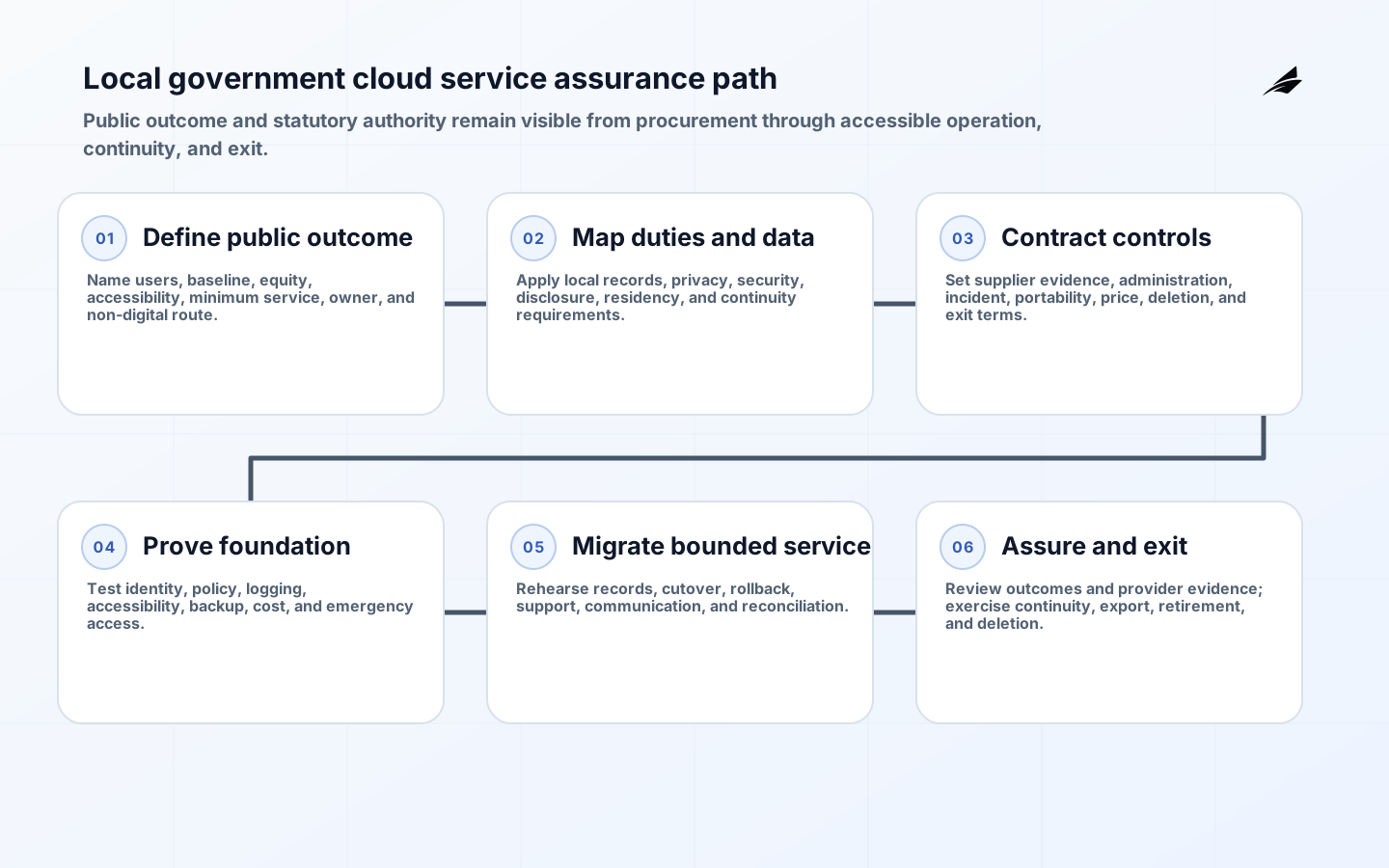
A local government cloud services implementation checklist must protect continuity, public rights, records, privacy, accessibility, accountability, and constrained budgets while improving a real service. Cloud does not transfer statutory responsibility to a provider. Requirements vary by country, state, locality, service, and data class, so counsel, records officers, accessibility leaders, emergency management, procurement, and security authorities must approve the controls that apply.
This checklist is jurisdiction-aware rather than a substitute for local policy. Use the local government cloud scope and delivery guide to frame the program, the public value, security, and continuity FAQ for stakeholder questions, and the government cloud professional services checklist when procuring implementation support.
Define the public service outcome and authority
Choose one end-to-end resident, business, staff, or partner journey and document current delay, error, manual work, exclusion, cost, and continuity risk. Define the intended outcome, measurable baseline, equity and accessibility guardrails, minimum viable service, and accountable service owner. A server move is not a public outcome. Include non-digital and assisted routes so modernization does not make essential services inaccessible to residents with limited connectivity, language access, disability, or low digital confidence.
Establish decision rights for program leadership, department owner, technology, security, privacy, records, legal, finance, procurement, accessibility, data, communications, emergency management, and provider. Map ordinances, statutes, contracts, grants, retention schedules, public-disclosure duties, residency, criminal-justice or health constraints, and collective agreements where relevant. Record interpretations and exception authority. Federal references such as NARA can inform contract questions but do not automatically govern a local body.
| Public duty | Implementation question | Acceptance evidence |
|---|---|---|
| Continuity | How will essential service continue during cloud or network failure? | Exercised degraded route and recovery objective |
| Records | Can records be captured, searched, held, exported, and disposed correctly? | Records officer validates lifecycle and metadata |
| Privacy | Is collection necessary and access purpose-bound? | Approved assessment, data map, and deletion behavior |
| Accessibility | Can disabled users complete the whole journey? | WCAG tests plus user research and assisted route |
| Accountability | Can decisions and administrative actions be explained? | Attributable audit and public communication process |
Classify data and design records behavior first
Inventory data sets, record series, owners, purposes, legal authorities, sensitivity, residency, sharing, retention, holds, disposal, archival value, and recovery. Distinguish public data from sensitive records; “government data” is not one class. Map every copy in integrations, analytics, logs, support, exports, test, backups, and provider sub-processors. Minimize collection and define how incorrect records are corrected without erasing required history.
Put records requirements into architecture and contract: capture, metadata, authenticity, integrity, usability, search, legal hold, disposition suspension, export format, transfer, audit, provider assistance, and verified deletion. NARA’s cloud bulletin emphasizes that moving records does not remove the agency’s responsibility and that providers need retention requirements. Local records officers should translate the same principle into applicable schedules and public-disclosure workflows.
Procure services around shared responsibility and exit
Specify service scope, locations, administrative access, personnel controls, sub-processors, encryption and key options, logging, vulnerability response, incident notification, evidence, availability, support, recovery, accessibility, data use, records, ownership, portability, transition assistance, deletion, price changes, audit rights, and termination. Evaluate the exact service and configuration, not the provider brand. A provider certification can support assurance but does not prove the local workload is configured or operated correctly.
Model total cost across implementation, connectivity, identity, security, logging, storage growth, data transfer, backup, support, training, accessibility, licenses, migration coexistence, records export, and exit. Define consumption owners, budgets, anomaly response, and renewal review. Preserve source, configuration, infrastructure code, data dictionaries, integration contracts, runbooks, keys or key access, and export tests under government control. Test exit before dependency grows.
| Supplier control | Contract or design requirement | Verification |
|---|---|---|
| Incident | Notification window, facts, evidence preservation, cooperation | Tabletop uses provider and government escalation |
| Administrative access | Named purpose, least privilege, monitoring, location | Sample access is attributable and reviewed |
| Data portability | Complete documented export with metadata and relationships | Import rehearsal into an independent environment |
| Continuity | Objectives, dependency assumptions, test participation | Joint restore and degraded-service exercise |
| Termination | Access revocation, return, retention, deletion certificate | Exit checklist closes every copy and integration |
Establish the cloud foundation and security controls
Create organization hierarchy, accounts, identity federation, privileged and emergency access, network, DNS, approved services and locations, encryption, logging, monitoring, policy, tagging, budgets, backup, and secure configuration through versioned automation. NIST CSF 2.0 can organize governance and operational outcomes. NIST zero trust guidance supports resource-focused access without implicit trust from network location. Apply least privilege to staff, contractors, providers, applications, and devices.
Centralize essential visibility while preserving departmental context. Log authentication, privilege, policy, data access where appropriate, configuration, deployment, and administrative events with protected time and retention. Avoid placing sensitive case content into general logs. Define vulnerability intake, patching, exception, incident command, law-enforcement coordination where applicable, public communication, and lessons learned. Exercise compromised credentials and provider administration, not only malware on a server.
Build accessible service and continuity together
Use WCAG 2.2 as a technical baseline where applicable and test with residents and staff who use assistive technology. Cover forms, identity proofing, authentication, document upload, payment, appointment, map, notification, status, appeal, and error recovery. Provide language and assisted-service paths according to local obligations. Third-party widgets and identity or payment services remain part of the journey; include them in accessibility acceptance and supplier remediation.
Define RPO, RTO, maximum tolerable outage, degraded service, manual processing, backlog reconciliation, and recovery authority for each essential service. Consider loss of internet, provider region, identity, payment, telephony, building, and key staff. Protect backups from production compromise and restore into an isolated environment. Verify resident journeys, permissions, records, integrations, pending cases, payments, and public messages before declaring recovery.
Migrate one public service through controlled gates
- Approve the public outcome, authority, accessibility, records, privacy, continuity, and owner.
- Inventory data, dependencies, users, integrations, suppliers, costs, and current operating evidence.
- Prove the cloud foundation and contract controls with a representative non-production service path.
- Rehearse data migration, records validation, support, rollback, recovery, communication, and assisted routes.
- Release to a bounded cohort or service area and reconcile every authoritative record and payment.
- Stabilize performance, security, accessibility, support, cost, and continuity before retiring legacy access and systems.
Operate, report, and improve with public evidence
Assign service objectives and monitor completion, error, wait time, accessibility defects, assisted-channel demand, availability, latency, data quality, security, backlog, recovery, cost, and provider performance. Segment carefully enough to reveal unequal outcomes without exposing personal information. Publish performance or incident information according to local transparency policy. Give every alert and exception an owner and action; avoid dashboards that create visibility without authority.
Hold a cross-functional service review and periodic supplier review. Reassess risk after incidents, legal change, provider feature change, acquisition, new data sharing, and major releases. Exercise exit, records export, and continuity. Maintain evidence for elected oversight, audit, public records, and residents without disclosing security-sensitive detail. Fund recurring issues and retire cloud resources, accounts, copies, and contracts when the service ends.
Key takeaways
- Define cloud success through an accessible public-service outcome, not infrastructure location.
- Translate applicable records, privacy, security, procurement, and continuity duties into testable controls.
- Contract for evidence, portability, incident cooperation, and verified exit.
- Exercise non-digital routes, provider failure, restoration, and backlog reconciliation.
- Operate the service with transparent ownership, measured outcomes, and recurring cross-functional review.
Frequently asked questions
Must public data stay out of the public cloud?
Not as a universal rule. Placement depends on applicable law, policy, classification, risk, provider terms, architecture, and approved locations. “Public cloud” describes a service model, not public access to data. The government remains responsible for configuration, identity, data handling, oversight, and the exact shared-responsibility boundary.
Does provider certification complete compliance?
No. Certification or assessment can provide useful provider evidence for a defined scope and period. Local implementation still needs correct service selection, configuration, identity, data, integration, operating process, records behavior, accessibility, monitoring, and contractual controls. Map inherited controls and customer responsibilities explicitly, then test the workload.
How can a small local government operate cloud safely?
Standardize a small set of approved services and configurations, use shared or regional capabilities where lawful, automate identity and logging, contract for responsive support, maintain an independent recovery route, and prioritize essential services. Managed providers can fill skill gaps, but government must retain decision authority, records, access oversight, incident escalation, and enough capability to verify and exit.
Prepare council and executive oversight before incidents. Agree who can authorize emergency spending, service suspension, public notice, data-sharing changes, and provider escalation. Give leaders a concise view of affected public outcomes, confirmed facts, continuity routes, records and privacy implications, decisions due, and next update. Technical responders should not have to improvise democratic accountability while restoring a service under pressure.
Coordinate cloud changes with frontline staff and community partners. Libraries, contact centers, emergency services, nonprofit providers, schools, courts, utilities, and neighboring jurisdictions may depend on the same identity, forms, data exchange, or notice. Include them in journey mapping, readiness, training, cutover communication, and exercises according to role. A local service can meet its internal technical checks and still fail publicly because an external handoff was invisible to the project.
Conclusion
Local government cloud implementation is a public-service redesign with a technology foundation. Start from resident and staff outcomes, translate jurisdiction-specific duties into architecture and contracts, and prove the complete journey through accessible, secure, recoverable operation. Migrate in bounded gates, preserve assisted and degraded routes, reconcile records, and retain exit capability. Rehearse these responsibilities when leadership, staff, suppliers, and public attention are all under pressure. Cloud earns public value only when the government can explain, operate, recover, and change the service under its own authority.