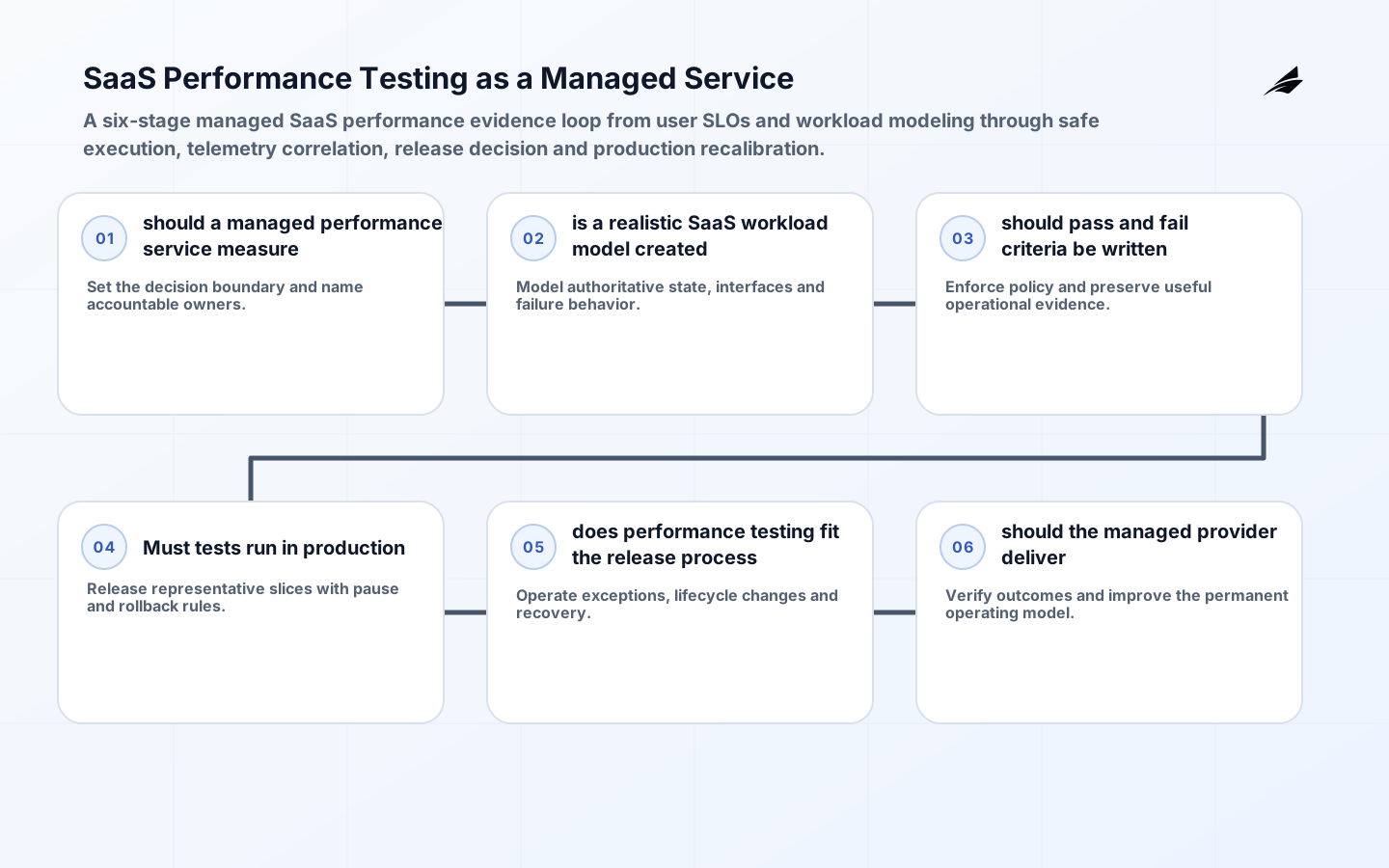
A SaaS performance testing managed service should give a product team repeatable evidence about user experience, capacity, stability and recovery. It should not merely generate a large request count and deliver screenshots. The provider must understand tenant behavior, critical journeys, asynchronous work, rate limits, caches, data volumes and production topology well enough to create a defensible workload model. The customer must provide business priorities, safe test environments and access to telemetry. Performance remains a shared engineering responsibility even when test execution is managed externally.
This FAQ explains how to scope the service, define pass criteria and turn results into release or capacity decisions. Microsoft’s Well-Architected guidance distinguishes load, stress, soak, spike and other tests because each answers a different question. Grafana k6 treats thresholds as explicit pass/fail criteria, while Google’s SRE guidance starts from service-level objectives that users can perceive. The managed testing scope guide and implementation checklist cover adjacent planning detail.
What should a managed performance service measure?
Begin with user journeys and business outcomes: sign in, search, create a record, import data, run a report, complete checkout or process a scheduled job. For each journey, identify response time, completion time, correctness and acceptable failure behavior. Percentiles matter because averages hide slow users. A target should name scope and measurement point, such as the 95th percentile server response for a specific API under a defined tenant mix, not a universal promise that the application is “fast.”
Include resource and dependency evidence. Correlate generated load with traces, service metrics, database waits, queue depth, cache behavior, third-party latency and autoscaling events. The managed team should explain which bottleneck limits throughput and what evidence supports that conclusion. Synthetic results without system telemetry can show that a limit exists but rarely identify a safe remedy. Production telemetry then checks whether the laboratory workload remains representative.
| Test type | Question answered | Typical evidence |
|---|---|---|
| Load | Does expected peak demand meet targets? | Journey percentiles, errors and saturation |
| Stress | Where does the system fail and how? | Breaking point, degradation and recovery |
| Soak | Does sustained use cause drift or exhaustion? | Memory, queues, storage and latency over time |
| Spike | Can sudden demand be absorbed safely? | Admission, scaling lag and backlog recovery |
How is a realistic SaaS workload model created?
Model arrival rate, concurrency, session behavior, journey mix, think time, payload size, tenant size and data distribution separately. One thousand idle sessions differ from one thousand simultaneous report requests. Use production aggregates with privacy controls to estimate distributions, then create named scenarios such as ordinary weekday, billing close, campaign spike and large-tenant import. Document assumptions and the date of the evidence so the model can be revised as the product changes.
Represent multitenancy explicitly. Include many small tenants, a few heavy tenants, background jobs and at least one noisy-neighbor scenario. Partition test identities and data so results can be compared by cohort. Preserve realistic authorization and rate limits instead of bypassing them, unless a component test intentionally isolates one layer. Seed enough data to exercise indexes, pagination and retention behavior. Empty databases produce reassuring but irrelevant results.
How should pass and fail criteria be written?
Translate product SLOs into test thresholds while acknowledging that a test environment is a model. Define latency percentiles, business error rate, throughput, queue age, job completion and resource headroom for each critical scenario. State the observation window and allowed exclusions. A single threshold across every endpoint encourages gaming and obscures user impact. Critical reads, expensive reports and asynchronous imports can have different targets when those differences are explicit and justified.

Add correctness and recovery gates. A run fails if responses are fast but records are duplicated, authorization breaks or delayed jobs never reconcile. After stress or spike tests, measure the time to drain backlog and return to target behavior without manual repair. Record autoscaling oscillation, rejected requests and dependency throttling. Thresholds should fail automation consistently; subjective review belongs in a separate investigation step, not in whether the test technically passed.
| Gate | Example definition | Why it matters |
|---|---|---|
| Journey latency | p95 for checkout below agreed target | Reflects common slow-user experience |
| Correctness | No duplicate order or cross-tenant response | Fast corruption is still failure |
| Headroom | Critical resource remains below saturation boundary | Supports forecast growth and failover |
| Recovery | Backlog drains within an agreed period | Shows the service returns to normal |
Must tests run in production?
Most high-load work should run in a controlled environment that resembles production in topology, configuration, data scale and dependency behavior. Record every material difference, including smaller databases, disabled integrations and different autoscaling limits. Use service virtualization carefully: a perfectly responsive stub can hide the dominant production constraint. Where a dependency cannot be exercised, model its latency, error and throttle distributions and label the resulting uncertainty.
Limited production experiments can validate assumptions when authorization, blast radius and rollback are strong. Use synthetic tenants, bounded cohorts, rate caps and an incident contact. Never treat customer traffic or data as test material without explicit governance. Coordinate with cloud and third-party providers where generated load could look abusive. The managed provider should supply a test safety plan and stop conditions before receiving production access.
How does performance testing fit the release process?
Use a layered cadence. Small component benchmarks and smoke scenarios can run on frequent changes. Representative journey tests run on release candidates. Larger capacity, soak and resilience exercises run on meaningful architecture changes or a scheduled cadence. Version scripts, datasets, workload models and thresholds with the application. A test result is reproducible only when code version, infrastructure configuration, region, data seed and generator capacity are recorded.
Compare against an approved baseline and explain statistically or operationally meaningful regressions. Avoid blocking every release because of natural variance; define repeat rules and confidence expectations. Conversely, do not normalize gradual decline by always comparing with the immediately previous build. Maintain a stable reference and a trend. If a release receives an exception, record owner, business reason, expiry and remediation rather than silently lowering the threshold.
What should the managed provider deliver?
The service should deliver maintainable test code, workload-model documentation, environment inventory, data-generation method, thresholds, raw results, telemetry correlations, findings with evidence and a rerun procedure. Reports should distinguish observed fact, interpretation and recommendation. Require the provider to transfer scripts and knowledge in portable formats. A glossy dashboard that the customer cannot reproduce creates dependency without improving engineering capability.
Define responsibility for test maintenance, triage and remediation verification. Set turnaround for a failed release gate, access controls for credentials and data, retention rules and change notification when tooling is upgraded. Review provider capacity: distributed generators can themselves saturate, distort timestamps or exhaust network paths. The provider should prove generator health and calibrate tests before attributing limits to the system under test.
How is the managed service accepted?
Start acceptance with a known performance defect or deliberately constrained component. The service should detect the regression, connect it to telemetry, fail the correct threshold and confirm the improvement after remediation. Run the same scenario twice to measure variance. Validate that test identities stay within their tenants and that generated data is removed or retained according to policy. Exercise an aborted run so operators know how to stop load safely.
Review value quarterly. Useful measures include critical journeys covered, escaped performance incidents, release regressions detected, time to diagnose, forecast accuracy and cost per meaningful run. Test count and generated requests are activity metrics, not outcomes. Retire scenarios that no longer represent the product and invest in emerging bottlenecks. The managed arrangement is healthy when internal teams understand and trust the evidence, not when only the supplier can interpret it.
Review saas performance testing as a managed service: practical faq as a living operating capability after launch. At each review, compare the documented boundary with production configuration, recent incidents, support work, supplier changes and measured outcomes. Sample evidence rather than relying only on aggregate status. Record decisions, owners and due dates, and retire controls or reports that no longer support a real risk or business need. This cadence keeps architecture, policy and day-to-day practice aligned as customer volume, integrations, regulations and team responsibilities change.
Key takeaways
- Base tests on user journeys and business SLOs, not arbitrary request counts.
- Model tenant mix, data scale, background work and failure recovery explicitly.
- Use deterministic thresholds for latency, correctness, headroom and recovery.
- Version scripts, data, environment assumptions and baselines with the product.
- Require portable assets, evidence-backed findings and reproducible reruns from the provider.
Frequently asked questions
How often should a SaaS product run load tests?
Run small regression scenarios frequently, representative release tests on candidate builds, and large capacity or soak exercises when architecture, demand or risk changes. The cadence should reflect consequence and cost; it should not wait for an annual event if the product changes weekly.
How many virtual users are enough?
There is no universal number. Convert observed or forecast arrival rates, concurrency, session duration and journey mix into a model. Validate generator capacity and increase load until the scenario target, saturation point or safety limit is reached.
Can a managed provider test the production SaaS service?
Yes, but only with explicit authorization, synthetic identities, bounded load, monitored stop conditions and an agreed incident path. Use production experiments to validate specific assumptions, not as a substitute for controlled environments and repeatable release tests.
Which performance testing tool is best?
Choose after defining protocols, browser needs, scale, scripting skills, observability integration and portability. Tool features matter less than a realistic workload model, reliable generators, explicit thresholds and evidence that the customer can reproduce.
Conclusion
Managed performance testing is valuable when it becomes a repeatable decision system for releases, capacity and architecture. The buyer supplies product intent and operational context; the provider supplies disciplined modeling, execution and analysis; both review the same evidence. With realistic tenant scenarios, production-linked telemetry, explicit thresholds and portable test assets, the service catches regressions before customers do and steadily improves the organization’s ability to reason about performance.