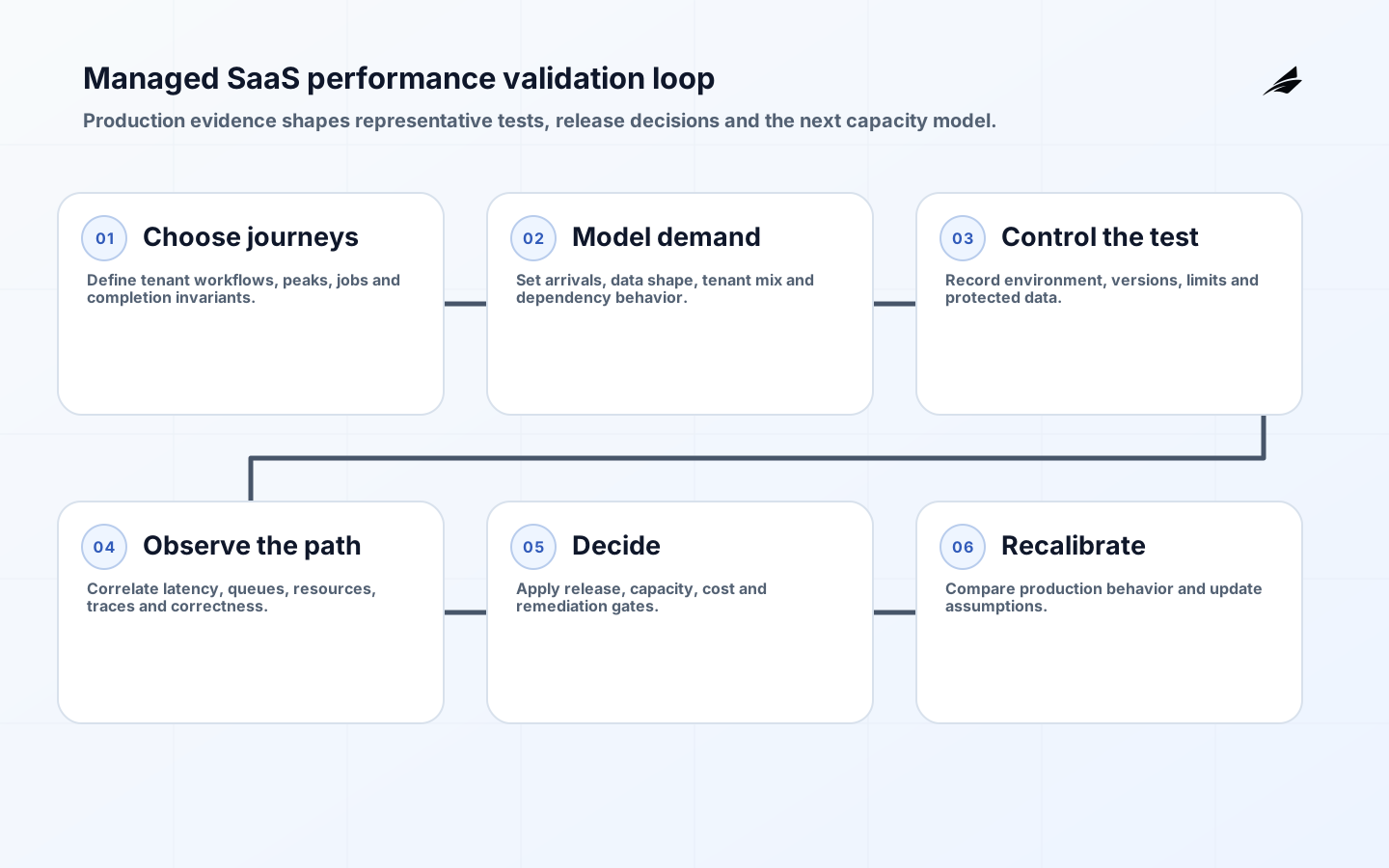
Performance testing for SaaS managed services is an ongoing engineering capability, not a one-time burst of synthetic traffic before launch. The service should prove that important tenant journeys meet defined latency, throughput, error and stability expectations under realistic demand, while also identifying the resource, dependency and data conditions that determine capacity. A provider can operate tools and environments, but the SaaS company must still define customer outcomes, commercial peaks, tenant isolation requirements and acceptable degradation. Without that shared model, a polished report can measure the wrong workload precisely.
This guide explains how to buy, build or govern the service. It complements the managed performance testing checklist and performance testing FAQ. Current Well-Architected guidance emphasizes early, regular testing in an environment that resembles production, with measurable criteria and production telemetry. The goal is a repeatable feedback loop that connects workload evidence to architecture, release and capacity decisions.
Define the managed service around SaaS risks
Begin with customer journeys and background work: sign in, search, create or update a record, upload a file, run a report, process a webhook, calculate usage, issue an invoice, import data and complete scheduled jobs. For each journey, document tenant type, data size, geographic path, concurrency, arrival pattern, dependency calls and completion criteria. Include administrative and recovery operations because a system that serves normal reads quickly but cannot drain queues or restore service after a surge is not performance-ready.
The service catalog should distinguish baseline benchmarking, release regression tests, planned peak validation, capacity experiments, endurance tests, stress and recovery tests, and production observation. State eligible systems, frequency, environment, traffic limits, data handling, notice periods, result turnaround and engineering support. Exclusions matter: a provider cannot guarantee third-party latency, production-like behavior from a tiny environment or business correctness without domain assertions. Make these boundaries visible before pricing.
| Test type | Decision supported | Useful evidence |
|---|---|---|
| Baseline | Is the current release within its normal envelope? | Latency distribution, throughput, errors and resource profile |
| Regression | Did a change materially degrade a key journey? | Comparable run, version and threshold result |
| Peak and endurance | Can the service sustain a forecast event? | Queue behavior, autoscaling, saturation and recovery |
| Stress and fault | How does the system fail and return? | Limit, failure mode, data integrity and restoration time |
Create a workload model that represents tenants and time
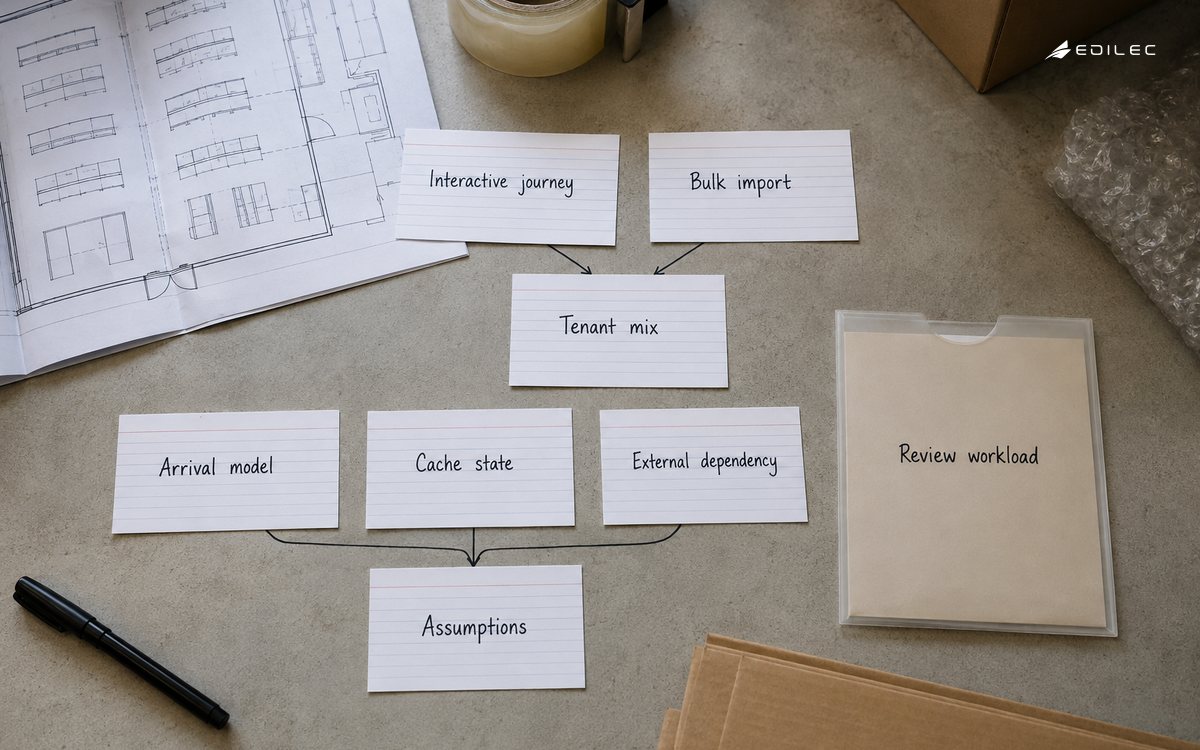
Concurrent virtual users are not a complete workload model. Use production observations to estimate arrival rates, journey mix, think time, payload sizes, tenant distribution, cache state, scheduled jobs and external events. Preserve privacy by using synthetic or carefully sanitized data. Model noisy-neighbor cases: one tenant may import a large catalog while many smaller tenants use interactive features. Also model cold starts, connection creation, cache expiry and daily or monthly billing boundaries. Document assumptions so results can be interpreted rather than copied into a capacity promise.
Calibrate test generators before trusting the application result. Confirm that load injectors have enough CPU, network and connection capacity; synchronize clocks; validate that generated requests reach the intended path; and ensure test credentials exercise real authorization without sharing one unrealistic cache key. Use open and closed workload models deliberately. A fixed-user model can hide overload through client-side waiting, while an arrival-rate model can reveal queue growth. Neither is universally correct; choose the model that resembles demand.
Control the environment and data without claiming false equivalence
A useful environment matches production in architecture, configuration, runtime versions, network path, autoscaling rules, data shape and observability. It does not always need identical scale, but any reduction must be explicit and justified. Infrastructure as code and automated configuration checks reduce drift. Record every test’s application version, infrastructure revision, feature flags, dataset, dependency stubs and regional placement. If a third party cannot be safely loaded, use a calibrated simulator and run a smaller contract test against the real service.
Protect tenant and customer information. Avoid cloning production databases without a governed masking process. Synthetic data should preserve distributions and relationships that affect query plans, serialization and permissions. Test accounts need minimum privileges and automatic expiry. Coordinate any production test with operations, security, providers and downstream owners; apply traffic caps and emergency stop controls. A test that resembles a denial-of-service attack or sends real notifications can create an incident rather than evidence.
Instrument the complete request and queue path
Collect user-visible latency and errors together with service metrics, traces, structured logs, queue age, database behavior, cache results, runtime pauses, network timing and infrastructure saturation. Use consistent trace context across asynchronous work where possible. Separate client, edge, application and dependency time. Percentiles need sample counts and aggregation boundaries; an average can hide a damaging tail. Track correctness signals as well, because fast duplicate processing or silently dropped work is not successful performance.
The managed provider should deliver a reproducible diagnostic narrative: what load was applied, what happened, where evidence points, which hypotheses were tested and what decision follows. Avoid presenting correlation as root cause. Repeat a focused experiment after a change and compare under controlled conditions. Preserve raw and summarized results with retention rules. Teams need access to evidence, scripts and configuration so that the service does not become dependent on a proprietary dashboard or one consultant’s memory.
Turn results into release and capacity gates
Define acceptance criteria before the run. Include a latency distribution for critical journeys, throughput, business error rate, queue drain time, resource ceilings and recovery behavior. Segment by tenant or payload class where consequences differ. A test should fail when an invariant breaks even if response time looks acceptable. Use a stable baseline plus an absolute customer target; a release can be faster than a poor baseline and still miss the service objective. Require review when a threshold is waived, with owner, reason, compensating action and expiry.
Run fast, lower-scale regression checks in delivery pipelines and schedule expensive full-system tests at risk-appropriate points. Trigger additional testing for database changes, caching changes, dependency upgrades, traffic shifts and major tenant onboarding. Connect capacity evidence to forecasts and cost. Headroom is not a single CPU percentage; it includes quotas, connection pools, partitions, queue consumers, rate limits and recovery time. Revalidate after autoscaling or resilience changes because each can alter performance under load.
| Acceptance dimension | Example definition | Required context |
|---|---|---|
| Responsiveness | Journey percentile remains within target | Region, tenant class and sample count |
| Capacity | Forecast load completes with agreed headroom | Workload mix, data volume and scaling policy |
| Correctness | No duplicate, lost or unauthorized business outcome | Reconciliation method and invariant |
| Recovery | Queues and latency return within a defined period | Fault, peak duration and operator action |
Price the service from cadence, fidelity and investigation depth
Cost drivers include scenario discovery, script maintenance, environment provisioning, data preparation, traffic generation, telemetry retention, specialist analysis, dependency coordination and remediation support. A simple URL test costs less than a multi-tenant workflow with asynchronous processing and reconciliation. Separate initial setup, recurring validation, event-based peak testing and investigation work. Cloud usage can be material; set budgets and automatic teardown. Ask whether scripts, dashboards and run history remain available when the engagement ends.
Avoid pricing only by virtual-user count. High user counts can be cheap to generate and expensive to interpret poorly. Commercial terms should identify run limits, failed-run treatment, environment responsibility, support hours, data handling, ownership of test assets and service-level targets for reports or urgent investigations. Measure the provider on reproducibility, useful defect discovery and decision turnaround rather than volume of tests. The objective is lower performance risk, not more charts.
Govern the managed service after onboarding
Assign a product owner for journey priorities, a service owner for operational outcomes, engineering owners for remediation and a provider lead for test execution. Review threshold breaches, flaky scenarios, production incidents, capacity changes and upcoming business events. Link discovered bottlenecks to an owned backlog and verify fixes. Sample supposedly successful releases against production telemetry. If test behavior drifts away from real traffic, update the model rather than protecting historical comparability at the expense of relevance.
Quarterly or major-change reviews should reassess journeys, tenant classes, data distributions, regions, dependencies and observability coverage. Retire obsolete scripts and credentials. Exercise provider exit by exporting scripts, datasets, configuration, baselines and findings. A mature service makes internal teams more capable of asking and answering performance questions; it should not create a black box that only the supplier can operate.
Key takeaways
- Scope the service around real SaaS journeys, tenant diversity and recovery work.
- Use production evidence to build workload models and disclose every assumption.
- Pair client results with complete-path observability and business reconciliation.
- Define gates before tests and connect capacity evidence to forecasts and cost.
- Retain ownership of scripts, baselines, data definitions and decision history.
Frequently asked questions
Should performance tests run in production?
Some carefully controlled validation may run in production when lower environments cannot reproduce scale or dependencies. Use synthetic tenants, traffic limits, explicit authorization, monitoring and an emergency stop. Most destructive stress testing belongs in an isolated production-like environment.
How often should a SaaS platform be load tested?
Use risk and change cadence rather than one calendar rule. Run lightweight regression frequently, fuller tests before major releases or peaks, and targeted tests after architecture, data, scaling or dependency changes. Production signals should continuously check whether assumptions remain valid.
Can a managed provider guarantee response time?
Only within a precisely defined scope and measurement method. End-to-end results depend on workload, customer networks and third parties. A credible provider commits to testing and operating responsibilities while making exclusions and shared dependencies explicit.
Conclusion
Performance testing for SaaS managed services succeeds when it becomes an evidence-producing operating loop. Real journeys become reproducible workloads; tests produce diagnostics; diagnostics become release, capacity and architecture decisions; and production observations improve the next test. Every handoff needs ownership and transparent assumptions.
The strongest acceptance question is not how much traffic a tool generated. It is whether the company can explain the system’s safe operating envelope, recognize when it is approaching a limit and recover without losing tenant correctness. A managed service that proves those capabilities can materially reduce growth and release risk.