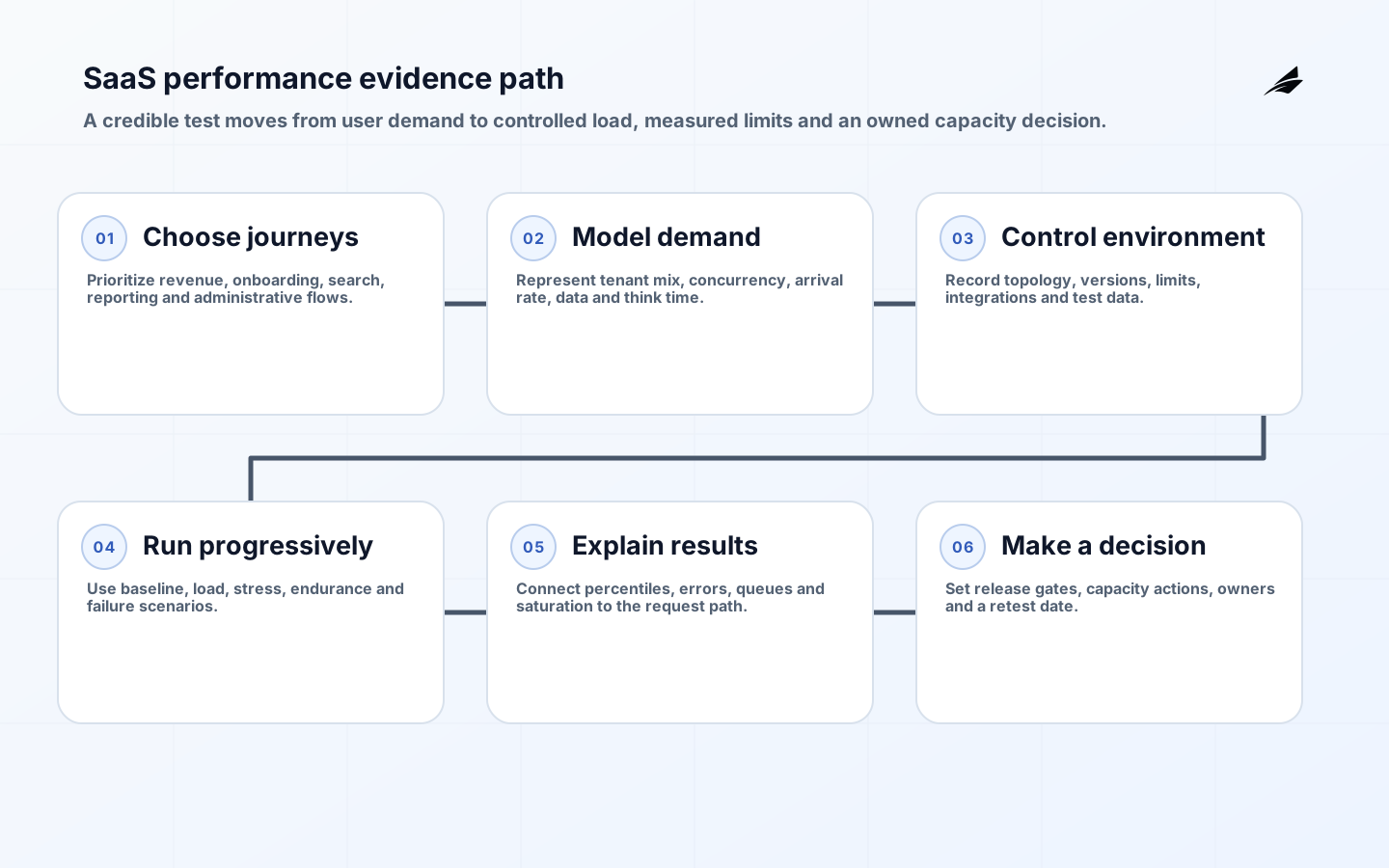
A SaaS performance testing implementation plan should answer a business question: can the product deliver important user journeys for the expected tenant mix while preserving isolation, reliability and cost boundaries? A single requests-per-second headline cannot answer that. SaaS demand combines interactive users, APIs, scheduled work, integrations and background jobs. Tenants have different data sizes and usage patterns, and one busy tenant can consume a shared bottleneck. A credible plan represents those conditions, defines acceptance before execution and preserves enough evidence to explain why a result changed.
This FAQ provides a repeatable plan for release testing, capacity planning and architecture validation. It aligns tests with service objectives, uses percentile distributions rather than averages, and treats the environment and data set as controlled inputs. The goal is not to manufacture an impressive peak. It is to discover the sustainable operating envelope, identify the first constrained dependency, verify recovery after overload and decide what must change before traffic grows. Results should be comparable across releases and useful to engineering, product, support and finance.
Which SaaS journeys should be performance tested?
Begin with journeys whose delay or failure creates customer, revenue or operational harm: sign-in, onboarding, search, checkout, core transactions, bulk import, reporting, billing, webhooks and administrator workflows. Map each journey across browser, API, queue, database, cache and external dependencies. Include asynchronous completion time, not only the first HTTP response. A report request that returns quickly but sits in a queue for twenty minutes has not met the user outcome. Rank journeys by consequence, expected frequency, growth and uncertainty.
Define a service-level indicator and test assertion for each journey. Examples include p95 interactive latency, successful completion ratio, maximum queue age, report freshness and webhook delivery delay. State where measurement occurs and which errors count. Separate product limits from accidental failures: a documented rate limit with a clear retry response differs from a timeout or corrupted result. Include accessibility and browser execution only where rendering affects the measured outcome; protocol-level tests are more efficient for sustained backend load, while a small browser layer validates real client behavior.
| Journey type | Primary measure | Important condition |
|---|---|---|
| Interactive transaction | p50, p95 and p99 completion latency | Realistic think time and authenticated session |
| Bulk or scheduled work | Queue wait and end-to-end completion | Representative item count and competing jobs |
| Integration or webhook | Accepted and delivered success ratio | Retries, idempotency and receiver latency |
| Reporting | Time to usable result and data freshness | Large tenant data and concurrent queries |
How is a realistic multi-tenant workload model built?
Use production telemetry, forecasts and contractual limits to define arrival rate, concurrency, session length, request mix, data distribution and regional pattern. Model tenants explicitly. Averages hide the long tail: many small tenants may share resources while a few large tenants generate expensive queries or imports. Build cohorts by size and behavior, then state how many of each participate in the test. Add background processing, scheduled tasks and integration traffic because they compete for the same databases, queues and network paths as interactive requests.
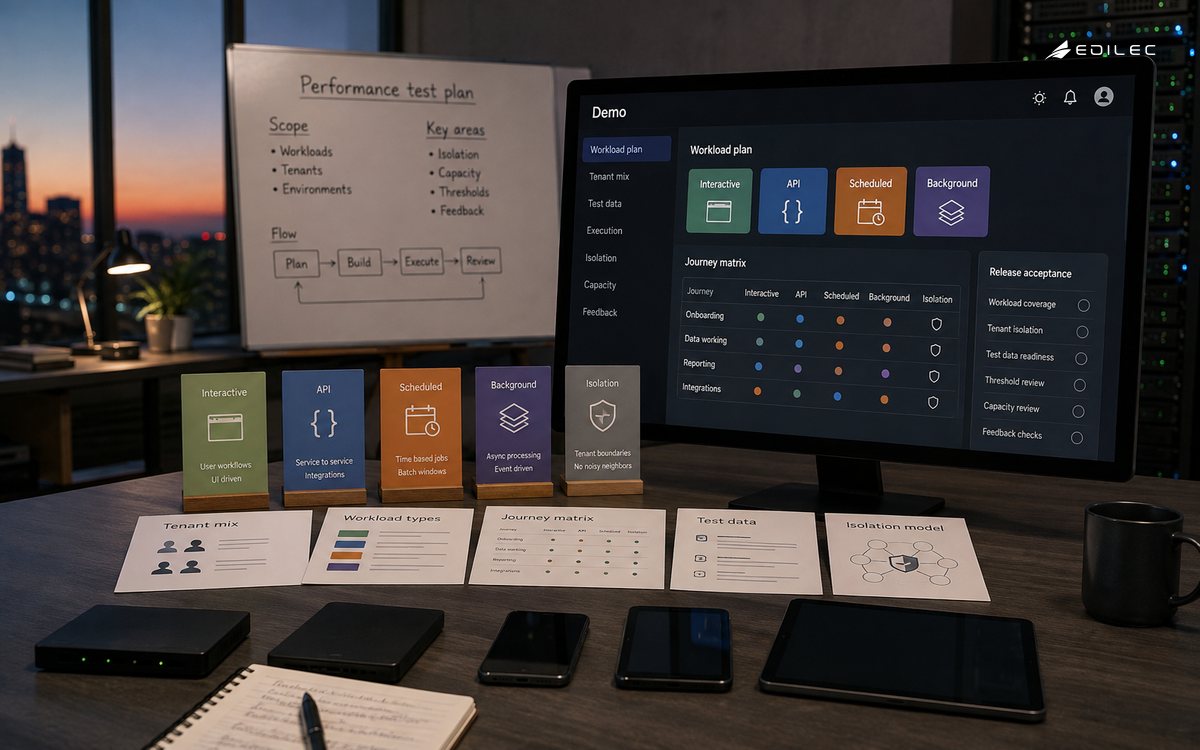
Keep the workload deterministic enough to compare releases but variable enough to expose contention. Seed accounts with realistic record counts and relationships. Rotate test inputs so caches do not make every request artificially warm. Include hot keys, large tenants and permission checks without using production personal data. Record the random seed, scripts, data version and test clock. When testing burst behavior, define the rise time and duration; instantly jumping from zero to peak can test autoscaling configuration, but it may not represent normal customer growth. Both scenarios are useful when labeled correctly.
How production-like must the environment be?
The environment must preserve the constraints that influence the question. Identical size is not always necessary, but topology, service versions, database indexes, network paths, quotas, autoscaling rules and downstream behavior must be documented. If the test environment is smaller, state the scaling assumption and validate it with targeted component tests. Shared nonproduction environments create noise from unrelated work; isolate the test window or measure competing activity. Never compare results from environments with unknown configuration drift.
External services require controlled treatment. Testing a third party without permission can violate terms and produce unstable results. Use a representative stub for sustained load, then run bounded integration tests against the real service to measure authentication, rate limits and failure behavior. Inject realistic latency and errors into the stub. Monitor both the load generator and the system under test: saturated generators can report false ceilings. Synchronize clocks and preserve deployment, feature-flag and configuration identifiers so traces and metrics can explain each run.
| Test stage | Question answered | Typical stop condition |
|---|---|---|
| Baseline | Is one representative journey correct and measurable? | Functional error or missing telemetry |
| Load | Does expected demand meet objectives? | Threshold breach sustained beyond allowance |
| Stress | Where is the first safe operating limit? | Error growth, saturation or unsafe queue accumulation |
| Endurance | Does long-running demand leak resources or degrade? | Trend exceeds recovery or capacity boundary |
| Recovery | Does the service return to normal after pressure? | Backlog, health or correctness does not recover |
Which thresholds should gate a release?
Set thresholds before the run using user objectives and capacity boundaries. Include latency percentiles, error ratio, throughput, queue age, data correctness and recovery time. Averages obscure slow users, so report distributions and cohort results. Guardrails should cover shared resources: connection pools, database locks, cache eviction, memory, CPU, storage latency and provider quotas. Define an observation window to avoid failing on harmless warm-up noise while still detecting sustained degradation. A release gate should be stable, explainable and tied to an owner.
Compare against both an absolute objective and a controlled baseline. A new release can remain under a loose SLA while regressing materially. Use repeated runs to understand variance and report confidence, not a single favorable execution. Treat failures as evidence, not as reasons to relax thresholds. If a threshold was unrealistic, change it through the same product and reliability governance used to define the objective. Preserve raw results and analysis so later teams can distinguish a real improvement from changed test data, environment or workload.
How do tests detect noisy-neighbor and isolation problems?
Run a normal cohort while one tenant performs an expensive but permitted operation. Compare latency, errors and resource consumption for unaffected tenants. Repeat at compute, queue, cache and database boundaries because isolation can fail differently at each layer. Verify that rate limits and quotas use the correct tenant identity, that background work carries tenant context and that one tenant cannot exhaust a shared connection pool. Include fairness measures such as per-tenant queue delay and throttling outcomes.
Isolation is also a correctness requirement. Load can expose missing tenant predicates, cache-key collisions and reused authentication state. Add assertions that every response, event and stored record belongs to the initiating tenant. Review logs for cross-tenant identifiers and test cancellation or retries during pressure. Where premium tiers receive dedicated capacity, confirm that routing and metering reflect the tier. Record the trade-off between shared efficiency and dedicated resources; performance testing should inform pricing and architecture, not quietly grant every tenant unlimited peak capacity.
How should performance tests fit into CI and release workflows?
Use layers. Run fast component benchmarks and a small smoke load on every relevant change. Run representative service tests on deployment candidates, and schedule heavier stress or endurance tests when architecture, data access or capacity changes. Version scripts with the application and review them like production code. Keep secrets outside scripts, generate unique run identifiers and publish results automatically. A flaky test should be investigated rather than retried until green; otherwise it trains teams to ignore the signal.
The pipeline should produce a decision record: code version, environment, workload, thresholds, result, anomalies and owner. Do not block every release on an unrelated long test. Map suites to changed components and service risk while keeping a periodic full-system test to catch interactions. After release, compare production indicators with the model. Differences reveal missing journeys, data distributions or dependencies and should update the next plan. Performance engineering becomes useful when production evidence continuously corrects the laboratory model.
Key takeaways
- Model user journeys, asynchronous work and tenant cohorts together.
- Define thresholds and stop conditions before execution.
- Control environment, data, generator capacity and external dependencies.
- Test noisy-neighbor behavior and tenant correctness under pressure.
- Feed production evidence back into scripts and capacity assumptions.
Frequently asked questions
How much traffic should a load test generate?
Test expected demand with forecast headroom, then explore stress separately to locate the limit. The multiplier should reflect growth, seasonality, failure scenarios and procurement lead time rather than an arbitrary ten-times target.
Can production be load tested?
Only with explicit approval, safeguards and a bounded scenario. Use synthetic tenants, rate limits, abort controls and active monitoring. Preproduction remains the primary place for destructive stress; small production probes help validate assumptions that a replica cannot reproduce.
What should happen after a successful test?
Publish the sustainable envelope, thresholds, configuration, evidence and next review trigger. Success expires when architecture, data distribution, traffic or dependencies change, so assign an owner and a retest condition.
Conclusion
A SaaS performance testing implementation plan is an evidence system for product promises and capacity decisions. It represents real journeys and tenant diversity, controls the conditions of the experiment and explains results through service telemetry. Start with expected demand, test isolation and recovery, then explore limits without confusing them with normal operation. When each run ends in an owned release or capacity action, performance testing becomes part of dependable SaaS delivery rather than a late-stage benchmark.