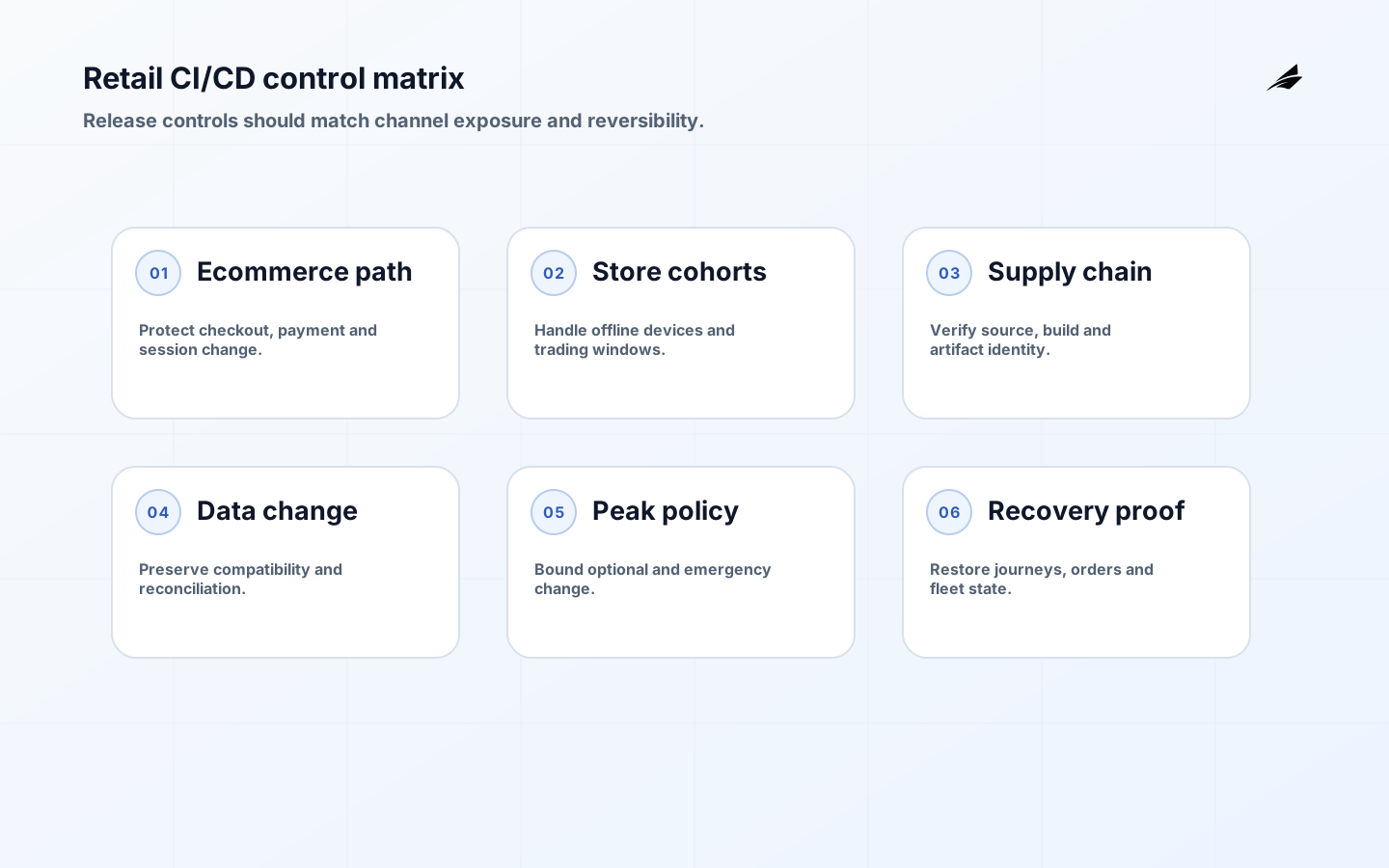
CI/CD modernization services for retail should make changes to commerce, stores, fulfillment and supporting platforms smaller, traceable and recoverable. Retail delivery is unusually exposed to synchronized demand, payment and inventory dependencies, long-lived store devices, third-party promotions and narrow trading windows. Modernization is therefore not complete when a new pipeline can deploy. It is complete when teams can prove which artifact reached which channel, detect customer impact quickly and recover without creating inconsistent orders, prices or stock.
This FAQ helps retail technology leaders evaluate the operating model behind the tools. The retail CI/CD scope and cost guide frames the investment, while the retail modernization checklist supplies delivery gates. The questions below focus on architecture, peak readiness, security, data change and evidence.
What belongs in retail CI/CD modernization?
Inventory every route from source to customer-facing behavior: ecommerce services, mobile applications, point-of-sale software, store servers, kiosks, warehouse systems, integration jobs, infrastructure and configuration. Record repositories, build workers, artifact stores, environments, approvals, deployment mechanisms, schedules and recovery methods. Map the business journeys each route can affect, including browse, price, promotion, checkout, refund, fulfillment and store opening.
Select one representative value stream rather than replacing all tools at once. A useful first slice crosses application code, infrastructure, a dependency and production telemetry but remains recoverable. Standardize artifact identity, evidence and promotion policy before interface cosmetics. The broad CI/CD modernization checklist can help teams distinguish essential controls from retail-specific operating requirements.
| Retail surface | Release concern | Evidence before exposure |
|---|---|---|
| Ecommerce | Traffic, sessions, payment and catalog compatibility | Journey tests and progressive health thresholds |
| Store software | Intermittent links, device diversity and trading hours | Cohort inventory and interrupted-update recovery |
| Mobile app | Store review lag and client-version overlap | Backward-compatible API and supported-version test |
| Fulfillment | Order state, carrier and warehouse integration | Replay-safe messages and reconciliation |
| Data jobs | Price, stock and customer timing | Freshness, completeness and rollback plan |
| Infrastructure | Shared blast radius and regional capacity | Policy checks, canary and restore evidence |
How should the software supply chain be secured?
Protect source branches and pipeline definitions, isolate build workers, use short-lived credentials, verify dependencies, scan for secrets, and produce an immutable artifact once. Promote the same artifact through environments instead of rebuilding it. NIST's SSDF gives producers and purchasers a common set of secure-development practices, including protecting software components and responding to residual vulnerabilities.

NIST SP 800-204D focuses specifically on software supply-chain security in CI/CD pipelines. Preserve the source revision, build environment, dependency inventory, checks, policy decisions, artifact digest, signer, approver and target. Protect artifact repositories against overwrite. A retail supplier that delivers binaries should provide equivalent provenance and vulnerability response commitments, not merely a file placed on a shared drive.
Do peak periods require a code freeze?
Peak periods require a risk policy, not an indefinite stop to all change. Classify changes by customer impact, reversibility, dependency and evidence. Reduce optional product change near major events, but preserve a tested path for security fixes, configuration correction and service recovery. A long blanket freeze increases batch size and leaves teams using a release process they have not exercised recently. Rehearse emergency authority, communications and recovery before the peak window.
The multi-agency safe software deployment guidance recommends a deployment program supported by verified processes, robust testing and measurement across well-defined phases. For retail, define pre-peak load assumptions, capacity margins, critical third-party contacts, stop conditions and store support. Validate the exact artifact and configuration that will run, then control late exceptions through explicit risk acceptance.
What testing should block a retail release?
Use risk-based gates. Every change needs fast unit and contract checks; critical journeys need integration and authorization tests; payment, promotion and inventory changes need business-rule reconciliation; high-impact surfaces need security and resilience checks. Test empty, duplicate, delayed and out-of-order events. Include a denied role, expired credential, unavailable dependency and partial data load. A green average response time cannot compensate for a checkout cohort receiving the wrong price.
Keep production verification narrow and observable. Synthetic journeys can confirm browse, cart and checkout behavior without creating uncontrolled orders. Progressive exposure should begin with internal, regional, store or traffic cohorts that represent real dependencies. Feature controls can separate deployment from exposure, but every flag needs an owner, expiry and tests for both states. Stop rules should be machine-readable where possible and understandable to the incident commander.
| Gate | Retail acceptance question | Failure action |
|---|---|---|
| Source | Was the change reviewed and attributable? | Block merge and identify the rule |
| Build | Are inputs declared and output immutable? | Discard artifact and retain diagnostics |
| Contract | Will clients, events and partners remain compatible? | Prevent promotion until compatibility is restored |
| Journey | Do price, cart, payment and fulfillment behave correctly? | Stop exposure and preserve test evidence |
| Cohort | Are customer and operational signals within thresholds? | Pause, roll back or disable the feature |
| Reconciliation | Do orders, money and stock agree after release? | Escalate and begin controlled repair |
How should teams handle database and event changes?
Design for version overlap. Use expand-and-contract schema changes, tolerant consumers and versioned events so old and new application instances can coexist. Backfills need checkpoints, idempotency, rate limits and reconciliation. A deployment rollback may be unsafe after customer transactions were written under a new model, so define roll-forward repair and business compensation as well as technical rollback. Preserve original events and adjustment records when financial or inventory state changes.
Exercise recovery with realistic transaction state. Restore data, replay bounded events, reconnect external partners and reconcile orders, payments, refunds and inventory. Store software needs a safe interrupted-update path and a way to report version and health after reconnect. Do not depend on an engineer visiting every location. Cohort deployment and remote diagnostics should make it possible to stop expansion before a local fault becomes a fleet-wide incident.
What should release observability show?
Connect release identity to customer and operational journeys. OpenTelemetry provides a vendor-neutral model for traces, metrics and logs. Tag service, environment, version, channel and cohort consistently, while excluding payment secrets and unnecessary customer data. Correlate technical signals with checkout success, order acceptance, store connectivity, fulfillment backlog and support contacts. Test that alerts still work after telemetry configuration changes.
DORA's current delivery performance metrics are useful at the application or service level: change lead time, deployment frequency, failed-deployment recovery time, change fail rate and deployment rework rate. Compare a service with its own baseline and investigate constraints. Do not rank store, mobile and ecommerce teams on one frequency target. Pair the measures with customer impact, peak readiness and reconciliation evidence.
How should the old pipeline and supplier be retired?
Run a defined comparison period in which both paths build from the same source and results are reconciled. Move one release class at a time, then remove old production credentials and disable the legacy route after acceptance. Archive the evidence needed for audit and incident investigation. Keeping an undocumented manual deployment 'just in case' creates a bypass that will be used under exactly the pressure when controls matter most.
Require the service provider to work in retailer-controlled repositories and cloud accounts, document platform decisions, disclose subcontractors and third-party tools, and transfer pipeline administration. Contracts should define vulnerability notification, artifact retention, privileged access, incident participation, support during peak windows and exit assistance. The general CI/CD modernization FAQ provides additional questions for vendor comparison and operating ownership.
What evidence should procurement request?
Ask vendors to map a proposed pipeline to one retail journey and show how a failed change is stopped, diagnosed and reconciled. Review an artifact record, policy exception, rollback or roll-forward exercise, store cohort report and peak support plan. Product demonstrations should use retailer-controlled identities and representative dependencies. A catalog of integrations does not prove that the provider can manage transaction state or field recovery.
Price discovery, migration, platform operation and peak support separately. Identify repository count, application profiles, store cohorts, retained legacy paths, data migrations and training assumptions. Contract for source and evidence export, privileged-access controls, vulnerability notification, service restoration and exit. Tie acceptance to a retailer-led release and failure exercise rather than pipeline installation or a predetermined number of migrated jobs.
Confirm ownership of reusable pipeline modules after the engagement. Retailer-specific policy, tests and deployment configuration should remain usable without a continuing consultancy license, while third-party components need clear terms and update responsibility. Record which team approves module changes and how an urgent upstream security fix reaches every consuming pipeline.
Key takeaways
- Map every release route to the retail journeys and operating windows it can affect.
- Build an attributable artifact once and protect the full source-to-production chain.
- Use a peak risk policy with an exercised emergency path instead of an unbounded freeze.
- Test transaction semantics, role denial, dependency loss and partial data, not only happy paths.
- Release by representative cohorts with measurable stop and recovery rules.
- Retire legacy credentials and manual routes after the modern path is accepted.
Additional retail CI/CD FAQ
Should stores and ecommerce use the same pipeline? They can share source, artifact, evidence and policy services, but deployment mechanisms should reflect connectivity, hardware, trading hours and recovery differences.
Can automated tests replace change approval? They can automate evidence and policy for routine changes. Consequential exceptions still need accountable authority, a reason and a recovery plan.
What is the best first modernization target? Choose an important, recoverable journey with enough dependencies to reveal real constraints. A cosmetic service that bypasses data and operations will not test the platform.
How is success measured? Look for smaller batches, shorter validated lead time, fewer manual release steps, lower change failure and rework, faster recovery, and stable customer journeys during change.
Conclusion: modernize the release decision, not only the tool
CI/CD modernization services for retail create value when every channel receives a traceable, tested and recoverable change through an operating model that works during peak pressure. Modernize one representative path, prove transaction and fleet recovery, measure customer outcomes, and retire the bypasses that made the old process fragile.