Managed cloud services for enterprise teams should be bought as an operating model with named outcomes, not as a vague promise that a provider will “run the cloud.” The enterprise remains accountable for business services, data use and risk. The provider can operate defined platform, security, reliability, change, support and cost processes. A useful agreement therefore identifies resources, events, decisions and evidence at every boundary between cloud provider, managed provider, platform team, workload team, security, finance and business owner.
NIST distinguishes cloud service models because customer control changes across infrastructure, platform and software services. Managed services add another responsibility layer rather than replacing that model. The AWS, Azure and Google architecture frameworks emphasize reliability, security, operations, performance and cost, while the FinOps Framework treats cloud value as a cross-functional practice. These ideas support a delivery plan that starts with discovery and service definition, proves operations on representative workloads, then transitions ownership with measurable acceptance and exit rights.
Define scope as a service catalog
List every managed service with eligibility, request path, service hours, target, dependency, exclusion and evidence. “Monitoring” must name telemetry sources, alert ownership, triage, escalation and response authority. “Backup” must name protected data, schedule, retention, failed-job handling, restore testing and who declares recovery. Distinguish standard operations, chargeable changes, projects and customer-retained work. Map each catalog item to business services so an infrastructure task is not mistaken for application or data accountability.
Create a responsibility matrix using verbs: design, approve, implement, verify, monitor and respond. One party can implement a policy while another approves risk and a third validates evidence. Define interfaces between parties, including asset synchronization, vulnerability intake, release notification, access requests and incident handoff. Include decision authority for isolating an account, exceeding a cost threshold, declaring disaster, accepting residual risk and communicating externally. A RACI without data, tools and timing is insufficient.
| Service area | Provider scope example | Enterprise-retained decision |
|---|---|---|
| Identity | Operate privileged access, federation health and reviews | Set access policy and approve exceptional authority |
| Platform | Patch, configure, monitor and scale supported services | Approve architecture and workload eligibility |
| Recovery | Run backups, restore tests and recovery procedures | Set business recovery objectives and declare disaster |
| Security | Collect telemetry, triage and perform authorized containment | Accept risk and direct notification |
| Change | Execute approved standard and emergency changes | Prioritize releases and accept business downtime |
| Cost | Allocate, forecast and identify anomalies | Approve budgets, commitments and product trade-offs |
Set service objectives and governance
Define objectives for the service behaviors parties can influence: incident acknowledgement and restoration, backup success and restore evidence, patch completion, change success, alert delivery, request fulfilment and cost anomaly response. Specify measurement source, clock, exclusions, maintenance treatment and reporting window. Monthly availability alone can hide a serious event or repeated short failures. Add maximum event duration and business-period protections where consequence warrants them.
Hold operational reviews that connect indicators to decisions. Review error budget, incidents, changes, recurring alerts, vulnerabilities, restore tests, capacity, cost, exceptions and customer experience. Repeated misses should create a corrective plan with owner and due date; service credits do not restore data or trust. Keep one decision log for approved risks and disputed measurements. Governance should be light enough to run every month and strong enough to change priorities.
Make security and compliance evidence contractual
Require least-privilege roles, strong authentication, time-bound provider access, separation of duties and customer visibility into material administrative actions. State whether the provider can contain an incident without customer approval and under which conditions. Document logging, vulnerability handling, key management, configuration baselines, data locations, subcontractors and evidence retention. Certifications are useful supplier assurance but do not prove that the customer workload is configured safely.
Define the assurance package before transition: architecture, data flows, inventory, privileged-access records, configuration findings, vulnerability status, change history, backup and restore evidence, incident records and relevant attestations. Name notification thresholds and preservation requirements. Align evidence to applicable obligations rather than collecting every report. The enterprise needs enough detail to govern its risk without requiring unrestricted access to the provider’s internal environment.
Model cost and commercial drivers
Separate underlying cloud consumption, managed-service base fees, per-resource or usage charges, projects, third-party tools and transition costs. Model at least current run rate, expected growth, committed-use decisions, recovery capacity, support tier and unusual events. A low base fee can be offset by expensive changes or excluded services. Define how new resources enter scope and how abandoned resources leave billing. Allocate provider work to services so optimization does not simply move cost into unmeasured labor.
Use FinOps practices to connect engineering, finance and product decisions. The provider can surface allocation, unit cost, forecasts and anomalies; product and business owners decide whether cost supports value. Define budgets and alert thresholds, but avoid indiscriminate shutdown automation. Rightsizing and commitments require reliability, demand and exit considerations. Report unit economics such as cost per tenant, transaction or environment where they can guide architecture and pricing.
Deliver transition in evidence-based waves
Discovery should inventory accounts, workloads, owners, data, dependencies, current incidents, changes, backup, vulnerabilities and cost. Resolve unknown ownership before the provider assumes tickets. Design the target catalog, tools, access, runbooks, service objectives and governance. Pilot representative workloads, including one critical service and one difficult operational pattern. Run shadow and reverse-shadow periods: the provider first observes customer operations, then leads while the customer verifies.

Acceptance must demonstrate normal and exceptional work. Exercise a failed backup, expiring certificate, privileged request, urgent vulnerability, scaling event, cost anomaly, application incident and recovery. Reconcile tools and records. Transfer only when both sides can identify current service state, authority and evidence. Expand by workload cohort, keeping clear entry criteria and hypercare. Do not declare transition complete merely because tickets route to a new queue.
| Delivery phase | Deliverable | Exit evidence |
|---|---|---|
| Discover | Estate, service, owner, risk and cost baseline | Critical unknowns assigned and bounded |
| Design | Catalog, responsibility, SLO, access and evidence model | All interfaces and decisions have owners |
| Prepare | Tooling, runbooks, integrations and trained roles | Representative events can be executed |
| Pilot | Shadow operation on selected workloads | Targets and handoffs hold under real work |
| Transition | Wave plan, hypercare and reconciled records | Provider leads and enterprise can govern |
| Operate or exit | Improvement backlog and portability package | Service can evolve or transfer without hidden dependency |
Plan improvement and exit before signing
The agreement should return current inventory, configuration as code, runbooks, architecture, incidents, changes, telemetry definitions, access records, cost data and open risks in usable formats. Define transition assistance, deletion evidence, subcontractor closure and revocation of provider access. Test portability during the service, not only at termination. Require the provider to maintain documentation as work changes so exit is not a reconstruction project.
Maintain an improvement backlog funded by recurring evidence. Automation should remove repeatable toil while preserving review for risky actions. Review whether alerts, queues and reports are still useful. Managed cloud service value appears in faster recovery, safer change, visible risk and better unit cost, not in the volume of tickets closed. Renewal should be based on those outcomes and the enterprise’s continuing ability to make informed decisions.
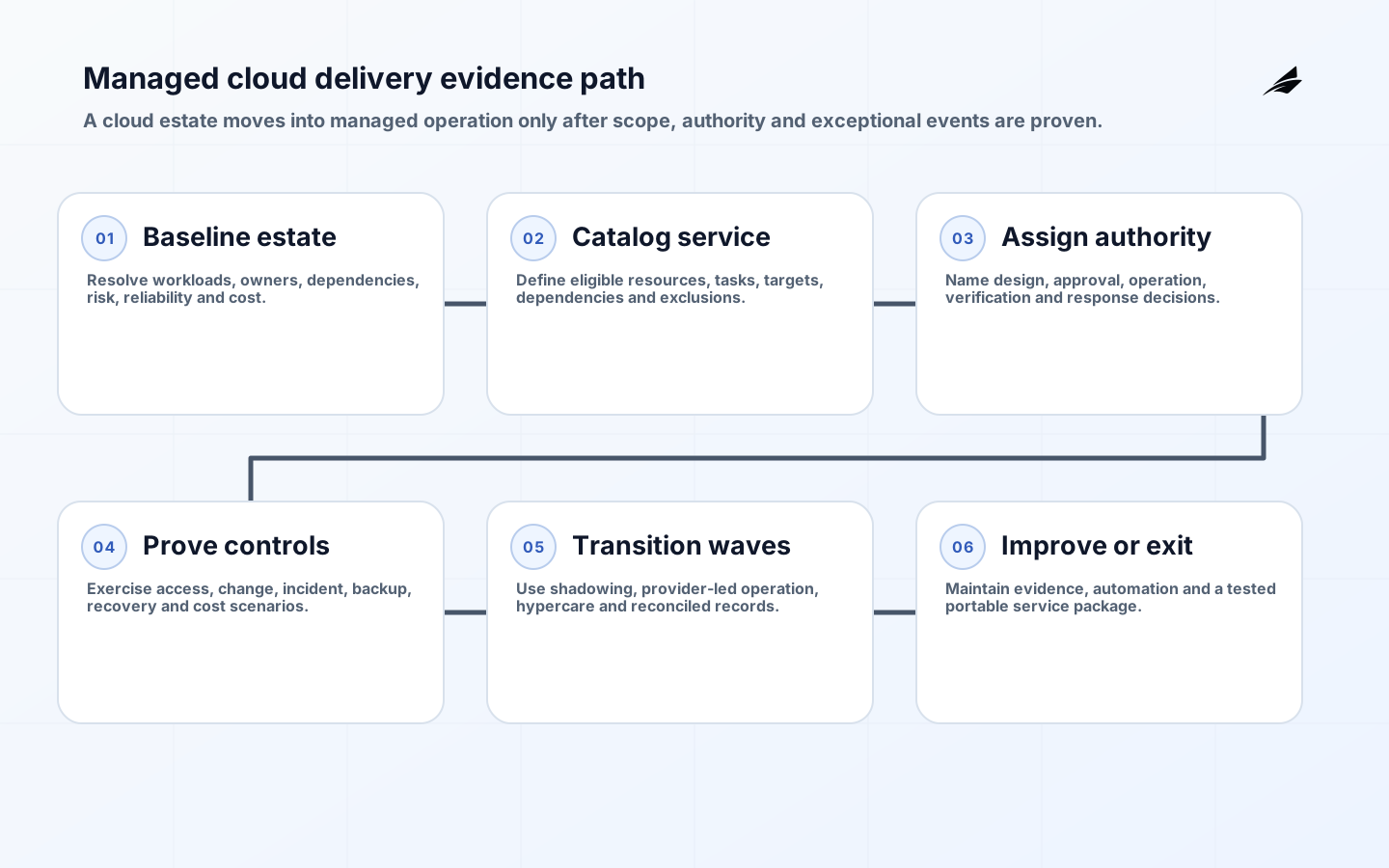
- Baseline business services, cloud estate, responsibilities, risk, reliability and cost.
- Approve a precise service catalog, exclusions, decision authority and evidence model.
- Configure least-privilege access, integrations, runbooks, SLOs and governance.
- Pilot representative operational events and disaster-recovery behavior.
- Transition by workload wave with shadowing, hypercare and reconciled records.
- Operate an improvement backlog and regularly exercise the exit package.
Evaluate provider capability with operational scenarios
During selection, give providers a sanitized estate and ask them to work through a failed deployment, suspected credential compromise, restore request, unexpected cost increase and critical dependency outage. Evaluate the questions they ask, the authority they assume, the evidence they preserve and the customer work they require. Verify named tooling, staffing locations, subcontractors and escalation paths. A polished service catalogue is not enough if the provider cannot explain how a real event crosses organizational boundaries.
Score proposals against service outcomes, transition risk, customer effort, evidence, improvement and portability. Price the baseline, growth, major incident, project changes and exit. Interview the people who will operate the account, not only sales and solution teams. Reference checks should discuss missed targets and difficult transitions. The final decision record should state why the selected model fits the enterprise and which risks remain customer-owned.
Key takeaways
- Buy defined service outcomes and evidence, not an undefined promise to manage cloud.
- Shared responsibility must cover decisions and interfaces as well as activities.
- Service levels should measure restoration, change, backup, security and requests alongside availability.
- Cloud cost management remains a joint engineering, finance and product practice.
- A tested exit package is part of service resilience, not only contract administration.
Frequently asked questions
What do managed cloud services usually include?
They can include platform operation, monitoring, incident response, backup, patching, security operations, change and cost reporting. The exact eligible resources, hours, targets, dependencies and exclusions must be stated in a service catalog.
How are managed cloud services priced?
Common models combine cloud consumption, a base service fee, resource or usage tiers, support level, projects and third-party tools. Compare total operating cost and service outcomes rather than one headline percentage.
Does a managed provider assume all cloud security responsibility?
No. Providers can operate controls, but the enterprise retains responsibility for business use, data classification, policy, risk acceptance and supplier governance. Responsibilities vary by cloud service and managed-service scope.
Conclusion
A managed cloud engagement succeeds when every important operational event has scope, authority, evidence and a tested handoff. A precise catalog, useful SLOs, visible security, shared FinOps and rehearsed transition turn provider activity into a governable business service. The same design also preserves the enterprise’s ability to improve, change supplier or bring work back in-house.