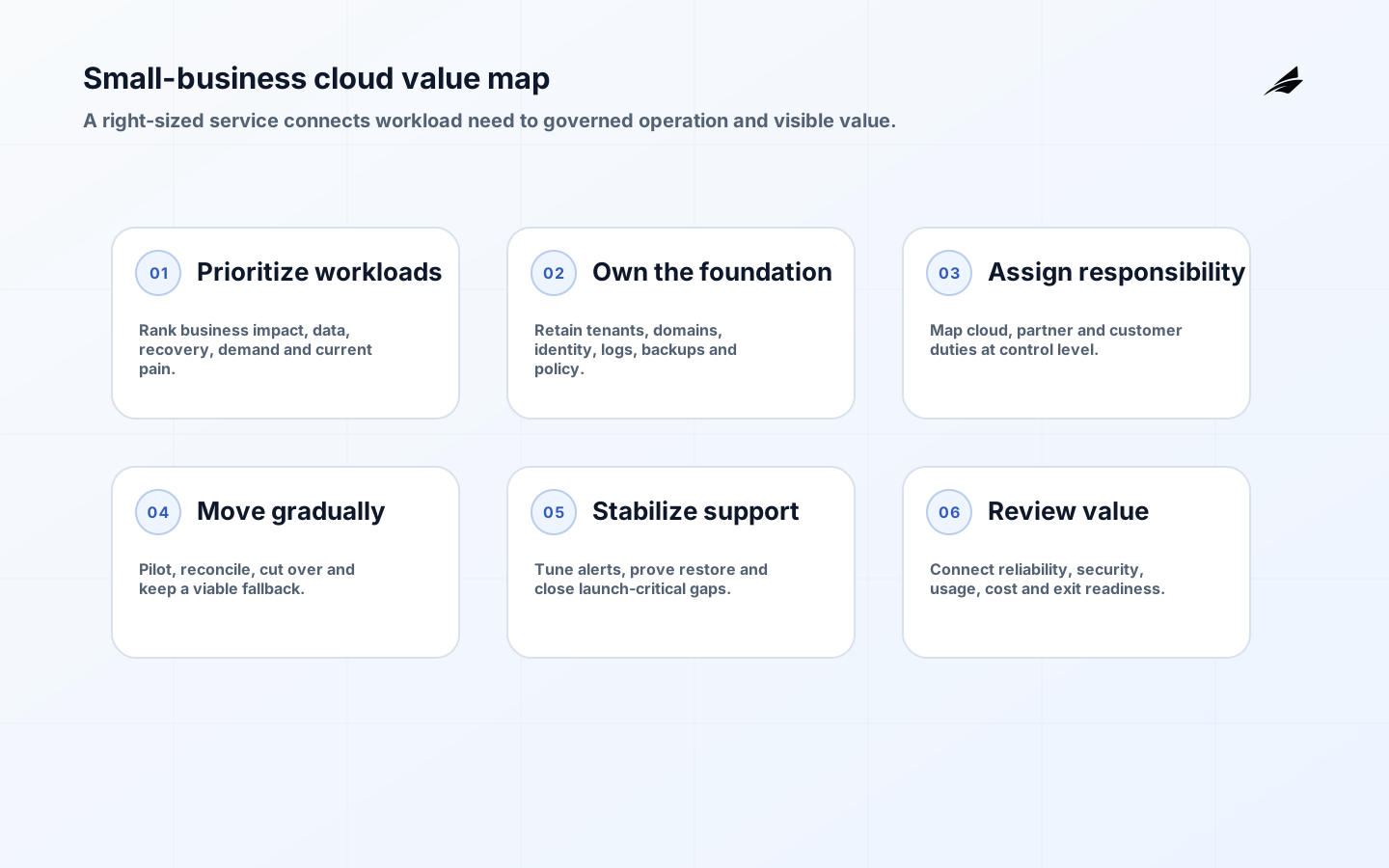
Managed cloud services for small business can provide architecture, migration, monitoring, security administration, backup, cost control and support without requiring a full internal platform team. The service is valuable when it closes a defined capability gap and leaves the business with clear ownership. It is risky when “managed” hides exclusions, weak recovery, uncontrolled consumption or dependence on one technician.
This guide helps an owner, operations leader or technology manager decide what to buy and how to deliver it. The small-business managed cloud checklist converts the plan into gates, while the managed cloud FAQ answers contract questions. Businesses that need delivery automation as well as operations should review the small-business Cloud DevOps guide.
Define the service around business-critical workloads
Start with the systems that support revenue, customer service, finance, operations and legal obligations. Record users, busy periods, data sensitivity, integrations, current pain, recovery needs and an accountable business owner. The NIST cloud definition describes on-demand access, resource pooling, elasticity and measured service. Those characteristics create flexibility, but measured consumption and rapid provisioning also require budget and configuration controls.
Choose service components from the gap. A company may need only monitoring, backup and monthly optimization for a stable SaaS-heavy estate. Another may require a landing zone, application migration, identity integration, security monitoring and on-call support. Separate included operations from project work. State whether the provider manages operating systems, databases, containers, application deployment, endpoint connectivity and third-party incidents. Name what remains with the customer.
| Need | Possible managed scope | Evidence to request |
|---|---|---|
| Reliable customer application | Monitoring, incident response, capacity and release support | Service objectives, alerts, runbooks and incident samples |
| Protected business data | Classification, access administration, backup and restore | Access reviews and measured restore reports |
| Predictable spend | Allocation, budgets, anomaly response and optimization | Workload forecast, unit-cost view and action register |
| Secure remote work | Federated identity, device posture and network controls | Authentication, revocation and access test results |
| Provider continuity | Documentation, customer-owned accounts and exit support | Export test, credential map and current architecture record |
Build a right-sized governed foundation

Small does not mean structure-free. Use separate production and nonproduction environments, federated identity, strong authentication, named owners, centralized logs, protected backups and policy-driven resource creation. Microsoft’s landing-zone guidance covers billing, identity, resource organization, networking, security, management, governance and automation. A small firm can implement a compact version while preserving those decisions.
Keep core ownership with the business. Cloud tenants, domains, billing relationships, encryption keys where feasible, source repositories and emergency contacts should not exist only inside the provider’s accounts. Grant the partner least-privilege roles and review them. Use infrastructure as code for repeatable setup and put changes through review. Establish a break-glass process that works when normal identity or the provider portal is unavailable.
Make shared responsibility explicit
Cloud does not outsource all security. The AWS shared-responsibility model distinguishes security of the cloud from customer duties in the cloud, with the boundary changing by service. A managed partner may perform customer-side tasks, but the contract must say which ones. Record who configures access, patches each layer, responds to findings, validates backups, owns application defects and communicates incidents.
Map controls to actual technology and people. The CISA Cloud Security Technical Reference Architecture addresses shared services, migration and cloud security posture management. For a small business, practical outputs include an asset list, identity diagram, approved services, logging baseline, vulnerability route, data-location record and exception register. Review them after major changes rather than treating compliance as an annual document exercise.
Deliver in reversible stages
Begin with discovery and a baseline. Inventory workloads, subscriptions, licenses, dependencies, credentials, backups and spend. Resolve unknown ownership before migration. Build the foundation, then move a bounded workload that exercises the operating model without carrying the highest consequence. Rehearse data transfer, cutover and rollback. Validate user transactions, integrations, monitoring, support and recovery. Keep the old path until acceptance criteria and retention obligations permit retirement.
Avoid a single date on which every system changes. Email, file collaboration, line-of-business applications, public websites and analytical workloads have different risks. Prioritize unsupported or fragile systems only after a viable target and fallback exist. Schedule change around business cycles. Give employees concise role-specific preparation, and keep a staffed route for launch issues. Capture decisions and known limitations in the normal work system.
| Stage | Primary deliverable | Go-forward decision |
|---|---|---|
| Discover | Owned inventory, dependencies, risk and cost baseline | Is the scope complete enough to design? |
| Design | Target architecture, responsibility matrix and estimate | Do controls and run cost fit the business? |
| Prove | Pilot with production-shaped demand and recovery | Does the service work beyond a demonstration? |
| Migrate | Reconciled wave, cutover record and fallback | Can users and operators accept the new path? |
| Stabilize | Resolved launch defects, tuned alerts and runbooks | Is steady-state support ready? |
| Improve | Quarterly reliability, security and value backlog | Should scope, architecture or provider terms change? |
Model cost before signing
Separate one-time discovery, foundation, migration and training from recurring cloud consumption, licenses, support and managed-service fees. Include network transfer, logs, backups, test environments, security tools, premium support and parallel running. Price expected growth and a peak or failure scenario. Ask how the provider charges for projects, after-hours changes, major incidents and exit assistance. Compare proposals on the same workload assumptions.
The 2026 FinOps Framework connects usage and cost to business value through collaboration among engineering, finance, product, procurement and leadership. A small business can apply that without a dedicated team: allocate costs to services, assign budget owners, alert on anomalies and review the largest usage drivers monthly. Reserve commitments only after demand is stable and ownership is clear. Optimize waste without removing resilience the business approved.
Evaluate the provider through evidence
Ask candidates to work through one representative incident, change and restore. Examine sample reports and runbooks with sensitive details removed. Verify staff coverage, escalation, subcontractors, certifications relevant to the scope, professional insurance and financial continuity. Check how the team handles privileged access, customer separation and employee departure. References should resemble your workload and operating hours, not merely your company size.
Use the AWS Well-Architected Framework or the equivalent provider framework to structure an architecture review, but require prioritized actions rather than a score. Contract for service outcomes, transparent tooling access, current documentation and improvement work. Service credits can support accountability, yet practical remedies are more important: corrective plans, executive escalation, termination rights for repeated failure and a usable exit process.
Control the risks that matter most
- Concentration: keep tenant ownership, exports, recovery knowledge and more than one emergency contact under customer control.
- Identity compromise: require phishing-resistant authentication where supported, short-lived privilege and immediate departure revocation.
- Cost shock: set budgets, allocation rules, anomaly thresholds and approval for expensive services before migration.
- False recovery confidence: restore representative applications and data, measure the result and fix dependency gaps.
- Unclear scope: maintain an asset-and-activity responsibility matrix and price normal lifecycle work explicitly.
- Change disruption: use production-shaped tests, staged release, rollback criteria and business-owner acceptance.
Example: moving a small professional-services firm
Consider a 60-person firm with file collaboration, a customer portal, accounting SaaS and one aging office server. Discovery identifies the portal and identity tenant as critical, while the server hosts an export that only finance uses monthly. The provider first secures identity, centralizes logging and proves cloud backup. It migrates the portal through a canary release, then replaces the monthly export with a managed scheduled job after reconciliation.
The contract covers portal monitoring, cloud administration, restore tests and monthly cost review; application feature work remains a project. The firm retains tenant and domain ownership, names an internal service owner and stores emergency recovery contacts outside the provider platform. Acceptance includes a portal rollback, a finance-output reconciliation and a restore observed by the customer. This bounded plan avoids treating every system as equally urgent while still removing the unsupported server.
- Sequence identity and recovery foundations ahead of workload growth.
- Move the customer-facing service with representative traffic and explicit rollback.
- Rebuild low-frequency legacy work only after its business output is understood.
- Keep provider operations and application change pricing visibly separate.
- Use customer-observed recovery and reconciliation as acceptance evidence.

Key takeaways
- Buy the capability gap around named workloads, not an undefined promise to manage cloud.
- Retain ownership of core accounts, domains, repositories, decisions and risk acceptance.
- Build a compact landing zone with identity, logging, backup, policy and cost controls before scaling.
- Migrate in reversible waves and accept each on user, security, recovery, operations and cost evidence.
- Review the provider against service value and exit readiness, not ticket volume alone.
Frequently asked questions
Are managed cloud services always cheaper than internal IT?
No. They can provide skills and coverage more economically than building a full team, but value depends on demand, scope and provider efficiency. Compare total cost, including cloud usage, licenses, internal oversight and exit, against the reliability and capability gained.
Should a small business use multiple clouds?
Only when a specific workload, customer obligation or resilience case justifies the additional identity, network, security, skills and cost complexity. Using SaaS from multiple providers is common; building the same application across clouds is a separate and more demanding decision.
How long should the first contract run?
Allow enough time to transition and stabilize, but preserve review points, performance remedies and practical exit rights. Tie renewal to current scope, service evidence and market fit. Avoid discounts that make data return or supplier change uneconomic.
Conclusion
Managed cloud can give a small business disciplined operations and specialist reach, but only when responsibility remains visible. Scope critical workloads, build a governed foundation, migrate gradually, model total cost and insist on recovery and exit evidence. The result should be a service the business can understand and steer, not a cloud estate it can access only through its supplier.