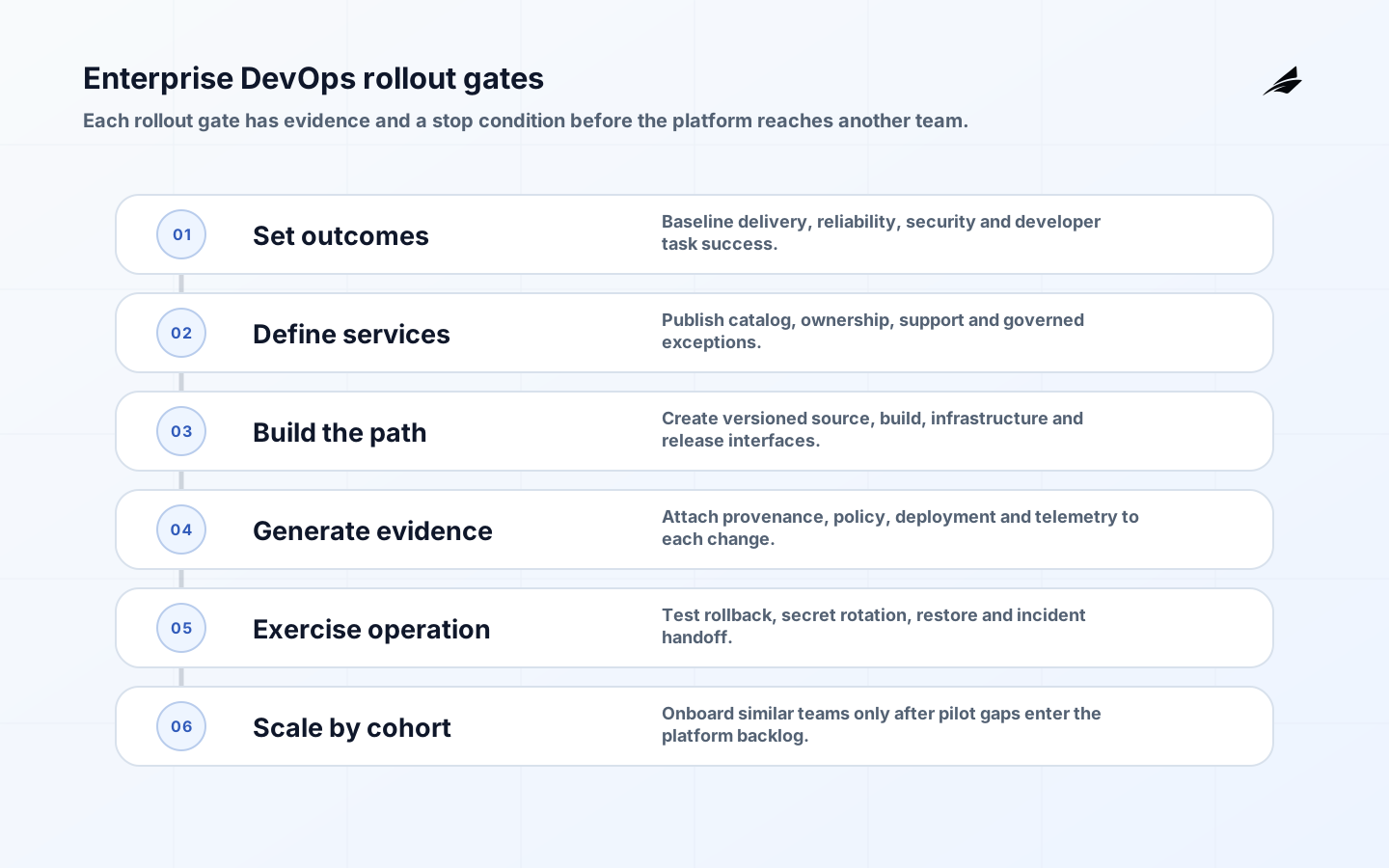
An enterprise cloud DevOps implementation checklist is useful only when it converts broad transformation language into services, controls and evidence that application teams can actually use. The goal is not to install a collection of CI/CD tools. It is to create a dependable path from an approved change to a running service, with clear ownership for source, build, release, infrastructure, telemetry, security, recovery and cost. Large organizations also need exceptions, legacy integration and regulated evidence without turning every delivery into a manual queue.
The checklist below organizes implementation into gates. Each gate has an outcome and proof, so leaders can stop unsafe scaling and teams can see what “ready” means. DORA’s current delivery measures cover throughput and instability; NIST’s Secure Software Development Framework supplies a common vocabulary for secure development; SLSA addresses build provenance; and OpenTelemetry defines interoperable telemetry signals. Use these references as design inputs, then adapt controls to workload consequence rather than imposing one pipeline on every system.
1. Define outcomes, service boundaries and baseline
Name the business and engineering outcomes before choosing a platform. Typical outcomes include shorter change lead time, lower failed-deployment recovery time, repeatable environment creation, stronger software provenance and less developer time spent on infrastructure tickets. Baseline the same product teams that will participate in the pilot. DORA cautions against comparing unlike applications or using a single metric as a target, so measure trends at the service or team level and pair speed with reliability and user outcomes.
Create a service catalog for the delivery path: repository onboarding, build, artifact storage, environment provisioning, secrets, deployment, policy checks, observability, incident support and decommissioning. Each service entry needs eligibility, inputs, outputs, owner, support hours, service objective and exception route. Document retained responsibilities. A platform team can operate pipelines and clusters while product teams remain accountable for application behavior, data correctness, dependency choices and on-call response.
| Gate | Required evidence | Do not scale when |
|---|---|---|
| Outcome | Baseline and target decision measures | Only tool adoption is measured |
| Service boundary | Catalog, ownership and support model | Critical handoffs are implicit |
| Architecture | Reference path and exception patterns | One pattern is forced on incompatible workloads |
| Security | Threat model and enforceable controls | Approval substitutes for verification |
| Operations | Telemetry, SLOs and recovery test | No team can restore the service |
2. Build a paved road with explicit escape routes
Design one reference path for a representative workload, not an abstract universal platform. Include repository structure, branch or trunk policy, build isolation, artifact naming, infrastructure modules, deployment strategy, configuration, secrets and telemetry. Prefer composable interfaces over a monolithic portal. Product teams should be able to use supported modules through versioned APIs or templates and understand what the platform changes on their behalf. Publish lifecycle and deprecation rules so upgrades are planned work rather than surprise breakage.

Treat exceptions as governed products. Record the unmet need, risk, compensating control, owner and expiry. A mainframe release, vendor package or safety-critical workload may require a different path, but it should still produce traceable artifacts, tested configuration and an operational handoff. Review exception patterns quarterly; repeated exceptions indicate a missing platform capability. Avoid bypass tokens that disable controls without preserving who approved the decision and what changed.
3. Secure source, build and release evidence
Map NIST SSDF practices into the delivery path: protect development environments and code, define security checks, review design, verify third-party components, test releases and respond to vulnerabilities. Isolate build workers from untrusted jobs, use short-lived workload identities, restrict release permissions and store immutable artifacts. Generate dependency and provenance records at build time. SLSA provides a graduated model for build provenance and tamper resistance; select a target appropriate to the risk rather than claiming the highest level without satisfying its requirements.
Policy checks should be versioned, testable and attributable. Distinguish hard release blocks from warnings and informational findings. A block needs a clear reason, owner and remediation path. Test policies against known good and bad fixtures before deployment, and roll out changes in observation mode where consequences justify it. Preserve the source revision, build environment, artifact digest, approvals, policy version and deployment result so an incident investigator can reconstruct exactly what reached production.
4. Make environments reproducible without hiding ownership
Represent cloud resources and policy as reviewed code where practical. Version modules, pin providers and dependencies, scan plans, and separate plan approval from execution for high-impact changes. Maintain state protection, locking, backup and recovery procedures. Detect drift, but do not automatically overwrite every emergency or provider-driven change. Classify drift, alert the owner and provide a safe reconciliation path. Test modules in disposable accounts or subscriptions before promoting them to the supported catalog.
Environment design should include account hierarchy, network boundaries, identity federation, naming, tagging, quotas, encryption, logging and lifecycle. Keep production permissions distinct from nonproduction. Use workload identity instead of long-lived cloud credentials wherever supported. Define who can create new regions, public endpoints, privileged roles and persistent data stores. Cost controls belong in the same path: every resource needs an owner and service, and deployment previews should surface material cost or quota changes.
5. Instrument the service and the delivery system
Instrument application and platform behavior using traces, metrics and logs with consistent service identity and environment metadata. OpenTelemetry can reduce vendor coupling, but semantic conventions and sampling still require governance. Start from user journeys and service-level indicators, then collect telemetry that explains those indicators. Define retention, access and sensitive-data filtering. A flood of unowned logs is not observability, and recording tokens, personal data or secrets creates a new incident surface.
Observe the delivery path itself. Track queue time, build duration, flaky checks, artifact promotion, deployment status, rollback and policy failures. DORA’s current metrics include deployment frequency, change lead time, failed-deployment recovery time, change fail rate and deployment rework rate. Use them to find constraints, not to rank individuals. Pair them with platform task success, adoption, developer satisfaction and reliability objectives so a faster pipeline that creates more operational toil is not celebrated as progress.
| Control plane | Minimum evidence | Operational owner |
|---|---|---|
| Source and build | Commit, isolated build, artifact digest, provenance | Developer platform |
| Infrastructure | Reviewed plan, module version, drift state | Cloud platform |
| Release | Policy result, approver, target, rollout and rollback | Product team |
| Runtime | SLIs, alerts, traces, logs and dependency health | Service owner |
| Security | Vulnerability, identity and exception records | Shared security ownership |
| Cost | Allocation, forecast, anomaly and commitment decision | Engineering plus finance |
6. Pilot, migrate and scale by evidence
Choose a pilot with real delivery pressure but bounded consequence, an engaged owner and enough architecture to exercise the path. Do not choose the easiest demo or the organization’s most critical system. Run discovery, onboard one environment, release a small change, trigger a rollback, rotate a secret, investigate telemetry and restore a component. Record developer effort and handoffs. The pilot is accepted only when the product team can operate the service with current documentation and support.
Scale in cohorts based on similarity and readiness. Provide migration tooling, office hours and a visible backlog. Do not count a repository as onboarded until it uses the production path and has an owner. Fund product management for the platform: interview users, prioritize friction, publish reliability and change notices, and retire unused capabilities. Keep a migration exit route for workloads whose economics or constraints do not fit. Centralization should reduce repeated work, not create an unavoidable bottleneck.
Worked example: onboarding a regulated API service
A regulated API pilot begins with one repository and two environments. The product team records a customer transaction SLI, recovery objective and data classification. The platform creates the account, workload identity, network, pipeline and telemetry from versioned modules. The release produces an immutable artifact, dependency record and provenance, then rolls to a small cohort. A deliberately failed health check stops promotion and proves rollback. A policy exception is created for one legacy dependency with owner, compensating control and expiry.
The pilot closes only after another engineer can release, investigate a trace, rotate a secret and restore data from the runbook. Delivery and security evidence is retrieved from the same change record. The team compares lead time, recovery and developer effort with the baseline, then adds the missing self-service and documentation work to the platform backlog before the next cohort.
Key takeaways
- Define measurable delivery and reliability outcomes before buying tools.
- Offer a supported reference path plus governed exceptions.
- Generate software supply-chain and release evidence automatically.
- Instrument both runtime services and the delivery system.
- Scale through tested cohorts and measure platform task success, not repository counts.
Frequently asked questions
Is platform engineering the same as DevOps?
No. DevOps describes capabilities and ways of working that improve software delivery and operations. A platform team can productize shared capabilities, but it succeeds only when product teams retain ownership and the platform makes good practices easier.
Should every team use the same CI/CD tool?
Not necessarily. Standard interfaces, evidence and control outcomes matter more than one user interface. Tool consolidation can reduce cost, but forced migration without workload fit may create fragile workarounds.
How long does enterprise implementation take?
A useful pilot can often run in weeks, while organization-wide adoption is a multi-quarter product effort. Duration depends on identity, network, legacy estates, regulatory evidence, team capacity and the amount of migration automation.
Conclusion
Enterprise cloud DevOps becomes durable when the delivery path is a product with users, service levels and evidence. Build the smallest complete path, test it under failure, and scale only after teams can release and recover without hidden help. The result should be faster learning with stronger control, not speed purchased by moving risk into production.