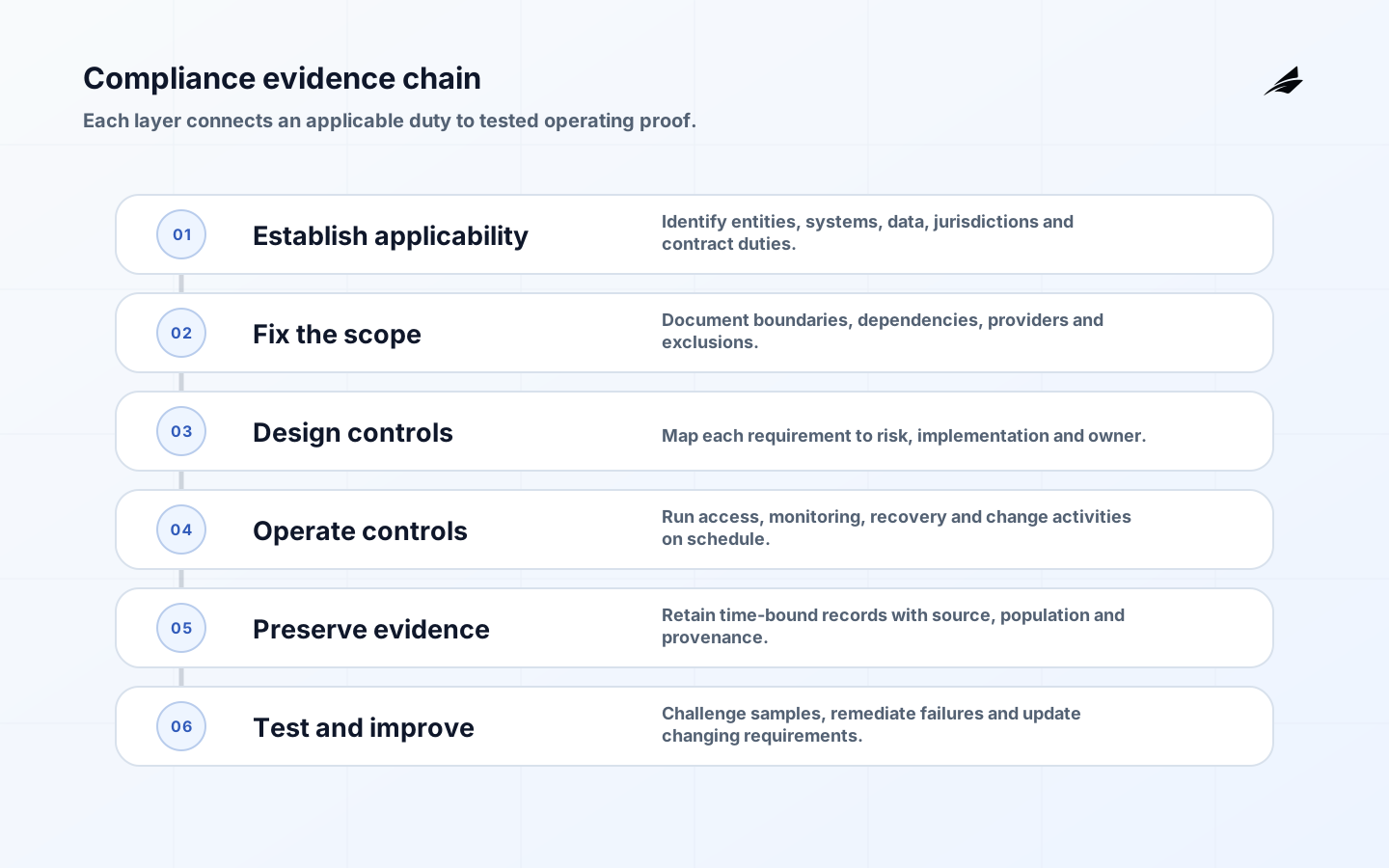
Compliance infrastructure services help an organization design, operate and evidence technical controls for systems subject to contractual, regulatory or internal requirements. They do not make an organization compliant by themselves. Compliance depends on scope, law, business process, people, vendors and continuing operation. This compliance infrastructure services FAQ addresses what buyers should ask, which evidence matters and how to prevent an audit project from becoming a short-lived collection of screenshots.
Teams already preparing delivery can use the compliance infrastructure implementation checklist. The infrastructure and cloud checklist covers broader platform readiness, while the cognitive infrastructure FAQ explores related governance questions for data-intensive systems. Legal counsel and qualified assessors should interpret obligations; engineering should translate approved requirements into operable controls and evidence.
What should compliance infrastructure services include?
A credible scope includes system and data inventories, requirement mapping, target architecture, identity, configuration baselines, logging, vulnerability management, backup and recovery, incident support, evidence collection, exception management and control testing. It also states exclusions. The provider should map each control to a risk or obligation, implementation, owner, frequency, evidence and test procedure. A platform feature is only a capability until it is configured, operated and reviewed in the customer's actual environment.
Use a framework to organize work without confusing it with law. The NIST Cybersecurity Framework 2.0 provides Govern, Identify, Protect, Detect, Respond and Recover outcomes that can connect leadership decisions to operations. A control catalog such as NIST SP 800-53 Revision 5 supplies more detailed control families. Tailor either to the applicable requirement and risk; do not claim certification merely because a control identifier appears in a spreadsheet.
| Service component | Provider output | Customer decision |
|---|---|---|
| Scope | System, boundary and data-flow inventory | Which entities and obligations apply |
| Control design | Mapped implementation statements | Risk treatment and control owner |
| Engineering | Configured preventive and detective controls | Approved exceptions and access |
| Evidence | Time-bound records and provenance | Retention and assessor access |
| Testing | Procedure, sample, result and defects | Risk acceptance or remediation |
Who remains accountable when a provider operates the controls?
The organization remains accountable for choosing its scope, interpreting obligations, approving risk and overseeing suppliers. A provider can perform control activities and produce evidence, but it cannot know every business use of data or accept consequences on management's behalf. Build a control-level responsibility matrix that distinguishes implementation, operation, monitoring, evidence review and approval. Include cloud and software vendors because their attestations usually cover only defined services, regions, periods and customer configurations.
Review subcontractors and support access, data location, breach notification, retention, deletion, audit cooperation and exit. Confirm that contract terms match architecture: a promise that data stays in one region is ineffective if support exports logs elsewhere. Require notification before material control changes. Preserve customer access to configuration and evidence during a dispute or transition. Service credits may address availability, but they do not replace indemnity, regulatory cooperation, corrective action or a workable exit plan.
How do requirements change across regulated contexts?
Start with applicability, not a universal compliance package. For U.S. regulated healthcare, the current HHS summary of the HIPAA Security Rule describes administrative, physical and technical safeguards for covered entities and business associates, including risk analysis and review of access records. It does not mean every health-related application is automatically a covered system. Identify the regulated entity, protected information, business-associate relationships and actual data flows before selecting controls.
For personal data within GDPR scope, Article 32 requires controllers and processors to implement security appropriate to risk and names measures such as confidentiality, integrity, availability, resilience, restoration and regular testing where appropriate. That is a risk-based duty, not a fixed cloud checklist. Sector rules, payment standards, government authorization programs and customer contracts can add requirements. Maintain one control implementation that maps to several obligations where the substance matches, while keeping distinct evidence for requirements that differ.
What makes control evidence credible?
Evidence should identify the system, control, period, population, action, actor and result. Prefer records generated by the operating process: version-control history, policy evaluation results, identity logs, ticket approvals, restore reports, vulnerability scans and incident timelines. Preserve original timestamps and source identifiers. A screenshot can illustrate a setting but rarely proves it remained effective throughout a period. Automate collection only after defining what the evidence proves, because automatically archiving irrelevant data creates expense without assurance.
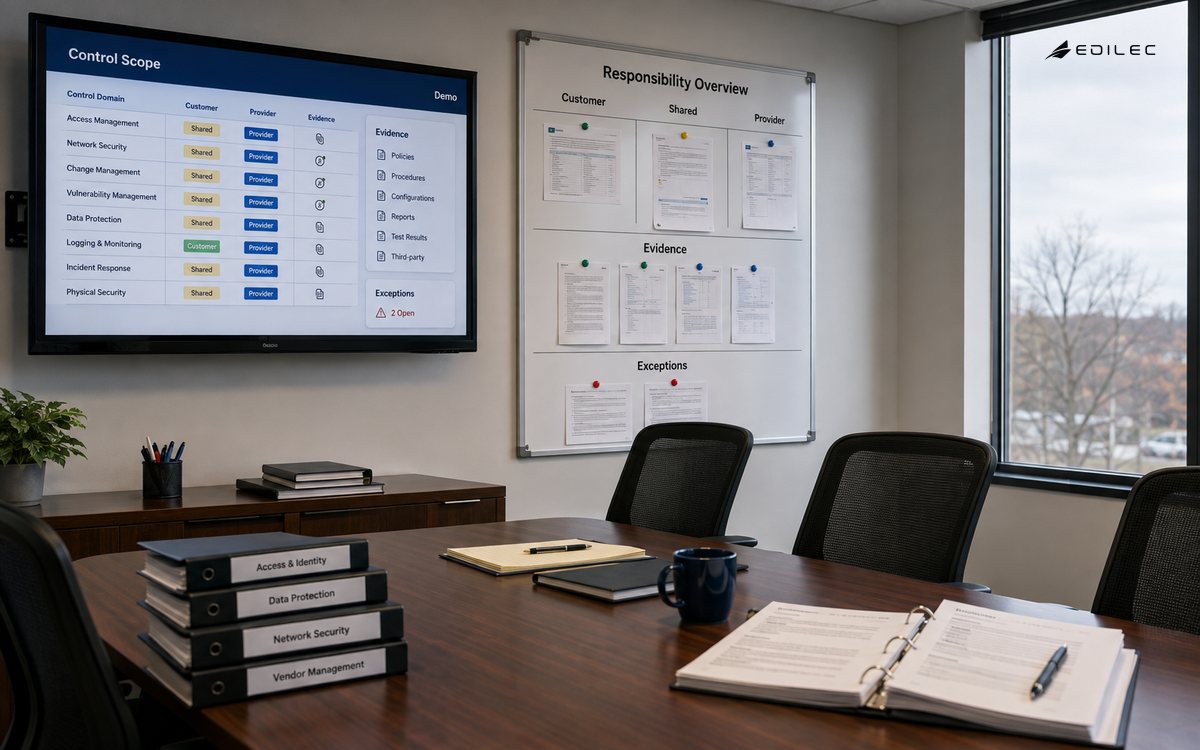
Design evidence at the same time as the control. If privileged access must be reviewed quarterly, define the authoritative population, reviewer independence, review criteria, treatment of service accounts, due date and retained sign-off. If encryption is required, record service, data state, algorithm or managed capability, key owner, rotation and exceptions. Sample-based tests need a documented population and defensible selection. Failed controls should create owned remediation records rather than disappear from the evidence repository.
| Evidence type | Strong example | Weak substitute |
|---|---|---|
| Configuration | Exported policy state tied to account and date | Cropped console screenshot |
| Access review | Complete population, reviewer decision and removals | Email saying access looks fine |
| Recovery | Timed restore plus business validation | Backup job marked successful |
| Change control | Approved request linked to tested deployment | Calendar invitation |
| Monitoring | Alert, triage record and response outcome | Dashboard without response history |
How much compliance work should be automated?
Automate deterministic checks with stable machine-readable inputs: encryption flags, public exposure, logging configuration, identity policy, unsupported versions, backup coverage and required tags. Policy as code can block or flag nonconforming deployments and produce consistent records. Keep human review for applicability, compensating controls, ambiguous data use, material risk acceptance and evidence interpretation. Every automated rule needs a version, owner, severity, test cases, exception path and handling for services the rule cannot evaluate.
Avoid treating a passing scanner as the control conclusion. Scanners can miss resources outside connected accounts, inherited permissions, application behavior and time-bounded failures. Reconcile tool coverage to the asset inventory. Test negative cases by deliberately creating a controlled violation and confirming detection, routing and remediation. Protect compliance tooling itself with least privilege and change control because it often has broad read access and can influence deployments across the estate.
Is an authorization or certification reusable?
Only within its stated scope and conditions. Examine the legal entity, services, regions, system boundary, control responsibilities, assessment period and report qualifications. The NIST Risk Management Framework illustrates a lifecycle of preparation, categorization, control selection, implementation, assessment, authorization and monitoring. An authorization still applies to a defined system and leaves organization-specific use decisions and responsibilities. Likewise, a vendor report may support due diligence without covering the customer's application configuration.
Create a reliance register for third-party evidence. Record which customer controls depend on each report, its validity period, exceptions, complementary user-entity controls and review owner. When a report expires or adds a qualification, trigger impact assessment. Do not upload sensitive assessment reports into a broadly accessible ticket system. Apply contractual restrictions, need-to-know access and retention rules while preserving enough evidence to show the review occurred.
What drives cost and timeline?
Cost follows scope uncertainty, number of environments, legacy variation, data sensitivity, integration count, evidence maturity, remediation depth and assessor involvement. Separate initial readiness, engineering remediation, independent assessment and continuing operation. A narrow, well-inventoried workload can progress quickly; a company-wide claim across unknown assets cannot. Ask proposals to state assumptions, customer effort, deliverables, excluded remediation, retesting and evidence handover. Reserve contingency for discoveries rather than disguising it as an optimistic fixed price.
Fund recurring work: access reviews, vulnerability remediation, supplier reviews, recovery exercises, awareness, incident tests, control monitoring and annual requirement updates. Measure aged exceptions, failed controls, evidence freshness, asset coverage, remediation time and repeat findings. Audit readiness is an operating property. A one-time project that produces policies but no scheduled control activity leaves the organization with documentation that becomes less accurate every month.
Define how disagreements are resolved. The control owner should decide whether evidence demonstrates operation; risk management should challenge material exceptions; legal or compliance should interpret the applicable obligation; and an assessor should apply the agreed criteria independently. A provider project manager should not quietly make all four decisions. Record conclusions, supporting facts and approval authority in a decision log. When an assessor requests a new artifact, determine whether it reveals a genuine control gap, clarifies existing evidence or changes scope before creating a manual process that will be difficult to sustain.
Key takeaways
- Compliance infrastructure implements and evidences controls; it does not transfer accountability.
- Map requirements to risk, implementation, owner, frequency, evidence and test procedure.
- Use operating records with provenance instead of relying on isolated screenshots.
- Automate stable checks while preserving human judgment for scope and risk acceptance.
- Budget for continuous control operation, evidence review and remediation.
Frequently asked questions
Can a provider guarantee compliance?
No provider can responsibly guarantee an organization's legal compliance across changing facts. It can warrant specific deliverables, qualified personnel, control operation and cooperation. Treat absolute claims as a due-diligence warning. Obtain legal interpretation and independent assessment where the stakes require them.
Do we need a governance, risk and compliance platform?
Not necessarily at the beginning. A platform becomes useful when control mappings, evidence schedules, owners and exceptions exceed what a disciplined repository can manage. Define the operating model first. Buying software before agreeing scope and evidence usually digitizes confusion.
When should an assessor become involved?
Involve the assessor early enough to confirm scope, criteria and evidence expectations, while preserving independence from management decisions and control operation. A readiness review before the formal period can reveal gaps. Do not ask an assessor to design the exact controls they will later judge if the applicable independence rules prohibit it.
Conclusion
Effective compliance infrastructure makes obligations traceable to controls that operate, produce evidence and improve when they fail. Clarify the boundary, tailor requirements to actual risk, test evidence quality and keep management accountable for decisions. The result is more than audit preparation: it is a defensible system for knowing whether important safeguards are working.