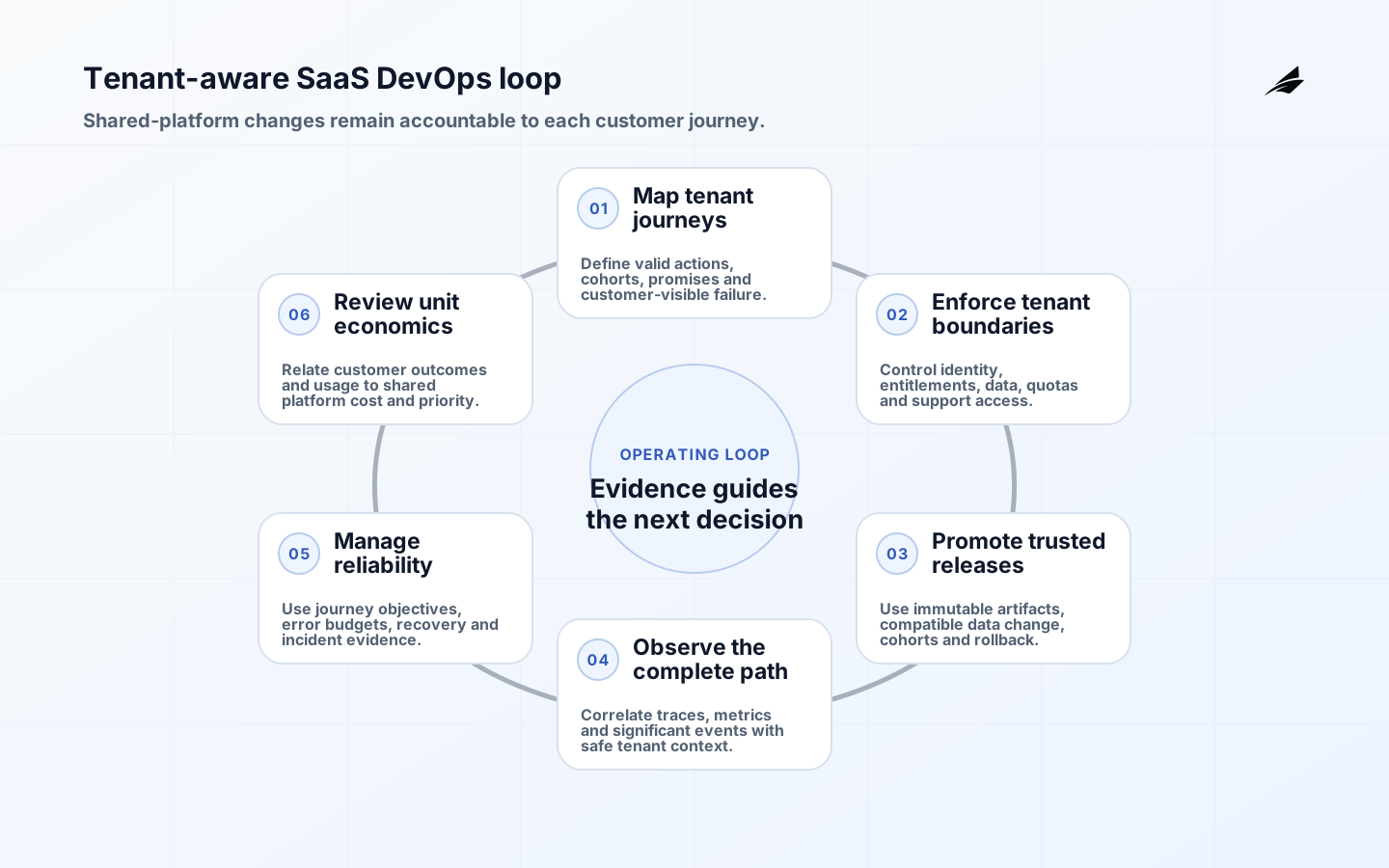
Cloud DevOps services for SaaS companies must protect two things at once: a rapidly changing product and a dependable shared service. The work spans tenant architecture, delivery automation, security, reliability, observability, support and cloud economics. A generic infrastructure service can keep resources running while missing tenant isolation, entitlements or customer-facing recovery. This FAQ focuses on the operating decisions that are specific to subscription software.
Teams defining a program can start with the SaaS cloud DevOps delivery plan and SaaS implementation checklist. Compare operational outsourcing through the managed cloud services guide and its implementation checklist.
What should SaaS cloud DevOps services cover?
The scope should follow a tenant request from edge to stored data and back. It normally covers cloud foundations, organization and tenant identity, network controls, runtime, data services, pipelines, secrets, observability, backup, recovery, incident response and cost allocation. It should also address plan entitlements, quotas, feature flags, integration credentials, data residency and tenant lifecycle. These product controls are where a technically healthy platform can still create customer harm.
Write a responsibility matrix for product, platform, security, data, support and finance. The provider may operate the platform, but the SaaS company should retain accountable owners for product behavior, tenant data, release risk and commercial promises. Define who can stop a deployment, disable a feature, access tenant data, communicate an incident and approve a regional move. Include third-party services such as identity, email, payment and analytics because they are part of the customer journey.
| SaaS concern | Required control | Operational evidence |
|---|---|---|
| Tenant isolation | Server-side authorization and scoped data access | Cross-tenant negative tests and access logs |
| Entitlements | Versioned plan and feature policy | Decision trace for each gated action |
| Release safety | Progressive exposure and reversible schema change | Cohort metrics, rollback and migration result |
| Reliability | Journey-level indicators and dependency objectives | Error budget, incident and recovery evidence |
| Unit economics | Tenant-aware usage and shared-cost allocation | Cost-to-serve trend by product segment |
How should tenancy influence platform design?
Choose isolation by consequence and scale, not by a simplistic shared-versus-dedicated argument. A service can share compute while isolating data through tenant keys and authorization, or dedicate resources for regulated or very large customers. Document the isolation unit for identity, runtime, queue, cache, database, encryption key, backup and observability. Test every route where a tenant identifier enters or changes, including background jobs and administrative tools.

Provision and retire tenants through one controlled workflow. It should create organization identity, roles, quotas, regional placement, encryption and retention settings, then verify them before activation. Offboarding should suspend access, complete export obligations, enforce retention and delete derived stores on schedule. Support impersonation needs explicit approval, short duration, visible indication and an audit trail. Engineers should not browse production tenant data through standing database privileges.
How can a SaaS team release frequently without losing control?
Use one versioned path from reviewed source to production. The NIST Secure Software Development Framework calls for organizational preparation, protected software, well-secured production and vulnerability response. Implement branch protection, dependency review, isolated builds, artifact signing, automated tests, policy checks and controlled deployment identities. Keep security findings in the same product backlog with severity, owner and due date.
Produce an immutable artifact once and promote it. The SLSA specification supplies progressive requirements for software supply-chain provenance and build integrity. Verification policy should reject an artifact from an unexpected source or untrusted build path. Record code, configuration, schema, feature flag and infrastructure versions for a release so support can reconstruct what one tenant experienced.
Progressive delivery needs meaningful cohorts. Start with internal or test tenants, then low-risk customers, a region or a defined percentage. Compare error, latency, correction, support and business measures with a control group. Keep database changes backward compatible while old and new application versions overlap. A flag is a temporary release control, not permanent undocumented product logic; assign an owner and cleanup date.
Which reliability measures matter for SaaS?
Measure complete customer actions such as sign-in, import, checkout, report generation or API write. Google's service level objective guidance defines an SLI as a quantitative service measure and an SLO as a target over that measure. Use valid events in the denominator, state latency thresholds and measurement windows, and segment important plans or regions where behavior differs. Infrastructure uptime alone misses partial and tenant-specific failure.
An error budget connects reliability to change. When consumption is normal, teams can release within the agreed policy. When a critical journey burns budget quickly, reduce exposure, fix the constraint or pause risky changes. Avoid a universal availability target for every feature. Billing and authentication may require stronger objectives than an asynchronous export. Test backups by restoring a tenant-scoped dataset and validating referential and authorization behavior, not merely checking job completion.
What telemetry should the service produce?
Collect signals that answer customer and operator questions. The official OpenTelemetry signals overview distinguishes traces, metrics, logs and baggage. Use trace context across APIs, queues and workers; metrics for aggregate behavior; and logs for significant events. Carry tenant context only through privacy-reviewed identifiers with controlled cardinality. Never place secrets or unnecessary personal content in telemetry.
A useful dashboard begins with journey success and latency, then shows dependency, deployment and saturation evidence. Add tenant distribution so one large tenant does not hide widespread smaller failures. Alerts should identify impact and an action, not duplicate every low-level signal. Preserve feature and deployment markers. Support needs a safe way to correlate a customer report with request, job, configuration and release history without receiving broad production access.
| Signal | Question answered | Release or operating action |
|---|---|---|
| Journey success ratio | Can customers complete the intended task? | Stop exposure when a critical cohort degrades |
| High-percentile latency | Are slower users receiving acceptable service? | Inspect dependency and saturation traces |
| Queue age | Is asynchronous work meeting its promise? | Add capacity, shed load or pause producers |
| Tenant error distribution | Is impact broad or isolated? | Disable a tenant path or investigate common dependency |
| Cost per completed action | Is efficiency changing with architecture or use? | Optimize the constrained resource without weakening the objective |
How should scaling and cloud cost be managed?
Load test representative tenant mixes, data shapes and background work rather than only a steady request rate. Establish saturation points and safe concurrency for databases, queues, external APIs and regional quotas. Autoscaling needs a leading metric, sufficient startup time and bounded maximum. Protect the service with quotas, backpressure and graceful degradation. A platform that scales compute cannot rescue an exhausted connection pool or serialized tenant operation.
Allocate direct resources by tenant where possible and distribute shared cost through a stable rule. Track cost per useful action, active tenant or revenue segment alongside reliability. Optimization can include storage lifecycle, request batching, right-sizing and architecture changes. Validate each saving under the same performance test and service objective. Reserving capacity may reduce price but creates commitment risk; keep demand assumptions and ownership visible.
How should a SaaS company evaluate a provider?
Ask the proposed team to explain a multi-tenant incident, a schema migration, a progressive rollout and a cloud cost investigation. Inspect anonymized examples of infrastructure code, pipeline controls, dashboards, post-incident records and recovery tests. Verify experience with the actual cloud, runtime and data technologies. Clarify after-hours staffing, subcontractors, staff replacement, intellectual property, data access and liability. A large tool catalog is not proof of coherent operations.
Use the current DORA delivery performance metrics as system signals: deployment frequency, change lead time, failed deployment recovery time, change fail rate and deployment rework rate. Join them with customer adoption, SLO performance, support demand and cost-to-serve. Do not use the metrics to rank engineers or require arbitrary deployment volume. The purpose is to reveal constraints in the shared delivery system.
Implementation example: reporting SaaS scale-up
A reporting SaaS product serves 600 organizations from one region. Releases are weekly, but large imports cause queue delays and support cannot tie a complaint to a job. The engagement first defines import accepted, processed and report available as separate journey measures. Trace context connects the API, queue and workers; a pseudonymous tenant key supports distribution analysis. The team establishes per-tenant concurrency, idempotent jobs and queue-age alerts.
A new worker release goes to internal tenants, then a cohort with varied data sizes. Database migrations remain compatible with the prior worker version. Rollback stops new deployment and safely requeues unfinished jobs. Cost reporting shows that one export format dominates compute, leading to batching rather than a broad capacity increase. The provider documents the path and pairs product engineers on an incident exercise. Acceptance depends on lower tail completion time, stable error rate and a demonstrated tenant-scoped recovery, not on infrastructure installation alone.
Key takeaways
- Map the service around tenant journeys and customer-visible promises.
- Define isolation, entitlement and support access at every shared layer.
- Promote trusted artifacts progressively with compatible data change and rollback.
- Use journey objectives, tenant distribution and tested recovery to manage reliability.
- Connect telemetry and cost to useful actions without exposing tenant data.
- Select a provider through operating evidence and preserve client capability to run or transfer the platform.
Additional SaaS DevOps FAQ
Is a single-tenant architecture always safer? No. Dedicated resources can narrow some isolation risks but add fleet, patching and consistency complexity. Select controls from consequence and prove isolation in the chosen design.
Should every service have an SLO? Prioritize customer-critical journeys and shared dependencies. An objective is useful only when measurement is trustworthy and the team will act on the result.
When should operations be managed externally? Consider it when scope is stable, evidence is accessible and internal owners remain capable of product and risk decisions. Do not outsource an undefined operating model and expect the contract to define it afterward.
How is handover accepted? The SaaS team should deploy, diagnose, restore, rotate credentials and explain cost using client-accessible systems. Revoke provider access and verify the export and deletion obligations at exit.
Conclusion
SaaS DevOps is the discipline of changing a shared product while preserving each tenant's trust. Design the service around customer actions, isolate authority and data, release through a verifiable path, and operate from journey evidence. The best cloud DevOps service leaves the SaaS company faster and more capable without making it dependent on invisible provider knowledge.