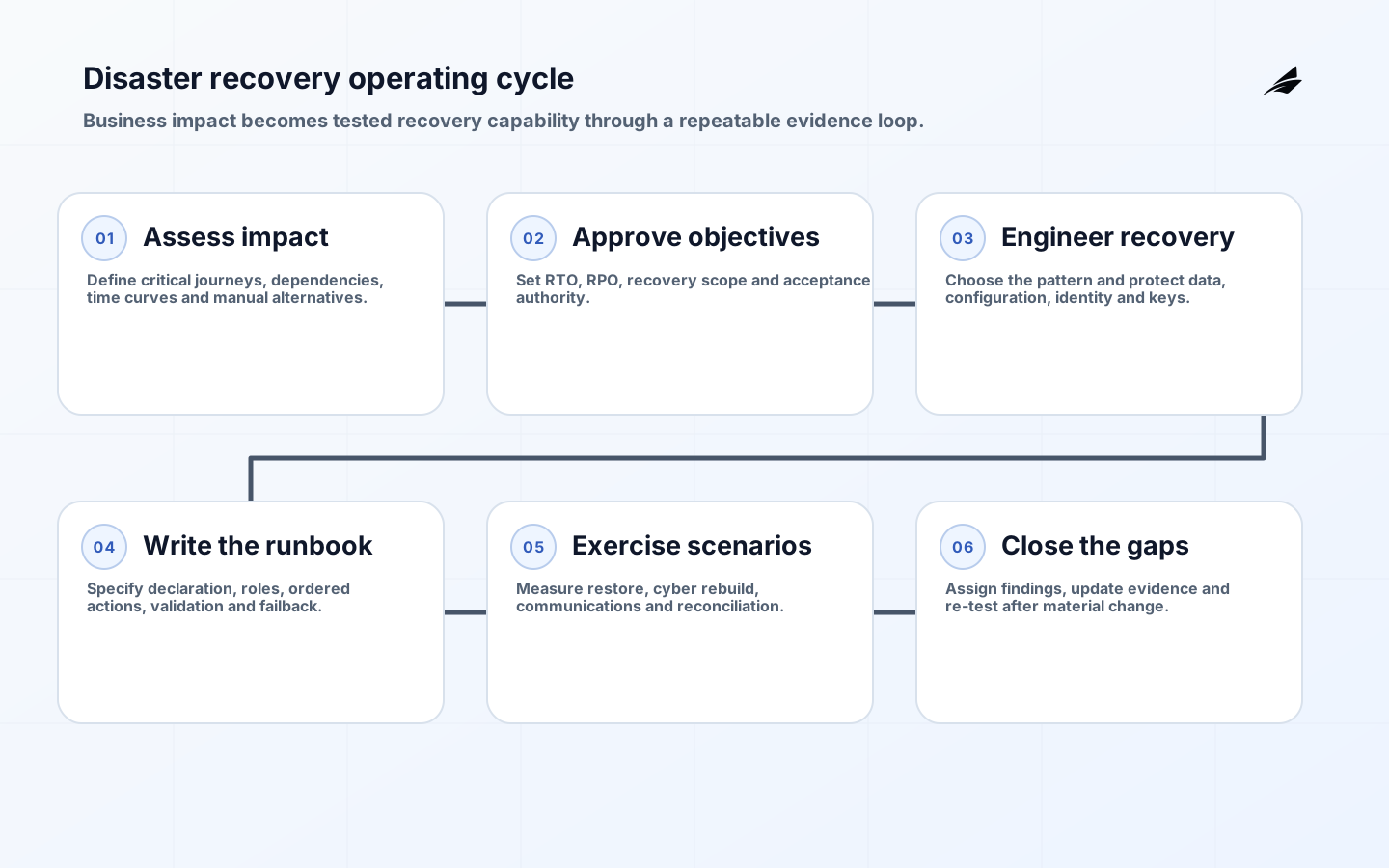
Disaster recovery planning is the work of restoring a business service, its data and its operating control after a severe disruption. It is broader than copying files and narrower than an organization-wide business continuity program. A usable plan connects business impact to recovery objectives, selects a technical pattern, identifies dependencies and gives named people a tested sequence for making the service dependable again. The plan must also cover destructive cyber events, configuration loss and supplier failure, not only a clean outage of one data center.
NIST SP 800-34 frames contingency planning as coordinated plans, procedures and technical measures for recovering systems, operations and data. Current cloud reliability guidance distinguishes an objective from demonstrated capability: recovery time objective and recovery point objective are business requirements, while actual recovery time and recoverable data are learned through tests. This FAQ turns those ideas into practical decisions for product, IT and cloud teams.
How do business impact and recovery objectives connect?
Begin with a business impact analysis at the service level. Identify customers and processes affected, financial and safety consequences, legal or contractual deadlines, manual alternatives and the point at which impact changes sharply. A payroll delay, online checkout outage and loss of industrial scheduling have different time curves. Map the technical service and its upstream and downstream dependencies. Recovery objectives chosen without those dependencies are often impossible: an application cannot recover in two hours if its identity provider or authoritative data source requires eight.
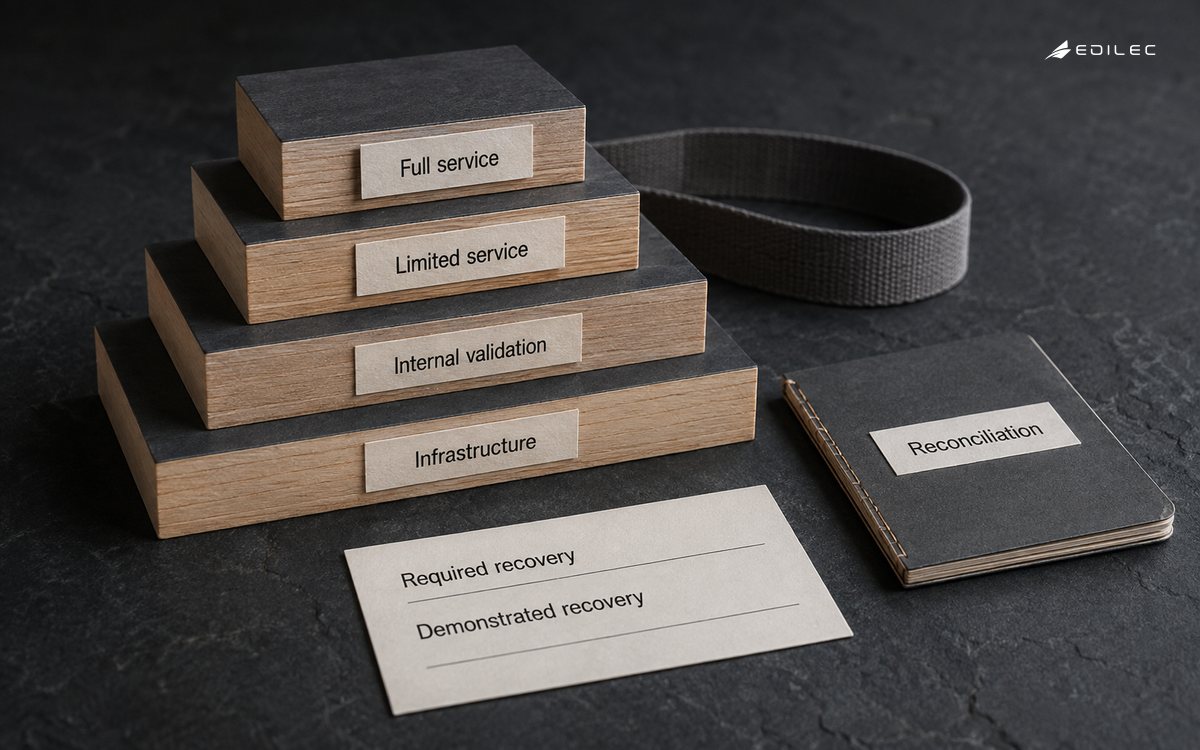
RTO is the maximum acceptable delay from disruption to restoration. RPO is the maximum acceptable period of data loss measured backward from the event. Neither is automatically zero, and stricter values increase complexity and cost. Define what “restored” means: infrastructure running, internal validation complete, a limited customer cohort served, or full traffic and reconciliation. Add a maximum tolerable outage and minimum service level where useful. Record who approved each objective and the impact evidence behind it.
| Planning term | Question answered | Evidence after a test |
|---|---|---|
| RTO | How long can restoration take? | Measured time to accepted service |
| RPO | How much recent data can be lost? | Newest verified recovery point |
| Recovery scope | Which journeys and regions return first? | Prioritized functions actually served |
| Manual workaround | What continues without the system? | Exercise result and capacity limit |
| Return to normal | How is temporary recovery reconciled? | Data and control reconciliation record |
Which recovery strategy should a team choose?
Choose the least complex pattern that meets the objectives and threat model. Backup and restore keeps recoverable data and rebuilds infrastructure after an event. Pilot light maintains core data and minimal services. Warm standby runs a reduced but functional copy. Active-active serves from multiple locations. Cost and operating complexity generally rise as recovery time and data-loss tolerance tighten. Replication improves availability but can copy deletion, corruption or ransomware, so it does not replace protected point-in-time recovery.
Match the pattern to failure scenarios. Availability zones may protect against local infrastructure failure but not every regional, identity or account compromise. A second region in the same administrative account may share a harmful control plane. A separate cloud may add independence but also creates configuration, skill and data-consistency burdens. Document what the design does not survive. Test provider quotas, DNS, certificates, keys, licensing, external allowlists and support access; these overlooked controls often determine actual recovery time.
What belongs in the recovery runbook and data plan?
A runbook needs trigger and declaration authority, communication channels, roles, prerequisites, ordered actions, verification, rollback and escalation. Use stable service and resource identifiers. Store the plan somewhere accessible when primary identity, network or collaboration systems are unavailable. Protect it from unauthorized changes and preserve an offline or independently accessible copy. Commands should be tested and explain expected results; a page of unexplained shell snippets is not an operable plan.
Classify data stores by authoritative source, consistency model, backup mechanism, retention and restoration sequence. Include object stores, queues, search indexes, secrets, configuration, audit records and third-party exports, not only the main database. Encrypt backups and separate access from production administrators. Test restoration into an isolated destination and verify application-level correctness. For transactions arriving during recovery, define replay, duplicate detection and reconciliation. A successful database restore can still leave billing, inventory or identity inconsistent.
How is cyber recovery different from ordinary failover?
Cyber recovery assumes the normal environment, identities, automation or data may be untrustworthy. Failing over a compromised configuration can reproduce the incident. Establish a clean administration path, protected backups, known-good infrastructure and criteria for selecting a recovery point. Preserve forensic evidence before destructive cleanup where legal and response needs require it. Coordinate incident command and recovery command so containment, investigation and restoration do not work against each other.
Practice credential rotation at scale, including service accounts, certificates, API keys and recovery personnel. Know which secrets are required to decrypt backups and how they remain available if the primary key service is affected. Rebuild from signed, verified artifacts and reviewed infrastructure definitions. Validate security controls before reopening traffic. Temporary recovery environments still need logging, access control and monitoring; “emergency” should not mean invisible administration.
| Exercise type | What it proves | Typical blind spot |
|---|---|---|
| Tabletop | Roles, decisions and communication | Technical actions remain untested |
| Component restore | Backup integrity and operator procedure | Dependencies and traffic not exercised |
| Regional failover | Capacity, routing and service sequence | Corruption or identity compromise excluded |
| Cyber rebuild | Clean control plane and trusted artifacts | Forensic and business reconciliation omitted |
| Return-to-primary | Failback and data convergence | Temporary changes are lost |
How often should recovery be tested and governed?
Set frequency from consequence and rate of change. Test component restores frequently, complete service recovery periodically and high-consequence scenarios at a cadence leaders can support. Re-test after major architecture, identity, data or supplier changes. Vary scenarios so teams do not rehearse only the easiest path. Include business validation and customer communication. Record actual recovery time, recovery point, manual interventions, failed assumptions and unresolved risk.
Every finding needs an owner and due date in the engineering backlog. Update plans, automation and training after the fix, then re-test material gaps. Review service inventory and recovery tiers at least annually and when business obligations change. Track percentage of critical services with current objectives, successful restore evidence, tested dependencies and expired exceptions. Avoid a dashboard that counts plans while ignoring whether they work.
Worked example: regional loss during a customer billing cycle
A subscription platform identifies invoice generation and payment posting as the critical journey. Business analysis sets a four-hour RTO and a fifteen-minute RPO during the billing window, with a longer objective at other times. The recovery design uses infrastructure definitions, cross-region protected backups and a warm application tier. Identity, DNS, signing keys, payment-provider allowlists and notification queues appear in the dependency sequence. The plan defines limited restoration as internal validation plus successful processing for a controlled merchant cohort.
The exercise declares the primary region unavailable and blocks its administrative path. A recovery lead creates the event timeline while technical owners restore the database, deploy signed artifacts and rotate exposed credentials. The team finds that the recovery region lacks one outbound allowlist and that a queue replay can duplicate a customer email. Both are corrected before traffic expands. Actual service restoration is three hours and the newest verified transaction is eleven minutes before declaration, so the objective is met for this scenario.
The exercise continues through return to normal. Transactions created in recovery are reconciled, temporary access is removed, DNS is restored gradually and customers receive an approved summary. Evidence includes timestamps, restored data checks, deployment digests, decisions, customer validation and corrective actions. This extended test matters because a system that can fail over but cannot safely converge creates a second outage later. The service owner reviews whether the result supports the approved business objective rather than declaring success from infrastructure health alone.
Three months later, a scheduled component restore verifies that backup format, decryption keys and operator access have not drifted. The full regional exercise remains annual, but smaller evidence is refreshed after database, identity and network changes. This risk-based cadence keeps the plan current without treating every test as a disruptive full failover.
The service register links every material architecture change to a recovery-review decision, so teams know when existing evidence is no longer representative.
Key takeaways
- Set recovery objectives from business impact and dependent services.
- Choose the simplest recovery pattern that meets tested objectives.
- Protect configuration, identities, keys and runbooks as well as data.
- Design cyber recovery around a potentially untrusted production environment.
- Measure actual capability through varied exercises and close every finding.
Frequently asked questions
Is high availability the same as disaster recovery?
No. High availability handles expected component failures during normal operation. Disaster recovery restores service after a severe event that exceeds those controls. A system needs both at levels justified by impact.
Should every service have zero RPO and RTO?
No. Near-zero objectives can require costly active architectures and complex consistency. Choose values from business consequence and verify that dependencies can meet them.
Who owns the disaster recovery plan?
The business service owner is accountable for objectives and acceptance. Engineering, security, infrastructure, suppliers and continuity teams own parts of implementation and response. One named coordinator should maintain the integrated plan.
Conclusion
Disaster recovery planning is credible when a service owner can state the impact, approved objectives, recovery pattern, dependent sequence and latest measured capability. Write plans for stressed operators, test them under realistic failure and treat every gap as engineering work. The finished artifact is not a document; it is a practiced ability to restore trustworthy service and reconcile the business afterward.