Backup and restore testing for SaaS teams is the practice of proving that a usable service can be reconstructed from protected recovery points within approved data-loss and downtime limits. A dashboard showing successful backup jobs proves only that a provider accepted a copy operation. Recovery depends on the backup’s contents, encryption keys, identities, infrastructure, application version, dependency configuration, data consistency, runbook, and the people authorized to make business decisions during an incident.
The test program should connect to the service’s reliability model. Use the service level objectives guide to define user-facing recovery expectations, the platform engineering paved road to standardize repeatable controls, and the edge and serverless tradeoff guide when provider-managed state or distributed execution changes what must be reconstructed.
Define recovery from business impact
Set a recovery time objective (RTO) for the maximum acceptable delay before the required service is restored and a recovery point objective (RPO) for the maximum acceptable data-loss interval. Define them per business service and data class, not as one aspirational company number. Add a maximum tolerable outage, minimum viable service, restoration priority, and decision owner. Recovery of read-only account history may precede exports, billing changes, or administrative configuration.
Describe acceptance in user terms: customers can authenticate, tenant boundaries hold, a representative transaction reads and writes correctly, background work resumes without duplication, integrations reconcile, and support can explain state. Include legal, contractual, safety, and records obligations. An RTO ends only when the agreed minimum service is usable and verified, not when a database process reports completion. Measure the whole timeline from incident declaration through business validation.
| Recovery objective | Definition for the test | Evidence |
|---|---|---|
| RPO | Oldest acceptable committed business event missing after restore | Compare restored transaction markers with the incident timestamp |
| RTO | Time from declared activation to validated minimum service | Timestamp each recovery and approval stage |
| Integrity | Required records and relationships are correct | Checksums, constraints, reconciliation, and journey tests pass |
| Isolation | Restored tenants and administrators remain separated | Cross-tenant and privilege tests deny unauthorized access |
| Continuity | Essential users can complete the degraded workflow | Named business owner accepts the demonstrated service |
Inventory everything needed to reconstruct the service
Map authoritative data stores, object storage, search indexes, queues, caches, identity configuration, secrets, certificates, infrastructure definitions, application artifacts, feature configuration, schemas, migration history, observability configuration, DNS, external dependencies, and SaaS administration records. Classify each item as backed up, reproducible, replicated, externally owned, or intentionally disposable. Replication improves availability but can copy corruption or deletion; it is not automatically a historical recovery point.
Track dependencies and restoration order. A database restored without the matching encryption key, schema, application release, or identity mapping may be unreadable or unsafe. Configuration stores and infrastructure repositories need their own protection and recovery access. Record provider region and account boundaries, backup ownership, retention, immutability, and deletion authority. Eliminate circular dependencies such as storing the only recovery runbook or credentials inside the identity domain being recovered.
Protect backups from the production failure domain
Use separate administrative roles, strong authentication, least privilege, encryption, and deletion controls for recovery systems. Where risk warrants it, copy recovery points across accounts, subscriptions, projects, regions, or providers and use immutability or logically air-gapped controls supported by the platform. Ensure the same compromised production identity cannot silently encrypt or delete every backup. Monitor backup-policy changes, vault access, retention reduction, failed jobs, and unusual restore or deletion activity.
Protect confidentiality through the full test. Restored production data remains sensitive in a temporary environment. Restrict network access, logging, exports, and personnel; use masked or synthetic data only where it can still prove the required property. Define cleanup and verify deletion after evidence is retained. Key recovery deserves a separate exercise: document custody, rotation, escrow where applicable, emergency access, and how historical recovery points remain decryptable after normal key changes.
| Test layer | Representative test | Pass condition |
|---|---|---|
| Recovery point | Select a recent and an older eligible backup | Both are readable, complete, and within retention policy |
| Resource restore | Create isolated data and storage resources | Automation finishes without undocumented console actions |
| Application rebuild | Deploy compatible infrastructure and application artifact | Health checks pass with version and configuration recorded |
| Business correctness | Run critical reads, writes, permissions, and reports | Expected state and calculations reconcile |
| Resumption | Restart queues, jobs, webhooks, and integrations | No duplicate effects; backlog age returns within threshold |
| Operations | Execute communications, handoffs, and cleanup | Named owners complete decisions with retained evidence |
Design several kinds of recovery test
Automate frequent component restores into isolated environments, then run integrity and application checks. Add scheduled end-to-end exercises for critical services and less frequent scenario tests that remove a control plane, region, identity provider, key, or staff member. Select both recent and older recovery points; always testing the newest snapshot misses retention and compatibility defects. Include accidental deletion, logical corruption, ransomware, failed migration, provider outage, and insider misuse because each can demand a different recovery point and containment step.
Do not test by writing into production or by overwriting the only known-good copy. Predefine isolation, naming, network, quotas, cost limits, synthetic traffic, and cleanup. A test coordinator should inject the scenario without hiding information responders would realistically possess. Observers record elapsed time, access requests, manual steps, decisions, errors, and deviations. Treat a successful but undocumented workaround as a finding, because it may not exist during the next emergency.
Validate application and business correctness
Check more than row counts. Verify database constraints, object references, tenant ownership, authorization policy, ledger or balance reconciliation, sequence and timestamp semantics, attachment readability, search freshness, and audit continuity. Run representative customer journeys and administrative operations. If multiple stores were backed up at different times, prove the application can reconcile them or document which source is authoritative. Confirm that point-in-time recovery selects a business-safe moment before destructive or corrupt events.
Resumption can be riskier than restoration. Queues may replay, scheduled jobs may run twice, webhooks may reach partners again, and expiring tokens may no longer work. Use idempotency keys and durable processing records, then reconcile external effects such as payments and emails. Decide whether integrations remain disabled until approval and how missed work is reintroduced. Test customer communication and support lookup so the company does not announce recovery while account state remains inconsistent.
Run a restore exercise from declaration to cleanup
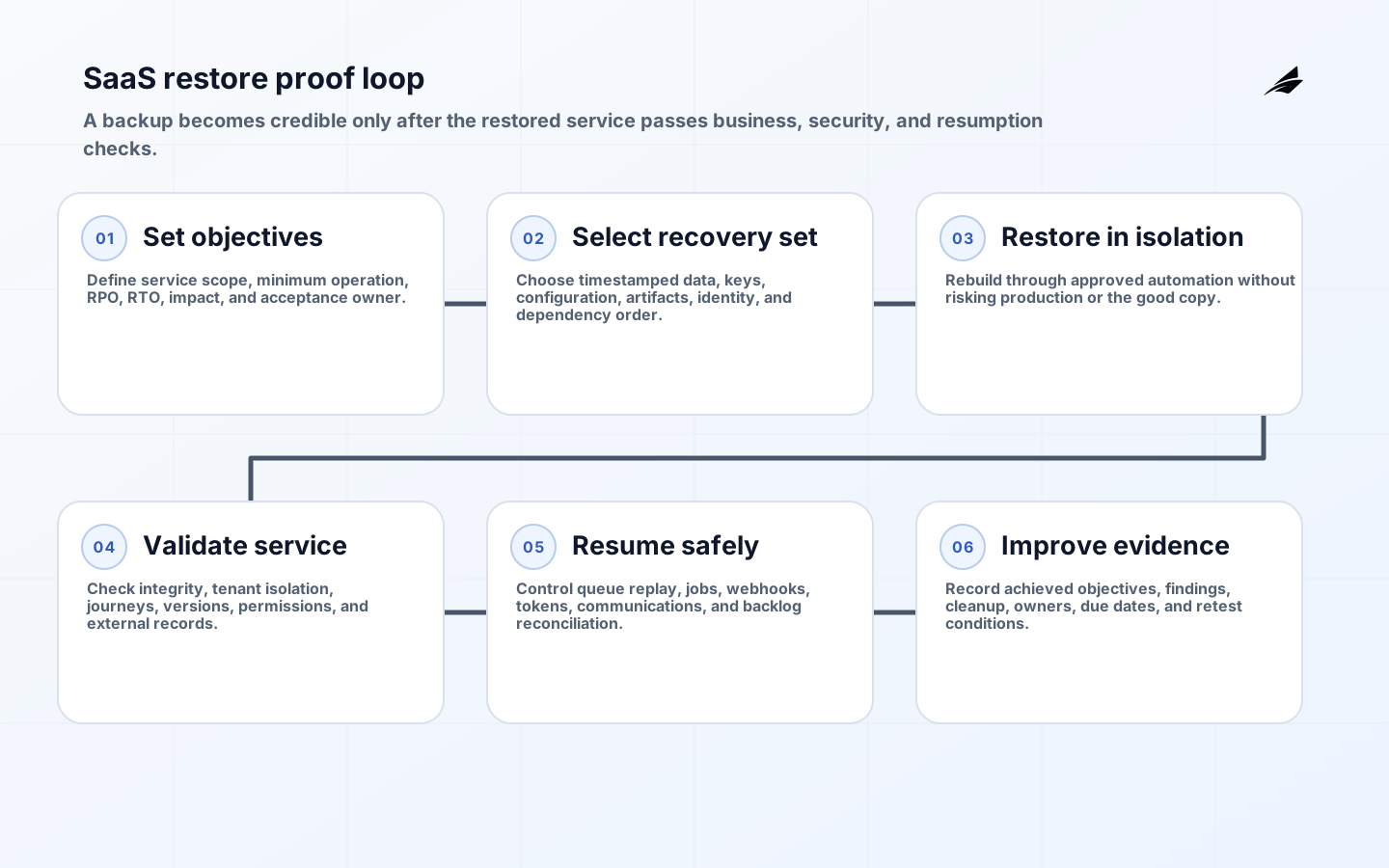
- Declare the scenario, recovery scope, decision owner, RPO, RTO, and minimum viable service.
- Contain the failure and choose a recovery point using timestamped business evidence.
- Establish isolated access, infrastructure, keys, configuration, and compatible application artifacts.
- Restore data in dependency order and record every automated and manual stage.
- Validate integrity, tenant isolation, critical journeys, external reconciliation, and operational readiness.
- Obtain business acceptance, preserve evidence and findings, securely remove test resources, and fund corrective work.

Turn test evidence into reliability improvement
For every exercise, retain scenario, recovery-point identity, environment, versions, start and finish times, achieved RPO and RTO, validation results, participants, manual actions, exceptions, cleanup proof, and acceptance. Trend restore duration by stage, coverage of critical data, automation success, stale runbook steps, access delays, reconciliation breaks, and age of the oldest tested recovery point. Do not report only a binary pass rate; a slow pass can still violate the service promise.
Assign each finding an owner, due date, severity, and retest condition. Feed recurring manual work into platform automation and recovery architecture. Review objectives after major product, data, tenancy, provider, regulatory, and organizational changes. A new database, encryption model, region, queue, identity provider, or acquisition can invalidate old evidence. Recovery readiness is a maintained capability, not an annual compliance event.
Key takeaways
- Define recovery in business journeys and measure the complete activation timeline.
- Inventory data, configuration, keys, artifacts, identity, integrations, and restoration order.
- Separate and monitor backup authority so production compromise cannot erase recovery.
- Test recent and historical points through application correctness and safe resumption.
- Retain evidence, fund findings, and retest after material architecture or operating changes.
Frequently asked questions
How often should a SaaS team test restores?
Set frequency from service criticality, RPO, change rate, retention, and consequence. Automate component restores frequently, exercise critical end-to-end services on a regular schedule, and run broader scenarios after material changes. The cadence is adequate only when it can detect failure before the business is likely to need the recovery point or procedure.
Must a restore test use production data?
Not always. Synthetic or masked data can validate mechanics and many application properties, but some integrity, scale, encryption, and historical compatibility claims require tightly controlled production recovery points. Select the minimum sensitive data needed, isolate access, prevent outbound effects, retain only approved evidence, and verify cleanup. Privacy and records owners should approve the method.
Is a cloud provider’s successful backup status enough?
No. It confirms only part of the provider operation. The SaaS owner must prove that the selected point can be restored with available access and keys, combined with compatible configuration and code, validated for business correctness, and resumed within objectives. Shared-responsibility details vary by service, so include managed-service settings and provider dependencies in the inventory.
Include third-party SaaS in the recovery analysis even when the team cannot restore the provider itself. Export configuration and records where available, preserve independent contact and escalation details, understand provider recovery commitments, and define a manual or replacement route for critical work. Test what the organization can control instead of assuming the supplier’s continuity plan reproduces the customer’s complete business service.
Conclusion
Recovery confidence comes from repeated evidence, not backup volume. Define the service that must return, protect a complete and independent recovery set, automate reconstruction, and validate customer journeys, isolation, data integrity, asynchronous effects, and communication. Each exercise should produce measured RPO and RTO results plus funded improvements. That discipline turns backup from stored hope into an operating capability the SaaS business can rely on.