Cloud monitoring and alerting is a planning and operating capability, not a tool purchase. Connect customer journeys to bounded telemetry, actionable pages, and a response loop that improves signal quality. The useful first step is to connect a real client or customer outcome to an owner, a technical boundary, and evidence that the team can use when normal delivery is interrupted.
Key takeaways
- Start cloud monitoring and alerting from the business or customer outcome that can be harmed, then select controls proportionate to that consequence.
- Name the service owner, operating authority, and fallback decision before automation obscures the handoffs.
- Pilot a narrow real path, including controlled failure and recovery, before standardizing it for every team.
- Measure the evidence that changes the next decision rather than collecting activity metrics for their own sake.
What cloud monitoring and alerting needs to solve
Dashboards full of infrastructure counters do not tell responders what customers are experiencing or which action to take. Page only where a person can promptly reduce harm.
| Decision area | What to decide | Why it matters |
|---|---|---|
| Outcome and owner | Identify the critical journey, accountable service owner, and consequence of failure for cloud monitoring and alerting. | Technical choices need a customer and operational context. |
| Scope boundary | Define the customer transaction, SLI, target, evaluation window, telemetry boundaries, alert route, and escalation authority before choosing thresholds. | A bounded first release can be tested and supported. |
| Evidence | Choose the health, change, access, and recovery record required for cloud monitoring and alerting. | Teams should not reconstruct important facts during an incident. |
| Authority | Set who can approve, pause, contain, and verify a material change. | Fast action depends on clear decision rights. |
Set a practical scope and architecture
Define the customer transaction, SLI, target, evaluation window, telemetry boundaries, alert route, and escalation authority before choosing thresholds. Build the first version around one meaningful service path and document its dependencies, access model, data handling, and expected failure behavior. A concise service brief should describe what healthy looks like to a customer, where the important state lives, and which assumption would require the design to change. This keeps architecture choices anchored to a supportable result rather than a broad platform promise.
| Planning artifact | Minimum content | Evidence of readiness |
|---|---|---|
| Service brief | Customer outcome, owner, critical journey, and consequence of interruption | Product and service owners agree what healthy means. |
| Dependency map | Data, identity, integrations, limits, and likely failure paths | The team can describe expected behavior when a critical dependency is slow or absent. |
| Operating contract | Routine changes, access, alerts, escalation, and recovery authority | A responder can act without first discovering ownership. |
| Change record | Intent, risk, validation, stop conditions, and recovery option | Review distinguishes a known trade-off from an unknown risk. |
Design the operating path for cloud monitoring and alerting
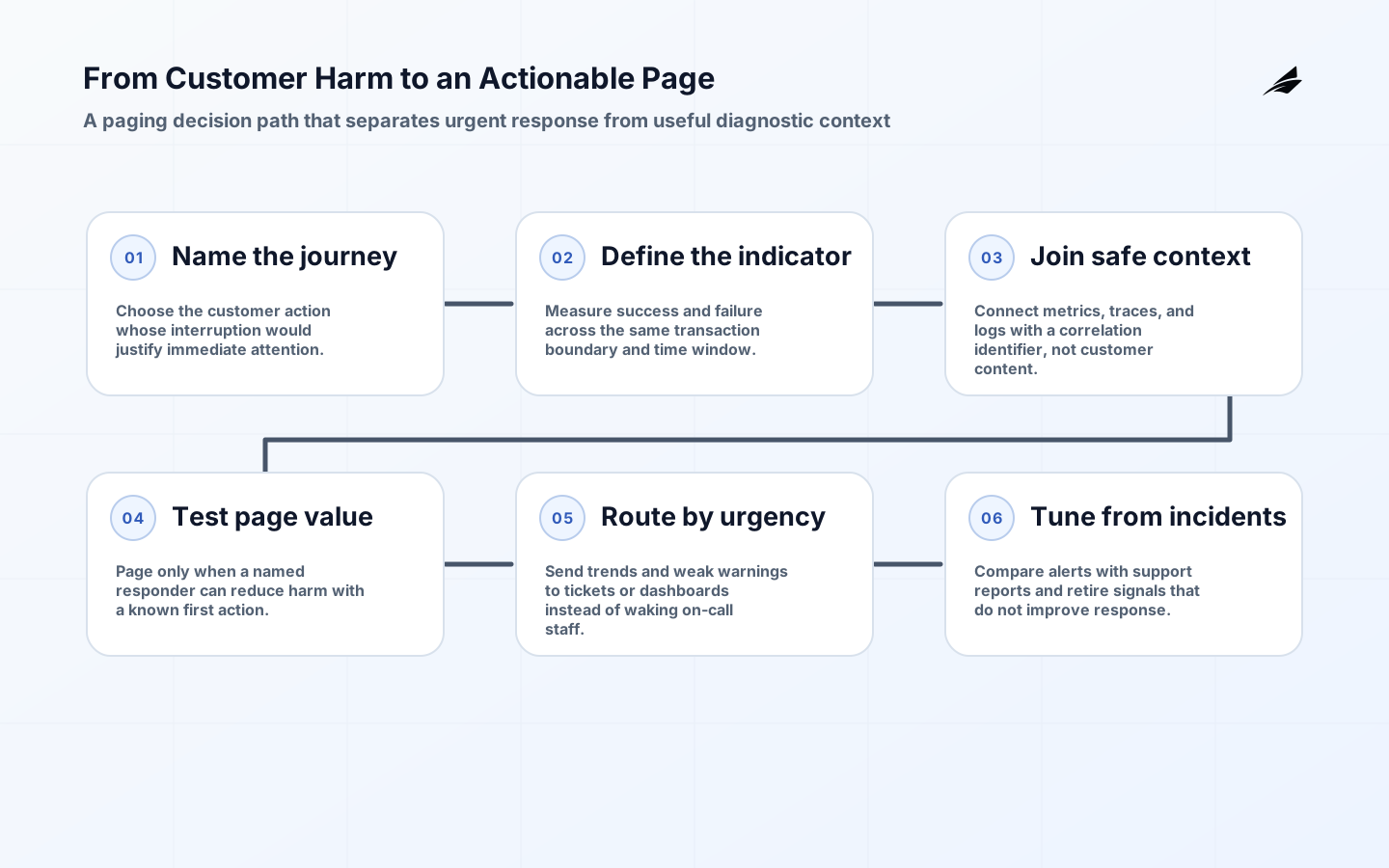
Cloud monitoring and alerting should begin with the customer action that must remain possible, then work backward to the service signals that explain its failure. For a document-upload product, success rate and time-to-usable-document are better paging inputs than raw CPU. Pair those indicators with traces that preserve a request identifier and logs that record the dependency result without exposing customer content. A page is justified only when a named responder can act now; a capacity trend, a single failed synthetic check, or a noisy dependency warning may belong in a ticket or dashboard instead.

Set alert thresholds that support a response decision
| Signal | Acceptance check | Operating risk |
|---|---|---|
| Customer completion | The indicator counts successful and failed attempts from the same journey boundary. | Counting only successful requests conceals retries and abandoned work. |
| Page threshold | The threshold has a severity, an owner, a runbook, and a stated action. | A page without an action trains responders to ignore urgent alerts. |
| Telemetry context | Metrics, traces, and logs share a safe correlation identifier and known retention period. | Responders cannot connect a symptom to its dependency or affected cohort. |
| Synthetic check | The check uses an isolated account and validates an externally visible result. | A passing internal probe can miss a broken identity, network, or browser path. |
Put controls where the work happens
Use structured context and correlation identifiers. Review routes and runbooks from the on-call perspective; retire pages that do not prompt immediate action.
- Give every material alert, approval, exception, or recovery decision a named owner and escalation route.
- Keep changes to access, configuration, and production state reviewable and traceable.
- Document pause and fallback conditions in the normal workflow, not only in an incident binder.
- Exercise recovery and access paths with the people who will use them in production.
- Treat repeated exceptions as feedback on the supported operating contract.
Pilot the path before scaling it
Shadow one critical-journey alert during normal traffic. Compare it with support reports and incident timelines, then remove weak signals before adding more.
| Pilot question | How to test it | Decision enabled |
|---|---|---|
| Can customers complete the critical path? | Use a representative workflow and service signal. | Proceed, redesign, or narrow scope based on outcome evidence. |
| Can the team operate it? | Have actual service and support owners perform routine work. | Clarify ownership, improve documentation, or reduce complexity. |
| Can the team recover it? | Introduce a controlled fault or failed change and follow the runbook. | Fix recovery gaps before wider exposure. |
| Can the team govern it? | Review access, audit history, cost or capacity, and exceptions. | Accept the operating model or add focused controls. |
Measure decisions, not activity
Metrics for cloud monitoring and alerting should reveal whether the intended service outcome is holding and whether the team can make a timely operating decision. Establish a baseline before the pilot and attach context to material changes. Do not use a single number as a verdict on people; use it to locate the next improvement while the evidence is fresh.
| Metric | What it reveals | Review use |
|---|---|---|
| Customer outcome | Completion, success, or timeliness for the critical journey | Compare against the agreed service objective. |
| Detection and response | Time to recognize, own, contain, and verify a material problem | Improve routes, authority, and runbooks. |
| Control adherence | Changes using the supported, evidenced path | Investigate exceptions and friction. |
| Recovery confidence | Recent exercises that reached business validation | Prioritize untested or unreliable services. |
Frequently asked questions about cloud monitoring and alerting
What is the difference?
Monitoring collects evidence; alerting selects the small subset that needs notification or escalation. Most monitoring should not page anyone.
Should CPU page people?
Only when it predicts user-impacting degradation and has an immediate action. It is often valuable diagnostic context without being a page.
How many SLOs?
Begin with measures representing the main customer promise, then add objectives only when they change a real operating decision.
A practical checklist for cloud monitoring and alerting
- Confirm the service owner, support contact, and authority to pause or contain a material issue.
- Keep the decision record, current configuration, dependency map, and verification evidence discoverable to the people on call.
- Run a controlled exercise before wider rollout and record the actual time to detect, act, and verify recovery.
- Review exceptions and repeated manual steps; they identify where the operating contract needs improvement.
- Set a review date after significant product, dependency, staffing, or compliance change.
For observability, define a short diagnostic path for each page: confirm user impact, identify the affected service or dependency, apply the first mitigation, and decide whether escalation is needed. Link the alert to the relevant dashboard, trace query, recent deployment record, and runbook. The objective is not to eliminate investigation; it is to eliminate the first ten minutes of hunting for context.
Keep the plan alive after launch
Review alerts after incidents and during quiet periods. Ask whether the page identified a condition a person could act on, whether the route reached the right owner, and whether the runbook reflected reality. Combine repeated low-value pages, lower their urgency, or retire them. Healthy on-call practice protects responders from noise while preserving fast escalation for genuine user harm.
Make cloud monitoring and alerting survive real handoffs
The enduring test for cloud monitoring and alerting is whether a capable person who was not present for the original design can make the next safe decision. Keep customer-impact signals, page routing, and first-response authority in a concise operating record that is linked from the normal delivery and support path. The record should distinguish facts from assumptions, name the current owner, and say what evidence is needed before an exception becomes a permanent change. During a staff change, vendor incident, or urgent customer request, this clarity is more valuable than a polished architecture diagram because it shows who may act and how success will be verified. Review the record after every meaningful release or incident. Remove instructions that are no longer true, add the context that responders had to discover, and turn recurring verbal advice into a visible control or supported workflow. This review habit prevents the service from quietly depending on a few people who remember why an old decision was made.
| Handoff item | Question to answer | Owner check |
|---|---|---|
| Current state | What version, configuration, and operating condition is in effect for cloud monitoring and alerting? | A named owner can locate the evidence quickly. |
| Decision boundary | Which action can proceed routinely, and which needs escalation? | Authority matches the service consequence. |
| Verification | What customer, technical, and operational signals confirm the action worked? | The result is recorded before work is declared complete. |
| Review trigger | Which change, incident, or date requires the plan to be revisited? | The operating record remains current. |
Conclusion
Cloud monitoring and alerting creates value when it becomes a dependable operating capability rather than another layer of tooling. Start with one accountable service path, make failure and recovery concrete, and use pilot evidence to decide what deserves standardization. That is a plan clients can fund, operate, and improve without relying on untested assumptions.