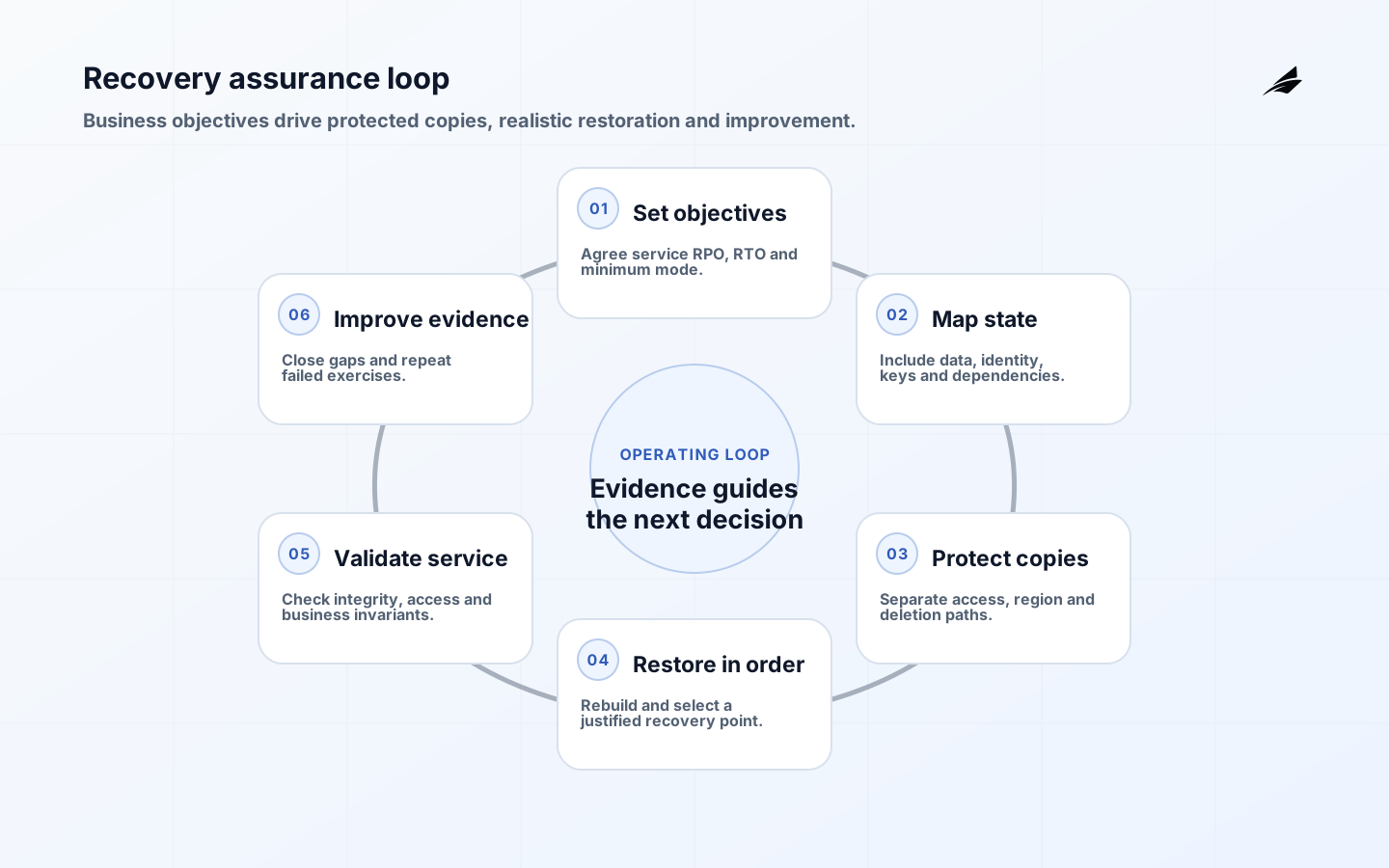
Backup and restore succeeds only when a business service can be recovered to an acceptable point, within an acceptable time, with its integrity and dependencies intact. A console showing green backup jobs is weak evidence. The real test is whether the organization can identify the right recovery point, obtain keys and credentials, rebuild the destination, restore data in the correct order, reconcile the result and return safely to normal operation.
Cloud services make copying easier but distribute state across databases, object stores, queues, identity systems, configuration and third parties. The backup operations playbook provides day-to-day routines, and the incident response planning guide connects recovery to command and communication.
Key takeaways
- Set recovery objectives per business service and data class.
- Inventory all state, dependencies, keys, configuration and external prerequisites.
- Keep protected copies isolated from production identities and destructive paths.
- Test application-consistent restoration, not only snapshot creation.
- Reconcile recovered data and rehearse returning to normal operations.
- Treat restore evidence, exceptions and corrective actions as owned operational records.
Define recovery objectives from business consequence
Recovery point objective describes tolerable data loss in time; recovery time objective describes the target for restoring the service. Neither should be copied from a vendor tier. Ask how much order, payment, clinical, operational or employee activity can be reconstructed, and how long the process can remain unavailable before harm becomes material. Different capabilities within one product may need different objectives.
NIST's contingency planning guide provides a lifecycle covering policy, business impact analysis, controls, strategies, plans, testing and maintenance. Translate that into a service recovery sheet: owner, critical functions, RPO, RTO, recovery order, minimum viable mode, dependencies, communication and authority to declare recovery complete. Resolve conflicts between stated objectives and actual backup frequency before an incident.
| Data class | Planning question | Restore proof |
|---|---|---|
| Transactional | Which committed events may be lost? | Point-in-time boundary and reconciliation |
| Object or document | Are versions and metadata protected? | Sample versions, permissions and checksums |
| Configuration | Can the environment be rebuilt independently? | Versioned code and applied settings |
| Identity and keys | Who can decrypt and authorize recovery? | Break-glass access exercise |
| Analytics | Can it be regenerated from governed sources? | Rebuild duration and completeness |
Inventory the recoverable system, not just databases
Map every stateful component and the order in which it is needed. Include database logs, object versions, queue state, search indexes, secrets, certificates, identity configuration, infrastructure code, deployment artifacts, feature flags, DNS, vendor configuration and runbooks. Decide which items are restored and which are regenerated. A database restored into an environment without its encryption key, schema migration or identity provider is not a recovered service.
Snapshots can be useful primitives but are not automatically application-consistent backups. Kubernetes documents volume snapshots as a way to create copies of volumes through storage-system support. For a multi-volume or transactional application, coordinate writes, logs and dependent stores so the recovery point represents a valid business state. Record provider and region dependencies for each copy.
Isolate and protect backup copies
Use separate accounts or security boundaries, restricted backup roles, independent alerts and deletion controls. Encrypt copies and manage key recovery with equal care. Production administrators should not automatically have authority to delete every recovery point. The CISA StopRansomware Guide recommends offline, encrypted backups and regular testing because accessible backups may also be deleted or encrypted by attackers.
Cross-region and cross-account copies protect different failure modes; neither replaces restore testing. AWS documents centralized policies, lifecycle, cross-region and cross-account capabilities in AWS Backup. When using a managed service, confirm resource coverage, copy semantics, immutability options, retention enforcement, key ownership, audit events and behavior after account compromise. Monitor unprotected resources and failed copies as service risks.
| Failure scenario | Design response | Exercise |
|---|---|---|
| Accidental deletion | Versioned or point-in-time copy | Restore one record and one dataset |
| Compromised admin | Independent account and deletion authority | Attempt protected-copy deletion |
| Regional outage | Copy and rebuild path in another region | Restore minimum service elsewhere |
| Corrupted application write | Multiple recovery points and integrity checks | Select the last known-good point |
| Lost key or identity | Escrowed recovery and break-glass controls | Recover access with primary identity unavailable |
Run a dependency-aware restore exercise
Start from an incident statement, not a prepared empty environment. Ask the team to identify the affected service, choose a recovery point and justify it. Rebuild network and identity boundaries, obtain artifacts and keys, restore in order, apply migrations carefully, and keep the recovered environment isolated until validated. Time each step and record waiting, manual work, missing access and vendor escalation. A runbook is useful only if someone other than its author can follow it.
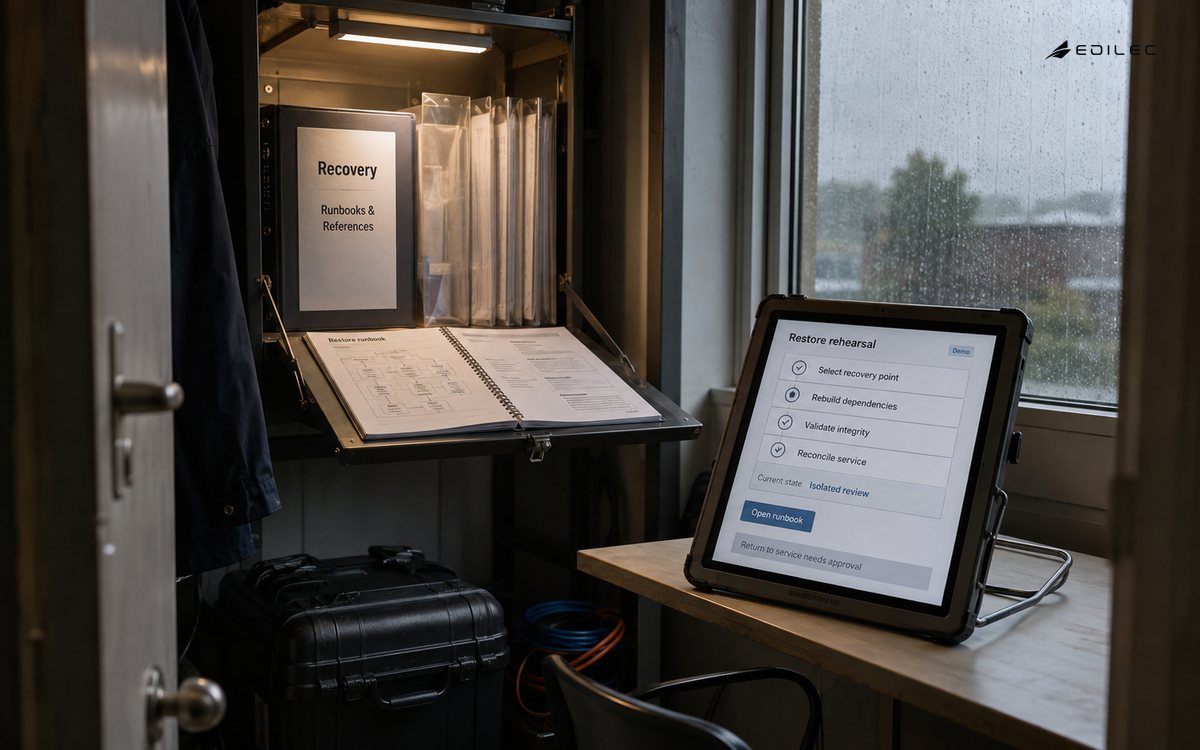
Validate at several levels: backup checksum, database integrity, schema and row counts, business invariants, access policy, application smoke tests and representative user journeys. Reconcile events between the selected point and the incident. Google SRE's discussion of managing critical state highlights the operational care required around state and recovery. Do not connect downstream integrations until duplicate and replay behavior is understood.
Plan the return to normal operation
Recovery does not end when a login page loads. Decide whether the restored environment becomes primary, how DNS and traffic move, how queued work is replayed, how writes from a degraded mode are merged and how customers are informed. Define a freeze on risky changes during stabilization. Preserve evidence about the cause and selected recovery point before cleanup removes it.
After each test or incident, compare actual recovery point and time with objectives. Classify gaps: missing coverage, slow data transfer, access failure, undocumented dependency, integrity issue or decision delay. Assign improvements and retest the failed step. The deployment rollback architecture guide is useful for separating a reversible software release from a data recovery event; the two often interact but are not interchangeable.
Choose recovery tiers from evidence and cost
Not every dataset needs identical protection. Group services by consequence and reconstruction ability, then choose copy frequency, retention, isolation and exercise depth. A payment ledger may need frequent point-in-time recovery and cross-account copies; a derived search index may need protected configuration plus a tested rebuild; an analytics sandbox may accept regeneration from governed sources. Document the dependency between tiers. A low-tier cache cannot be essential to restoring a high-tier transaction service without invalidating the high-tier objective.
Cost discussions should compare the full recovery design, not storage price alone. Include snapshot and log retention, transfer, isolated accounts, keys, cataloging, restore environments, provider requests, staff exercises and the cost of keeping old formats readable. Also price the stated outage and data-reconstruction effort. If the selected design cannot meet the approved objective under a realistic regional or identity failure, change the objective transparently or fund the missing capability; do not leave the contradiction inside a runbook.
Test corruption, replay and reconciliation
A restore test should sometimes begin with logical corruption rather than total loss. For example, a faulty deployment updates account status for six hours before detection. The team must determine the last trustworthy point, restore it in isolation and identify valid business events that occurred afterward. Replaying all messages may reproduce corruption; replaying none may lose legitimate transactions. Use immutable event identifiers, source evidence and domain invariants to construct a bounded repair set.
Define reconciliation before the exercise. For orders, compare counts and values by status, verify payment references, find orphaned shipments and identify messages accepted by one side only. For an identity service, compare active accounts, role grants, revocations and authentication configuration. Record every manual decision and its approver. A recovered row count can match while the business state remains wrong, so domain owners must participate in declaring the service usable.
Preserve an exercise packet containing the scenario, selected point, commands, access used, elapsed times, integrity checks, exceptions and final sign-off. Redact secrets but retain enough evidence to repeat the path. Compare packets across exercises to see whether access is becoming slower, restore tooling is drifting or the same dependency is repeatedly omitted. Close only the findings that have been implemented and retested; accepting a risk should name the authority and review date.
Automate the repeatable mechanics without automating the recovery decision. Infrastructure creation, copy selection queries, integrity scans and reconciliation reports can reduce delay and transcription error. Keep the selected recovery point, destructive cleanup, traffic switch and declaration of restored service under explicit authority. Test automation from a restricted recovery identity and preserve its dependencies offline or in an independent boundary. A recovery script that requires the failed production control plane, an unavailable package registry or the same compromised credentials is not a dependable shortcut.
Backup and restore checklist
- Business owners approve service-level RPO and RTO targets.
- The inventory includes data, logs, objects, configuration, identity, keys and vendors.
- Backup policies identify coverage, frequency, retention, region and account.
- Protected copies resist deletion through compromised production access.
- Alerts detect failed jobs, missed resources, expiring keys and policy drift.
- Restore exercises start from selection and rebuild, not a prepared shortcut.
- Validation includes integrity, business invariants, permissions and reconciliation.
- Failback, replay, communication and corrective-action ownership are documented.
Frequently asked questions
Is a cloud snapshot the same as a backup?
A snapshot can be part of a backup strategy, but evaluate consistency, isolation, retention, deletion protection and restoration. A snapshot controlled by the same compromised identity and stored in the same failure boundary may not provide the recovery assurance the service needs.
How often should restore tests run?
Test frequently enough to detect changes before objectives become fiction. Critical services may automate component restores regularly and run full exercises quarterly or after material architecture changes. Less critical systems can use a longer cadence, provided ownership and evidence remain current.
Is backup job success rate a useful metric?
It is necessary but insufficient. Pair it with coverage, age of the latest protected point, restore success, achieved RPO and RTO, integrity results, exception age and time since the last dependency-aware exercise. A successful copy that cannot be decrypted or reconciled is not useful protection.
Conclusion
Cloud backup and restore is a recovery capability, not a storage feature. Set objectives from business consequence, protect every required dependency, isolate copies and rehearse the full return to service. Proof comes from a restored, reconciled outcome under realistic conditions, followed by improvements that are tested again.