Intelligent automation services combine deterministic workflow with models that classify, extract, generate, rank or recommend. Their value comes from handling variation that rigid rules cannot, but model output is probabilistic and may be influenced by ambiguous or hostile input. Implementation must therefore bound what the system can observe, decide and change; route uncertainty to people; and preserve evidence from request through action. Automation rate alone is never a sufficient success measure.
This checklist is for document processing, service operations, knowledge assistance and agentic workflows that interact with enterprise systems. Pair it with the AI workflow automation checklist for a narrower delivery audit and the AI automation scope and risk plan for commercial framing. Applicable legal and sector obligations require qualified review in the deployment jurisdictions.
Define the outcome and autonomy boundary
Map the current workflow using real cases: inputs, decision points, systems, approvals, exceptions, corrections and downstream harm. Select one bounded task with enough volume and stable evidence to evaluate. State whether AI drafts, recommends, decides or executes. Name actions it must never take, data it must not access and the conditions that force abstention. A concise autonomy policy should be enforceable in code and understandable to operators.
Baseline cycle time, rework, error types, backlog and cost, then define outcome and risk guardrails. For example, an intake service may target faster complete-case creation while limiting missed required documents and unauthorized disclosures. Include the cost and delay of human review. A high straight-through rate can hide expensive downstream correction; evaluate the complete process and affected users rather than the model step in isolation.
| Automation level | Permitted behavior | Required control |
|---|---|---|
| Assist | Retrieve or draft for a person | Source visibility and user confirmation |
| Recommend | Rank or propose a decision | Reason, confidence cue and accountable reviewer |
| Prepare action | Build a structured command | Schema validation and explicit approval |
| Execute bounded action | Call approved tool within limits | Policy enforcement, idempotency and audit |
| Escalate | Stop and route uncertainty | Owned queue, context and service expectation |
Establish governance before model selection
The NIST AI RMF organizes activity around Govern, Map, Measure and Manage and treats risk management as continuous across the lifecycle. Assign a business owner, system owner, model or evaluation owner, data owner, security owner and human-review owner. Inventory providers, models, prompts, tools, knowledge sources and affected workflows. Set risk tier and approval requirements based on consequence and reach.
Document intended use, excluded use, affected parties, known limitations, retention, human oversight and incident authority. The AI RMF Playbook supplies voluntary actions aligned to the framework outcomes; select those that match the context instead of treating it as a universal linear checklist. Review procurement terms for data use, model changes, availability, security, audit, intellectual property, subcontractors and exit.
Separate orchestration, intelligence and enforcement
Use a deterministic orchestrator to manage workflow state, retries, timeouts, approvals and tool calls. Put model interaction behind a gateway that applies approved model and prompt versions, data minimization, output schemas, content controls, rate limits and telemetry. Keep the policy enforcement point outside the model. The model may propose an action, but code should verify user authority, resource scope, amount, destination and current business preconditions before execution.
Provide tools with narrow, typed operations rather than broad database, shell, email or browser access. Use workload identity and least privilege, short-lived credentials, destination allowlists and transaction limits. Require idempotency for side effects and serialize conflicting changes. For retrieval, enforce source permissions at query time and carry citations or record references into review. Treat model output as untrusted input even when the model is operated by the organization.
| Threat or failure | Preventive control | Detection and recovery |
|---|---|---|
| Prompt injection | Separate instructions from content and constrain tools | Log policy denials; quarantine hostile cases |
| Unauthorized action | Server-side identity, scope and precondition checks | Audit tool calls and revoke workload credentials |
| Unsupported answer | Grounding, citations, schema and abstention | Sample review and correction workflow |
| Duplicate side effect | Idempotency key and state version | Reconcile target system and safely replay |
| Provider or model change | Pinned versions and evaluation gate | Drift alerts and rollback to approved version |
Govern data and knowledge sources
Classify every input and output. Define collection purpose, allowed models and regions, retention, encryption, access, deletion and whether provider training is prohibited. Remove secrets and unnecessary personal data before model calls. For documents, preserve source identity, version, owner, access policy and effective dates. Retrieval should not flatten restricted repositories into a universally searchable index. Test that revoked access propagates to indexes and caches.
Create data quality rules for completeness, legibility, language, document type and metadata. Route unsupported or low-quality inputs instead of forcing a confident-looking result. Maintain a curated evaluation set containing ordinary, difficult, adversarial and changed-policy cases, with sensitive data handled under approved controls. Avoid using live production conversations as an evaluation corpus without purpose, notice, access and retention decisions.
Evaluate the workflow, not only model accuracy
Define task-specific metrics: field-level precision and recall for extraction, groundedness and citation correctness for answers, appropriate abstention, policy compliance and valid tool parameters. Measure by relevant language, document type, customer segment or difficulty where lawful. Compare with the existing process and a simple deterministic baseline. Record reviewer disagreement because uncertain labels set an upper limit on meaningful accuracy claims.
Test normal, boundary and adversarial cases before release. Include prompt injection, conflicting instructions, stale knowledge, inaccessible sources, tool timeout, duplicate delivery, malformed output, model refusal and provider unavailability. Evaluate end-to-end outcomes, review time, correction effort and downstream errors. Require a regression suite for every prompt, model, tool or retrieval change. A vendor benchmark cannot establish fitness for the organization's data and workflow.
Design human oversight as a real operating function
Send reviewers the original evidence, proposed output, material uncertainty, policy checks and available actions. Avoid automation bias by making review meaningful, not a default approve button. Define which changes a reviewer may make, when a second approval is required and how disagreements improve policy or evaluation data. Set staffing from arrival rate and review time; an unowned queue is not human oversight.
The OECD principle on robustness, security and safety calls for lifecycle risk management and mechanisms to override, repair or safely decommission systems when needed. Give operators pause, rollback and kill controls with clear authority. Preserve enough context for investigation without exposing sensitive prompts broadly. Inform affected users about automated involvement and routes to correction where required or useful.
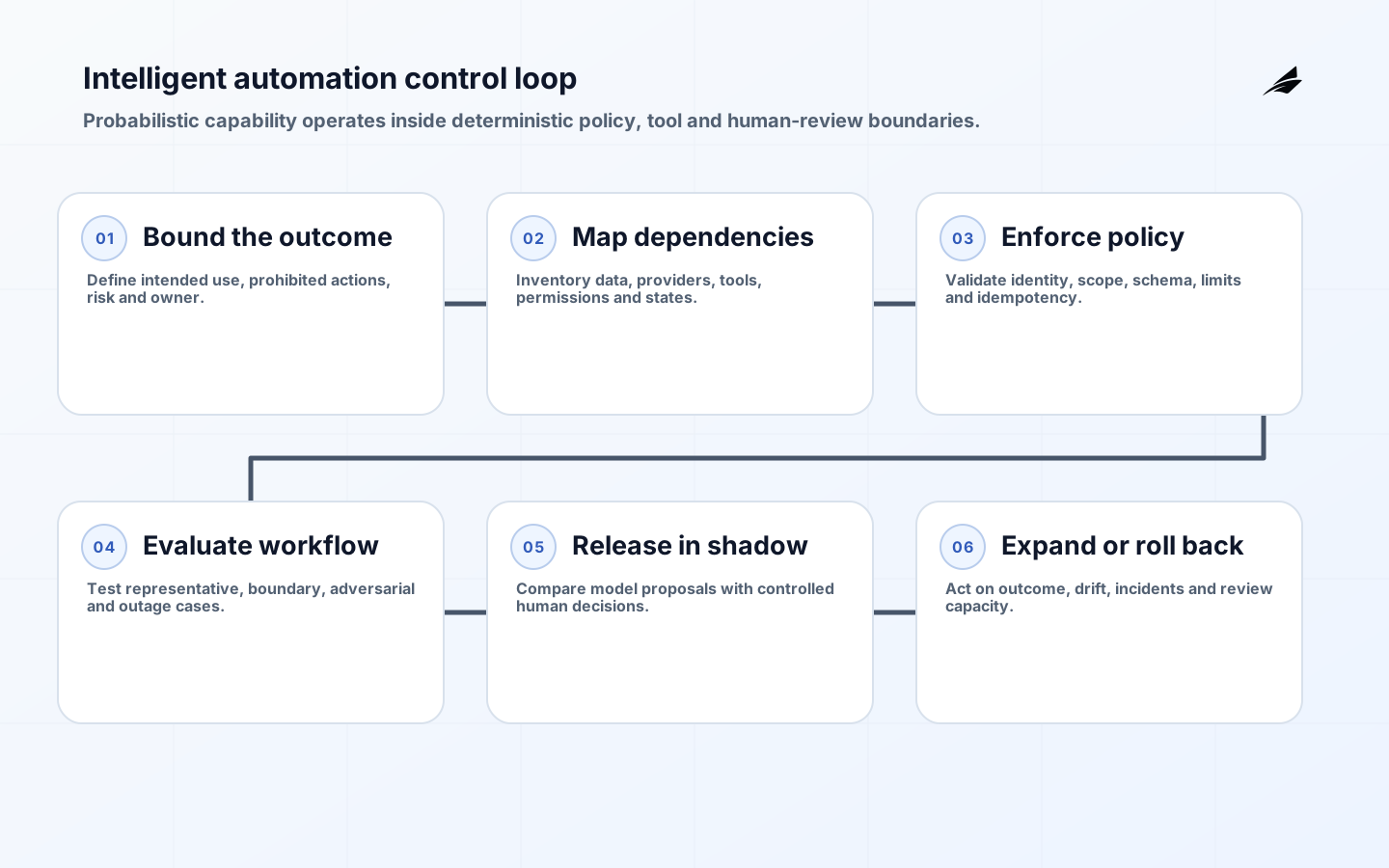
Release through a six-stage control loop
- Define the outcome, prohibited actions, risk tier and human decision owner.
- Map data, tools, permissions, providers and deterministic workflow states.
- Build policy enforcement, typed tools, audit events and an exception queue.
- Evaluate representative, boundary and adversarial cases against release gates.
- Run shadow mode, then a bounded cohort with monitored human approval.
- Expand, pause or roll back from outcome, risk, drift and incident evidence.

Secure and operate the complete service
Apply NIST's SSDF to orchestration code, connectors, evaluation tooling and deployment. Inventory dependencies and model providers, protect source and prompts, scan artifacts, review changes and maintain vulnerability response. The OWASP agentic applications guide provides current practical guidance for systems with planning and tool use. Threat-model both conventional application paths and model-specific manipulation.
Monitor request volume, completion, abstention, policy denials, review backlog, tool errors, latency, cost and outcome quality. Sample completed cases under controlled access and compare with the approved evaluation baseline. Detect changes in input mix, knowledge freshness and provider behavior. Every alert needs an owner and response. Maintain runbooks for provider outage, erroneous bulk action, data exposure, model regression and queue overload, and rehearse pause and rollback.
Review value and retire harmful automation
Calculate value from end-to-end cycle time, quality, capacity and user experience, subtracting provider cost, review labor, correction, support and control overhead. Track whether work is truly removed or shifted downstream. Compare outcomes with a non-AI path. Review who benefits and who bears errors. The intelligent automation FAQ offers companion questions for scaling and sourcing decisions.
Set review dates and retirement triggers. A workflow should be paused when critical policy violations, unexplained quality decline or unmanageable review backlog exceeds approved boundaries. Decommission obsolete prompts, indexes, credentials and data stores, and preserve required audit evidence. Intelligent automation is a maintained operational product; if ownership or evidence disappears, reducing autonomy or returning to the previous process may be the responsible decision.
Key takeaways
- Define autonomy limits and prohibited actions before choosing a model.
- Keep workflow state, authorization and tool enforcement deterministic.
- Evaluate end-to-end outcome, abstention, policy compliance and review effort.
- Fund human oversight with usable evidence, clear authority and queue capacity.
- Monitor drift and incidents, and preserve practical pause, rollback and retirement paths.
Frequently asked questions
How is intelligent automation different from RPA?
Traditional robotic process automation follows defined rules and interfaces. Intelligent automation adds probabilistic interpretation or generation for variable inputs. The two can coexist, but model-assisted steps need evaluation, abstention and stronger input controls, while all side effects still need deterministic authorization and audit.
When can human approval be removed?
Only after representative evidence shows that the bounded action is low enough risk, policy checks are enforceable, errors are detectable and reversible, and monitoring and incident controls work. Remove approval by action class, not for the entire workflow, and retain sampling and a rapid return to review.
Can vendor safety controls replace internal governance?
No. Provider controls are one layer. The deploying organization defines purpose, data access, tool permissions, human oversight, acceptance tests, monitoring and response. Verify provider claims, contract for material changes and keep policy enforcement outside the model endpoint.
Conclusion
Intelligent automation is dependable when probabilistic capability sits inside a controlled workflow. Bound autonomy, minimize data, constrain tools, evaluate real cases and give people meaningful authority over uncertainty and harm. With monitored outcomes and reversible releases, organizations can automate useful variation without surrendering accountability to a model or provider.