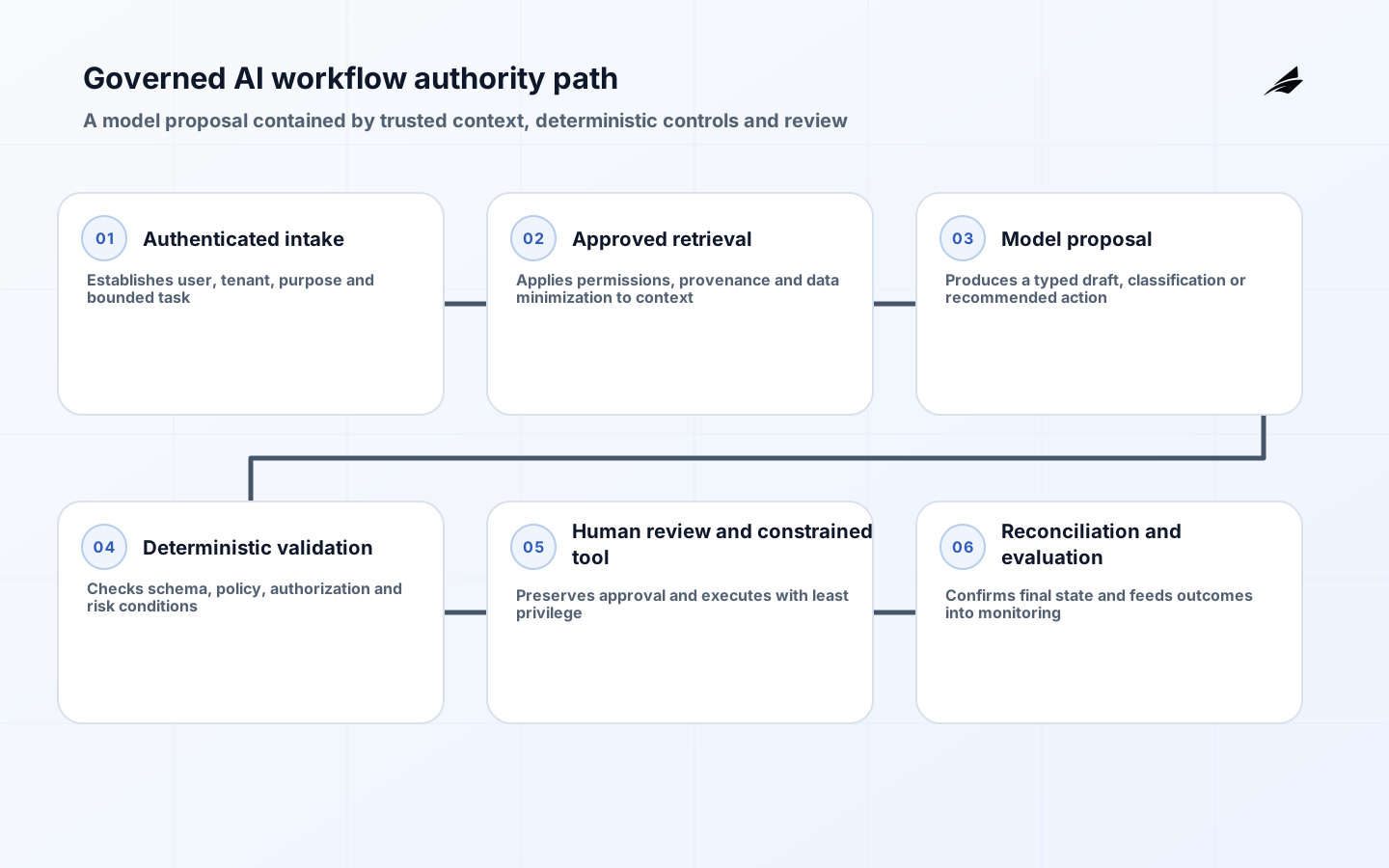
AI business process automation uses models to classify, extract, draft, summarize, recommend or select actions inside an operational workflow. The implementation challenge is not connecting a model endpoint. It is deciding where probabilistic output is useful, which evidence the model may see, what authority it receives and how the organization detects harmful failure. A sound plan starts with one bounded task, preserves a deterministic workflow and gives consequential decisions to an accountable person or policy-controlled service. Open-ended autonomy should never be the default.
Govern the outcome and bound the use case
Name the business owner, system owner, risk owner and affected people. Describe the current process, baseline, decision points, records and consequences of error. Choose a task whose output can be evaluated: route a request, extract fields, draft a reply or assemble evidence. Specify excluded uses and users. NIST AI RMF organizes work through Govern, Map, Measure and Manage; governance is cross-cutting rather than a final approval. Record legal, privacy, security, employment, accessibility and sector obligations with qualified specialists.
Decide whether AI is needed. Deterministic rules are preferable when policy is stable, inputs are structured and exact reproducibility matters. Search or templates may solve retrieval and drafting without generative decisions. Use AI where variation or unstructured content makes probabilistic interpretation valuable and the residual risk can be controlled. Compare against the current process and a simple baseline, not only a sophisticated model. Define acceptable abstention and escalation. A system that declines uncertain cases can be more useful than one forced to answer every input.
| Use-case factor | Lower-risk shape | Higher-risk shape |
|---|---|---|
| Output | Draft or classification reviewed before use | Irreversible external action |
| Evidence | Approved, bounded and attributable context | Open web or user files mixed with instructions |
| Authority | Read-only or narrow proposed action | Broad tools and shared credentials |
| Impact | Correctable delay or wording issue | Rights, safety, finance or employment decision |
| Evaluation | Reference cases and observable final state | Subjective success with no ground truth |
| Fallback | Human queue and deterministic path | No owner when confidence or service fails |
Keep deterministic orchestration around the model
Represent the business workflow as explicit states and transitions. Code controls intake, authorization, retrieval, model call, validation, review, action and final reconciliation. The model produces a typed proposal; it does not decide which policy applies or silently update state. Use schema validation and allowlisted values. Treat confidence scores cautiously because they may not be calibrated to the task. Route malformed, unsupported or high-impact outputs to review. Persist model, prompt, retrieval and tool configuration versions with the case.
Separate instructions, trusted system data and untrusted content. Retrieved documents, emails and webpages can contain prompt injection. Label provenance, restrict sources and never treat content as instruction merely because it appears in context. Minimize sensitive data and apply purpose, retention and access controls. Retrieval improves relevance but does not guarantee factuality or prevent injection. Require citations to the supplied evidence where useful, then verify the cited text actually supports the claim. Protect embeddings and caches under the same data classification as their source.
Constrain tools and design meaningful human review
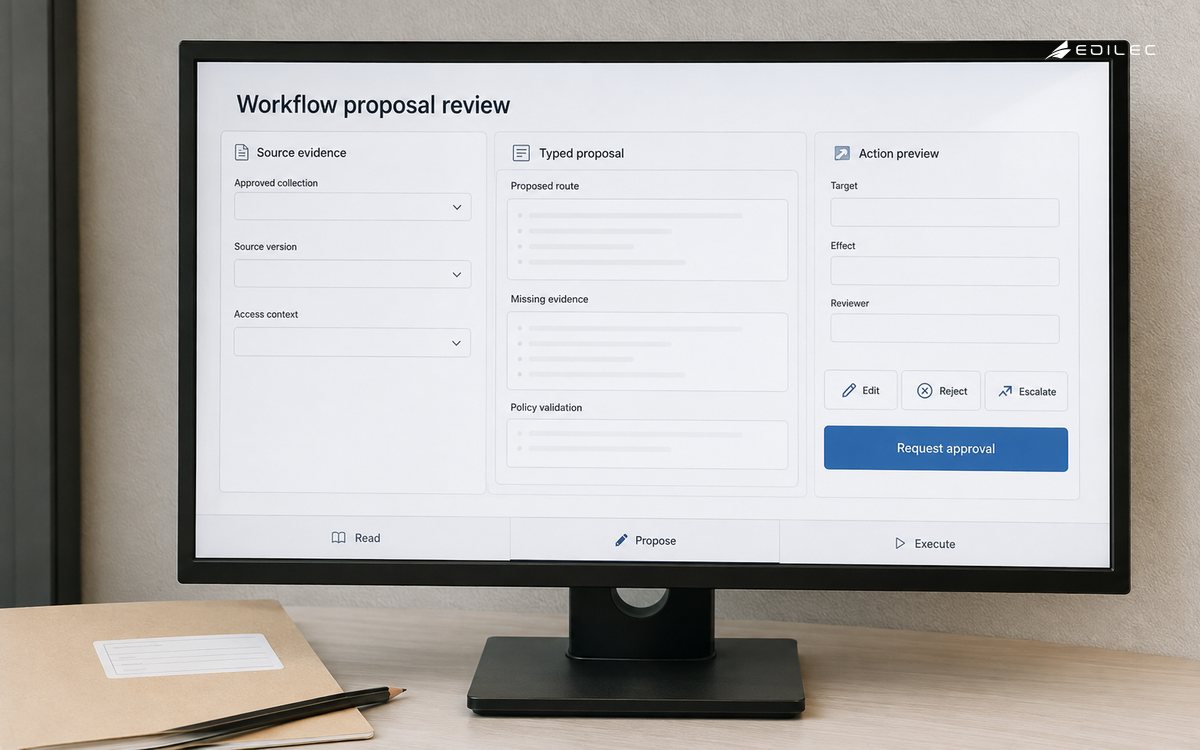
Give each tool a narrow operation, typed parameters and a service identity with least privilege. Check user and tenant authorization in deterministic code at execution time. Separate read, propose and execute permissions. Use idempotency and business constraints for side effects; set timeouts, budgets and rate limits. Preview consequential actions and require approval with the exact target and effect. Do not expose generic network, database or shell access when a bounded API can perform the task. Log invocation, authorization, result and correlation identifier.
Human review must provide enough evidence, time and authority to catch errors. Show source material, model proposal, uncertainty or policy flags and the exact action. Avoid automation bias by including known limitations and allowing edit, reject and escalate. Sample accepted low-risk cases for quality review. Measure overrides and disagreement by reason, while protecting workers from simplistic performance conclusions. For high-impact decisions, AI may assist evidence gathering but accountable humans or validated rules should retain final authority. Design workload capacity so review does not become a ceremonial click.
| Control layer | Implementation | Evidence |
|---|---|---|
| Identity | User, tenant and service authorization outside the model | Denied and permitted action tests |
| Context | Approved sources, provenance and data minimization | Retrieval log and source version |
| Output | Schema, allowlist and policy validation | Rejected-output reasons |
| Tools | Narrow permissions, budgets and idempotency | Invocation audit and duplicate suppression |
| Human review | Evidence, meaningful choice and escalation | Override quality and queue age |
| Operations | Versioning, monitoring, rollback and incident response | Evaluation trend and exercise result |
Build an evaluation system before release
Create a versioned evaluation set from representative historical or synthetic cases with privacy controls. Include normal, ambiguous, rare, multilingual and adversarial inputs. Define task-specific measures: extraction accuracy by field, routing precision and recall, citation support, policy compliance, harmful action rate, abstention quality, latency and cost. Segment results by relevant user or case groups to find uneven performance. Human-rated rubrics need clear criteria, multiple reviewers where consequence warrants and disagreement analysis. Do not reduce everything to one average score.
Test the complete system, not only the model. Probe prompt injection, unauthorized retrieval, data leakage, unsafe output rendering, excessive tool use, duplicate actions, provider timeout, model change and fallback. Red-team according to likely actors and assets. Establish release thresholds and guardrails from risk tolerance and baseline. A model upgrade is a system change: rerun evaluations, inspect regressions and canary it. Monitor production distributions, abstention, review outcomes, incidents, latency and unit cost while respecting privacy.
Estimate cost and deliver through authority levels
Cost includes workflow redesign, data preparation, model and retrieval use, evaluation, security, integration, user experience, review labor, observability and support. Model per-case consumption with realistic prompt, retrieval, tool and retry behavior. Include provider limits and fallback. The cheapest model call can produce higher total cost through correction and review. Keep ranges until a production-like proof reveals throughput and exception patterns. Evaluate provider data terms, location, retention, model-change notice, security, portability and incident obligations.
- Observe the current process and select one bounded, measurable task.
- Govern owners, affected people, obligations, prohibited uses and risk tolerance.
- Prototype read-only output against a representative evaluation set.
- Integrate a typed proposal into deterministic workflow and human review.
- Pilot with no or limited action authority and daily quality review.
- Grant a narrow automated action only after evidence supports it.
- Expand inputs or tools one authority boundary at a time, with rollback.
Use shadow mode first where possible: the AI produces output without changing work, allowing comparison to actual outcomes. Then assist a small trained group, record edits and abstentions and test fallback during provider outage. If narrow automation is justified, limit it to low-impact cases that pass deterministic validation. Define stop conditions for harmful output, unsupported citations, queue overload, tool anomalies or cost excursion. Preserve the prior path until recovery and reconciliation are proven. Communicate system limits and appeal routes to affected users.
Operate, learn and retire responsibly
Maintain an AI system inventory with owners, purpose, models, prompts, data sources, tools, evaluations and dependencies. Version releases and retain enough evidence to investigate outcomes. Monitor provider changes, vulnerabilities and data drift. Establish incident response for leakage, unsafe action, harmful bias and sustained quality decline. Give operations a kill switch that actually removes tool authority and a fallback that has been exercised. Review whether the use case still creates value; retire models, indexes, credentials and retained data when it does not.
Operational governance should include a change calendar and periodic access review. Track model and provider versions, prompt templates, retrieval indexes, tool schemas and policy code as separate but linked artifacts. Require an owner to assess provider notices before automatic upgrades reach production. Review service identities and tool permissions against actual use; remove dormant tools and credentials. Sample production cases for unsupported claims and harmful disparity, then route findings into evaluation data without retaining unnecessary personal information. This closes the loop between daily operation and the next controlled release.
Key takeaways
- Start with a bounded task and preserve a deterministic workflow around the model.
- Treat retrieved content and model output as untrusted.
- Authorize every tool action in code with narrow service permissions.
- Make human review evidence-rich and operationally feasible.
- Evaluate the complete system before release and after every material change.
Frequently asked questions
Does business automation require an AI agent?
No. Many useful systems make one classification or draft inside a conventional workflow. Add planning or multiple tools only when the task requires them and controls can bound the additional authority and failure modes.
Can a confidence threshold replace review?
Not by itself. Scores may be poorly calibrated and can shift with model or data changes. Validate thresholds on representative cases, combine them with deterministic risk rules, monitor outcomes and retain review where consequences require accountability.
How should value be measured?
Compare correct end-to-end outcomes, cycle time, rework, review effort, user impact and operating cost with the current process and a simple baseline. Include exceptions and incidents. Automation percentage is not value when quality or rights deteriorate.
What should be checked with an AI provider?
Review data use and retention, security, access, location, model and version controls, availability, limits, incident notification, intellectual-property terms, evaluation support, export and exit. Test claims in the actual system boundary.
Conclusion
AI can improve business processes when its uncertainty is placed inside a governed service. Bound the task, separate trusted instructions from untrusted content, validate proposals, constrain tools and preserve accountable human authority. Build evaluation and fallback before production, then increase authority only through evidence. This produces useful automation without asking a probabilistic model to become the policy, identity system or final source of truth.