AI automation services should begin with a workflow in which better timing, classification or drafting produces measurable value, not with a mandate to “add AI” everywhere. A credible engagement identifies the record that starts the work, the action that completes it, the person accountable for the outcome and the conditions that require a human decision. It then separates model suggestions from application authority. The model may extract a purchase-order field, propose a support response or rank a queue; deterministic software still validates identity, permissions, amounts, destinations and state changes before anything is committed. This article explains how to scope that service, estimate cost, control risk and move from a narrow proof to an operated production capability.
Key takeaways
- Choose one recurring workflow with a measurable baseline, stable records and a named business owner.
- Price the complete service: discovery, integration, evaluation, human review, monitoring, support and model usage.
- Keep consequential authority in deterministic controls or an empowered human checkpoint.
- Evaluate the end-to-end workflow against representative normal, edge and adversarial cases before release.
- Expand only when production evidence shows useful outcomes, controlled exceptions and supportable operating load.
Define the first AI automation service boundary
Write the scope as an event-to-outcome contract. For example: “When an emailed invoice enters the approved mailbox, create a reviewed draft payable record with source-page evidence; never release payment.” That sentence names the trigger, output, evidence and prohibited action. It is substantially more useful than “automate accounts payable.” Inventory input channels, formats, languages, exception classes, systems of record and deadlines. Record who may correct extracted data, who resolves a supplier mismatch and what happens when the service is unavailable. The related Edilec guide to human-in-the-loop automation shows how to reserve review for decisions where human authority genuinely changes the outcome.
Scope should also state what is deliberately excluded from the first release. Handwritten documents, legal interpretation, high-value transactions or cross-border cases may require a different control. Exclusions are not failure; they keep evaluation honest. Use historical work to estimate volume and exception shape, then sample recent cases with the operators who know where records are incomplete. The NIST AI RMF organizes risk work around Govern, Map, Measure and Manage. For delivery, that means ownership and policy are established before model selection, context is mapped before metrics are chosen, and measured results determine whether controls or scope should change.
| Scope element | Decision to record | Evidence before build |
|---|---|---|
| Trigger and finish | Exact event that starts work and authoritative state that completes it | Representative cases and current process map |
| Model role | Extraction, classification, ranking, drafting or recommendation | Baseline quality and failure examples |
| Authority | Actions allowed automatically and actions requiring approval | Permission matrix and approval owner |
| Exception path | Conditions for abstention, retry, correction or escalation | Queue capacity and service target |
| Recovery | How work continues if the model, provider or integration fails | Tested manual path and reconciliation method |
Build a complete cost model
Model charges are often a small and volatile part of total cost. Estimate discovery interviews, data preparation, connector development, identity integration, evaluation-set construction, security review, rollout, monitoring and ongoing exception handling. For variable usage, model input and output tokens, retrieval calls, document processing, retries and peak concurrency. Then add the labor cost of human review and the cost of a safe fallback. A workflow that saves four minutes on routine cases but creates an eight-minute investigation for every uncertain case may still be valuable, but only if the observed exception rate makes the arithmetic work. The Edilec AI automation ROI planning model provides a complementary way to connect adoption, quality and operating cost.
Use ranges instead of a single return estimate. A base case should include expected adoption and observed handling time; a downside case should assume slower adoption, more review and higher provider cost; an upside case can model better straight-through completion after evidence supports it. Avoid claiming that every minute removed is cash saved. Capacity becomes financial value only when the organization can redeploy it, handle more work, reduce delay or avoid a specific loss. Record one-time and recurring costs separately, and include the cost of re-evaluation when a model, prompt, policy, data source or workflow changes.
| Cost group | Often omitted | How to estimate |
|---|---|---|
| Implementation | Identity, integration, data repair and test environments | Work packages with owners and acceptance evidence |
| Model and platform | Tokens, embeddings, storage, safety services and network traffic | Volume bands plus peak and retry assumptions |
| Human operation | Review, exception resolution, appeals and quality sampling | Minutes per case multiplied by observed routing rate |
| Reliability | Monitoring, on-call, incident work and fallback operation | Service tier and rehearsal effort |
| Change | Provider upgrades, prompt changes, policy changes and regression tests | Planned evaluation cadence and release frequency |
Design authority and safeguards before prompts
The safest architecture treats a model response as untrusted input. Validate the response against a typed schema, enforce field constraints and derive authorization from the authenticated user or workload rather than text produced by the model. Limit tools to the smallest set of operations, restrict destinations and amounts, use idempotency keys for repeatable writes, and require a fresh authorization decision for a consequential action. Retrieved documents may contain instructions that attempt to redirect the model, so separate application policy from retrieved content and validate every tool call. The OWASP LLM application risks are a useful threat-model prompt, while the NIST SSDF keeps these controls inside ordinary software delivery.
Evaluate the workflow, not just the model
Create an evaluation set from real, lawfully usable cases that represents routine work, rare formats, ambiguous records and known failures. Define field-level or decision-level acceptance criteria before tuning. Measure the complete result: correct input association, grounded evidence, policy compliance, latency, escalation quality, downstream state and successful recovery. A model can score well on extraction while the service posts values to the wrong customer because identity mapping is defective. Conversely, an intentional abstention may be the correct result. Track false automation and false escalation separately because they create different harms and operating costs.
Run security and misuse tests alongside quality tests. Include hostile document instructions, malformed files, unsupported languages, oversized inputs, cross-tenant identifiers, stale permissions and attempts to make the system act outside scope. The NIST Generative AI Profile emphasizes governance, pre-deployment testing, content provenance and incident disclosure. Translate those themes into release evidence: named risk owner, versioned test set, source trace, known limitations, monitoring plan and a tested containment route.
Use six gates from discovery to production
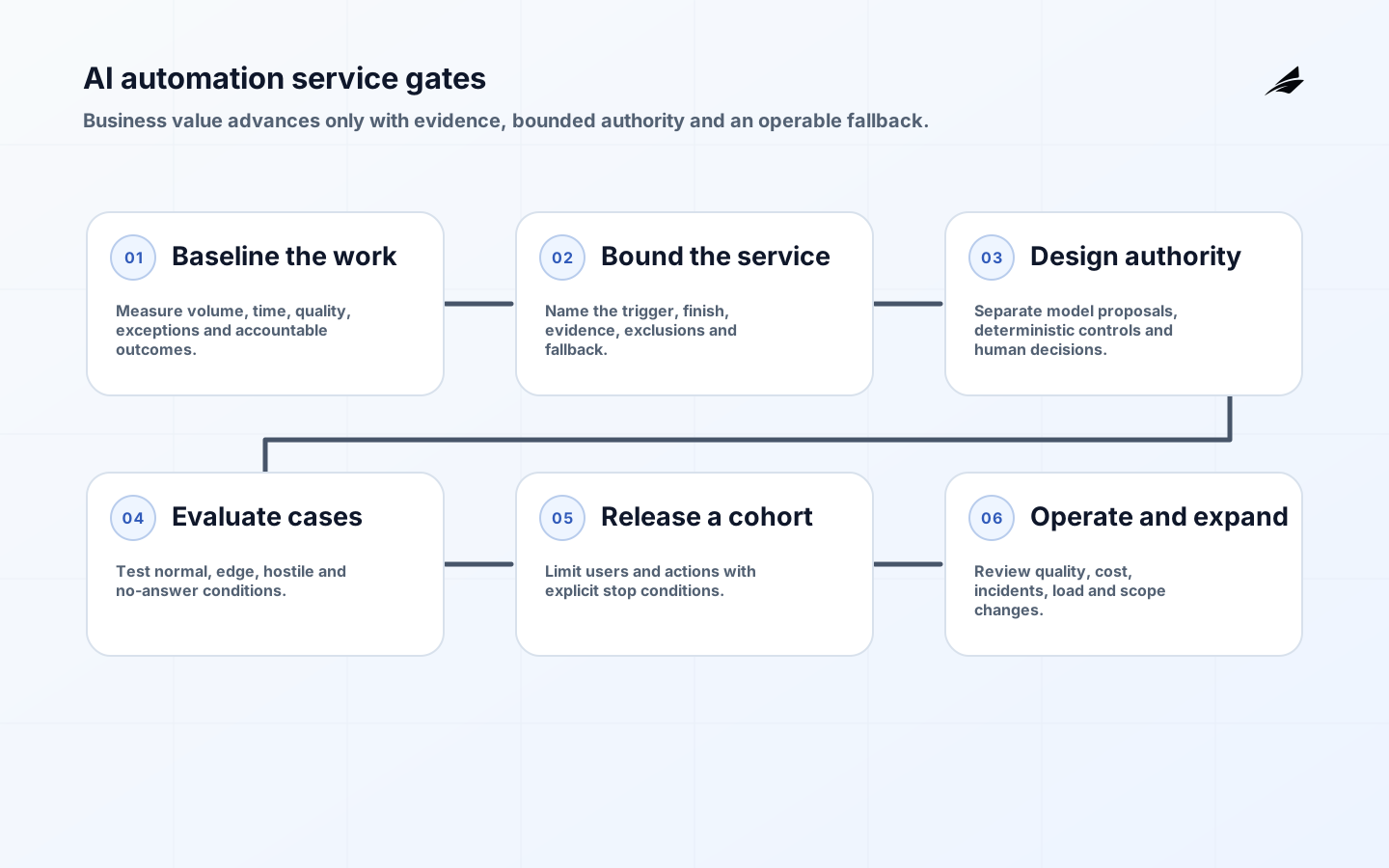
A useful delivery plan has explicit decisions rather than calendar-only phases. Discovery proves the workflow and baseline. Boundary design fixes authority, data and exclusions. A technical slice proves the hardest integration with production-like identity. Evaluation demonstrates quality and control against a frozen set. A limited release measures adoption, exception load and customer effect. An operating review then decides whether to expand, revise or stop. Each gate should produce an artifact that another person can inspect: a process map, data contract, threat model, evaluation report, runbook or production decision record.
Do not make a demonstration the production architecture. Demonstrations often use elevated credentials, hand-selected documents and manual cleanup. A production slice must use the real permission path, durable state, observable integrations and an explicit fallback. Start with a cohort whose owner can provide rapid feedback and whose volume will not overwhelm reviewers. Define stop conditions in advance: an unauthorized disclosure, incorrect consequential action, sustained quality regression, queue overload or inability to reconcile state. The AI workflow escalation guide explains how to turn those conditions into resolvable cases.
Operate the service as a changing system
Production monitoring needs more than uptime. Observe input mix, model and prompt version, retrieval quality, schema failures, automated-action rate, escalation reasons, reviewer overrides, queue age, downstream errors, cost per completed outcome and customer-impact indicators. Sample successful cases as well as failures; silent errors may never enter the exception queue. Preserve enough provenance to reconstruct which source, policy and software version produced a result without retaining sensitive content longer than needed. Assign owners for business policy, model quality, application reliability, security and vendor management, and state who has final authority during an incident.
Frequently asked questions
How large should the first AI automation pilot be?
Large enough to exercise meaningful variation and small enough to contain mistakes. Choose one workflow, one accountable operating group and a bounded case population. Use historical evaluation first, then shadow mode, then a controlled production cohort. Sample size should follow the consequence and expected error rate rather than an arbitrary number of users.
Can AI automation services be fixed-price?
Discovery and a bounded proof can be fixed-price when inputs, integrations and acceptance evidence are explicit. Production operation is usually better priced with a defined service scope plus volume and change assumptions. Unknown data quality, third-party access and exception load should be resolved or represented as ranges before a credible fixed commitment.
Conclusion
Good AI automation services make one workflow measurably easier without hiding who remains accountable. A strong plan fixes the boundary, prices the complete operating system, tests representative failures, limits authority and expands only from production evidence. That discipline turns an impressive model demonstration into a service that people can use, challenge, recover and improve.