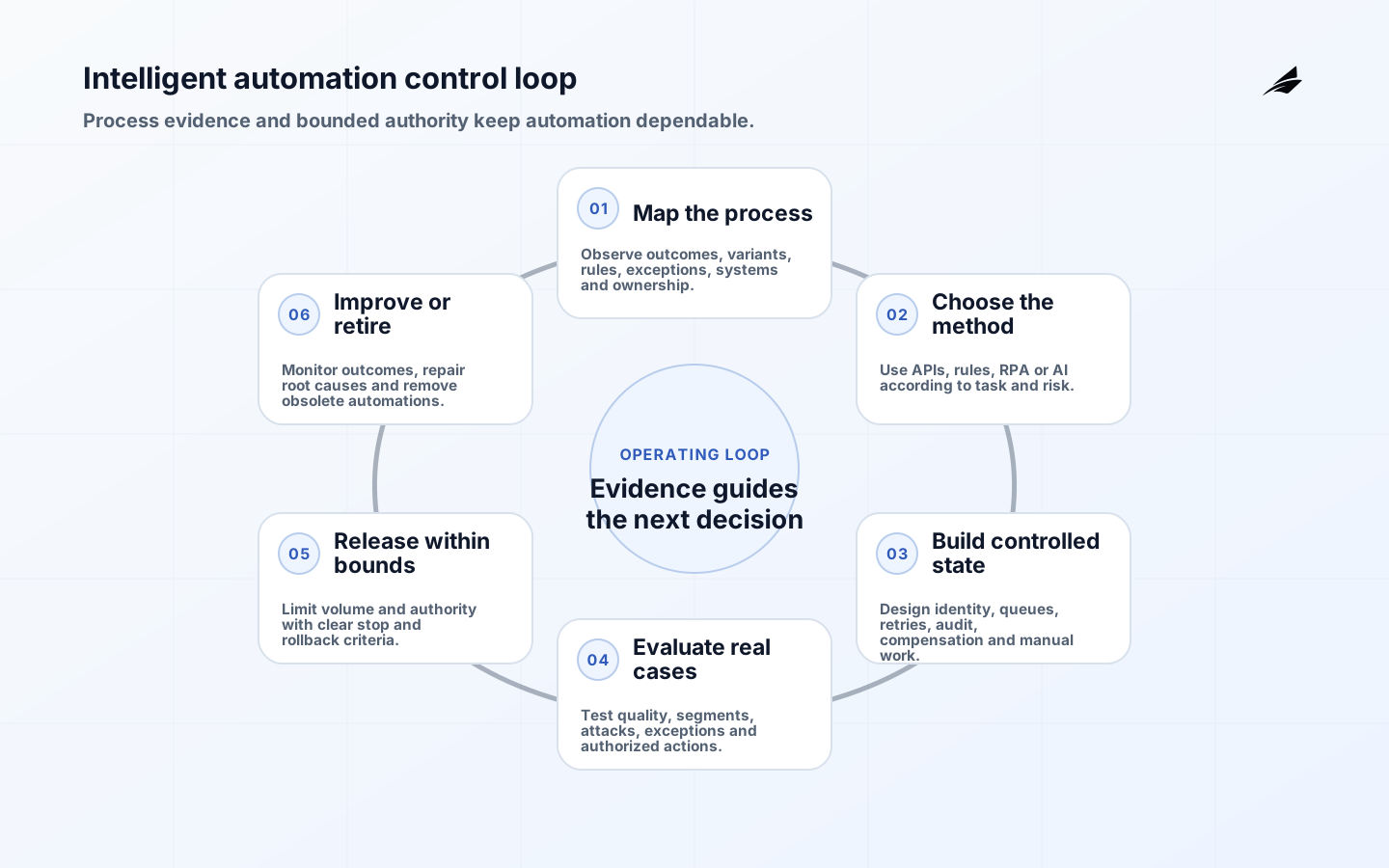
Intelligent automation services combine workflow design, integration, rules, robotic process automation and selected AI capabilities to improve a business process. The useful question is not whether a provider has bots or agents; it is whether the service can complete a bounded outcome with controlled exceptions, auditable authority and sustainable operations. These answers help buyers distinguish a reliable automation capability from a demonstration that succeeds only on clean examples.
Use this FAQ with Edilec's intelligent automation implementation checklist, AI workflow automation checklist and automation delivery plan. Start with the process and its decision rights; tool selection follows.
What are intelligent automation services?
They are professional or managed services that discover, redesign, build and operate automated workflows using APIs, orchestration, business rules, document processing, RPA, machine learning or generative AI. A provider may supply discovery, platform setup, development, quality, governance, support and a reusable automation center. The service boundary should specify which processes, systems, decisions, environments and support hours are included, and which client roles retain authority.
Automation should improve an end-to-end outcome, not merely remove keystrokes from one step. Model the current process, variants, messages, decisions, exceptions and handoffs. The OMG BPMN specification provides a standard notation for communicating business processes. Teams do not need to model every implementation detail, but a shared process representation makes ownership, waiting, rework and failure visible before code hardens them.
Which processes are suitable for intelligent automation?
Good candidates have meaningful volume, stable outcomes, accessible inputs, measurable errors and an accountable owner. Rules-based, repetitive tasks may fit API integration or RPA. Classification, extraction or language tasks may justify AI when variability defeats deterministic methods. Poor candidates have unresolved policy, very low volume, constantly changing interfaces, undocumented exceptions or decisions whose impact cannot be safely reviewed. Improve or standardize the process first when that is cheaper.
Score candidates on value, feasibility, risk and reuse. Observe actual work and sample cases across periods, teams and edge conditions. The federal RPA Playbook provides program and technology-management guidance that remains relevant even when AI is added. Require a baseline for handling time, queue age, quality, rework and exception volume. An automation percentage is meaningless if the remaining cases become slower or riskier.
| Candidate signal | Favors automation | Needs redesign first |
|---|---|---|
| Inputs | Structured or reliably extractable | Missing, disputed or inaccessible |
| Rules | Stable with explicit authority | Policy changes by operator |
| Exceptions | Known and routable | Large hidden long tail |
| Value | Volume and error cost are measurable | Benefit depends on unowned capacity |
| Risk | Actions are reversible or reviewable | Irreversible high-impact action has no challenge path |
How should intelligent automation be architected?
Separate orchestration, integrations, decision logic, AI inference, credentials, work queues and audit evidence. Prefer supported APIs over screen automation; use RPA when no stable interface exists and monitor the dependency closely. Make every work item idempotent where possible, assign correlation identifiers and record state transitions. Design retries, timeouts, dead-letter handling, duplicate detection and compensation. A bot that silently retries a financial action can create more damage than a visible failure.
Run automations under dedicated least-privilege identities. Keep secrets in managed storage, restrict network destinations and authorize external actions outside untrusted model output. Preserve input, rule or model version, decision, action and outcome according to privacy and retention needs. Provide a manual queue that includes context and reason, not just an error code. Capacity-test both the automation and the people who receive exceptions during peak periods.
What controls are needed when AI is involved?
Map context and affected groups, define prohibited uses and evaluate realistic cases before deployment. The NIST AI RMF connects governance, context, measurement and risk treatment. Test important segments, uncertain inputs, prompt attacks, leakage, unsupported content and unsafe tool calls. Use confidence thresholds only when they are calibrated for the task; a high model score does not guarantee a correct or authorized business action.
Maintain lifecycle records and approvals. ISO/IEC 42001 specifies an AI management system for responsible development and use. Review changes to data, model, prompts, retrieval sources, thresholds and actions. Human review must have sufficient information and authority to correct or reject a result. Monitor overrides and eventual outcomes. Stop automation when quality, safety or data provenance falls outside the approved boundary.
How much do intelligent automation services cost?
Cost depends on process variation, integrations, document types, model use, platform licenses, environments, security, testing, support and change frequency. Include discovery, redesign, build, exception handling, monitoring, vendor consumption, internal ownership and maintenance. RPA that touches a frequently changing interface may have low initial cost and high upkeep. AI evaluation and human review can exceed inference cost. Estimate ranges from sampled work rather than a vendor's standard bot price.
Calculate value from completed outcomes, not labor minutes in isolation. Confirm whether released capacity reduces spend, absorbs growth, improves service or shifts to higher-value work. Subtract review, errors, rework, incidents and platform operation. Measure cycle time, straight-through completion, exception age, quality, user experience and cost per successful case. Set a payback or value threshold, but do not trade away mandatory controls to improve a spreadsheet return.
| Cost layer | Typical driver | Buyer question |
|---|---|---|
| Discovery | Variants, systems and sample quality | Is the process ready to automate? |
| Build | Interfaces, rules, models and controls | What is reusable versus process-specific? |
| Run | Volume, licenses, inference and support | What is cost per successful outcome? |
| Change | Interface and policy volatility | Who owns regression testing and repair? |
| Exceptions | Review rate and handling time | Can the receiving team absorb peak load? |
How should a provider be selected and contracted?
Ask the proposed team to model a real process and explain where it would use rules, integration, RPA and AI. Inspect code, tests, monitoring, incident handling, platform administration and a failed automation example. Check subcontractors, data locations, access controls, vulnerability response, support coverage and financial continuity. Certifications can support due diligence; they do not prove that the proposed workflow is safe or maintainable.
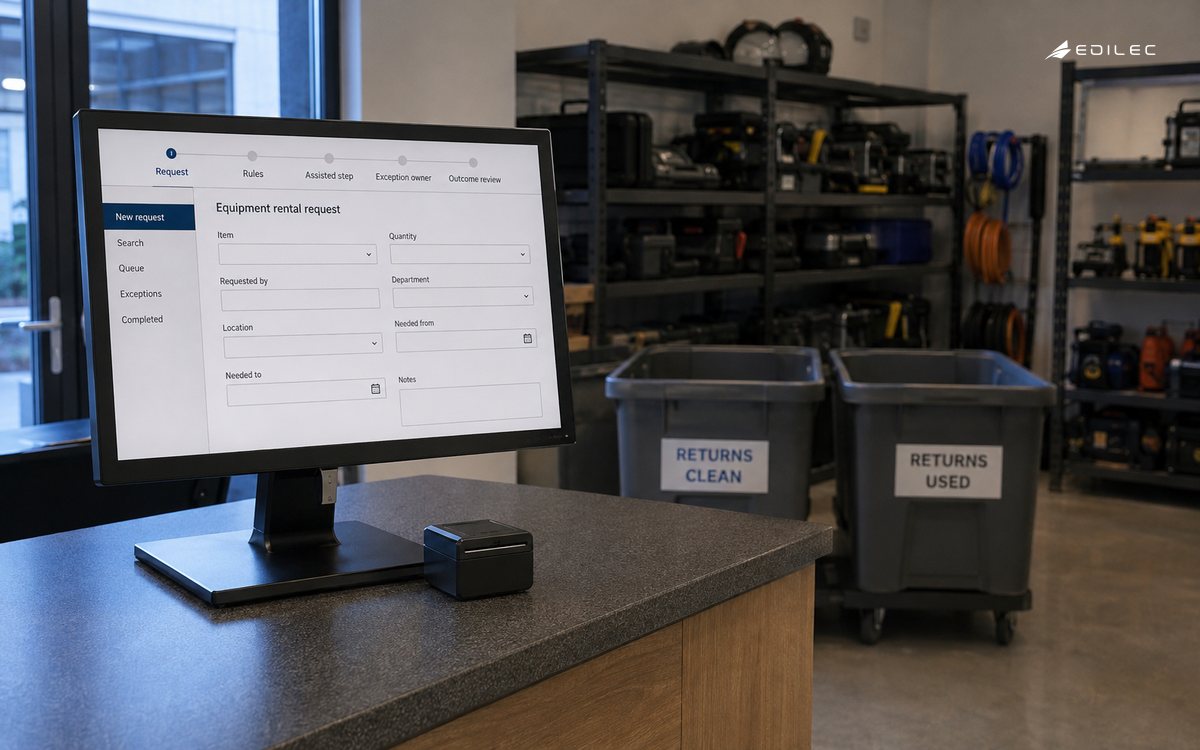
Contract for repositories, documentation, audit access, change notice, service objectives, incident duties, pricing drivers, data return and transition assistance. The delivery process itself should follow secure practices; the NIST SSDF provides a useful acquisition vocabulary. Avoid supplier ownership of client credentials or opaque automations that cannot be exported. Define acceptance through observed business and recovery tests.
Example: automate supplier onboarding safely
A procurement team may receive supplier forms, tax records, bank evidence and sanctions checks through email. Discovery should map required fields, legal review, duplicate suppliers, country variation and approval authority. A suitable design uses a portal or managed intake where possible, document extraction for bounded fields, deterministic validation and a workflow queue. AI can suggest classification, but it should not approve a supplier or change bank details autonomously.
Test clear and poor scans, multiple languages, conflicting records, expired documents, prompt-like text and deliberate account substitution. Require source highlighting for extracted fields and independent verification of sensitive changes. Each case record should show document version, extraction, validation, reviewer, approval and system updates. Simulate a downstream ERP outage and duplicate submission; the workflow should pause or retry idempotently without creating two suppliers or losing review evidence.
Pilot with one supplier class and trained reviewers. Measure elapsed time, reviewer effort, extraction correction, exception age, duplicate detection and successful ERP creation. Recalculate value after knowledge cleanup and support cost. Broaden only when exceptions are understood and internal owners can update rules, evaluate model changes and recover failed cases. The example shows intelligent automation as controlled process redesign, not a bot placed over an unstable inbox.
How is intelligent automation operated at scale?
Maintain an inventory with process owner, technical owner, purpose, systems, identities, version, risk tier, support, dependencies and retirement date. Standardize reusable queue, logging, credential, testing and deployment patterns. Monitor throughput, success, exception reason, queue age, business outcome, cost and access. Give operations authority to pause safely. Reconcile automated actions with systems of record so silent partial completion does not accumulate.
Use a review cadence based on risk and change rate. Analyze exception clusters before adding another model or rule; many signal upstream data or policy problems. Retest after interface and vendor changes. Retire automations when the underlying process disappears, an API replaces fragile screen control, or value no longer covers operation. Revoke identities, drain queues, archive required evidence and confirm downstream owners have moved.
Intelligent automation service takeaways
- Redesign and measure the process before automating tasks.
- Choose rules, APIs, RPA and AI according to the work, not a platform preference.
- Make retries, exceptions, identities and audit evidence part of architecture.
- Evaluate AI output and authorized business action separately.
- Calculate value from successful outcomes after review and error cost.
- Operate every automation as an inventoried service with a retirement path.
Frequently asked questions
Is intelligent automation the same as RPA?
No. RPA automates user-interface interactions and is one possible component. Intelligent automation may also use APIs, workflow engines, rules, document processing and AI. Prefer the most reliable supported interface and add probabilistic methods only where their benefit and risk can be measured.
Does intelligent automation remove human work?
It often changes work rather than removing it. People may handle exceptions, improve policy, review consequential actions and manage the service. Forecast both capacity released and new control work. Design roles and training early so exceptions do not become an unowned queue.
Conclusion
Intelligent automation services are valuable when they make a whole process more reliable, measurable and governable. Choose suitable work, design explicit state and exception handling, constrain AI authority and price the operating lifecycle. A service should leave behind controlled automation that internal owners can understand, challenge, improve and retire.