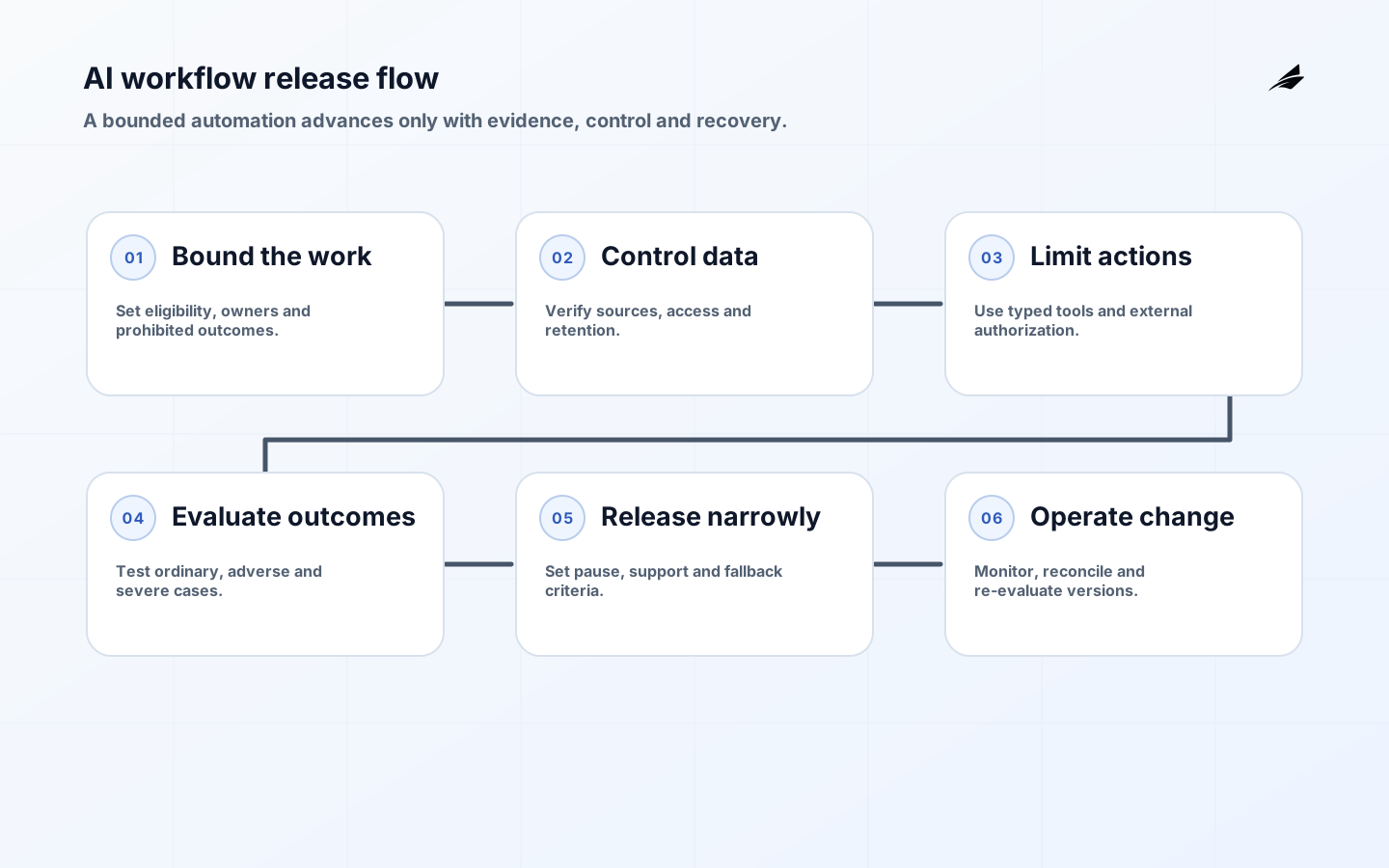
An AI workflow automation implementation checklist should prove that a bounded piece of work can be completed with acceptable quality, authority and recovery. It should not begin with model selection or end when a demonstration succeeds. Production readiness includes source data, user experience, tool permissions, evaluation, human review, exception ownership, monitoring, change control and fallback. The most important artifact is an explainable workflow with evidence at each consequential transition.
Use this checklist for document intake, service triage, knowledge assistance, drafting and other operational automation. The AI automation ROI guide helps define value, while the workflow escalation guide covers reliable human handoff.
Key takeaways
- Define eligible work, prohibited outcomes and accountable owners before selecting models.
- Keep authorization, validation and transaction limits outside generated content.
- Evaluate complete workflow outcomes with ordinary, difficult and malicious cases.
- Make human review usable, informed and connected to a correction route.
- Release to a bounded population with pause and fallback criteria.
- Monitor quality, exceptions, cost, drift and downstream effects after launch.
Scope the workflow and authority
Write the trigger, eligible population, inputs, output, downstream action, deadline, business owner and technical owner. Name what the automation may recommend, draft, update or never decide. Map affected people and their recourse. The NIST AI RMF organizes lifecycle work through Govern, Map, Measure and Manage; use those functions to prevent a narrow model test from standing in for workflow governance.
Baseline the current path using representative records. Count elapsed time, accepted outcomes, rework, exceptions, escalations, unit cost and severe errors. Include hidden preparation and follow-up. Select a first scope that is frequent enough to evaluate but reversible enough to correct. The human-in-the-loop mistakes guide explains why adding a nominal approval does not create meaningful oversight.
| Scope decision | Required answer | Release evidence |
|---|---|---|
| Eligibility | Which records may enter? | Deterministic filter tests |
| Authority | What may AI suggest or change? | Tool and role matrix |
| Quality | What counts as acceptable? | Task-specific rubric |
| Recourse | How can a person challenge an outcome? | Owned correction path |
| Fallback | How does work continue safely? | Rehearsed manual route |
Build a controlled data and action path
Inventory prompts, files, retrieval sources, model endpoints, tool calls, outputs, feedback, logs and stores. Apply current identity and tenant permissions before retrieval. Minimize sensitive data and define retention. Treat documents and tool results as untrusted inputs. OWASP's LLM application risks highlight prompt injection, disclosure, improper output handling and excessive agency.
Expose narrow tools with typed parameters and server-side authorization. Validate identifiers, amounts, recipients and state transitions independently of the model. Use idempotency for write actions, transaction limits, confirmation for consequential changes and complete audit records. A model should not choose its own permissions or convert retrieved instructions into new authority. Secrets must remain outside prompts and generated logs.
| Boundary | Control | Failure test |
|---|---|---|
| Retrieval | Current purpose and role filtering | Cross-user document request |
| Prompt | Separate trusted policy from untrusted content | Indirect instruction in attachment |
| Output | Schema and business validation | Malformed or unsupported value |
| Tool | Least privilege and confirmation | Attempt unauthorized action |
| Record | Provenance and immutable decision evidence | Correction after downstream write |
Evaluate the complete workflow
Create a versioned test set from real cases: common, rare, incomplete, ambiguous, multilingual where relevant, adversarial and out of scope. Label expected workflow outcomes with domain experts. Evaluate source use, task correctness, unsupported claims, harmful content, authorization, abstention, escalation and downstream validity. The NIST Generative AI Profile offers risk actions for generative systems.
Set separate gates for frequent errors and severe failures. An average score can hide one unauthorized disclosure or harmful action. Run end-to-end tests with the production prompt, retrieval settings, model version and tools. Compare against the baseline and retain failed cases as regression tests. Review evaluation disagreements; they often reveal unclear policy that automation would otherwise amplify.
Design human review as real work
A reviewer needs the source, proposed output, uncertainty, applicable policy and meaningful choices. Avoid automation bias by showing evidence before confidence theater. Route cases by skill and consequence, set service targets and permit escalation. Record approve, edit, reject and defer outcomes with reasons useful enough to improve policy, data or system design.
Sample accepted cases as well as exceptions; otherwise systematic errors can pass silently. Do not feed every reviewer correction directly into model behavior. Treat feedback as governed data: check quality, privacy, incentives and representativeness before use. Microsoft’s responsible AI workload guidance discusses accountability, transparency, reliability, privacy and inclusiveness in workload design.
Release, observe and recover
Launch with a bounded population, feature control and named support. Define expansion, pause and rollback criteria. Monitor eligible volume, accepted outcomes, correction, abstention, escalation age, severe incidents, latency, cost and drift in inputs. NIST's Cybersecurity Framework 2.0 connects governance, detection, response and recovery, useful when AI-specific controls sit within normal operational risk management.

Rehearse model unavailability, bad retrieval, compromised source, tool failure and a harmful output that already changed a record. The team should isolate the affected capability, preserve evidence, reconcile downstream effects, notify responsible parties and restore a tested version or manual path. Review material model, prompt, data, tool and policy changes against the same gates before release.
Sequence implementation around evidence
Start with a shadow path that receives representative inputs but cannot affect the live record. Compare its proposed output with actual outcomes and capture where required context is absent. Next, expose drafts to trained reviewers while retaining the existing process. Only after the review queue, source trace and correction path work should the team consider a narrowly scoped write. This sequence distinguishes model limitations from integration and policy defects before authority increases.
Use a release packet for every configured version. Include workflow scope, data-flow diagram, supplier versions, prompt and retrieval configuration, tool permissions, evaluation set, results, unresolved risks, reviewer readiness, support route and approval. Record hashes or immutable references for executable artifacts where practical. The packet should let an incident responder identify what was deployed without reconstructing the release from chat messages and personal notebooks.
For a document-intake example, the first release might extract invoice header fields and propose a match to an existing purchase order. The system can create a draft, but it cannot approve payment, create a supplier or alter bank details. A reviewer sees the source region for each field and the current supplier record. Duplicate invoice number, conflicting currency, missing order and changed bank instructions route to distinct exception queues rather than one catch-all confidence threshold.
Measure the production workflow without losing the cases
Pair aggregate measures with sampled case review. Track eligible volume, completion, acceptance without edit, material correction, abstention, escalation age, unauthorized attempts, downstream rejection, latency and unit cost. Segment by meaningful workflow characteristics such as document type, language or customer group where lawful and useful. A stable average can conceal a new failure concentrated in a small population, while a rising correction rate may reflect a changed input source rather than a model regression.
Set thresholds with actions. If the exception queue exceeds staffed capacity, reduce eligible volume. If a source becomes stale, disable claims that depend on it. If a severe authorization test fails, suspend tools while retaining a read-only or manual path. Review false alarms as well as missed incidents so controls remain usable. Every threshold needs an owner, current baseline, decision window and recorded result after action.
Reconcile side effects after a pause. List records created or changed during the affected version, compare each with source evidence and classify it as valid, corrected, reversed or awaiting review. Notify affected operators or people according to consequence and policy. Resume only after the cause is understood, the failed case is in the regression set and the bounded population still has a workable fallback. Rollback of code alone does not repair an already changed business record.
Maintain an exception taxonomy that operators can apply consistently: ineligible case, missing evidence, conflicting source, policy ambiguity, low-quality output, prohibited action, integration failure and suspected abuse. Review volume, age and disposition by category. A rising missing-evidence queue calls for intake repair; repeated policy ambiguity needs a business owner; unauthorized attempts need security investigation. This prevents every difficult case from being labeled model error and gives the improvement backlog an accountable destination.
AI workflow automation implementation checklist
- Purpose, eligibility, prohibited outcomes, owners and recourse are documented.
- Data sources, rights, permissions, retention and correction are verified.
- Tools use typed inputs, least privilege, idempotency and transaction limits.
- Evaluation covers ordinary, adverse, malicious and out-of-scope cases.
- Human reviewers receive evidence, authority, time and escalation.
- Release gates include severe failures, quality, cost and operational readiness.
- Live signals have baselines, owners and pause thresholds.
- Fallback, incident response, reconciliation and change review are rehearsed.
Frequently asked questions
What is the first implementation step?
Map one recent case end to end, including exceptions and correction. Define the desired outcome, authority and baseline before evaluating tools. That produces a testable boundary and exposes policy or data gaps that a model cannot solve.
When is an AI workflow production-ready?
When representative evidence meets release gates, severe failures are controlled, reviewers and support can operate it, and fallback has been exercised. Production readiness is a workflow claim tied to a specific version and scope, not a general model property.
When should the team stop the automation?
Pause when severe harm occurs, permissions fail, quality drops below threshold, exceptions overwhelm reviewers or evidence becomes unreliable. Use the pause to contain effects and diagnose data, policy, integration or model causes before deciding whether to narrow, repair or retire.
Conclusion
Production AI workflow automation is disciplined service design. Bound the work, protect data and action, evaluate complete outcomes, support reviewers and rehearse failure. A checklist is valuable when every item produces evidence and an owner, giving the organization a credible basis to launch, expand or stop.