AI automation services for business workflows can classify requests, extract fields, retrieve approved knowledge, prepare drafts, recommend routes and execute bounded actions. The useful question is not whether AI can touch a process, but which decision or task can improve with acceptable error, oversight and recovery. This FAQ explains how to move from a promising demonstration to dependable operational software without giving a probabilistic model unbounded authority over records, money, access or customer commitments.
For project sequencing, use the AI workflow scope and cost plan, the implementation checklist, the AI workflow automation checklist and the AI workflow automation FAQ. Keep an accountable process owner, system owner, data owner and risk reviewer involved after launch; buying a managed model does not transfer responsibility for the workflow outcome.
Which workflows are good candidates?
Start with frequent work where inputs, desired outputs and exceptions can be observed, and where a person can correct errors before serious harm. Strong candidates include document triage, support summarization, knowledge retrieval and draft preparation. Be cautious with final eligibility, employment, medical, legal, financial, safety or access decisions. Map volume, cycle time, rework, error cost, data, systems and current controls. Select one bounded outcome and retain the original evidence so operators can compare the model’s proposal with source material.
| Pattern | Suitable AI role | Required boundary |
|---|---|---|
| Inbound documents | Classify and extract with confidence | Schema checks and reviewed exceptions |
| Knowledge support | Retrieve and draft cited answers | Approved sources and no unsupported action |
| Case routing | Recommend queue and priority | Deterministic entitlement and appeal |
| Record updates | Prepare a change set | Authorization, preview and approval |
| Multi-step agent | Plan bounded tool calls | Allowlisted tools, budgets and stop control |
What architecture is needed?
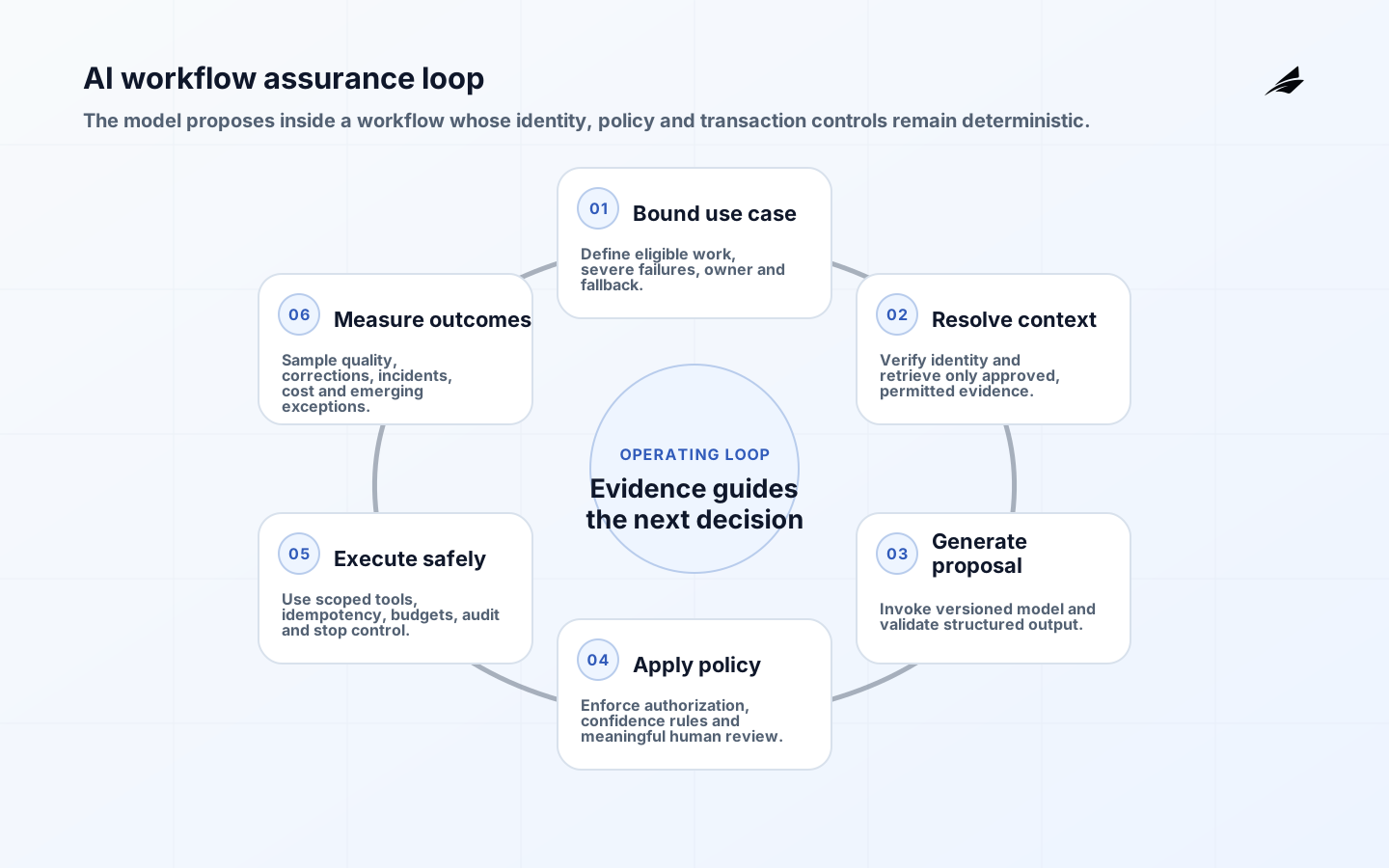
Separate model reasoning from workflow authority. An orchestrator should resolve the user, tenant and case; retrieve only permitted context; invoke a versioned model; validate structured output; apply business policy; request approval where required; call narrowly scoped tools; and write an attributable audit event. Keep system-of-record transactions idempotent and enforce authorization in downstream services. Treat retrieved documents, emails and web content as untrusted data because they can contain instructions intended to manipulate a model.
Where should humans review?
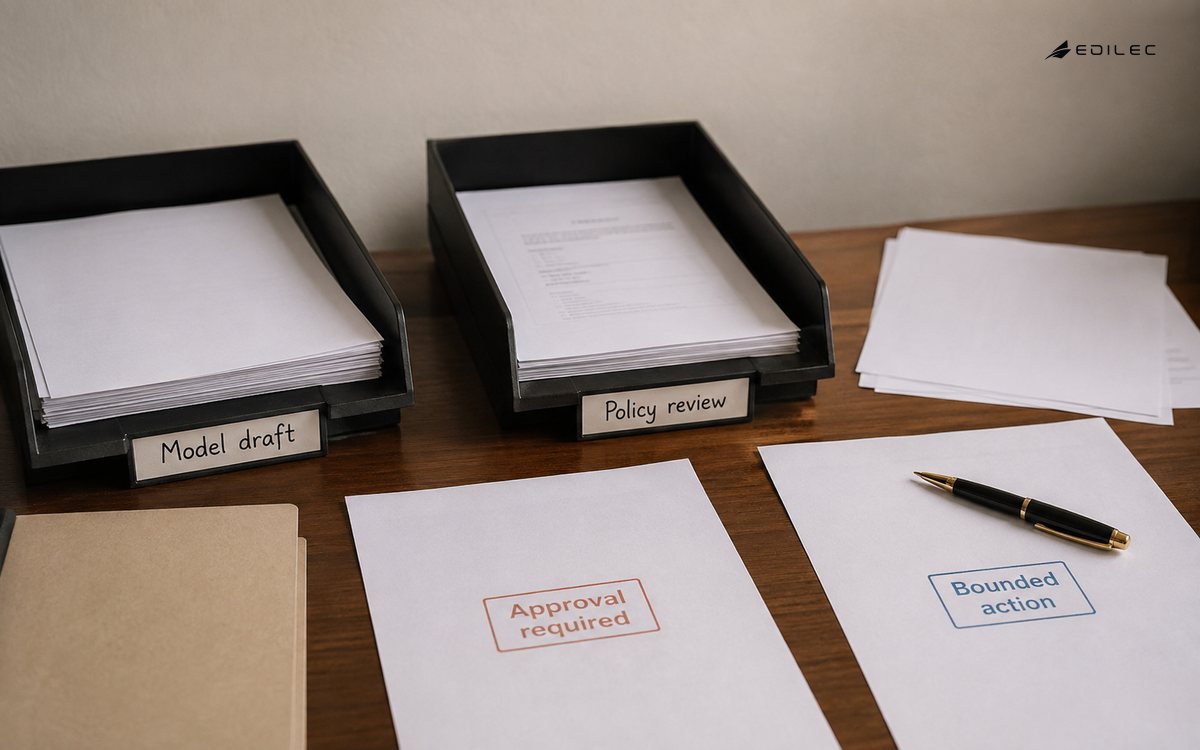
Place review where consequence, uncertainty, novelty or accountability requires judgment. The reviewer needs source evidence, proposed action, confidence or reason, policy checks and a safe edit or reject path. Do not create rubber-stamp queues with impossible volume. Use thresholds to auto-process low-risk, well-tested cases and route ambiguous or high-impact cases. Measure disagreement and correction, then update rules and evaluation sets. Human approval does not fix excessive permissions; technical policy must still prevent actions neither the person nor model may perform.
How is quality evaluated?
Build a versioned set of representative tasks including common cases, rare exceptions, adversarial inputs and affected user groups. Define failure labels before testing: unsupported claim, wrong extraction, missed policy, privacy disclosure, unsafe tool call or poor escalation. Score the whole workflow, not only model text. Compare with the current process and a simple deterministic baseline. Run regression tests for model, prompt, retrieval, policy and tool changes, then monitor sampled production outcomes and user appeals for failures absent from the laboratory set.
| Measure | Meaning | Release use |
|---|---|---|
| Task success | End-to-end accepted outcome | Primary quality gate |
| Severe failure rate | High-consequence errors per eligible case | Stop or human-review threshold |
| Coverage | Share handled within approved boundary | Capacity forecast, not quality substitute |
| Correction rate | Material operator edits | Learning and workload signal |
| Latency and unit cost | Resources per completed outcome | Architecture and scaling decision |
| Escalation quality | Correct cases reach capable people | Fallback acceptance gate |
What determines cost and delivery time?
Cost includes process discovery, data preparation, integrations, identity, retrieval, model use, evaluation, security, observability, change management, support and exception handling. Token price alone is rarely a useful total. Estimate volume and input size ranges, tool calls, retries, review minutes and peak demand. Prototype the riskiest integration and evaluation question first. Deliver a read-only assistant before write actions where possible, then expand by evidence. Include recurring model changes, content maintenance, incident response and vendor exit in the operating forecast.
How are security and privacy controlled?
Minimize data sent to models, classify fields, redact where appropriate and verify provider retention, training, location and subcontractor terms. Use least-privilege identities, allowlisted tools, schema validation, output encoding, rate and spend limits, and complete mediation in downstream APIs. Protect prompts and indexes as configuration, but do not rely on hidden prompts as authorization. Log relevant versions and actions without indiscriminately storing sensitive content. Test direct and indirect prompt injection, cross-tenant access, data exfiltration and denial-of-wallet scenarios.
How should rollout and operations work?
Begin in shadow mode or with a consenting cohort. Set promotion and halt thresholds for severe failure, user outcome, correction, latency, cost and queue health. Maintain deterministic fallback and a gateway stop control. Version every dependency, canary changes and reconcile any writes before rollback. Give operators clear limitations and escalation routes. Review model and supplier changes, incidents, complaints, drift, access and cost on a defined cadence. Retire unused prompts, indexes, tools, credentials and data rather than leaving experimental paths exposed.
Pilot one workflow from intake to reconciliation
Select a bounded workflow with an authoritative system of record, frequent examples and recoverable mistakes. Invoice intake is a useful illustration: the service may extract fields and propose a match, but enterprise policy decides whether the supplier is active, the purchase order is valid and the amount can proceed. Document eligible invoice channels, unsupported formats, duplicate rules, tax and currency requirements, reviewer authority and the exact event that counts as completed. Establish baseline cycle time, touch time, exception rate, duplicate prevention and correction cost from recent production cases. Exclude consequential payment release from the first pilot even if the model can call that API.
Build a representative evaluation set from approved historical or synthetic cases, preserving difficult scans, multi-page documents, changed bank details, credit notes, multiple languages and adversarial instructions embedded in attachments. Label the expected extraction, routing decision and severe failures with finance specialists. Run a deterministic parser or existing process as a baseline. Evaluate the entire task, not isolated field accuracy: a plausible supplier matched to the wrong account can be more harmful than several blank optional fields. Report confidence intervals and results by case type, then place low-confidence, novel and policy-sensitive cases into a review queue with source evidence visible.
Release in read-only shadow mode. Compare proposals with actual operator decisions without allowing the service to modify records. Investigate disagreement samples, queue age, latency, cost and missing telemetry each day. When acceptance thresholds hold, allow creation of a draft record through a scoped service identity. Require schema validation, supplier authorization, duplicate checks, idempotency and an audit event at the downstream API; hidden prompt instructions cannot provide those controls. Keep bank-detail changes and payment approval behind established independent verification. A model timeout should route work to the normal queue rather than leaving an invoice in an uncertain intermediate state.
Promote by case type and reconcile every write. Define a maximum number of automated drafts, spend limit, severe-error threshold and gateway stop control. Sample accepted cases as well as exceptions because reviewers do not see silent errors that pass policy. Measure accepted outcomes, operator correction, review minutes, duplicate avoidance, end-to-end cycle time, support contacts and cost per completed invoice against the baseline. After model, prompt, retrieval or integration changes, replay the evaluation set and canary production traffic. At pilot end, either expand a named boundary, continue against a new uncertainty or remove credentials, queues, indexes and retained documents. Never broaden authority merely because volume increased.
Treat reviewer behavior as part of the system. Measure whether source evidence is opened, how often proposals are accepted without inspection, which reasons cause overrides and whether queue pressure changes error rates. Rotate a sample to a second qualified reviewer to estimate disagreement. Improve the interface and policy when reviewers routinely correct the same field or cannot understand uncertainty. Do not use acceptance rate as proof of correctness: people may defer to confident wording or rush under workload. Training, staffing and escalation capacity must be tested at the peak volume expected after promotion.
- Choose a recoverable workflow and define completion in the system of record.
- Label severe failures and difficult cases with accountable domain specialists.
- Start read-only, then allow only validated idempotent draft writes.
- Keep authorization and sensitive changes in deterministic policy controls.
- Measure accepted outcomes, correction effort, queue health and total unit cost.
- Expand by case type only after regression and production evidence remain within thresholds.
Key takeaways
- Choose bounded workflows with observable outcomes and recoverable errors.
- Keep model suggestions separate from policy and transaction authority.
- Evaluate complete tasks with severe-failure labels and production feedback.
- Budget integration, review, operation and change, not only model usage.
- Expand autonomy only after evidence and retain a tested stop and fallback path.
Frequently asked questions
Should we build or buy?
Buy commodity model or workflow capability when contracts and controls fit; build the differentiating process logic and integrations. Preserve portability for data, prompts, evaluations and audit records.
How is ROI measured?
Compare accepted outcomes, cycle time, quality, avoided rework, review effort and total recurring cost against a baseline. Include new support and risk costs.
Is a model accuracy percentage enough?
No. Require task definitions, representative labels, severe-error rates and confidence intervals. Aggregate accuracy can hide unacceptable failures in important cases.
When should an agent execute actions?
Only after tool choice, permissions, parameters, budgets, approvals, idempotency and recovery are bounded and tested for that action’s consequence.
Conclusion
Dependable workflow automation joins a narrow business outcome to permission-aware context, measured model behavior, deterministic policy, human judgment and recoverable tools. That architecture lets teams gain speed while keeping responsibility and evidence attached to every consequential action.