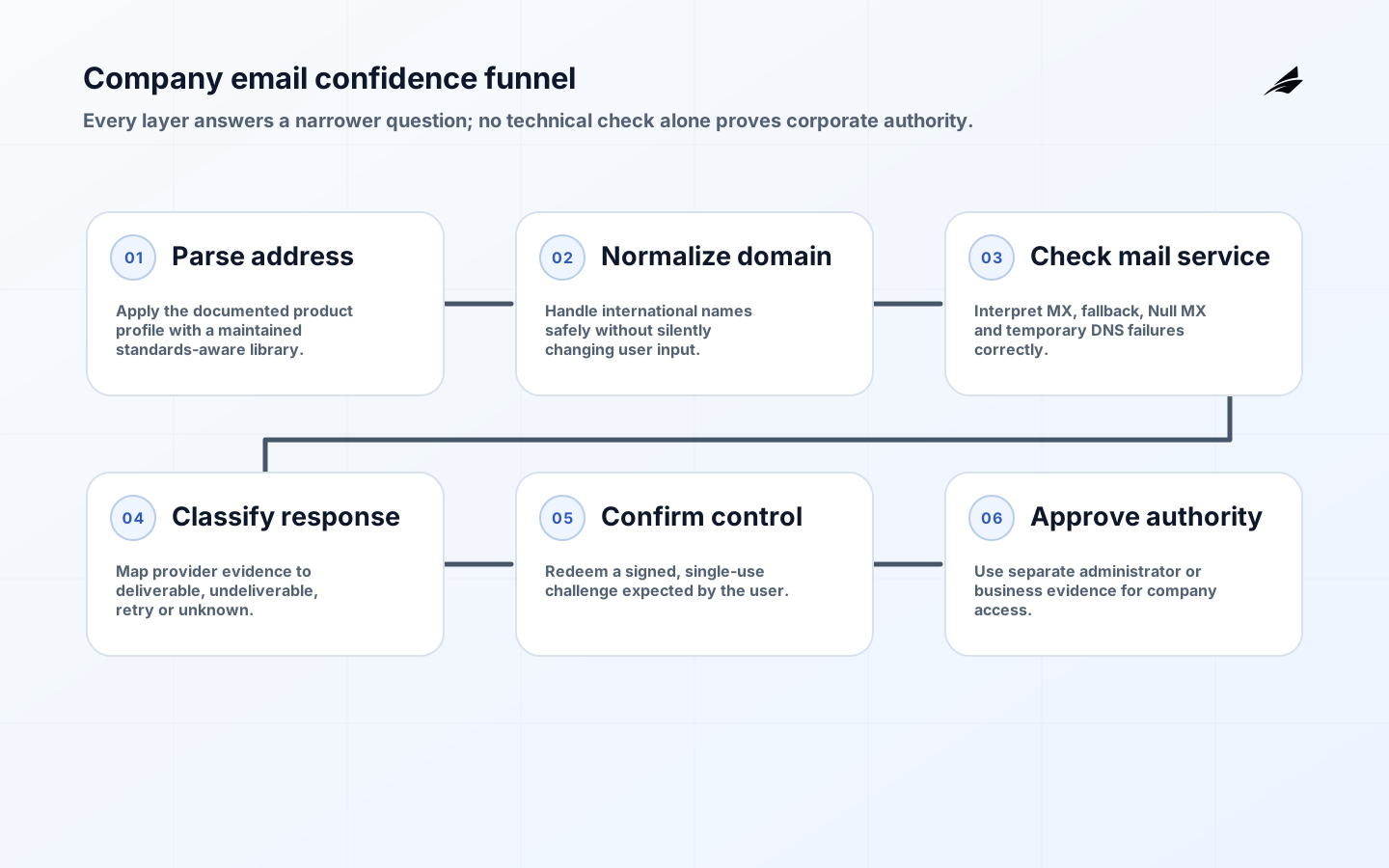
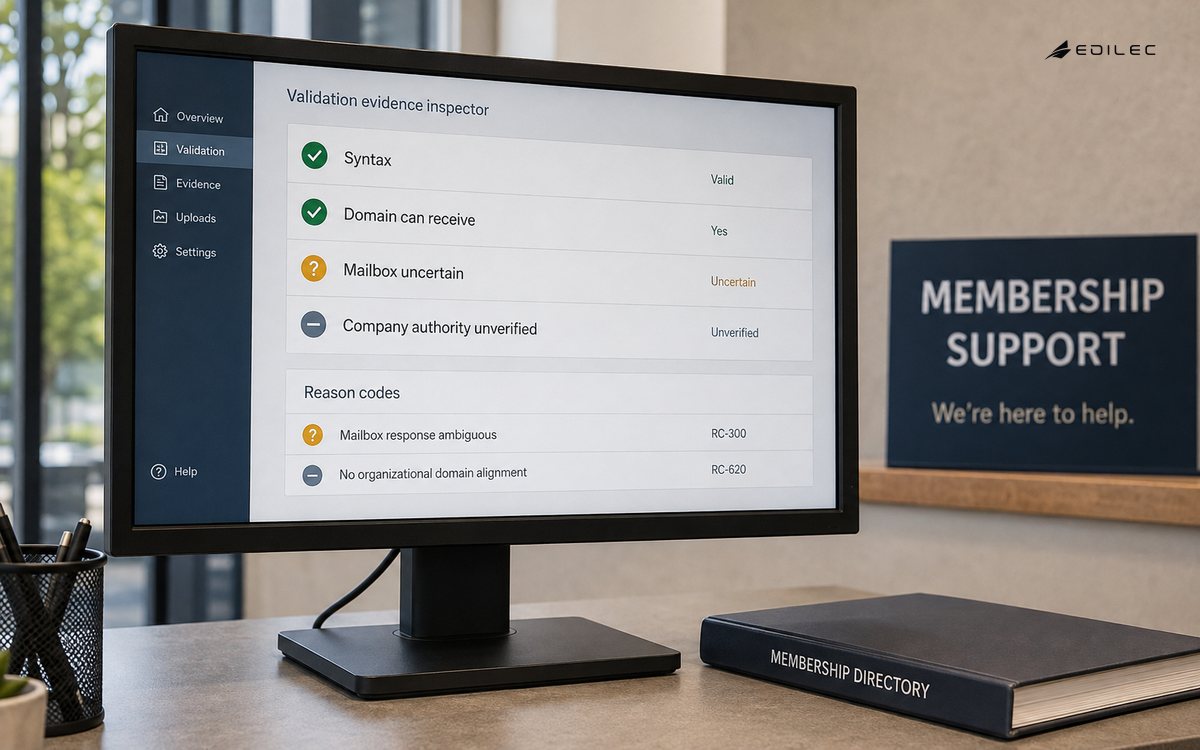
A valid company email is not a single technical fact. An address can be syntactically acceptable but use a nonexistent domain; its domain can receive mail while the mailbox does not exist; the mailbox can exist but belong to a shared role; and a person can control it without being authorized to represent the company. A useful validation service therefore returns evidence and uncertainty, not an absolute verdict that quietly combines deliverability, identity and business affiliation.
This guide is for teams building lead forms, account onboarding, partner registration or data-quality workflows. It explains what can be checked safely, what should require user action, and how to estimate and operate the service. Continue with the company email implementation checklist and company email FAQ; use the business workflow automation plan when validation feeds a larger process.
Define what valid means for the decision
Start with the business action. A newsletter signup may need only a confirmation link and bounce handling. A partner portal may require control of the mailbox plus administrator approval and organization evidence. A fraud-sensitive payout must not treat an email domain as proof of employment. Write separate attributes for syntax, domain mail capability, mailbox evidence, user control, domain classification and asserted organization relationship. Give each attribute a timestamp and provenance because DNS, mailbox state and employment change.
Publish a decision policy above those attributes. For example, allow a trial when syntax and domain checks pass, send a confirmation challenge, and hold enterprise privileges until an authorized administrator approves the account. Do not reject a user solely because an enrichment model has never seen the domain. A false negative can exclude a legitimate new business or international organization, while a false positive can grant access to an impersonator. Set asymmetric thresholds according to the consequence.
| Evidence layer | What it supports | What it cannot prove | Recommended result |
|---|---|---|---|
| Address parsing | Input conforms to the accepted address profile | Domain or mailbox exists | pass or malformed |
| DNS lookup | Domain can resolve for mail or declares no service | Specific recipient exists | mail-capable, null-MX, absent or temporary |
| Provider response | A server returned a protocol status | Stable mailbox ownership | deliverable, undeliverable, unknown or retry |
| Confirmation link | Someone currently receives at the address | Employment or signing authority | control verified with timestamp |
| Organization approval | A named process accepted affiliation | Future affiliation remains valid | approved, rejected or review due |
Implement standards-aware parsing and DNS checks
Use a maintained email-address library instead of a home-grown regular expression. The Internet message syntax in RFC 5322 is broader than the address profile many products choose to accept, and SMTP’s mailbox rules in RFC 5321 are not identical to a simplistic name@domain pattern. Document product constraints such as maximum length, surrounding whitespace, case handling and allowed display-name behavior. Preserve the original address for communication while using a carefully defined comparison key; do not assume every local part can be lowercased.
Normalize the domain using an established internationalized-domain implementation, then query DNS with timeouts and caching that honors record lifetimes. SMTP normally uses MX records and defines fallback behavior when no MX exists. A domain publishing the Null MX convention explicitly does not accept mail and should produce a durable undeliverable-domain reason. Distinguish NXDOMAIN, an empty answer, DNSSEC validation failure, timeout and temporary resolver error. Temporary infrastructure failure must not become permanent user rejection.
Choose an international email policy deliberately
Internationalized domain names and internationalized local parts are different capabilities. RFC 6531 defines SMTPUTF8 for non-ASCII mailbox names, but not every sender, receiver, identity system or downstream CRM supports them consistently. Decide whether the complete delivery path can store, display, compare and transmit Unicode safely. If it cannot, explain the limitation at entry rather than accepting an address that later fails in a hidden integration.
Test normalization, right-to-left display, visually confusable characters, mixed scripts, plus addressing, apostrophes, long labels and subdomains. Never “correct” a user’s domain silently. A typo suggestion may be offered as a choice, but automatic substitution can send personal information to the wrong organization. Keep the accepted syntax policy versioned so a future expansion does not change historical evidence without explanation.
Treat mailbox probing as uncertain and potentially intrusive
An SMTP conversation can sometimes reveal whether a recipient is accepted, but many providers intentionally obscure that information, accept all recipients, defer decisions, rate-limit probes or block reputation-poor clients. A positive response does not guarantee later delivery, and a temporary or policy response does not prove the mailbox is absent. Use enhanced status codes where available, retain the raw class for diagnosis, and map it to product-safe categories without promising certainty.
Do not perform aggressive enumeration. Use owned infrastructure with clear identity, low concurrency, timeouts, backoff and provider-respectful rate limits. Never send test content without an expected user action. For most onboarding, a signed, single-use confirmation link is stronger and more respectful than covert probing because it proves current control of the exact address. Expire challenges, bind them to the pending action, limit attempts and avoid revealing whether another person has an account.
Separate company classification from authority
A “company domain” classifier may exclude known consumer-mail and disposable-mail domains, but those lists age quickly and contain edge cases. Small businesses often use hosted consumer products; contractors may legitimately use agency addresses; universities and public bodies do not fit a commercial-company taxonomy. Return the classification source and confidence. Let a user request review, and measure rejection rates by geography and organization type to detect systematic exclusion.
Domain ownership can be established by a DNS token, well-known file or administrative email challenge, but that proves control of the domain, not authority over every employee or legal entity. For enterprise access, combine domain verification with named administrator enrollment, contractual records, role approval and periodic recertification. Use stronger identity evidence for high-impact actions. Email is a communication and recovery factor; by itself it is not a corporate authorization model.
Design a resilient validation service
Expose a versioned API that returns normalized domain, check results, reason codes, confidence, checked-at times and the policy decision. Keep network checks asynchronous when latency is unpredictable. A synchronous form can perform parsing and cached domain checks, create a pending record, and let workers retry DNS or send confirmation. Make requests idempotent, cap retries, isolate provider failures and keep manual review available. Cache domain-level evidence separately from mailbox-level evidence and never let one address’s result contaminate another.
| Component | Responsibility | Failure behavior | Operational signal |
|---|---|---|---|
| Input boundary | Parse, length-check and encode safely | Return a specific correctable error | Malformed rate by client version |
| Domain worker | Resolve MX and classify DNS outcome | Retry temporary failures | Latency, timeout and NXDOMAIN rate |
| Policy engine | Apply use-case thresholds | Fail to pending review, not silent allow | Decision and override distribution |
| Challenge service | Issue and redeem signed one-time links | Expire safely and rate-limit | Send, delivery and completion rates |
| Evidence store | Retain bounded provenance and timestamps | Protect and delete by policy | Access, age and deletion completion |
Estimate cost and delivery stages
Cost comes from request volume, DNS and provider traffic, challenge email, third-party lookup fees, review operations, support, abuse defense, observability and privacy work. Model peak signups and retries, not only average addresses. Buying an API may shorten delivery but adds data sharing, variable per-check cost and dependency on opaque decisions. Building gives policy control but creates mail-operations and reputation responsibilities. Require exports, reason codes, deletion support, regional terms, service limits and an exit path from any provider.
- Define the action, false-positive cost, false-negative cost and evidence attributes.
- Implement parsing and DNS checks against a curated edge-case test suite.
- Add a pending state, confirmation challenge, rate limits and privacy-safe logging.
- Pilot in observe-only mode beside the current workflow and compare outcomes.
- Enable blocking only for high-confidence permanent failures; route uncertain cases to retry or review.
- Reconcile delivery, bounce, complaint and override data monthly, then adjust the policy version.
Control privacy, abuse and retention
An email address is personal data in many contexts. Record the purpose for each check, minimize provider disclosure, encrypt transport and storage, restrict access and set retention separately for pending challenges, evidence, suppression and audit. Do not place full addresses in general application logs or metrics labels. The NIST Privacy Framework can help identify and manage privacy risk, while counsel determines notice, consent, deletion and cross-border duties for the relevant jurisdiction.
Defend the endpoint against address enumeration, disposable-account farming, DNS amplification and confirmation bombing. Apply per-origin and per-destination limits, bot defenses proportional to risk, generic account responses and complaint handling. Monitor sudden concentration by domain, provider errors and confirmation sends without completion. Preserve enough evidence to investigate abuse without turning the validation database into an indefinite directory of people.
Key takeaways
- Model syntax, domain capability, mailbox evidence, user control and company authority separately.
- Use maintained standards-aware libraries and distinguish permanent DNS facts from temporary failures.
- Prefer expected confirmation over intrusive mailbox enumeration for most onboarding.
- Return reasoned, timestamped evidence and allow review for uncertain company classifications.
- Measure downstream delivery, abuse and overrides instead of optimizing a vendor score in isolation.
Frequently asked questions
Does an MX record prove an email address is valid?
No. It is domain-level routing evidence. It does not prove that a particular mailbox exists, that mail will be accepted later, or that the user belongs to the company. Also account for SMTP’s no-MX fallback and explicit Null MX behavior rather than requiring an MX record blindly.
Should free email domains always be blocked?
Usually not as a universal rule. Blocking may fit a narrowly defined enterprise-administration flow, but it can exclude sole proprietors, contractors and legitimate small organizations. Use classification as one policy input, explain the requirement and provide an alternate verification route.
Where does AI help in email validation?
It may rank uncertain patterns, detect abuse clusters or assist manual review, but deterministic standards and user confirmation should remain authoritative for core checks. Evaluate model error by segment, retain reason codes and never infer employment or authority from an opaque score alone.
Conclusion
A dependable company email service is a confidence pipeline, not a binary oracle. Parse conservatively, interpret DNS accurately, respect provider uncertainty, ask the user to prove control, and require separate evidence for organizational authority. With explicit policy, privacy controls and downstream measurement, validation improves data quality without becoming an exclusion or abuse mechanism.