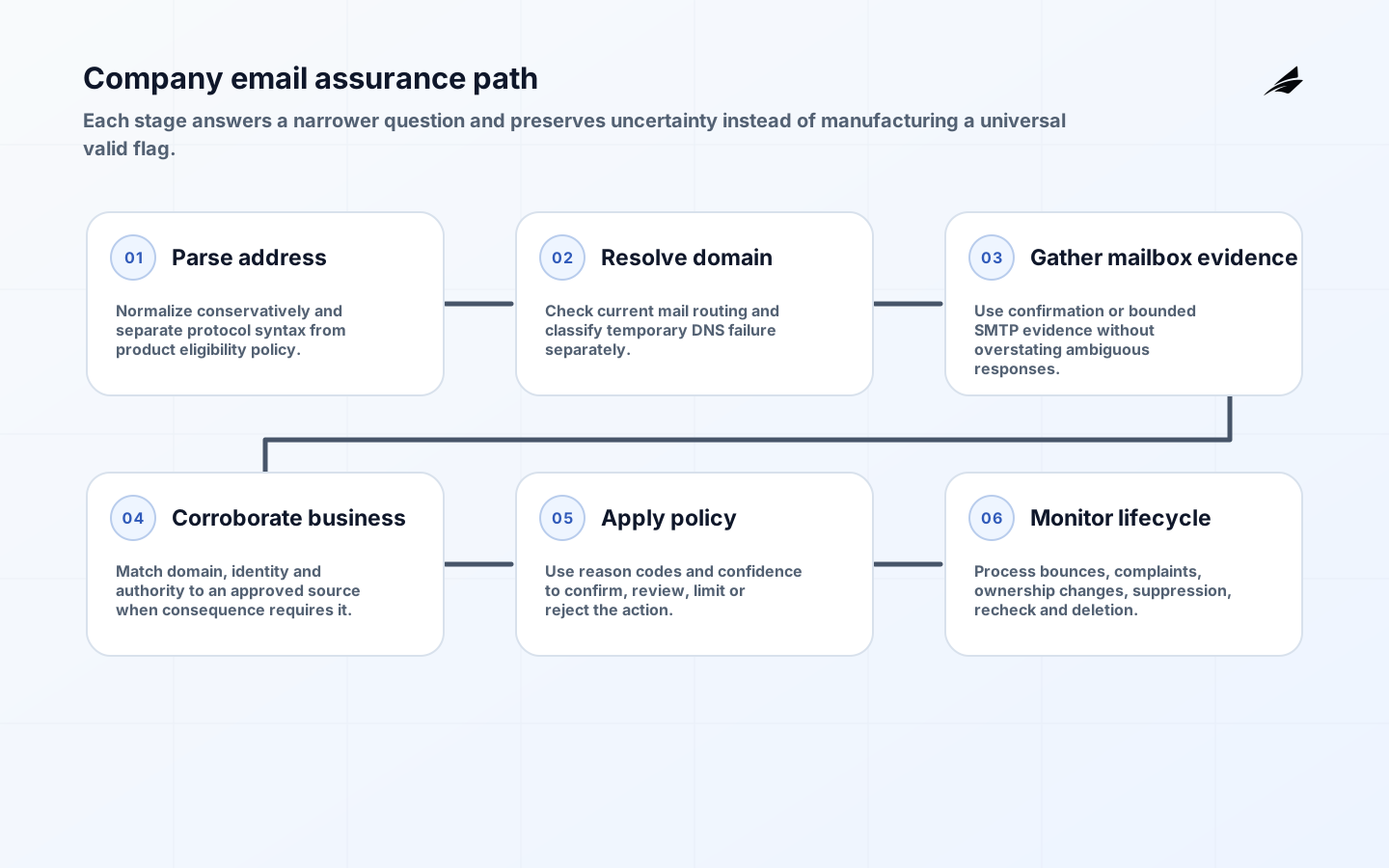
A valid company email is not a single yes-or-no property. An address can be syntactically well formed yet have no routable domain, point to a mailbox that rejects mail, accept mail through a catch-all, or belong to someone unrelated to the company. It can also receive a message while the sender lacks consent or a legitimate purpose for contacting the person. Reliable verification therefore produces evidence with confidence and expiry, not an unsupported badge that says valid.
This FAQ complements the company email planning guide, the email verification implementation checklist, the business workflow automation plan and its implementation checklist. Use it to design signup, account recovery, supplier onboarding, CRM enrichment or outreach controls without overstating what an automated check proves.
What does a valid company email mean?
Treat validity as a layered decision. RFC 5322 describes message and address syntax, while SMTP delivery behavior is defined separately in RFC 5321. A parser can reject impossible structure, but accepting structure does not prove that the domain accepts email. A DNS query can establish that a mail route is advertised, but it does not prove a particular mailbox exists. An SMTP response may be temporary, intentionally ambiguous or affected by anti-abuse controls. A delivered challenge proves current access, not employment, authority or future reachability.
| Evidence layer | What it can support | What it cannot prove |
|---|---|---|
| Syntax | Address is parseable under the chosen product rules | Domain, mailbox or owner exists |
| Domain and MX | A current mail route is advertised | Specific recipient accepts messages |
| SMTP response | Receiving system accepted, deferred or rejected this attempt | Human ownership or durable deliverability |
| Confirmation link | A person controlled the inbox at that moment | Employer relationship or purchasing authority |
| Business corroboration | Domain and identity match approved records | Consent for every proposed use |
How should a company email be verified?
Normalize input conservatively, preserve the submitted value for audit, and parse with a maintained library rather than a homemade regular expression. Apply product policy separately from protocol syntax: a business service may decline disposable domains or require an organizational domain, but that is a policy decision. Resolve DNS with bounded retries and classify no-domain, no-mail-route and temporary resolver failures differently. If the decision matters, send a signed, short-lived confirmation link and bind its redemption to the pending account and intended action.

Mailbox probing should be optional and low impact. SMTP servers may disable VRFY, accept all recipients, tarpitting clients, defer unfamiliar senders or vary behavior by reputation. Do not interpret a blocked probe as proof that the address is bad. Record the method, result, timestamp and reason code; avoid retaining raw protocol transcripts longer than operationally necessary. Recheck only when risk justifies it, such as a hard bounce, account recovery, supplier-payment change or evidence that the domain changed ownership.
How should confidence drive workflow decisions?
Map evidence to the consequence. A newsletter form can accept syntax plus confirmation and suppress bounces. A staff-only portal may require confirmation through an approved corporate domain plus directory or administrator evidence. A request to change bank details should never rely on email validity alone; use an authenticated session, established callback or dual approval. Store reason codes such as confirmed, domain-only, catch-all, temporary failure or hard rejection so downstream systems can make proportionate decisions instead of inheriting a misleading boolean.
| Workflow | Minimum useful evidence | Failure or exception path |
|---|---|---|
| Newsletter signup | Parse, consent record and inbox confirmation | Keep unconfirmed records out of campaigns |
| Customer account | Confirmation plus abuse and duplicate checks | Offer correction without exposing account existence |
| Employee access | Approved domain plus authoritative identity source | Route contractor and affiliate cases to an owner |
| Supplier onboarding | Confirmed contact plus independent company evidence | Verify sensitive changes out of band |
| CRM enrichment | Source provenance and confidence, not silent overwrite | Queue conflicts for steward review |
Do SPF, DKIM and DMARC validate a company email?
No. SPF authorizes sending infrastructure for a domain used in the SMTP transaction. DKIM attaches a domain-backed signature to a message. DMARC evaluates alignment between the visible From domain and a passing SPF or DKIM identity, then supplies policy and reporting. These mechanisms help receivers assess whether a message was authorized by a domain; they do not certify the person behind the mailbox, the truth of the content or the safety of a link. They also do not determine whether an address entered in a form can receive mail.
They still matter when your company sends verification messages. Publish complete SPF records, sign mail with DKIM, roll out DMARC with reporting and alignment, use TLS, maintain forward and reverse DNS where applicable, and separate transactional from promotional traffic operationally. Google’s current sender guidance also distinguishes requirements for all senders and higher-volume senders. Monitor authentication results, bounces, complaints and deferrals; passing authentication improves accountability but does not guarantee inbox placement.
What privacy and abuse controls are needed?
Collect only the evidence needed for a declared purpose. Tell the person why the address is requested, who will use it and how to correct or delete it. Protect confirmation tokens from replay, expire them promptly, rate-limit submissions by multiple signals and avoid responses that reveal whether a sensitive account exists. Hashing an email is not automatic anonymization because address spaces can be guessed. Define retention for failed checks, suppression records and audit evidence, and restrict bulk export from enrichment or verification tools.
Verification must not become permission to contact. Consent, contractual necessity and other lawful grounds depend on jurisdiction and context. Purchased lists, scraped addresses and guessed name patterns can create privacy, reputation and security problems even when messages are technically deliverable. For sales or fraud workflows, require provenance for every address and provide suppression and objection handling. Review third-party processors for data use, subcontractors, breach duties, deletion, model training terms and whether their probing behavior could damage your sending reputation.
How should the service be monitored?
Monitor the funnel by method and cohort: parse failures, DNS outcomes, confirmation completion, hard and soft bounces, complaint rate, false rejection appeals, catch-all prevalence and time to confirmation. Sample decisions against later delivery outcomes and reviewed identity evidence. A provider claiming near-perfect accuracy without defining labels, time horizon and test population is not offering actionable evidence. Set thresholds for pausing a data source or rule when false rejection rises, and retain a human route for high-value exceptions.
- Version validation rules and record why each rule exists.
- Separate temporary infrastructure failures from permanent negative evidence.
- Prevent automation from overwriting stronger verified identity data.
- Reconfirm after material risk events instead of on an arbitrary daily schedule.
- Test internationalized addresses only if every dependent system can safely support them.
Key takeaways
A defensible implementation procedure
Begin with a decision register that lists every place the organization consumes an email address and the consequence of a false acceptance or false rejection. Assign a purpose, evidence threshold, expiry and correction owner to each use. Implement parsing, DNS and confirmation as independently observable steps, then return a structured result with method, timestamp and reason instead of a shared valid flag. Test quoted local parts, long addresses, subdomains, international characters, null or malformed input, temporary DNS failure, domains without MX records, catch-all behavior, delayed confirmation and replayed tokens. Include accessibility and localization in confirmation messages. Before release, compare a reviewed sample with later bounce and support outcomes, investigate uneven rejection by user group or region, and document accepted limitations. In production, reconcile hard bounces, provider response codes, complaints, confirmation completion and user corrections. Alert on sudden shifts by source or rule version. A quarterly owner review should remove obsolete uses, expire vendor access, test account-enumeration protections and verify that suppression, retention and deletion still work. When a rule changes, run it against a historical labeled sample before rollout and preserve the previous decision reason so users are not silently reclassified.
For example, a supplier portal can accept a domain-only result while an invitation is pending, require inbox confirmation before account activation, and require an authenticated callback plus dual approval before bank details change. The same address therefore carries different evidence states across the workflow. This is safer than repeatedly calling one vendor and treating its latest score as universal truth.
- Validity is layered evidence, not a universal boolean.
- Inbox confirmation proves access at a point in time, not employment or authority.
- SPF, DKIM and DMARC authenticate domains and messages, not lead quality.
- Match verification strength to consequence and preserve reason codes.
- Privacy, consent, suppression and abuse controls remain required after verification.
Frequently asked questions
Is a free-mail address invalid for business?
No. Sole traders, applicants and partners may legitimately use one. If an organizational address is required, describe it as an eligibility policy and provide a review path rather than labeling the address technically invalid.
Is a catch-all domain safe to accept?
A catch-all means the server may accept mail for many recipient names, so mailbox existence is uncertain. Use confirmation or stronger business evidence where the workflow carries risk; do not reject solely because the domain is catch-all.
Does one bounce prove the address is bad?
A permanent recipient rejection is meaningful, while a timeout, quota or temporary policy response is not. Parse SMTP status, apply bounded retry rules and suppress only according to documented classifications.
Should AI decide whether an email is trustworthy?
AI can rank patterns or route exceptions, but deterministic protocol evidence and authoritative records should remain visible. High-impact rejection needs explainable reasons, evaluation for uneven error rates and a human correction route.
Conclusion
A dependable valid company email process asks a precise question at each layer: can the address be parsed, can its domain route mail, did the inbox respond, does the identity match the business context, and is the intended use permitted? Preserve those answers with timestamps and uncertainty. That design makes automation useful without turning weak network signals into false claims about people, companies or consent.