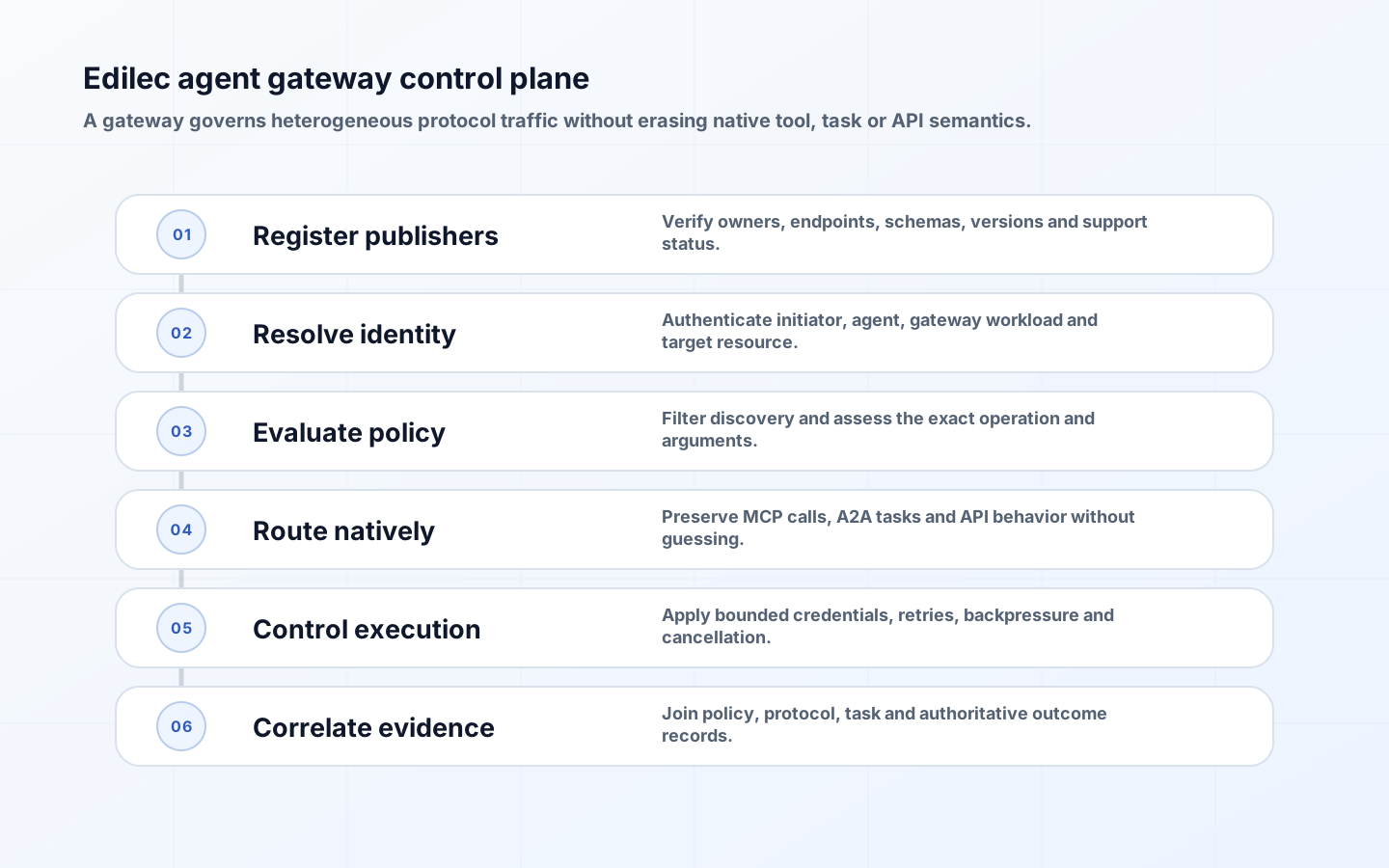
An agent protocol gateway is the controlled entry and exit point through which enterprise AI applications discover and invoke MCP tools, delegate A2A tasks and reach selected internal APIs. Its value is not superficial protocol conversion. A useful gateway applies identity, trust, policy, routing, version, rate and evidence controls consistently while preserving the meaning of each downstream contract. It should make approved capabilities easier to consume and unapproved authority harder to acquire.
Treat the gateway as a platform product with a narrow mandate. It can verify callers, resolve catalogs, issue audience-bound credentials, enforce policy and connect traces. It should not become a universal agent that rewrites task intent or guesses how a tool maps to a business process. The design complements Edilec's MCP server architecture guide and secure API access control guide by focusing on multi-protocol mediation.
Define the agent protocol gateway boundary
Place the gateway where agent traffic crosses a meaningful trust or ownership boundary: between business applications and a shared tool estate, between internal agents and external specialist agents, or between an AI runtime and protected legacy APIs. Avoid inserting it into every in-process call. The gateway needs enough context to authorize a request, but it should not receive model prompts, private reasoning or full conversation history unless a documented policy requires those data.
Separate data plane from control plane. The data plane handles protocol sessions, requests, streams, task events and responses. The control plane manages publisher registration, endpoint verification, capability metadata, policy versions, credentials, compatibility status and operator decisions. This separation lets teams deploy routing capacity independently from catalog governance and reduces the temptation to embed mutable policy in individual gateway instances.
Build six explicit gateway capabilities
A production reference architecture has six concerns: verified discovery, caller authentication, delegated credential issuance, policy enforcement, protocol-aware routing and end-to-end evidence. Each concern can be implemented by existing enterprise components, but the gateway composes them for agent traffic. For example, an identity provider authenticates a workload, a policy decision point evaluates the requested capability, and a token service issues a credential whose audience is only the selected resource.
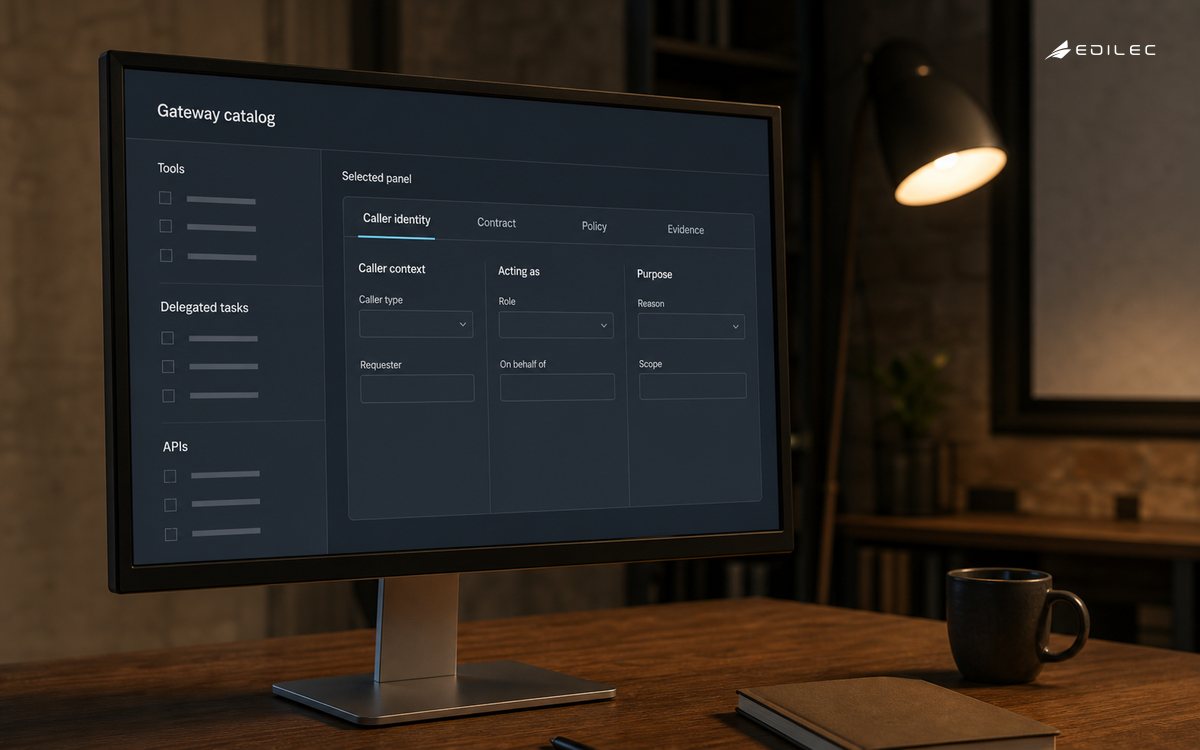
The MCP specification defines hosts, clients, servers and negotiated capabilities; the A2A specification defines Agent Cards, interfaces, tasks and artifacts. Preserve those native objects in the gateway's canonical event envelope. A shared envelope can add tenant, actor, policy decision, trace and route fields without flattening a tool invocation and an asynchronous task into the same behavior.
| Gateway capability | Input | Decision or output | Fail-closed condition |
|---|---|---|---|
| Verified discovery | Publisher and endpoint metadata | Approved capability record | Unknown owner or unverifiable endpoint |
| Identity mediation | User, workload and agent identities | Authenticated principal chain | Missing audience or untrusted issuer |
| Policy enforcement | Capability, arguments and context | Allow, deny or require approval | No applicable policy version |
| Protocol routing | Negotiated version and operation | Native MCP, A2A or API request | Unsupported semantic feature |
| Evidence | Trace, task and action identifiers | Correlated audit event | Side effect cannot be reconciled |
Preserve identity across every mediated hop
The gateway should distinguish the human or service that initiated work, the agent that selected an action, the gateway workload that mediated it and the executor that changed the system. Do not forward a broad user token through all layers. Validate the inbound credential, evaluate policy, then mint or exchange a narrowly scoped credential for the selected resource. Record the delegation chain in protected claims or authoritative trace context, not in user-editable prompt text.
Apply the resource-centric principle in NIST's Zero Trust Architecture: access decisions protect specific resources rather than trusting a network location. A gateway inside a private network still authenticates each caller and authorizes each capability. Mutual workload identity can protect service connections, while user delegation and business policy answer whether this actor may perform this action on this object now.
Turn discovery metadata into a governed catalog
Ingest MCP capability lists, A2A Agent Cards and API descriptions into a normalized catalog, but retain the original signed or retrieved metadata. Registration should capture owner, environment, data classification, allowed tenants, authentication method, schema version, support contact, risk tier and expiry. Verify endpoint control before publication. A discovered description is a publisher claim; production availability requires review and ongoing health evidence.
Clients should query views filtered to their identity and purpose rather than receive the entire enterprise inventory. Keep dangerous capabilities out of model-visible lists unless a workflow can legitimately use them. This minimizes accidental selection and prompt-injection leverage. The agent tool permissions guide provides the corresponding application-side approach to narrowing what a model may propose.
Translate envelopes, never invent semantic equivalence
Safe translation handles mechanical differences such as headers, connection pooling, error envelopes and trace propagation. Risky translation changes lifecycle meaning. An A2A task that can pause for input and complete later cannot be faithfully represented as a one-shot internal API call without a durable adapter. An MCP resource read should not become an autonomous task merely because a common gateway endpoint prefers one shape. Reject unsupported features explicitly.
Where an adapter is justified, make its state model visible. Map request IDs to task IDs, define timeout separately from cancellation, store terminal results, deduplicate retries and expose reconciliation. Version the adapter as its own product contract. Consumer tests must cover errors and partial completion, not only example payloads. A gateway that silently converts exceptions into plausible text destroys exactly the evidence a platform team needs.
Enforce policy at discovery and execution time
Discovery-time policy decides which capabilities a caller can see. Execution-time policy decides whether a specific request is allowed with its current arguments and context. Use both. A purchasing agent may discover create_purchase_order but still require human approval above a threshold, a permitted supplier, an open budget and a valid segregation-of-duties check. The downstream system must also enforce its own invariants because the gateway is one control, not the final owner of business state.
Policy decisions should return an identifier, version, reason and obligations such as redaction, approval or maximum duration. Bind approval to a digest of the consequential request fields so a later retry cannot alter the destination or amount. Rate limits need principal and capability dimensions; a global limit alone lets one noisy agent starve others. Emergency overrides require named authority, expiry and retrospective review.
Correlate protocol telemetry without logging secrets
Create one trace across application, gateway, agent, tool and downstream service. Record protocol operation, capability identifier, publisher, policy decision, latency, retry, status and resource outcome. The OpenTelemetry generative AI semantic conventions provide a standards-based vocabulary for AI telemetry, but teams should review convention stability and add governed business identifiers where needed. Trace context must not become an authorization mechanism.
Do not default to recording prompts, tool arguments, credentials or returned records. Capture schemas, hashes, classifications and selected safe fields, with access-controlled detail for investigations. Connect gateway events to the SaaS audit log design guide so operators can answer who requested, which agent selected, what policy allowed, which executor acted and whether the authoritative system confirmed the effect.
| Rollout stage | Allowed traffic | Evidence to advance | Rollback trigger |
|---|---|---|---|
| Observe | Shadow discovery and read-only calls | Complete identity and trace correlation | Unclassified data enters logs |
| Constrain | Approved read tools and test agents | Policy matches expected allow and deny cases | Caller can bypass catalog filters |
| Pilot effects | Low-impact reversible actions | Idempotency and reconciliation pass | Ambiguous outcomes remain unresolved |
| Scale domains | Multiple owners and protocol versions | Contract and failure tests remain green | Schema drift breaks consumers |
| External agents | Verified third-party endpoints | Delegation, egress and incident exercises pass | Publisher or endpoint trust changes |
Operate the gateway as critical infrastructure
Set service objectives by traffic class. A synchronous record lookup and a long-running delegated task have different latency and availability expectations. Provide circuit breakers per endpoint, bounded retries, backpressure for streams and health signals that distinguish gateway failure from downstream failure. Preserve task retrieval and cancellation paths during partial outages. Never retry a side-effecting operation merely because the client connection closed.
Maintain a compatibility matrix covering protocol versions, optional capabilities, authentication profiles and adapter releases. Rehearse certificate rotation, identity-provider outage, policy rollback, catalog corruption and downstream compromise. The gateway's blast radius makes minimal privileged access, reproducible configuration and independent audit especially important. A second route for critical operations may be justified, but it must enforce equivalent controls rather than becoming an undocumented bypass.
Key takeaways
- Use a gateway at real trust or ownership boundaries, with separate data and control planes.
- Preserve native MCP tool and A2A task semantics inside a shared evidence envelope.
- Authenticate the full principal chain and issue audience-bound credentials for each protected resource.
- Filter discovery, enforce argument-aware execution policy and keep downstream business controls authoritative.
- Roll out from observation to reversible effects, advancing only with identity, compatibility and reconciliation evidence.
Frequently asked questions
Is an agent protocol gateway just an API gateway?
It can reuse API gateway capabilities, but it must understand protocol-specific discovery, sessions, streaming, task lifecycle, artifacts and agent delegation. Traditional routing and rate limiting remain valuable; they are insufficient when a request creates durable work or transfers authority between agents.
Should the gateway execute business rules?
It should enforce cross-cutting access and risk policy, but authoritative domain invariants belong with the system that owns the record. Duplicating pricing, eligibility or accounting rules in the gateway creates drift. The gateway can require evidence that the domain service evaluated them.
Can the gateway hide protocol versions from clients?
It can absorb compatible transport changes, but clients still need an explicit capability contract. When semantics change, publish a new catalog version and test consumers. Pretending every version is equivalent moves failures from deployment into production tasks.
Conclusion
An enterprise agent protocol gateway earns its place by making identity, policy, discovery and evidence coherent across heterogeneous agent traffic. It should reduce integration toil without erasing the difference between invoking a bounded tool, delegating a durable task and calling an internal API. Those distinctions carry accountability.
Begin with one trust boundary and a small approved catalog. Prove end-to-end identity, deny behavior, version compatibility, cancellation and outcome reconciliation before adding more protocols or domains. A deliberately narrow gateway becomes a dependable control plane; an all-purpose translator becomes another opaque agent in the path.