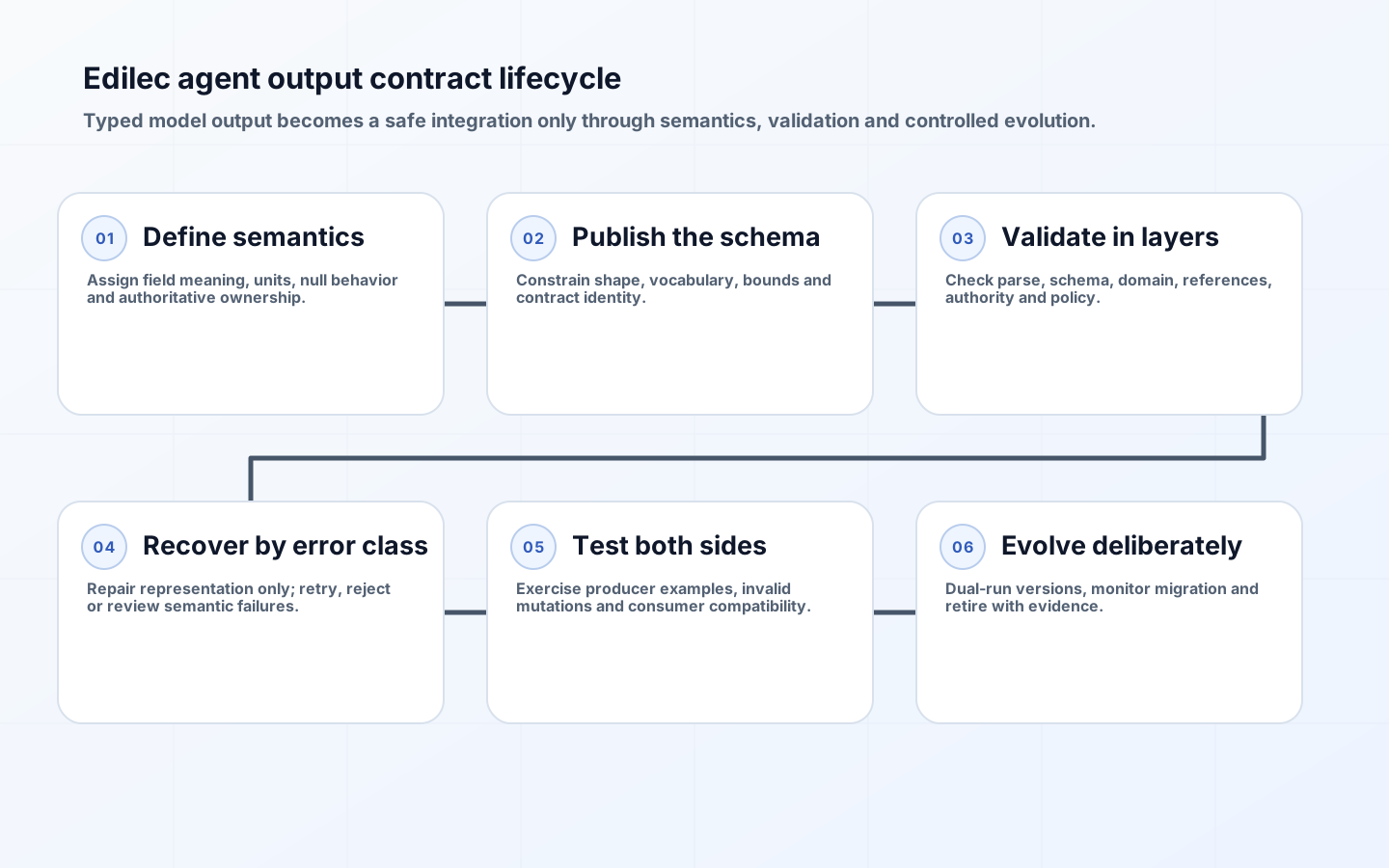
Structured outputs for AI agents are integration contracts between probabilistic generation and deterministic software. A valid JSON object is only the first condition. Production consumers need stable field meaning, explicit versions, constrained values, business invariants, compatibility rules and a recovery path when generation or downstream processing fails. Treating the output as 'some JSON' pushes ambiguity into every consumer and turns model changes into uncontrolled API changes.
The OpenAI Agents SDK agent guide supports typed output definitions, and the JSON Schema specification separates core schema mechanics from validation vocabularies. Those capabilities are foundations, not the whole contract. Teams still decide who owns semantics, which constraints belong in schema, what needs domain validation, how versions coexist and whether a malformed or unsafe output is repaired, retried, rejected or sent for review.
Draw the contract boundary before defining fields
Identify the producer, consumer and side effect. A classification object used for search ranking has a different failure cost from a payment instruction. Decide whether the output is advisory, an input to another agent, a proposed tool call or a record to persist. Name the system that remains authoritative for each field. The model may propose a customer category, but it should not invent the customer identifier. A runtime can inject verified identifiers after generation and before validation, keeping model responsibility narrow.
Write field semantics in business language before converting them to types. Define units, timezone, currency, null meaning, ordering, confidence interpretation and the difference between absent, unknown and not applicable. Avoid one field that changes meaning based on another without an explicit discriminator. Put user-facing explanation in a separate field from machine decision codes. This allows localization and copy changes without altering control logic and prevents downstream systems from parsing prose to recover a decision.
Design a narrow schema with explicit invariants
| Layer | Examples | Primary owner | Enforcement point |
|---|---|---|---|
| Serialization | Object shape, required fields, primitive types | API or platform team | Decoder and schema validator |
| Vocabulary | Enums, discriminators, stable reason codes | Domain and API owners | Schema plus compatibility tests |
| Business invariants | Amount is positive; date follows approval | Domain service | Deterministic validator |
| Authority | Requester may act on target | Security or policy service | Runtime before side effect |
| Evidence | Claim references existing source elements | AI platform and domain owner | Provenance validator |
| Presentation | Readable explanation and optional suggestions | Product team | UI and content checks |

Prefer closed, shallow structures for action-critical outputs. Use required fields for data the consumer cannot safely default. Set bounds on strings and arrays to control payload growth. Use enums for machine decisions, but plan how new values reach older consumers. Include a contract version and a correlation identifier generated by the runtime. Do not ask the model to emit secrets, timestamps it cannot know reliably or checksums of content it did not receive. Fields should reflect information the producer can actually establish.
Schema constraints are not authorization. A perfectly valid transfer object can still target an account the user cannot access. Likewise, format validation is not evidence validation. A source ID can match a pattern and refer to nothing. Keep layered checks visible so a successful schema parse is never mistaken for an approved action. The tool-calling cost and scaling guide offers broader operating considerations; the output contract governs the typed boundary before those calls are accepted.
Version semantics, not every wording change
Adopt a compatibility policy similar to an internal API. Adding an optional field can be backward compatible when consumers ignore unknown fields. Making an optional field required, narrowing an accepted enum or changing a unit is breaking. A description edit that clarifies existing meaning may not require a new major version, but it still needs evaluation because model behavior can change when instructions change. Version the schema, generation instructions, deterministic validators and consumer mapping independently, then capture all four in traces.
| Change | Compatibility risk | Recommended release | Consumer action |
|---|---|---|---|
| Add optional informational field | Low if unknown fields are tolerated | Minor | Ignore until adopted |
| Add enum value | Medium; exhaustive switches may fail | Minor only with capability negotiation | Add unknown-value handling |
| Rename or remove field | High | Major | Dual-read during migration |
| Change unit or business meaning | Critical even if type is unchanged | Major | Transform explicitly and reconcile |
| Tighten length or numeric bound | Potentially breaking for stored data | Major or gated minor | Test representative payloads |
| Improve field description | Behavioral risk at producer | Patch with eval gate | No wire change; monitor output shift |
Run old and new versions side by side during migration. The producer may dual-write only when the mapping is deterministic and side effects are disabled for the shadow result. Consumers should declare supported versions. Avoid indefinite permissive parsing because it hides drift; establish a removal date and measure remaining traffic. Store the original validated payload with its contract identity so historical records are interpreted under the rules that existed when they were created.
Validate in layers before any side effect
The pipeline should parse once, validate structure, normalize only approved representations, enforce domain invariants, resolve references, check authority and evaluate policy. Each stage returns a typed result and machine-readable error. Do not pass an almost-valid object deeper into the workflow. Validation should be deterministic and idempotent. When external state matters, read it with a version or precondition and recheck immediately before execution to prevent a valid proposal from acting on changed data.
The MCP tools specification defines tool descriptions and input schemas at the protocol boundary. An agent output that becomes tool input should be validated against the currently advertised tool schema and local policy, not a cached assumption. Pin or record the schema revision used for the proposal. When tools can change independently, capability discovery and compatibility tests become part of deployment readiness.
Choose repair, retry and rejection by error class
Automatic repair is appropriate only for unambiguous, non-semantic defects: removing an unsupported wrapper, normalizing a known date representation or filling a runtime-owned correlation ID. Never 'repair' an amount, recipient, authority decision or missing evidence by guessing. A constrained regeneration can handle producer defects when it receives the validation errors and the original task context, but set a strict attempt limit. Repeated retries can increase cost while producing different invalid answers that obscure the original failure.
Classify failures as parse, schema, domain, reference, authority, policy, dependency or consumer errors. Route non-recoverable payloads to a dead-letter store with contract version, redacted input reference, validation report, attempt history and owner. Do not place raw sensitive prompts in a broad operations queue. A human reviewer needs the proposed object, failed rules and authoritative source links. After correction, create a new payload linked to the rejected one rather than mutating history.
Test producers and consumers as one release unit
Build canonical examples for every decision code, boundary value and optional-field combination. Add invalid examples for forbidden extra properties, unknown enums, broken references, contradictory fields and unauthorized actions. Producer evaluations should measure valid-at-first-attempt, valid-after-retry and semantic correctness. Consumer tests should prove unknown-field behavior, version negotiation, idempotency and safe rejection. Contract tests belong in both deployment pipelines because either side can break the integration.
Use mutation testing to discover weak validators: swap currencies, reverse date order, remove evidence IDs, duplicate action identifiers and replace target resources. Replay production-shaped payloads after removing sensitive values. The model evaluation engineering notes explain release evidence for model changes; add contract-specific gates so aggregate answer quality cannot hide a rise in invalid or unsafe typed outputs.
Observe contract health without logging sensitive payloads
Record contract name and version, producer configuration, validation stage, error code, retry count, latency, consumer version and final disposition. Track first-pass validity, semantic rejection, dead-letter age, version distribution and repair frequency by workflow. High parse validity with rising domain rejection suggests the model learned the shape but not the business rules. A sudden spike after a tool release may indicate schema drift rather than model regression. Sample payload bodies only under controlled access and retention.
The model observability guide connects traces, evaluations, cost and human review. Add contract events to the same trace so operators can follow generation through validation and execution. Alerts should map to action: stop a new schema rollout, disable repair, route a version to review or roll back a consumer. Avoid paging on every malformed draft when the workflow already handles it safely; page when safety, throughput or queue age crosses an owned threshold.
Assign contract ownership and secure the lifecycle
Name a domain owner for meaning, a platform owner for serialization and runtime enforcement, and consumer owners for compatibility. Require review for breaking changes and authority-related fields. The NIST SSDF AI profile extends secure-development practices across the AI lifecycle; apply those practices to schemas, prompts, validators, evaluation assets and third-party libraries. Sign or integrity-protect released schemas, restrict registry publication and audit who can change a contract used for consequential actions.
Retire versions deliberately. Inventory consumers, publish migration guidance, monitor remaining use and prevent new integrations from choosing a deprecated contract. Preserve interpreters for regulated historical records or migrate data with reconciliation evidence. A contract registry should show status, owner, sensitivity, supported producers, consumers, examples, validators and sunset date. This small amount of discipline prevents a typed output from becoming an undocumented event format that nobody can safely evolve.
Key takeaways
- Define business semantics and authoritative field ownership before writing JSON Schema.
- Keep serialization, domain validation, authority and evidence checks as distinct layers.
- Version meaning, instructions, validators and consumer mappings with a documented compatibility policy.
- Repair only deterministic representation defects; never guess consequential values.
- Use dead-letter handling that preserves validation evidence without broadly exposing prompts.
- Release producers and consumers through shared contract tests and observable migration gates.
Frequently asked questions
Does schema-constrained generation eliminate validation? No. It can improve structural conformance, but domain rules, reference existence, authority, freshness and side-effect safety remain runtime responsibilities.
Should every output include a confidence score? Only when the score has defined semantics, calibration evidence and a consumer decision rule. An unexplained decimal often creates false precision rather than control.
When is a retry appropriate? Retry a bounded producer failure when the task remains valid and the validation message is safe to expose. Do not retry authorization denials, stale preconditions or ambiguous missing business data.
Conclusion
Structured outputs for AI agents become reliable when teams treat them as governed software contracts. Keep the schema narrow, define semantics and invariants, separate validation layers, evolve versions with compatibility evidence and make failure an explicit workflow. Combine producer evaluations with consumer tests and trace every disposition. The result is not a promise that generation will always be correct; it is a boundary that prevents uncertain output from silently becoming deterministic business damage.