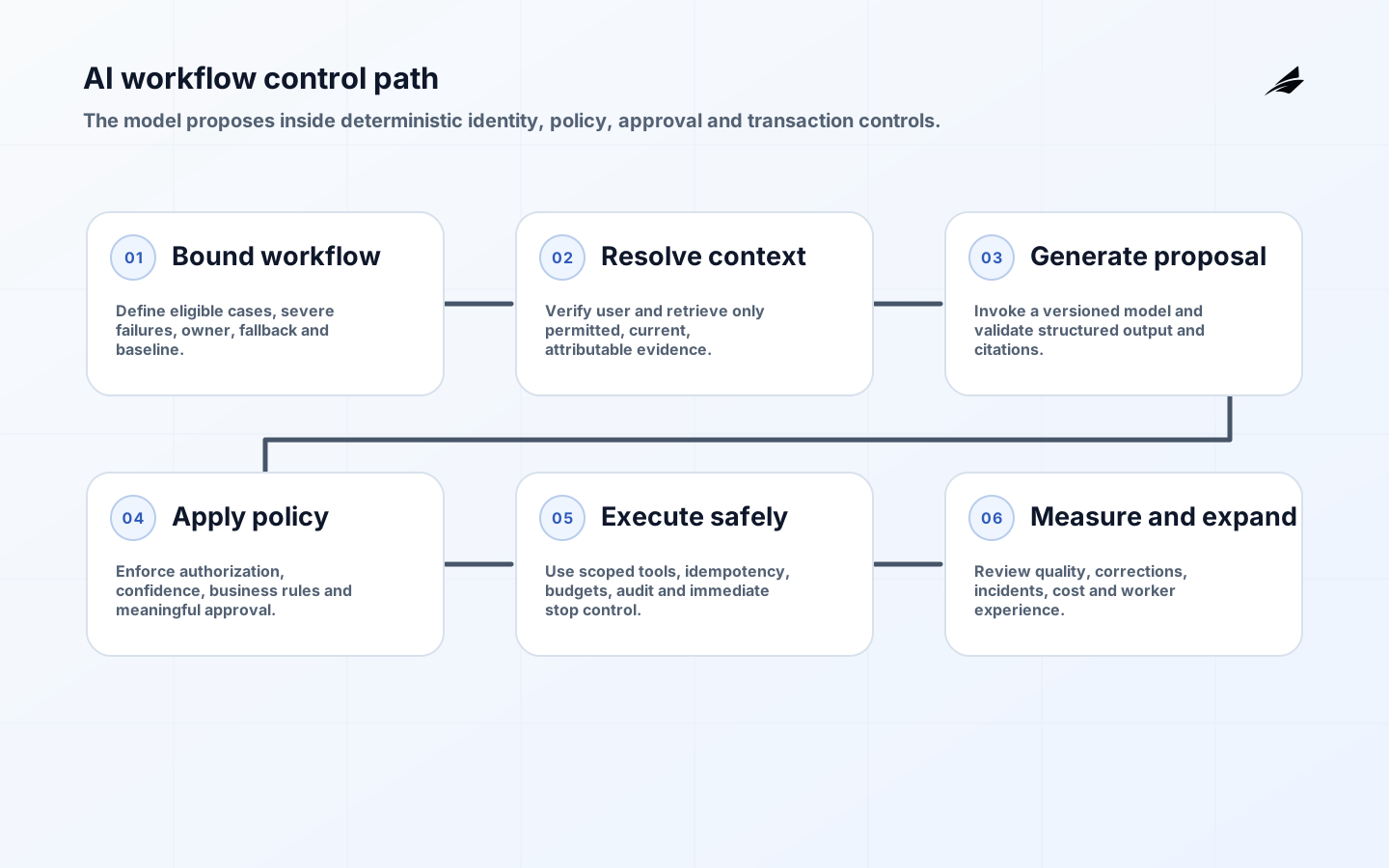
AI automation services for business workflows combine models with process, approved information, deterministic rules, integrations and accountable people. The useful question is not whether AI can produce an answer. It is whether the complete workflow improves a measured outcome while preserving authorization, review, audit, exception handling and recovery. The safest first release is usually narrower than a demonstration suggests.
Use this guide with the AI workflow implementation checklist, AI automation FAQ, AI automation services plan and digital automation services guide. It supports procurement or internal delivery without assuming a particular model vendor.
Choose a bounded workflow with a measurable baseline
Map the current process from trigger to accepted outcome. Include people, systems, records, decisions, queues, exceptions, rework and downstream consequences. Measure volume, cycle time, handling time, error, abandonment, service level and cost. Select a case with frequent enough evidence, tolerable failure and a clear owner. Drafting, classification and information retrieval are often easier starting points than autonomous payments, access changes or irreversible customer decisions.
Define eligible and ineligible cases. Name severe failures, affected people and mandatory fallback. A support workflow might permit draft responses for published product questions, require review for account-specific issues and prohibit the model from changing entitlements. This boundary should appear in routing logic and tests, not only in policy. The owner must be able to stop automation and keep work moving manually.
| Workflow class | Suitable first automation | Required boundary |
|---|---|---|
| Document intake | Extract and propose classification | Preserve original, confidence and correction route |
| Knowledge support | Retrieve evidence and draft answer | Permission-aware sources, citations and abstention |
| Case routing | Recommend queue and priority | Deterministic protected rules and human override |
| Transaction preparation | Populate a reversible draft | Independent authorization before commit |
| Customer communication | Draft or summarize approved information | Disclosure, review and prohibited claims |
| High-impact decision | Evidence organization only | Qualified person remains decision maker |
Design the model inside a controlled workflow
Separate probabilistic proposal from deterministic authority. Verify the user, resolve current permissions, retrieve only approved context, call a versioned model, validate output structure, apply business policy, obtain required approval and execute through a narrow service. The downstream system should enforce authorization and transaction integrity. A prompt that says “do not exceed your authority” is not an access control.
Minimize model context and tool capability. OWASP describes excessive agency as risk arising from excessive functionality, permissions or autonomy. Give each tool the smallest operation and scope needed, execute in the user’s context where appropriate and require approval for high-impact actions. Use idempotency keys, amount or volume limits, rate limits, timeouts, allowlists and a kill switch. Separate read, propose and commit permissions so expansion can be deliberate.
Govern context and evaluate the complete task
Create a source register with owner, purpose, classification, access policy, freshness, retention and known limitations. Retrieval must filter by the requesting identity before content reaches the model. Preserve source identifiers and versions used for consequential outputs. Test for stale, conflicting, malicious and missing documents. A model can produce a fluent answer from bad context; evaluation must distinguish retrieval, reasoning, policy and execution failures.
Build an evaluation set from representative work and severe edge cases, with protected handling of personal or confidential data. Define acceptance by task: supported factual accuracy, correct routing, citation validity, policy compliance, appropriate abstention and successful human correction. Evaluate groups and languages affected by deployment. Include prompt injection, data exfiltration, tool misuse, ambiguous instruction, unavailable dependency and duplicate transaction scenarios. Re-run after material model, prompt, retrieval, tool or policy changes.
| Measure | What it reveals | Decision use |
|---|---|---|
| Accepted first-pass rate | Outputs used without substantive correction | Capacity and quality planning |
| Severe failure rate | High-consequence errors per eligible task | Release or stop threshold |
| Abstention precision | Whether escalation occurs on genuinely uncertain cases | Routing and threshold tuning |
| Reviewer correction time | Real human effort after automation | Business-case validation |
| Action reversal or duplicate rate | Transaction control quality | Permission and idempotency review |
| Cost per accepted outcome | Model, integration, review and operations together | Scale and model-selection decision |
Make human review meaningful
A reviewer needs competence, time, evidence, authority and a usable interface. Show source context, proposed action, uncertainty or reason code, policy checks and differences from the original record. Avoid default buttons that encourage automatic approval. Route high-risk or novel cases to specialists. Capture corrections as structured feedback, but do not automatically retrain on them without data rights, quality review and change control.
Monitor automation bias and workload. If the system produces too many plausible drafts, reviewers may inspect less carefully. Sample approvals independently, compare error detection with and without assistance and measure queue pressure. Make escalation psychologically and operationally safe. Human review is not a disclaimer attached to an interface; it is a control whose effectiveness should be tested.
Estimate cost and risk across the whole workflow
Include discovery, process redesign, data preparation, model and embedding use, retrieval, integrations, evaluation, security, privacy, review, observability, support, incident response, vendor change and decommissioning. Model cost per eligible task and accepted outcome under baseline, growth, peak and fallback. Token price is only one driver. Long context, retries, agent loops, duplicate processing and human correction can dominate unit economics.
Maintain an AI risk register connected to workflow controls and owners. NIST’s AI RMF organizes risk work through Govern, Map, Measure and Manage, while the Generative AI Profile adds risks and actions relevant to generative systems. Use these as outcome frameworks, not a one-time checklist. Review impacts on customers and workers, privacy, security, reliability, intellectual property, information integrity, supplier concentration and environmental resources according to context.
Follow a staged AI automation delivery procedure
Begin with offline evaluation against the current process. Move to shadow mode where proposals are generated but cannot affect work. Next, let trained users review every eligible proposal in a small cohort. Introduce constrained actions only after task evidence and transaction controls pass. Expand by case type, user group or permission, not all at once. Keep a manual path and rehearse provider outage, corrupt retrieval, model rollback and unauthorized-tool attempts.

- Baseline the current workflow, affected people, severe failures, eligible cases, owner and fallback.
- Build permission-aware context, versioned model invocation, output validation and deterministic policy gates.
- Evaluate representative, subgroup, adversarial, dependency and transaction scenarios before live use.
- Pilot in shadow and review modes; train reviewers and sample their decisions independently.
- Enable narrow, reversible tool actions with least privilege, idempotency, budgets, logs and stop control.
- Expand only when quality-adjusted time, incidents, cost and user evidence meet agreed thresholds.
Example: an accounts-payable team automates invoice intake. The service extracts fields, retrieves purchase-order data and proposes a match. Deterministic code validates supplier, amount and duplicate identifiers. Exceptions and all bank-detail changes go to trained staff; the model cannot create or release payment. The pilot compares accepted handling time, correction, duplicate detection, fraud referrals and cost. Only after evidence does the team consider posting low-risk matched invoices, still without payment authority.
Evaluate an AI automation provider on operational evidence
Ask providers to demonstrate your workflow and failure cases, not a generic chat. Verify data flows, model and subprocessor choices, retention, training use, location, identity, tool authorization, evaluation, secure development, incidents, model changes, export and deletion. Contract notice and reapproval for material changes. Preserve customer access to prompts, policies, test sets, logs and integration artifacts needed for oversight and transition.
Compare providers using the same acceptance set and whole-life cost model. A more accurate model may be worse if latency, unavailable regions, poor permission handling or review burden prevents reliable operation. Require service objectives for the complete managed components and define who responds when the model, retrieval, integration and business process disagree. No provider should be the sole holder of the customer’s workflow knowledge.
Plan feedback operations before launch. Give workers and affected users a simple route to report wrong sources, unsafe proposals, access leaks and confusing review behavior. Triage reports by consequence, connect them to the exact system version and close the loop with the reporter where appropriate. Review patterns across incidents, corrections and appeals; repeated “user error” may indicate poor interface design, unclear policy or an evaluation set that omitted real work. Publish internal release notes for material fixes and confirm that corrected cases enter regression testing without exposing sensitive data.
Key takeaways
- Select a bounded workflow from measured operational evidence and define severe failures plus manual fallback.
- Keep authorization and transaction policy outside the model, with minimal tools and permissions.
- Evaluate the complete task, including retrieval, review, action, affected groups and adversarial conditions.
- Treat human review as a measurable control with evidence, competence, time and authority.
- Scale by permission and case type only when quality-adjusted value and operational safety are demonstrated.
Frequently asked questions
Does an AI agent need permission to take actions?
Yes. The downstream system should authenticate the actor and enforce authorization for every action. Use least privilege, user context where appropriate and independent approval for consequential changes. Model intent is not authority.
How should ROI be calculated?
Compare quality-adjusted outcomes with the baseline. Include reviewer time, corrections, incidents, integration, operations and fallback, not only model fees or gross hours. Track value per accepted outcome and avoid counting work that was merely shifted to another team.
What accuracy is good enough?
There is no universal threshold. Set measures by consequence, prevalence and available review. A rare severe error may dominate a high average score. Define release, escalation and stop thresholds before the pilot.
Should AI automation replace the existing process immediately?
No. Run offline, shadow and reviewed stages, preserve fallback and compare cohorts. Remove the old path only after recovery, support, audit, user and business evidence show that the new workflow is sustainable.
Conclusion
AI workflow automation is a controlled service design, not a model demo. Bound the work, govern context, evaluate real tasks, place deterministic authority around model proposals and expand carefully. The durable advantage comes from faster accepted outcomes with visible evidence, not from granting the model as much autonomy as the tools allow.