Multimodal AI processes more than one kind of input or output: text, documents, images, audio, video, diagrams, or sensor records. In operations, that may mean extracting fields from an invoice, matching a photograph to an asset, transcribing a call, locating an event in video, combining a maintenance note with telemetry, or explaining a scanned form. The opportunity is to reduce manual search and preparation. The risk is that a fluent summary can hide missing frames, poor audio, cropped evidence, incorrect optical character recognition, or a transformation that separated the result from its source.
Operations leaders should frame multimodal AI as an evidence-handling system. The model is one component between source intake and an accountable decision. The NIST AI RMF organizes risk work across govern, map, measure, and manage, while the NIST Generative AI Profile addresses risks specific to generative systems. Apply those practices to the complete workflow: capture, transformation, model, interface, reviewer, action, monitoring, and appeal.
Choose a decision where multiple modalities add evidence
Start with a narrow work moment and a baseline. For invoice intake, the decision may be whether the record is complete enough for review, not whether the model should approve payment. For field service, it may be whether a photograph and sensor reading support a fault classification. Describe volume, current effort, error, delay, consequence, and escalation. Identify which modality contains authoritative evidence and which provides context. A transcript can help search a call, but the audio remains relevant when tone, interruption, or transcription uncertainty changes interpretation.
Do not add a modality because the model supports it. Each input increases consent, security, storage, accessibility, and evaluation obligations. Images may include faces or location; audio may capture bystanders; documents may contain hidden text; video may reveal adjacent activity; sensor data may be miscalibrated. Establish lawful purpose, minimization, permitted use, access, retention, and deletion before ingestion. Record whether the organization owns the source, received it from a customer, or retrieved it from a third party.
| Modality | Common quality failure | Operational control |
|---|---|---|
| Document | Skew, handwriting, missing page, wrong version | Page count, source hash, field confidence, and visual review |
| Image | Crop, glare, scale, orientation, or misleading context | Capture guidance, metadata, original preview, and abstention |
| Audio | Noise, speaker confusion, language, or truncation | Channel checks, timestamps, speaker review, and replay |
| Video | Sampling misses an event or sequence | Time-bound clips, frame provenance, and source navigation |
| Sensor | Calibration, units, clock drift, or missing values | Device identity, quality flags, unit contract, and time sync |
| Text | Prompt injection, stale content, or ambiguous meaning | Source authority, parsing boundary, citations, and policy |
Preserve originals, transformations, and provenance
Keep the original asset or an authoritative reference where policy allows, then record each transformation: resizing, compression, cropping, transcription, optical character recognition, frame extraction, normalization, redaction, or feature generation. Link derived text and model findings to page, region, timestamp, frame, channel, or sensor interval. A reviewer should be able to navigate from a claim back to the evidence and understand what may have been lost. Use immutable identifiers and content hashes where appropriate, but do not expose sensitive identifiers in public URLs or telemetry.
The C2PA Content Credentials specification defines manifests, assertions, signatures, and bindings for media provenance. Content Credentials can provide useful tamper-evident history, but they do not prove that depicted content is factually true. Treat provenance as one trust signal. Record when credentials are absent, invalid, or removed and decide what that means for the workflow. Do not automatically reject all uncredentialed material, especially where capture tools do not support the standard.
- Retain a path from every extracted claim to source evidence.
- Record model, prompt, parser, and transformation versions.
- Mark missing, redacted, cropped, low-quality, and synthetic content.
- Separate source authenticity from factual interpretation.
- Provide an accessible alternative for material visual or audio evidence.
- Expire derived artifacts when the source or purpose no longer permits use.
Evaluate each modality and the combined decision
One aggregate accuracy number is insufficient. Build a representative evaluation set from real capture conditions, including devices, layouts, languages, accents, lighting, background noise, document versions, sensor models, and difficult edge cases. Keep a protected holdout that did not shape prompts or tuning. Label at the level the operation uses: document class, field, region, timestamp, event, or final decision. Review disagreement among qualified annotators because ambiguity in the task should not be presented as model certainty.
Use metrics appropriate to the output. Field extraction may use precision, recall, F1, and exact or normalized match; detection may use localization and false positive rates; transcription may use word error plus critical-entity accuracy; generated summaries need claim support and omission review. Google Cloud's Document AI evaluation guidance illustrates field-level evaluation and confidence-threshold analysis. Set thresholds by consequence and route uncertain cases to review rather than forcing a result.
| Evaluation layer | Question | Release evidence |
|---|---|---|
| Input fitness | Was the asset complete and usable? | Quality and rejection rates by source |
| Transformation | Did preprocessing preserve material evidence? | Sampled source-to-derived comparison |
| Modality model | Did extraction or detection work by slice? | Precision, recall, error type, and threshold |
| Fusion | Did combining modalities improve the decision? | Ablation comparison and conflict cases |
| Human review | Could reviewers verify and correct results? | Time, agreement, override, and escalation |
| Outcome | Did the workflow reduce harm or effort? | Decision quality, delay, incidents, and appeals |
Use a multimodal evidence lifecycle
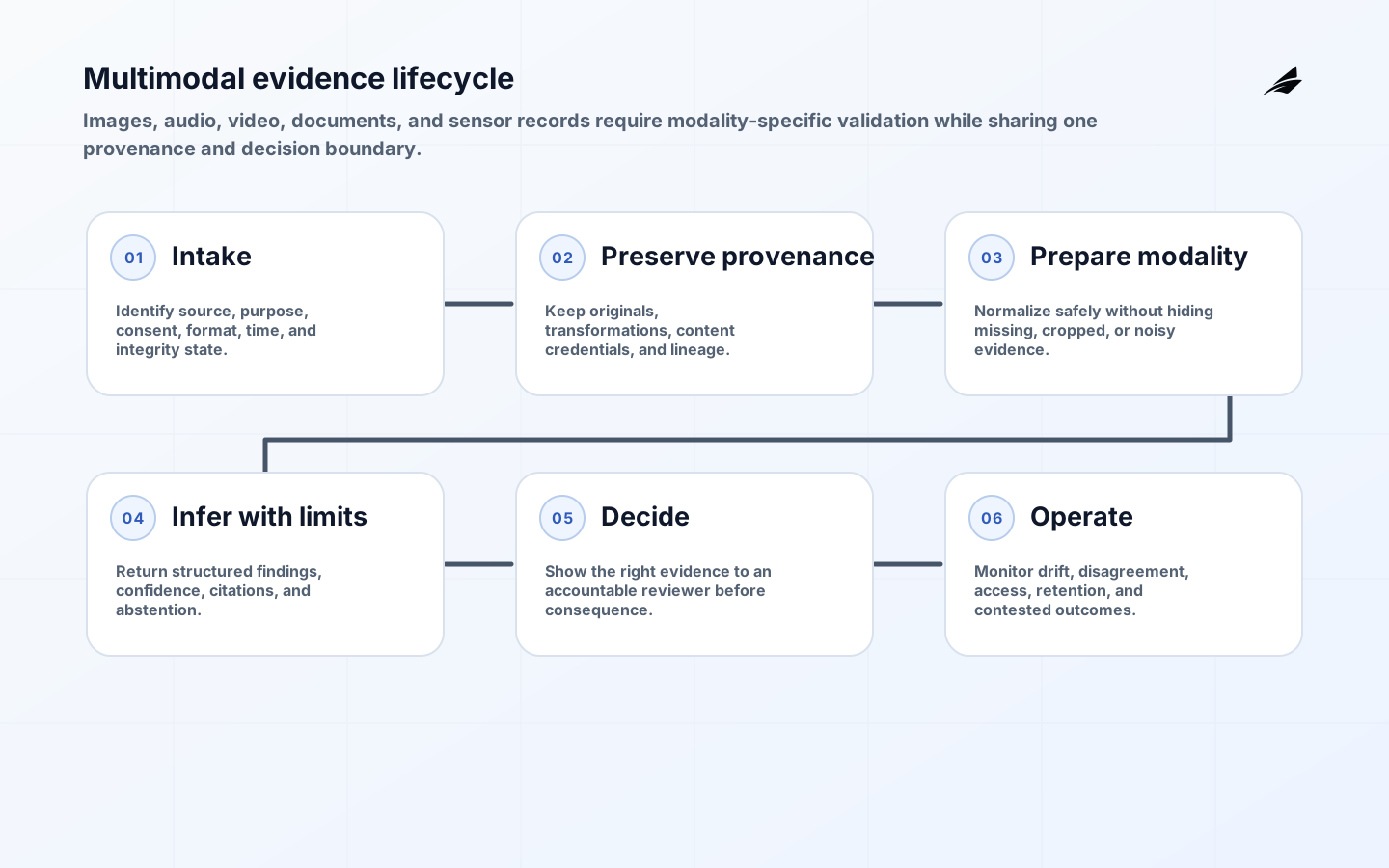
The lifecycle treats each asset as evidence with source, purpose, transformation, model result, reviewer, and retention state. It deliberately preserves originals and exposes uncertainty before consequence. This approach fits the broader AI agent workflow architecture: a model may propose a classification or next step, but deterministic permissions, policy, and human approval govern consequential tools.

Secure every parser and modality boundary
Treat files and remote media as untrusted. Restrict type, size, duration, resolution, decompression, network retrieval, and parser resources. Scan uploads, isolate processing, patch codecs and libraries, and prevent a model from following instructions embedded in a document or image as if they were trusted system commands. The OWASP Top 10 for LLM Applications highlights prompt injection, sensitive-information disclosure, improper output handling, excessive agency, and other risks relevant to multimodal workflows.
Separate model output from action. Validate structured results against schema and authoritative data, escape content in downstream interfaces, and authorize every tool call independently. Protect tenant boundaries in storage, indexes, caches, traces, and review queues. Redact only after preserving the lawful evidence path, and test whether hidden text, metadata, alternate audio tracks, or embedded objects can reach the model unexpectedly. Rate-limit expensive media operations and make processing status recoverable.
Plan for conflicts between modalities. A document may state one identifier while a barcode indicates another; a transcript may contradict the audio segment; a photograph timestamp may not align with sensor data. Do not let the fusion model silently choose. Preserve each observation, apply deterministic checks where possible, and route material disagreement to a reviewer with both sources visible. Record which modality drove the result and whether the reviewer accepted or corrected it. Conflict rates are useful operating signals because they can reveal capture problems, tampering, integration errors, or a changing process that a single-modality benchmark would miss.
Protect accessibility through the full evidence path. Supply accurate text alternatives for images used in decisions, captions and transcripts for audio or video, keyboard access to timelines and annotations, and a nonvisual method for selecting regions or confirming findings. Automated descriptions can assist but should be reviewed when they carry material meaning. Keep original media available to authorized reviewers and mark AI-generated summaries clearly. Accessibility testing should include review and correction, not only upload, because a person must be able to challenge the same evidence another reviewer can see or hear.
Roll out with experts, fallback, and appeals
Begin in shadow mode or as reviewer assistance. Show source and finding together, collect corrections, and distinguish model error from bad source, transformation, or policy. Release by bounded document type, location, device, language, or team. Define when the system abstains, who handles the case, and what the user sees. If the workflow affects a person, provide a challenge or correction route appropriate to the consequence. The human approval design guide helps place review where judgment and accountability matter.
Operate data and model drift together. Monitor source mix, capture quality, missing pages or frames, confidence distribution, human disagreement, override, false negative and false positive outcomes, processing failure, latency, cost, access anomalies, and appeal results. Record deployment markers and model versions using the practices in the LLM observability checklist. Reevaluate when capture devices, forms, languages, sensors, providers, prompts, or business rules change.
Key takeaways
- Choose a bounded decision where multiple modalities add material evidence.
- Preserve originals and link every transformed claim back to its source.
- Evaluate each modality, fusion behavior, human review, and business outcome.
- Treat parsers, media, embedded instructions, and model output as untrusted boundaries.
- Use confidence and abstention to route uncertainty, not to disguise it.
- Monitor source drift, correction, disagreement, access, retention, and appeals.
Frequently asked questions
Does multimodal AI always combine inputs in one model?
No. A workflow may use separate OCR, speech, vision, sensor, retrieval, and language components. The operational question is whether their outputs and uncertainty are combined transparently, evaluated end to end, and governed before action.
Can a confidence score replace human review?
No. Confidence must be calibrated and tested on representative slices. Use it with consequence, data quality, disagreement, and policy to decide whether to automate, review, or abstain. High confidence does not prove the source was complete.
Do Content Credentials prove that media is true?
They can provide tamper-evident provenance assertions and history. They do not independently establish that a scene or statement is factual. Review signer trust, validation status, context, and other evidence.
Conclusion
Multimodal AI can make operational evidence easier to find and use, but only when the system preserves the evidence it transforms. Define the decision, limit modalities to what adds value, protect provenance, evaluate real capture conditions, expose uncertainty, secure every parser, and keep consequential action under accountable control. A staged rollout with source-linked review and appeal turns impressive model capability into a service people can trust.