Artificial intelligence in digital operations is the use of AI inside products, services and internal processes that people rely on. It includes prediction, classification, recommendation, generation, perception and agentic action, whether built in-house or embedded by a supplier. The operating challenge is to preserve purpose, accountability and evidence as data, models, prompts, integrations, users and legal obligations change.
This FAQ connects the practical AI operations guide, AI implementation checklist, AI services scope guide and AI services checklist. It offers a portfolio operating model; legal classification and sector obligations still require jurisdiction-specific expertise.
What should an enterprise AI inventory contain?
Inventory systems and uses, not only models. Record purpose, business process, affected people, provider or developer, accountable owner, users, countries, input and output data, model and version, prompts or rules, integrations, decisions influenced, human role, fallback, monitoring, incidents and lifecycle state. Include AI embedded in purchased software. A contract that mentions “smart” or “assistive” features may hide a material AI dependency.
Use discovery from procurement, architecture, privacy records, repositories, model gateways, expenses and interviews. Provide a route for staff to register experiments before live data or decisions are involved. Assign each record a review date and material-change triggers. Inventory completeness can be sampled by comparing business systems and suppliers to registered AI uses. An unverified spreadsheet updated once a year cannot support change control or incident response.
| Inventory field | Why it matters | Refresh trigger |
|---|---|---|
| Purpose and affected outcome | Defines intended use and evaluation target | New use, user group or decision |
| Actors and accountable owner | Locates authority, review and escalation | Reorganization or supplier change |
| Data and geography | Supports rights, quality and transfer analysis | New source, location or retention |
| Model and system components | Makes evaluation and incidents attributable | Model, prompt, retrieval or tool change |
| Human oversight and fallback | Shows how errors are prevented or recovered | Workflow, staffing or authority change |
| Impact and legal role | Drives proportionate controls and obligations | Law, market or product classification change |
How should AI uses be classified?
Classify by context and consequence, not model sophistication. Consider affected rights and opportunities, safety, financial or service impact, scale, reversibility, vulnerability of people, transparency, contestability, data sensitivity, autonomy and dependency. Identify whether the organization is developer, provider, deployer, importer, distributor or another role under applicable rules. One model can support low-impact drafting and a high-impact employment process; the use cases need different records and controls.
Use a triage that leads to a named control profile and approval path. Prohibited or unacceptable uses should be blocked. High-impact uses need stronger domain ownership, impact assessment, data and evaluation evidence, human oversight, logging, incident and appeal routes. Lower-impact uses still need security, privacy, accuracy and supplier management. Reclassify when scope changes. Do not treat an early sandbox approval as permission for production or a new market.
What does an AI management system add?
ISO/IEC 42001 specifies a management-system approach for organizations developing, providing or using AI. It connects policy, objectives, roles, risk assessment, treatment, resources, operation, performance evaluation and improvement. The value is coordination: procurement, product, data, security, privacy, legal, quality, HR and operations can work from one lifecycle and evidence model. Certification is a separate claim and should not be implied merely because selected practices are used.
NIST’s AI RMF organizes outcomes through Govern, Map, Measure and Manage. Govern is cross-cutting; Map establishes context, Measure assesses and tracks risk, and Manage prioritizes and acts. Use frameworks to structure decisions, then tailor procedures to the system. A control library without accountable application becomes paperwork. Every required artifact should support a decision, test, operation, incident or right of an affected person.
How should data, models and suppliers be governed?
Keep provenance for training, tuning, retrieval, evaluation and operational feedback according to role and feasibility. Record authority, collection purpose, consent or other basis where relevant, representativeness, known gaps, transformations, retention, access and deletion. Prevent live prompts, outputs or corrections from silently becoming provider training data. For retrieval systems, enforce user permissions before content enters context and retain source references for consequential outputs.
Maintain an approved component register for models, prompts, embeddings, datasets, libraries, tools, safety policy and providers. Contract data use, location, subprocessors, security, service levels, incident notice, evaluation support, model changes, intellectual-property terms, export and deletion. Require notice and reapproval for changes that affect risk. Supplier assurance does not transfer accountability for the organization’s purpose, workflow or impact.
| Evaluation dimension | Example evidence | Release question |
|---|---|---|
| Task performance | Representative cases, baselines and uncertainty | Does the system improve the intended outcome? |
| Affected groups | Disaggregated results and qualitative review | Are important differences understood and treated? |
| Safety and misuse | Severe scenarios, adversarial tests and safeguards | Can harmful use be prevented, detected and recovered? |
| Human interaction | Usability, reliance, override and workload study | Can people recognize limits and act effectively? |
| Security and privacy | Threat testing, permissions, leakage and retention checks | Are data and tools controlled end to end? |
| Operations | Latency, availability, cost, drift, fallback and rollback | Can the service be sustained and stopped safely? |
What should AI evaluation prove?
Evaluation should answer whether the complete system is fit for a declared use in a defined context. Compare with the current process and a reasonable non-AI alternative. Use representative, edge, subgroup, adversarial and dependency-failure cases. Measure severe errors separately from average quality. Include retrieval, business rules, user interface, human review and downstream action. A model benchmark does not establish product performance.
Define thresholds and owners before the final run. Preserve test-set lineage, environment, model and configuration, evaluator instructions and deviations. Use independent review for high-consequence claims. The NIST AI Resource Center supports operationalization and test, evaluation, verification and validation resources. After release, compare live samples with pre-release expectations and investigate changes rather than assuming the benchmark remains representative.
When is human oversight effective?
Human oversight works when a competent person has enough context, time, authority and an alternative. Define whether the person reviews every case, handles exceptions, monitors a cohort or decides an appeal. Show source evidence and system limitations, not only the recommendation. Avoid interfaces that preselect acceptance or punish escalation. Measure override, correction, missed errors, review time and independent sample quality.
Keep responsibility with the appropriate role. A recruiter cannot meaningfully validate a model’s security, and an engineer cannot decide employment fairness alone. Use multidisciplinary review while maintaining a single accountable decision owner. Inform affected people when required and provide accessible correction or contest routes. Automation should not make it harder to reach a person or understand the basis of a consequential outcome.
How should enterprise AI move from idea to operation?
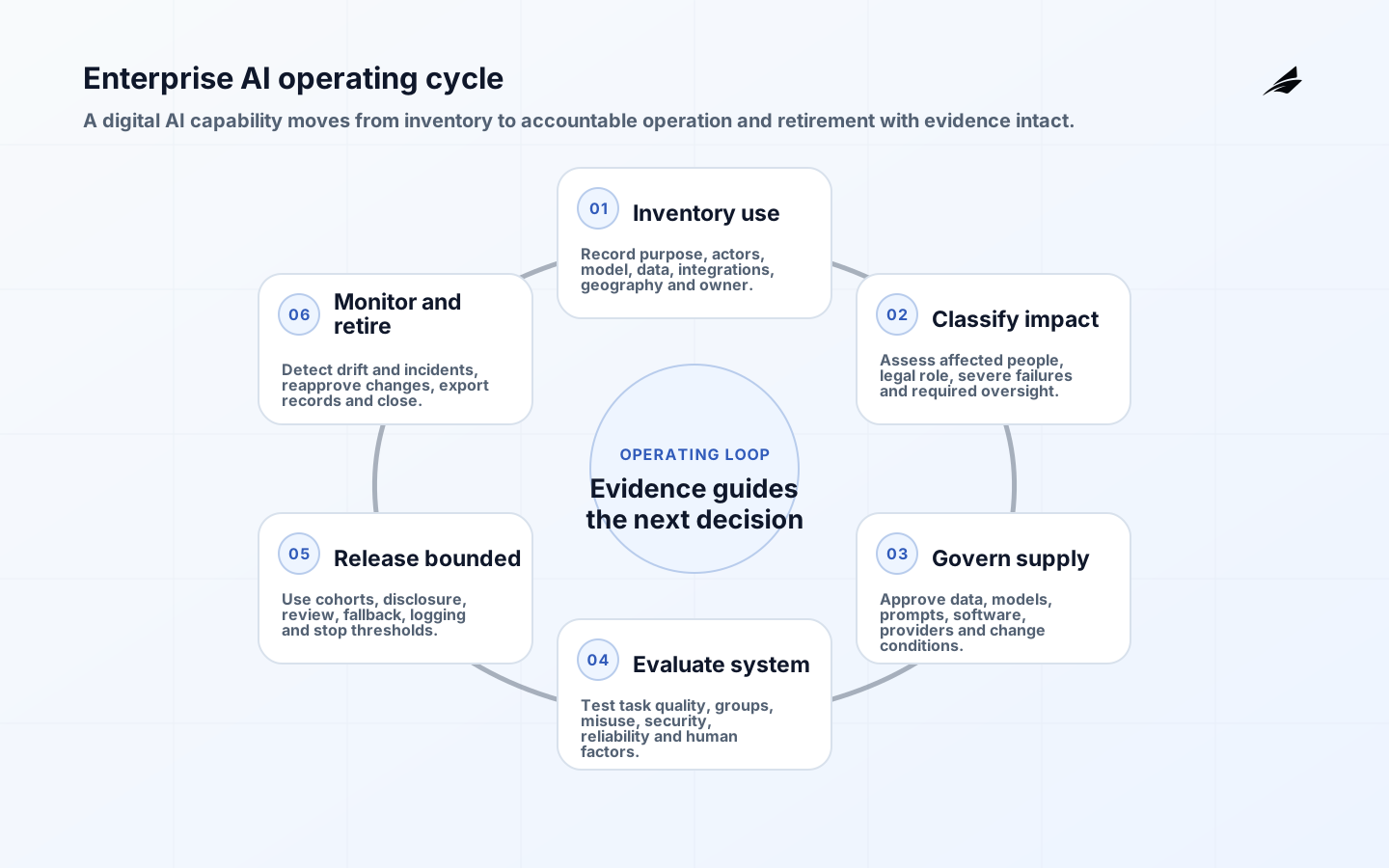
Register the proposed use before live experimentation. Classify impact and legal role, then approve data and supplier conditions. Build the smallest complete workflow and evaluate it offline. Pilot with a bounded cohort, disclosure, meaningful review and fallback. Require a release packet containing purpose, architecture, data, evaluation, risk treatment, operating measures, incident plan and owner acceptance. Reapprove material changes and retire systems through a controlled process.

- Inventory the use, purpose, actors, model, data, integrations, geography, human role and owner.
- Classify impact and applicable organizational role; assign a proportionate control and approval profile.
- Govern data, components and suppliers with provenance, access, change notice, export and deletion.
- Evaluate task quality, affected groups, misuse, security, human interaction, operations and fallback.
- Release to a bounded cohort with disclosure, review, monitoring, incident thresholds and stop authority.
- Monitor, reapprove material changes and retire by removing access, preserving required records and supporting affected users.
Example: a service center introduces a summarization assistant. The organization registers employee and customer impacts, prohibits automated case closure, limits retrieval to the worker’s permissions and evaluates omissions on representative languages and complex cases. A pilot shows faster note preparation but higher omission rates for transferred calls. The team narrows eligibility and improves source display rather than scaling on average time savings alone.
How should changing AI regulation be handled?
Maintain an obligations register by country, sector, role and use. The EU AI Act uses a risk-based framework and phased application; the European Commission’s current implementation pages should be checked for dates, guidance and amendments rather than relying on an old summary. Link each obligation to an owner, system evidence and refresh trigger. Legal advice should confirm applicability, especially for high-risk, employment, biometric, safety or general-purpose model roles.
Use regulatory change as one input to lifecycle governance, not the only reason for it. The OECD AI Principles and management frameworks emphasize human-centered values, transparency, robustness, accountability and sustainable development. Those outcomes remain useful across jurisdictions. Keep local differences visible within a common control structure so teams do not mistake one market approval for worldwide permission.
How should AI incidents and retirement work?
Define incident thresholds for harmful output, unauthorized action, data exposure, systemic bias, model or provider failure, security compromise and unapproved change. Preserve prompts or inputs proportionately, outputs, sources, model and configuration, user action, transaction record and timeline. Contain by disabling a feature, tool, model or cohort while maintaining service fallback. Notify affected people and authorities when required, support correction and test remediation before restoration.
Retirement is more than turning off an endpoint. Identify dependent workflows, communicate alternatives, export required decisions and records, resolve appeals, end provider access, delete data according to policy, revoke keys, remove integrations and update inventory. Preserve evidence needed for audit or affected-person rights. Monitor for shadow continuation through copied prompts, spreadsheets or downstream models. A clean retirement reduces unknown AI exposure.
Key takeaways
- Inventory AI as complete uses and systems, including embedded supplier features, not only model assets.
- Classify by context, consequence and organizational role; the same model can require several control profiles.
- Evaluate task, groups, misuse, security, human interaction and operation against a current baseline.
- Use human oversight as a tested control with competence, evidence, time, authority and accessible appeal.
- Manage material change, incidents and retirement with the same rigor used for initial release.
Frequently asked questions
Is a spreadsheet enough for an AI inventory?
It can be a starting interface, but the operating process matters. Integrate procurement and change triggers, assign owners, verify completeness and link records to architecture, evaluation, incidents and approvals. High-volume organizations usually need workflow and access control around the register.
Does ISO/IEC 42001 certification prove an AI system is safe?
No. A management-system certification concerns defined organizational processes and scope. It does not replace use-specific evaluation, legal compliance or product assurance. Verify the certification scope and the evidence for the actual system.
Does every model update require full reapproval?
Use documented materiality criteria. Changes affecting purpose, data, capability, provider, evaluation, permissions, affected groups or obligations may require substantial review. Lower-risk changes still need versioning, regression tests and monitoring. Automatic provider changes should be contractually controlled.
How can shadow AI be reduced?
Offer usable approved tools, make registration quick, train staff on data and decision boundaries, monitor procurement and technical signals lawfully, and respond proportionately. Punitive policy without practical alternatives drives use underground and weakens the inventory.
Conclusion
Enterprise AI becomes manageable when every use has a purpose, owner, impact profile and evidence trail throughout its life. Inventory systems, govern their supply chain, evaluate complete tasks, release within clear boundaries and respond to change. Responsible operation is not a gate passed once; it is the organization’s continuing ability to understand, challenge, recover and retire AI-enabled services.