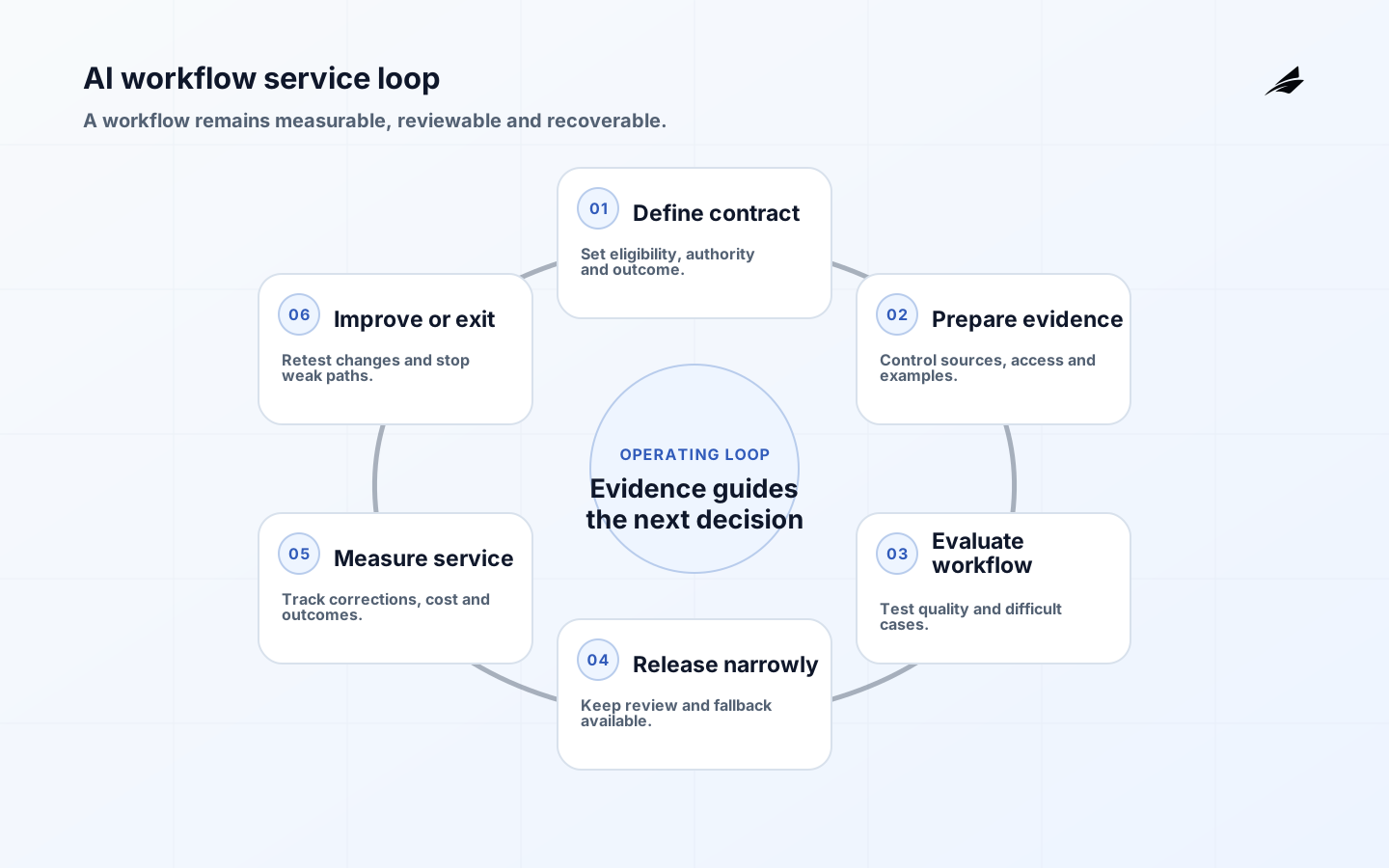
AI workflow automation services combine process design, data access, model behavior, integration, human review and production operations. The service is successful only when the whole workflow produces a better controlled outcome, not when a model returns an impressive answer. This FAQ addresses the practical questions buyers and delivery teams face: where to start, what to automate, how to evaluate quality, how much review is needed, what costs persist and who owns failures. The NIST AI Risk Management Framework organizes risk work around governance, context, measurement and management. Use that lifecycle view while keeping the delivery boundary concrete: one trigger, one eligible population, one output, one next action and a named exception owner.
Establish the operating baseline
For AI workflow automation services FAQ, observe ordinary cases and difficult cases. Capture arrival volume, elapsed time, touch time, handoffs, exceptions, rework, and the systems people consult. Ask the operators who resolve edge cases what makes a case hard; their answers reveal dependencies that a process diagram misses. Keep facts separate from assumptions. A report count is evidence, but an expected adoption rate is a hypothesis that must be tested. The baseline lets the team compare a changed workflow fairly after release and prevents a temporary improvement from being mistaken for durable value.
| What to inspect | Evidence to collect | Decision it informs |
|---|---|---|
| Demand and variation | Weekly volume, peaks, channels, and incomplete inputs. | Whether the change covers representative demand. |
| Decision complexity | Rules, judgment calls, delegated authority, and policy exceptions. | Which work may assist and which must remain human. |
| Quality and delay | Corrections, returns, complaints, queue age, and service commitments. | Which outcome matters beyond speed. |
| System context | Sources of truth, permissions, identifiers, and retention. | Whether integration and evidence are feasible. |
| Accountability | Named operator, policy owner, technical owner, and escalation contact. | Who can change, pause, or review the service. |
Set a bounded first scope
A credible first scope for AI workflow automation services FAQ has one cohort, a defined input boundary, a clear output, and an explicit fallback. Choose a path with reliable source data and a person who can correct or decline a result without inventing a workaround. Write down what the system may draft, classify, retrieve, or route, and what it cannot finalise. That separation protects operators and makes the sponsor's accountability clear. Adjacent implementation decisions are explored in AI automation ROI planning for IT managers; the useful lesson is that a handoff needs an owner, a reason, and enough context to act.
- Name the user, outcome, and decision served by the first release.
- Specify accepted inputs, missing-information handling, and rejected-input reasons.
- Preserve the record identifier and source evidence with every result.
- Set a confidence or policy threshold for human review.
- Choose a small cohort and a representative evaluation period.
- Define the rollback path before production actions are enabled.
Design controls into the workflow
Controls shape the lived experience of AI workflow automation services FAQ: who may submit work, which data is available, when a person must decide, and what the record shows afterward. The NIST AI Risk Management Framework offers a practical vocabulary for mapping, measuring, and managing risk. Apply it proportionately. A low-consequence draft may need sampled review; an action that affects money, access, safety, or employment needs tighter authority, evidence, and escalation. Treat control design as product work, because a rule people cannot follow will be bypassed when demand is high.
| Control | Practical implementation | What to review |
|---|---|---|
| Access boundary | Use role-based access and restrict sources to the task purpose. | Unexpected users, data paths, and privilege changes. |
| Evidence trail | Store source reference, proposed result, human decision, and timestamp. | Whether a later reviewer can reconstruct the case. |
| Human handoff | Route conflicting evidence or policy exceptions to a named queue. | Queue age, resolution quality, and repeated causes. |
| Change control | Version instructions, rules, integrations, and evaluation cases. | What changed and whether quality moved afterward. |
| Recovery | Allow pause, correction, replay, and manual completion. | Whether a failure can be contained without losing work. |
Run a pilot that tests the claim
Do not judge AI workflow automation services FAQ from a handful of friendly examples. Use a representative sample, preserve a comparison path, and define acceptance criteria before results are seen. Measure completion, reviewer correction, elapsed time, exception causes, user confidence, and unit cost. Review aggregate numbers and selected cases. A favourable average can conceal a small but serious failure class. The pilot should answer whether the workflow is useful, supportable, and appropriately controlled, not merely whether it can generate an impressive demonstration. Record decisions and changes so later results have an explanation.
- Test clean, incomplete, duplicate, conflicting, and urgent cases.
- Ask operators why they accepted, corrected, or rejected a result.
- Measure handoff time and burden shifted to exception reviewers.
- Check records and permissions after integration failures.
- Rehearse a pause, rollback, and manual catch-up procedure.
- Set a decision meeting to approve, revise, extend, or stop.
Price the full service
The cost of AI workflow automation services FAQ includes discovery, integration, source preparation, identity design, evaluation, training, support, usage, monitoring, and periodic improvement. Separate one-time delivery work from recurring run cost. Attribute shared platform expense consistently so local success does not hide a central burden. If the claim is capacity value, specify where freed capacity will go; it is not automatically a cash saving. If the claim is quality or speed, agree how that benefit will be observed. Transparent unit measures turn a vague promise into a decision that finance, operations, and technical owners can examine together.
Operate, learn, and change deliberately
After release, treat AI workflow automation services FAQ as a service with a review rhythm. Watch adoption, exceptions, correction patterns, quality samples, backlog, usage cost, and changes to source systems. Investigate before celebrating a metric: fewer corrections may mean that users stopped reporting issues, and faster completion may mean work was diverted elsewhere. Use recurring findings to improve inputs, policies, instructions, and training. The NIST Cybersecurity Framework is a useful companion for keeping governance, protection, detection, response, and recovery visible while the service evolves.
What should the service contract contain?
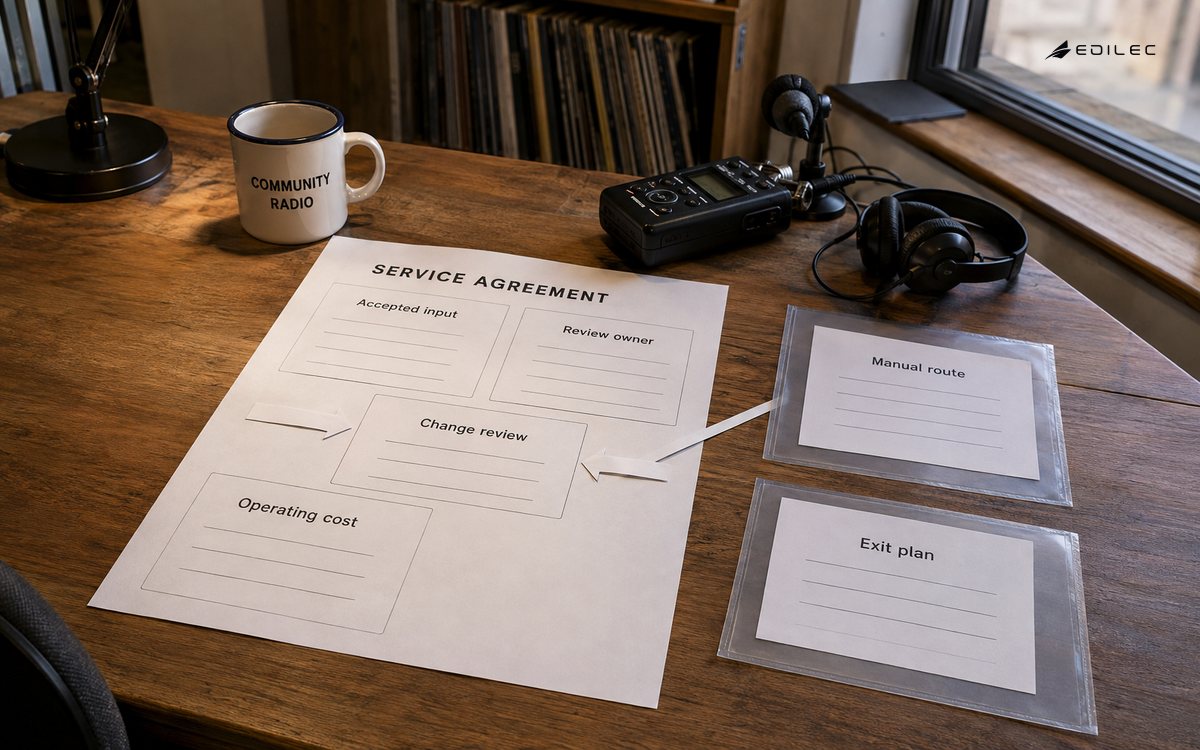
Define eligibility, required sources, prohibited data, expected output, quality threshold, allowed actions, review route, response target, correction method, retention and support hours. Include model and provider change rules. The implementation checklist turns these fields into release evidence, the automation ROI guide helps model value and operating effort, and the workflow escalation guide explains how to design a reliable handoff.
For a support-email triage service, eligibility might exclude legal notices and account-security incidents; sources might include the message, account tier and approved taxonomy; output might be a suggested queue and summary; the allowed action might be routing only above an evaluated threshold. Reviewers need the original message and reason for the route. The correction record should update the case and feed a sampled evaluation set without silently training on sensitive content. NIST’s AI RMF Core calls for production monitoring and documented measurement. Track correction rate by case type, exception age, unsupported claims, elapsed time, user overrides, unit cost and downstream resolution, not model accuracy in isolation.
| Service question | Release answer | Operational measure |
|---|---|---|
| What is eligible? | Explicit case rules and exclusions | Eligible volume and leakage |
| What may AI do? | Recommend, draft, route or act within bounds | Actions by authority level |
| Who reviews? | Qualified role with deadline and evidence | Review time and override rate |
| How is failure handled? | Manual route and recovery owner | Exception age and backlog |
| What changes require retest? | Model, prompt, source, policy and integration triggers | Change evaluation completion |
| When should it stop? | Value, quality, risk and cost exit criteria | Threshold breaches |
Key takeaways
- Start with observed work and name the decision that matters.
- Keep the first scope bounded, reversible, and owned by operators.
- Make evidence, access, escalation, and recovery part of design.
- Test representative difficult cases, not just favourable demonstrations.
- Count operating cost and review effort alongside delivery cost.
- Use a recurring review to decide what should change next.
Frequently asked questions
What is the smallest sensible starting point?
For AI workflow automation services FAQ, begin with a narrow path that has an identifiable source record and a named reviewer. Choose a case that occurs often enough to reveal variation, but where a correction does not create an irreversible harm. In document work, that may be one document type and one destination queue; in approvals, it may be a single policy threshold. The point is to learn the actual failure modes, ownership gaps, and support needs before extending the boundary. A well-instrumented start produces evidence a broader launch cannot supply.
How should success be measured?
Measure AI workflow automation services FAQ against the promise it made. Track completed eligible work, correction rate, elapsed time, exception age, evidence completeness, user acceptance, and unit cost, then inspect representative records with the people who operate them. Distinguish a genuine improvement from a change in input mix, reporting behaviour, or work shifted into another queue. Assign an owner to interpret each measure and define the threshold that triggers investigation, pause, or redesign.
When should a team stop or redesign the work?
Stop or redesign AI workflow automation services FAQ when the workflow cannot meet its quality threshold, the exception route becomes the dominant path, access or evidence cannot be made appropriate, or operating cost exceeds credible value. Stopping is not a failed experiment when it prevents a larger commitment. Record what was learned about inputs, policy, integration, and user needs so the next scope begins with stronger evidence rather than repeating the same uncertainty.
Conclusion
AI workflow automation services should be purchased and operated as accountable workflow changes. Define a service contract, evaluate representative difficult cases, keep human authority meaningful and measure downstream outcomes and operating cost. A narrow service that can abstain, escalate and recover is more valuable than broad automation that hides exceptions. The strongest answer to most FAQ questions is evidence from the actual workflow, reviewed by the people who own its policy and consequences.