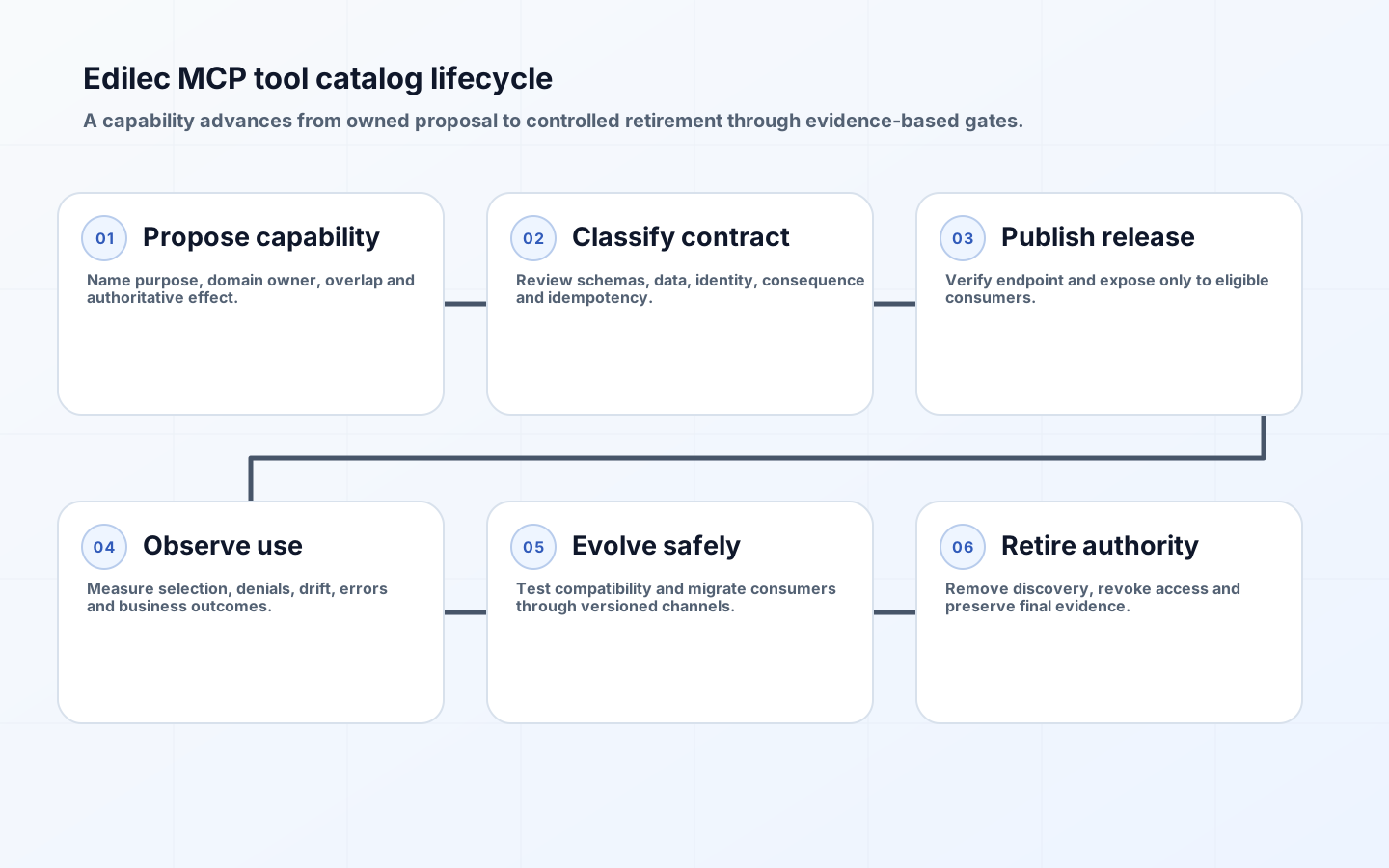
MCP tool governance begins when a tool stops being a local convenience and becomes a capability other teams or agents depend on. At that point, its name, schema, authority, owner, compatibility and retirement policy form a production contract. A catalog is not merely a searchable list returned by tools/list; it is the controlled portfolio that decides which server claims are trusted, which consumers may see them and what evidence supports continued use.
A well-governed catalog helps models select fewer, clearer capabilities while giving platform owners a reliable inventory of side effects and dependencies. It extends the implementation guidance in Edilec's MCP server architecture guide and MCP design for business systems into lifecycle management across many publishers. The goal is stewardship, not a central committee approving every wording change.
Define the MCP tool governance unit
Govern a capability release, not just a server URL. One release combines publisher identity, server deployment, tool name, input and output schemas, descriptions, annotations, authorization policy and expected effects. Assign a stable catalog identifier independent of display name. That identifier lets traces, approvals and deprecation notices refer to the same contract even when an endpoint moves or a description improves.
Record one accountable service owner and separate technical, security and data stewards. The owner accepts reliability and lifecycle obligations; stewards review specialist concerns. Include support channel, data classification, environments, tenants, dependencies, service objective, incident route and last review. An unowned tool should not be discoverable in production, regardless of how useful its demonstration appears.
Require metadata that supports a decision
The MCP tools specification defines tool names, descriptions, input schemas, optional output schemas, annotations and execution results. Preserve native metadata, then add enterprise fields: business purpose, side-effect class, reversibility, approval requirement, record authority, data handled, credential mode, idempotency behavior, rate policy, version and expiry. Tool annotations are hints and must not be treated as trusted authorization facts.

Metadata should be machine-filterable and human-reviewable. Use controlled values for consequence, data class and lifecycle status, while allowing concise examples and operational notes. Validate that descriptions state the outcome and constraints without embedding secrets or prompt instructions. Review model-visible text as untrusted supply-chain content because a compromised publisher can influence tool selection even without changing executable code.
| Catalog field | Why it matters | Publication blocker |
|---|---|---|
| Owner and support route | Makes incidents and changes accountable | No production owner |
| Input/output schema version | Enables consumer contract tests | Unbounded or invalid schema |
| Effect and reversibility | Determines approval and recovery | Unknown authoritative record |
| Identity and scopes | Defines enforceable authority | Shared credential or broad audience |
| Idempotency and reconciliation | Contains retries and uncertainty | No way to confirm consequential outcome |
Make names and schemas durable for consumers
Choose names that distinguish intent and domain, such as billing_invoice_get and billing_invoice_void, instead of overloaded verbs like process. Do not encode transient team names or environment labels in the public contract. Descriptions should identify when to use the tool, what authoritative system it affects and major preconditions. Avoid promotional language and ambiguous synonyms that make several tools appear interchangeable to a model.
Use closed, typed input schemas for consequential actions. Mark required fields, constrain enums and formats, set numeric limits and reject unknown properties where compatibility permits. Return structured output with stable outcome codes, authoritative identifiers and reconciliation status. A prose-only success message forces callers to guess whether the business effect occurred. Schema examples belong in tests and documentation; they do not replace validation at execution.
Classify tools by effect, not implementation
Risk tiers should reflect data sensitivity, financial or operational consequence, reversibility, scale and need for human judgment. A simple wrapper around a database update can be high risk; a complex search service can be low risk if it returns public data. Map each tier to catalog visibility, required identity, argument policy, approval, rate limits, monitoring, testing and review frequency. Keep classification evidence with the catalog record.
Apply the resource focus of NIST's Zero Trust Architecture. Network placement does not make a tool safe. Every invocation should authenticate a principal and authorize access to the actual resource. High-impact tools should be absent from general-purpose agents by default and exposed only to named workflows whose controls match the effect.
Version behavior and test compatibility
Separate compatible description improvements from contract changes. Adding an optional output field may be compatible for tolerant consumers; changing an enum meaning, required input, side effect or authorization rule may not be. Publish a compatibility policy and run consumer-driven tests against representative agents, deterministic clients and policy engines. A schema that validates can still be behaviorally incompatible if it changes which record is authoritative or when an effect occurs.
Use staged channels such as preview and stable rather than mutating production metadata in place. Pin critical workflows to an approved capability release while allowing exploratory clients to test newer versions. Compare live tools/list responses with the registered manifest and quarantine unexplained drift. The catalog should show current, successor and retirement dates so consumers can plan rather than discover changes through failures.
Filter discovery before a model sees the catalog
Return only tools allowed for the caller, tenant, environment and workflow. Then narrow further to capabilities relevant to the current task. Large undifferentiated lists increase selection error, latency and exposure to malicious descriptions. Tool search can be useful, but search results must respect authorization and risk policy. The application still needs runtime checks because visibility is not permission to execute every argument.
The MCP completion utility can suggest argument values for prompts or resource templates, but suggestions are not validation or authorization. Apply data-loss prevention and tenant filters to completion results. Never let completion enumerate secrets, hidden object identifiers or values outside the caller's accessible scope. Log the catalog release and filter decision that shaped each model-visible tool set.
Deprecate tools with a measurable exit path
Deprecation starts with a successor, migration guide, consumer inventory and date. Mark the old tool in catalog metadata, notify owners of traced consumers and stop new adoption. Provide a compatibility window proportionate to consequence and deployment cadence. For high-risk tools, rehearse migration and rollback rather than relying on a broadcast message. Remove model-visible descriptions before disabling the endpoint so new conversations stop selecting it.
Retirement completes only when traffic is zero or explicitly accepted, credentials are revoked, routes are removed, records are retained according to policy and downstream dependencies are closed. Do not leave disabled tools registered indefinitely; stale capability inventory creates false assurance and selection noise. Preserve the final manifest and decision record for audit without keeping executable authority alive.
| Lifecycle gate | Required evidence | Owner decision |
|---|---|---|
| Propose | Purpose, domain owner and overlap search | Build, reuse or reject |
| Review | Schemas, threat model and policy tests | Approve risk tier |
| Publish | Verified endpoint and support readiness | Expose to named consumers |
| Change | Compatibility and consumer test results | Release in place or new version |
| Deprecate | Usage inventory and successor readiness | Set sunset window |
| Retire | Zero accepted traffic and revoked authority | Remove from production catalog |
Run the catalog as a product
Give publishers a self-service path with automated schema, naming, security and ownership checks. Route only exceptions and high-risk capabilities to manual review. Measure time to publish, duplicate proposals, schema drift, selection failures, denied calls, unowned entries, deprecated traffic and incident recurrence. Volume alone is not success; a smaller catalog with clear capabilities can serve agents better than thousands of overlapping functions.
Integrate catalog checks into the secure development lifecycle. NIST's Secure Software Development Framework provides outcome-oriented practices for preparing, protecting, producing and responding to software. Apply that discipline to server source, manifests, dependencies, tests and release evidence. Periodic review should confirm not only that the tool still works, but that the business still needs its authority.
Prepare a catalog incident procedure. Operators must be able to hide a compromised capability from new discovery, block execution by stable identifier, identify affected consumers and preserve the last trusted manifest. Quarantine should be reversible and distinct from permanent retirement. After remediation, require fresh endpoint verification, schema comparison and owner approval before restoring visibility. Connect these actions to the audit log design guide so the catalog becomes an active containment control rather than a passive directory.
Key takeaways
- Catalog a versioned capability contract with a stable identifier and accountable owner.
- Add consequence, identity, data, idempotency and lifecycle metadata to native MCP schemas.
- Classify risk by business effect and filter discovery before tools reach a model.
- Test behavioral compatibility and quarantine drift between registered and live manifests.
- Deprecate through traced consumer migration, then revoke authority and remove stale entries.
Frequently asked questions
Is an MCP registry the same as a tool catalog?
A registry helps locate servers or metadata. A governed catalog adds enterprise approval, ownership, risk, consumer visibility, compatibility and lifecycle decisions. The registry can feed the catalog, but discoverability alone does not make a capability production-approved.
Should every schema change create a new tool name?
No. Compatible additions can follow the published version policy. Changes to required inputs, meanings, effects or authorization usually need a new contract version and migration. Use consumer tests and consequence analysis rather than a purely syntactic rule.
Who should own MCP tool governance?
A platform team should operate standards and automation, while domain service owners remain accountable for individual capabilities. Security, data and API governance teams contribute policy. Central ownership of every business tool would separate authority from the teams that understand its records and consequences.
Conclusion
MCP tool governance turns dynamic capability discovery into a trustworthy production portfolio. It gives every tool an owner, a durable contract, a consequence classification, an authorization model and an exit path. These controls improve model selection and operational accountability at the same time.
Start by inventorying the tools already exposed and identifying duplicates, unowned effects and unknown consumers. Establish a minimum publish gate, filter discovery to approved releases and trace actual use. Governance becomes useful when it shortens the path to a reliable capability while making unsafe authority visibly incomplete.