SASVA is Persistent Systems' branded enterprise AI engineering platform. The current vendor page describes SASVA 4.0 as a team-centered environment in which people and agents share context across an engineering lifecycle, with governed workflows and a deterministic layer around agent execution. Those are product claims and design intentions, not guaranteed outcomes for every organization. A buyer still needs to test fit, security, quality, integration effort and total operating cost in its own delivery system.
This SASVA AI solutions FAQ is for engineering, security, procurement and product leaders deciding whether to evaluate or adopt the platform. It complements the SASVA scope, cost and risk plan and SASVA implementation checklist. For a process-level alternative, use the business process solutions checklist. Product capabilities change, so confirm version-specific features and contract terms directly with the provider.
What problem are SASVA AI solutions intended to solve?
The official SASVA page positions version 4.0 around collective engineering work: humans and agents coordinate plans, lifecycle context and delivery rather than each developer using an isolated coding assistant. That scope potentially includes assessment, planning, implementation, modernization, testing, documentation and support. The meaningful buyer question is therefore not whether it can generate code. It is whether it can improve a selected value stream while keeping requirements, changes, quality evidence and accountability connected.
Start with a measurable constraint such as slow legacy analysis, inconsistent test creation, long pull-request review or weak transfer into support. Map the existing flow and identify the decisions an agent may propose, perform or never perform. Keep product ownership, architecture acceptance, security exceptions and production authorization with named people. If the organization has no reliable source repositories, work items, test practices or release controls, an AI layer may accelerate inconsistency rather than create an engineering system.
Which capabilities should an evaluation verify?
Evaluate end-to-end tasks with representative repositories and policies. Verify how SASVA discovers context, separates projects, preserves or expires memory, cites source artifacts, handles conflicting instructions and records agent actions. Test supported development languages, work-management tools, source control, CI/CD, identity providers and observability interfaces. Ask whether generated artifacts remain usable outside the platform and what happens when a connected model, extension or repository is unavailable.
| Capability area | Proof task | Acceptance evidence |
|---|---|---|
| Context and memory | Change a requirement after planning | Affected artifacts identified; stale assumptions exposed |
| Code and modernization | Modify a bounded legacy behavior | Reviewed diff, tests and traceable source context |
| Quality gates | Introduce an insecure or failing change | Policy blocks or routes it with an auditable reason |
| Team coordination | Hand work between agent and engineer | Owner, state and decision history remain clear |
| Lifecycle continuity | Move a feature from plan into support | Release version, runbook and telemetry stay connected |
How should security and AI governance be assessed?
Treat the platform as a privileged participant in the software supply chain. Inventory every identity, repository, model endpoint, plugin, data store and execution tool it can reach. Apply least privilege and separate read, propose, merge, deploy and administrative rights. Determine where prompts, code, logs and memory are processed and retained; which subcontractors receive them; and how deletion, legal hold and regional restrictions work. Test cross-project isolation and malicious instructions embedded in code, tickets or documents.
The NIST Secure Software Development Framework organizes practices around preparing the organization, protecting software, producing well-secured software and responding to vulnerabilities. Use that model to inspect the whole AI-assisted workflow. NIST's AI RMF adds governance, context mapping, measurement and treatment of AI-specific risks. Neither source certifies a product. Require the provider's architecture and assurance evidence, then map controls to your own risk and regulatory obligations.
What should a credible SASVA pilot include?
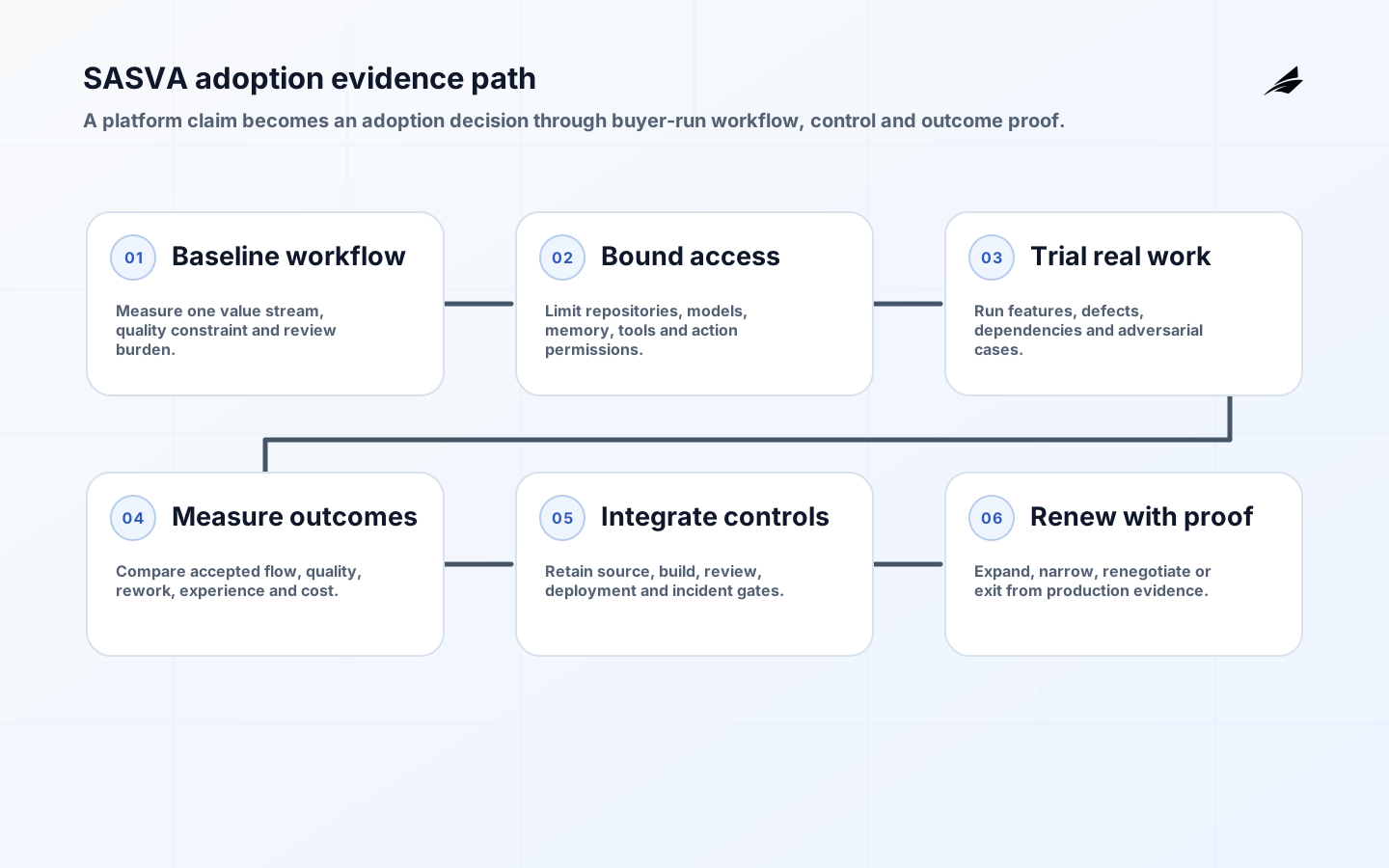
Choose one product area with enough real complexity to reveal context, review and integration behavior, but with bounded production risk. Establish a four-to-eight-week evidence window or an equivalent number of completed work items. Compare against the team's normal process. Include a feature, defect, dependency update, documentation task and one operational issue. Seed known failure cases: ambiguous requirements, outdated documentation, a vulnerable dependency and a test that passes for the wrong reason.

Do not evaluate by generated lines or prompt counts. Measure accepted cycle time, escaped defects, review effort, rework, policy violations, developer experience and time to diagnose an agent-produced issue. DORA's 2025 AI-assisted software development research emphasizes that AI adoption interacts with the surrounding technical and organizational system. Record where the tool saves time and where it moves work to reviewers, platform teams or security specialists.
- Baseline one product value stream and select representative work.
- Configure minimum permissions, approved models, policy gates and retention.
- Train participants on acceptable use, review duties and incident reporting.
- Run normal and adversarial tasks through the complete delivery path.
- Compare quality, flow, review effort, cost and developer feedback.
- Approve, narrow or stop adoption using documented thresholds.
How does SASVA fit into delivery and operations?
Prefer integration into established repositories, work records and pipelines over a parallel source of truth. Define which system owns requirements, code, tests, approvals, deployment records and incidents. Generated code should follow the same branch protection, peer review, testing, artifact signing and release controls as human code. The SLSA specification offers a useful vocabulary for build provenance and supply-chain integrity; an AI agent does not remove the need for a verifiable build path.
Operating ownership needs platform support, security response and product-team responsibilities. Monitor tool availability, model errors, policy blocks, action latency, usage cost and the downstream quality of accepted work. Use metrics, logs and traces to answer defined questions; the OpenTelemetry observability primer is a neutral starting point for signal concepts. Preserve correlation from an agent action to the work item, commit, build and deployment without logging secrets or unnecessary source content.
What drives cost and what belongs in the contract?
Total cost can include platform licensing, model consumption, integration, environments, identity and security work, data preparation, enablement, review time and ongoing administration. Ask how users, teams, agents, tokens, tasks and premium models are metered. Model low, expected and peak use with non-production activity included. Compare the net change in delivery cost and quality, not the tool invoice by itself.
| Contract topic | Question to settle | Evidence before commitment |
|---|---|---|
| Data and IP | Who may use prompts, code and outputs, and for what? | Executed terms and data-flow map |
| Service evolution | How are models, features and defaults changed? | Notice period, release policy and rollback route |
| Security | What assurance, incident and vulnerability duties apply? | Current reports and response workflow |
| Economics | Which units, overages and dependencies are billable? | Scenario-based cost model |
| Exit | Can context, records and artifacts be exported and deleted? | Test export and certified deletion process |
How should an adoption decision be documented?
Build a decision packet that contains the workflow baseline, pilot configuration, participants, repositories, permission model, connected services, task sample, evaluation method, observed outcomes, incidents, cost scenarios and unresolved risks. Separate evidence observed by the buyer from capabilities stated by the vendor. Record where results depend on unusually experienced participants or bespoke provider support; those conditions affect scalability. Security and legal reviewers should sign their specific conclusions, while the product or engineering sponsor accepts the overall business decision.
If adoption proceeds, define a bounded first production scope, platform owner, support route, allowed models, data classes, action permissions, quality gates and rollback criteria. Establish a change board for major platform, model or integration updates and a lighter path for routine configuration. Require periodic access review and removal of dormant projects, agents and connectors. New teams should pass readiness checks rather than inheriting a broad enterprise entitlement.
Set a renewal review after enough production work has moved through the platform. Compare the original baseline with accepted lead time, quality, review load, developer experience, incidents and total cost. Include teams that stopped using the tool and investigate why. Renew, narrow, renegotiate or exit based on observed value. Export required records and verify deletion before termination. This closes the loop that a time-limited pilot alone cannot address.
Create a small internal pattern library from accepted uses: repository preparation, permission bundles, review checklists, evaluation tasks and incident scenarios. Keep product-specific configuration out of shared templates and assign a maintainer. Publishing only successful prompts is not enablement; teams also need examples of rejected outputs, unsafe actions and escalation. Review the library after platform releases so old controls do not imply current assurance.
Key takeaways
- Evaluate SASVA as an engineering system, not only as a code generator.
- Use representative lifecycle tasks and intentionally difficult cases in the pilot.
- Keep privileged actions gated and trace every accepted change through the existing supply chain.
- Measure review effort, quality and flow together with platform and model cost.
- Contract for data boundaries, change notice, evidence, portability and deletion.
Frequently asked questions
Which SASVA version does this guide cover?
It reflects Persistent's public SASVA 4.0 description available in July 2026. Earlier versions may differ materially. Buyers should verify the offered edition, deployment pattern, connected models and release documentation during procurement.
Can SASVA agents deploy directly to production?
Technical capability and appropriate authority are different questions. Production deployment should remain behind the organization's identity, pipeline, testing and approval controls. Begin with read or propose access, and expand permissions only when risk-specific evidence supports it.
How should a team calculate return on investment?
Compare the change in accepted delivery throughput, quality, operational burden and staff time with all incremental costs. Use an observation period long enough to include onboarding and rework. Avoid converting generated artifacts directly into financial benefit.
Conclusion
SASVA AI solutions merit evaluation where teams need connected assistance across an engineering lifecycle and can govern the platform's access. A defensible decision starts with a constrained value stream, tests real and adversarial work, preserves established software controls and measures net outcomes. Product claims define what to investigate; your own evidence determines whether, where and how the platform should be adopted.