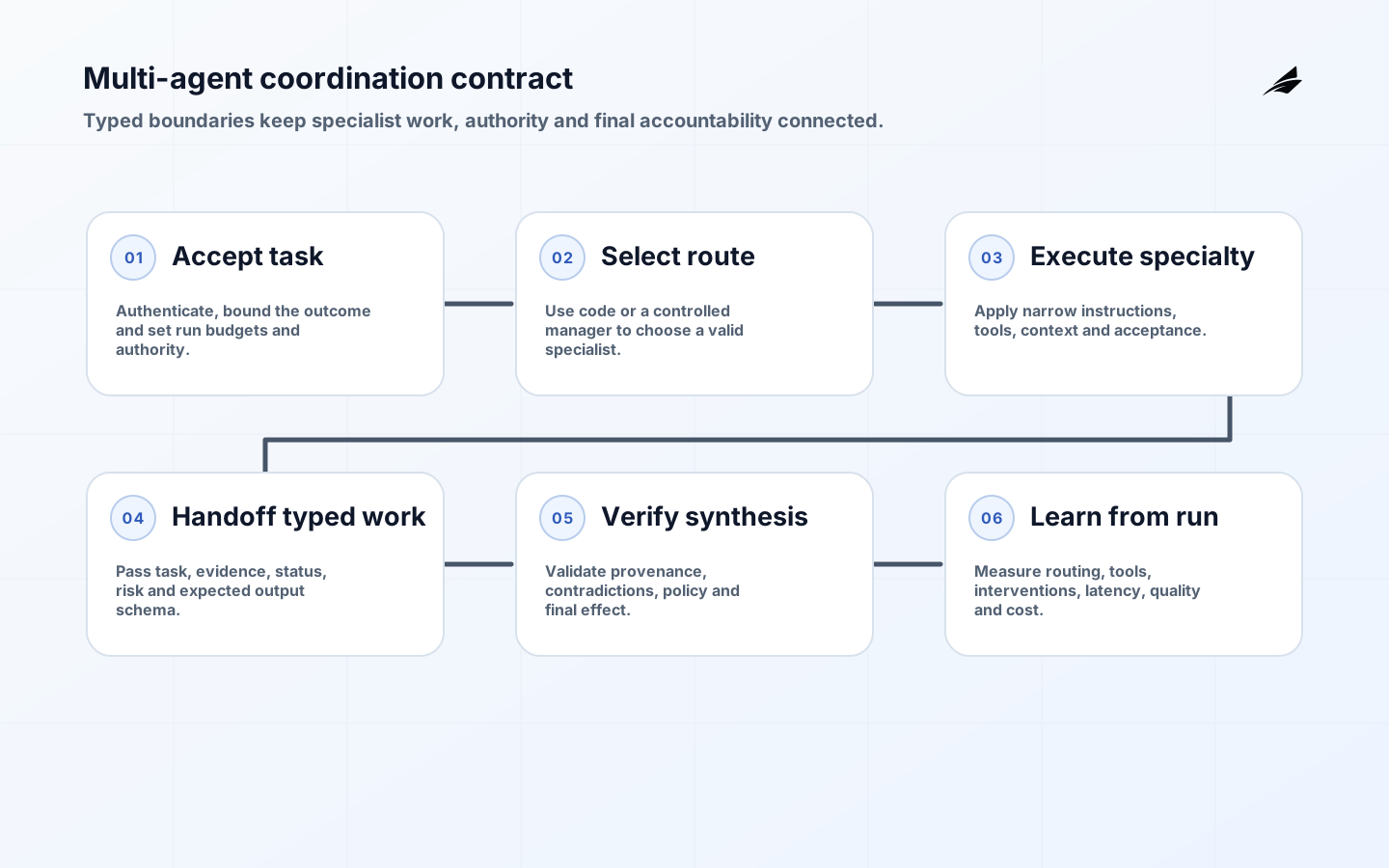
A multi-agent services suite combines specialized AI agents, orchestration, tools, state, evaluation and operational controls into a reusable system. Multiple agents can separate instructions, permissions and context for genuinely different responsibilities. They also add handoffs, latency, cost, failure modes and accountability questions. The design is justified only when specialization improves measured task outcomes or control more than a single agent with well-designed tools and deterministic workflow.
This FAQ supports architects, product leaders and risk owners evaluating a suite or building one. The multi-agent implementation checklist defines delivery gates, while the multi-agent scope and cost plan covers investment. Governance teams should connect both with the agent governance checklist and agent governance FAQ.
When does a multi-agent system help?
Use multiple agents when tasks need materially different instructions, models, context windows, tools, data access or responsible owners. A customer-service router may hand a verified billing case to a billing specialist whose tools cannot alter orders. A research manager may call independent retrieval and analysis specialists, then own the final answer. Specialization can reduce irrelevant context and make permissions easier to reason about, provided the handoff contract is explicit.
Do not split a workflow merely to imitate an organization chart or create a panel of model personas. If every agent sees the same data, uses the same tools and contributes prose to one answer, orchestration may only multiply variance. First test one agent with structured tools, clear phases and code-controlled branches. Add a specialist when evaluation identifies a recurring capability or control boundary that the simpler design cannot meet.
Which orchestration pattern should be used?
| Pattern | Best fit | Primary risk |
|---|---|---|
| Manager with agents as tools | One component must own final synthesis and shared controls | Manager obscures or alters specialist evidence |
| Handoff | A specialist should take over a bounded interaction | Context or authority crosses the boundary incorrectly |
| Deterministic chain | Order and transformation are known | Early errors propagate without a verification gate |
| Parallel specialists | Independent subtasks can reduce elapsed time | Duplicate cost and contradictory outputs |
| Planner-executor | Work requires adaptive decomposition | Unbounded plans and excessive tool use |
| Evaluator loop | A result can improve against explicit criteria | Non-termination or evaluator bias |
OpenAI's Agents SDK documents manager and handoff patterns and notes that code orchestration is more deterministic for known flows. Mix approaches deliberately. Code can route a regulated case from structured attributes, while a manager delegates bounded research tasks. Set maximum turns, agents, parallel calls, retries, cost and elapsed time. Every run needs a terminal success, safe failure or human-review state; a conversation that simply stops is not a workflow outcome.
How should agents exchange work?
Use versioned structured contracts instead of free-form summaries wherever downstream behavior depends on the result. A handoff should include task, scope, identity, evidence references, completed steps, unresolved questions, permitted actions, risk flags and expected output schema. Validate required fields at the boundary. Pass references to governed records rather than copying large or sensitive context, and reauthorize access for the receiving agent.
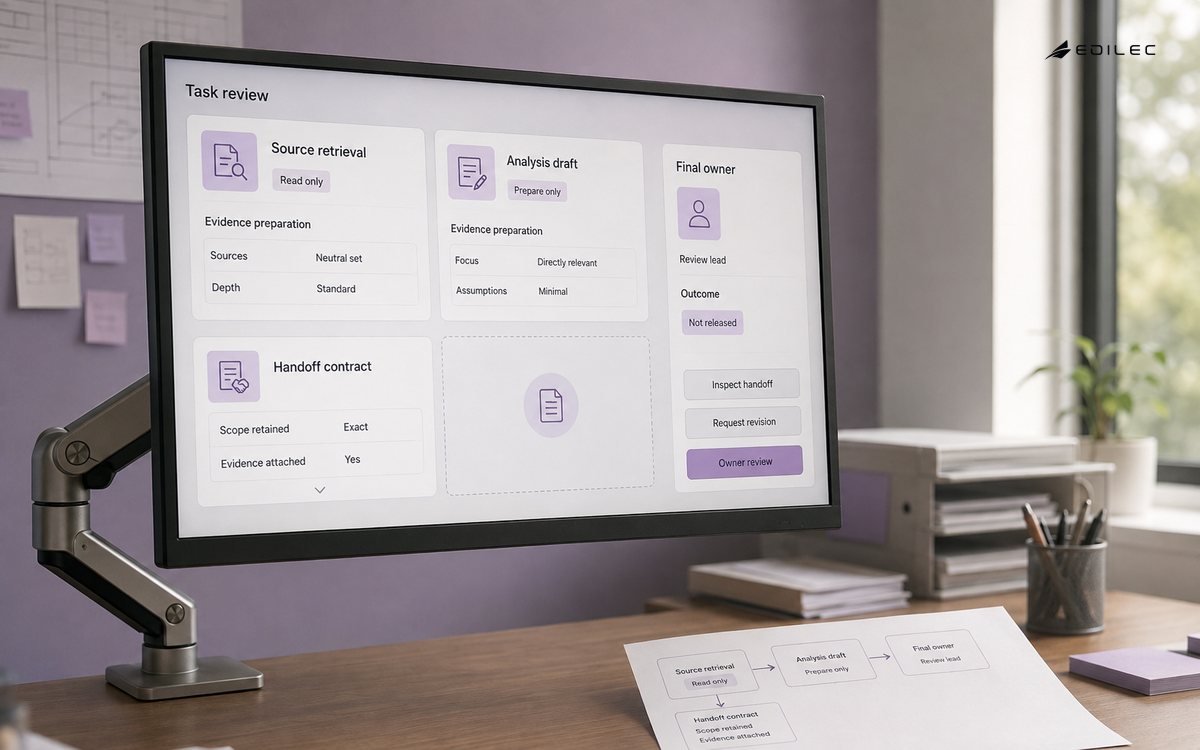
Keep the workflow state machine outside individual model memory. Persist which agent owns the task, contract version, tool effects, approval status, budget and completion reason. Use idempotency keys for side effects and correlation IDs across traces. Summaries can improve context efficiency, but preserve the underlying evidence needed for audit and review. An agent should not be able to erase or reinterpret a prior transaction by rewriting conversational history.
How are tools and data secured?
Assign each agent the minimum tools and data needed for its responsibility. Authorize at each tool call against the current user, tenant, workflow and policy. Treat messages, retrieved documents and outputs from other agents as untrusted content; prompt injection can cross agent boundaries. Separate instructions from data, validate structured outputs and prevent generated text from becoming executable commands. Use a policy service or application logic for limits that must always hold.
| Boundary | Control | Evidence |
|---|---|---|
| User to router | Authentication, input handling and scope validation | Identity and accepted task |
| Router to specialist | Allowlisted destination and typed handoff | Handoff reason and filtered context |
| Agent to retrieval | Permission-aware query and source allowlist | Document IDs, versions and access decision |
| Agent to tool | Server validation, approval and idempotency | Arguments, authorization and business effect |
| Specialist to manager | Schema and evidence validation | Result, uncertainty and provenance |
| System to operator | Redaction, retention and role-based trace access | Review and incident record |
How is a multi-agent suite evaluated?
Evaluate the full workflow and every boundary. Measure task success, routing precision, handoff completeness, evidence fidelity, tool correctness, safe escalation, latency, human intervention and unit cost. Compare with a single-agent or deterministic baseline. A specialist that scores well in isolation may reduce system quality if routing is poor or the manager loses its caveats. Include tool failures, unavailable agents, conflicting specialists and budget exhaustion in the evaluation set.
Trace each model call, tool call, handoff, guardrail and final outcome with privacy controls. OpenAI's tracing documentation describes these run components, but the operating team must decide what sensitive data may be retained. Use sampled quality review and incident-linked traces in production. Detect loops, unusual handoff depth, repeated tool use, context growth and disagreement. Evaluate after prompt, tool, model, policy or contract changes, not only after model upgrades.
What drives cost and performance?
Cost grows with model calls, context passed between agents, parallel branches, retries, retrieval, tool use, evaluation and human review. Estimate expected and worst-case path by intent. Cache stable governed results, summarize only with provenance, use smaller models for measured narrow tasks and stop branches that no longer affect the decision. Parallel work reduces elapsed time only when capacity and rate limits support it; it can increase spend even when the user receives an answer sooner.
Operate the suite as a platform only after common needs emerge. Shared identity, tool registry, policy, tracing, evaluation, model gateway and deployment controls can reduce duplication. Domain instructions, data authority, acceptance and incident ownership should remain with product teams. Chargeback by raw tokens can distort behavior; pair cost with successful outcomes, complexity and review effort. Publish service limits so teams do not design workflows that depend on unbounded orchestration.
How is the suite operated safely?
Maintain a registry of agents, purpose, owner, model, instructions, tools, data, risk tier, evaluations and active versions. Use staged release and the ability to disable one agent, tool or route without shutting down unrelated workflows. Define incidents for unauthorized action, sensitive-data exposure, systematic wrong outcomes, runaway cost and degraded routing. Preserve the last known safe configuration and rehearse rollback. Model providers and dependencies need availability and change monitoring.
How should coordination failures be contained?
Design every specialist to fail closed at its boundary. If routing confidence is low, use a deterministic fallback or human queue. If a specialist times out, return a typed incomplete status rather than guessed work. If two specialists disagree, preserve both evidence sets and apply an explicit adjudication rule. Circuit breakers should stop repeated calls to a failing agent or tool, while the workflow budget prevents a local problem from becoming a costly loop. Side effects remain isolated behind transaction services and cannot be repeated by a retrying coordinator.
Run fault exercises before production: remove one specialist, corrupt a handoff field, delay retrieval, return contradictory policy, exhaust the token budget and fail a tool after it commits. Verify terminal states, user communication, audit evidence and business reconciliation. A multi-agent architecture needs partial-degradation behavior because one capability may be unavailable while others remain healthy. Operational dashboards should show failures by route and contract version so teams can disable the smallest affected component.
Set recovery ownership before launch. The orchestrator team handles routing and shared-state failures; specialist owners handle domain behavior; tool owners reconcile side effects. One incident commander joins those perspectives and communicates the service impact. This division speeds diagnosis without forcing users to navigate internal agent boundaries.
Key takeaways
- Prove that specialization beats a simpler baseline before adopting multiple agents.
- Select manager, handoff, deterministic and parallel patterns from control needs.
- Exchange typed tasks and evidence references through versioned handoff contracts.
- Authorize every tool and retrieval operation at the receiving boundary.
- Evaluate routing, handoffs, tools, synthesis, outcomes, latency and cost together.
- Keep one accountable service owner and operate every agent as a versioned component.
Frequently asked questions
How many agents should a system have?
As few as needed to create measured specialization or control. Begin with one orchestrator and one specialist boundary, then add roles when evaluation proves a gap. Agent count is not a maturity measure. Every addition expands contracts, tests, permissions, cost and operational states that the team must own.
Should all agents share memory?
Usually not. Share governed workflow facts and evidence by need, with access checks. Broad shared conversational memory leaks irrelevant or sensitive context and makes provenance unclear. Keep authoritative state in application records, pass bounded handoff context and let specialists retrieve only what their task permits.
Where does human approval belong?
Place approval immediately before a material action or commitment, after evidence and effect are visible. Avoid asking users to approve an opaque plan early or rubber-stamp a completed action later. The review interface should show source, specialist contributions, uncertainty, policy and exact tool parameters, with options to edit, reject or escalate.
Conclusion
A multi-agent services suite is worthwhile when specialization creates better outcomes or cleaner authority boundaries than a simpler workflow. Choose orchestration deliberately, keep state and policy outside model memory, secure every boundary and trace the whole run. Compare quality and economics with a baseline, then expand through measured production evidence. Coordination architecture should make the service easier to govern, not merely more elaborate.